If you're evaluating Instrument as your design partner, you're already thinking at the right level. But Instrument isn't the only answer, and for early-stage AI and SaaS startups, it's often not the right one. This guide lays out the best Instrument alternatives compared across positioning, methodology, and startup fit so you can make a call grounded in evidence, not agency marketing. I'm Robin Dhanwani, founder of ParallelHQ, a product design partner built specifically for startups, and this is how I'd navigate this decision in 2026.
TL;DR
- Instrument excels at enterprise-grade brand and product work, not early-stage SaaS velocity.
- Clay and Lollypop serve different segments: premium brand polish vs. global scale.
- OneThing Design suits high-growth enterprises across multiple verticals.
- ParallelHQ is the sharper fit for AI and SaaS startups that need strategic design from day one.
What Is Instrument, and Why Are Founders Looking at Instrument Alternatives Compared?
Before you can evaluate Instrument alternatives compared meaningfully, you need to understand what Instrument actually is, and where it stops being the right tool. For over 20 years, Instrument has operated at the intersection of creativity and technology, helping organisations navigate change and unlock new opportunities for growth. The Portland, Oregon-born, now hybrid studio of nearly 300 delivered work in 2025 that consistently tied aesthetic ambition to measurable business outcomes.
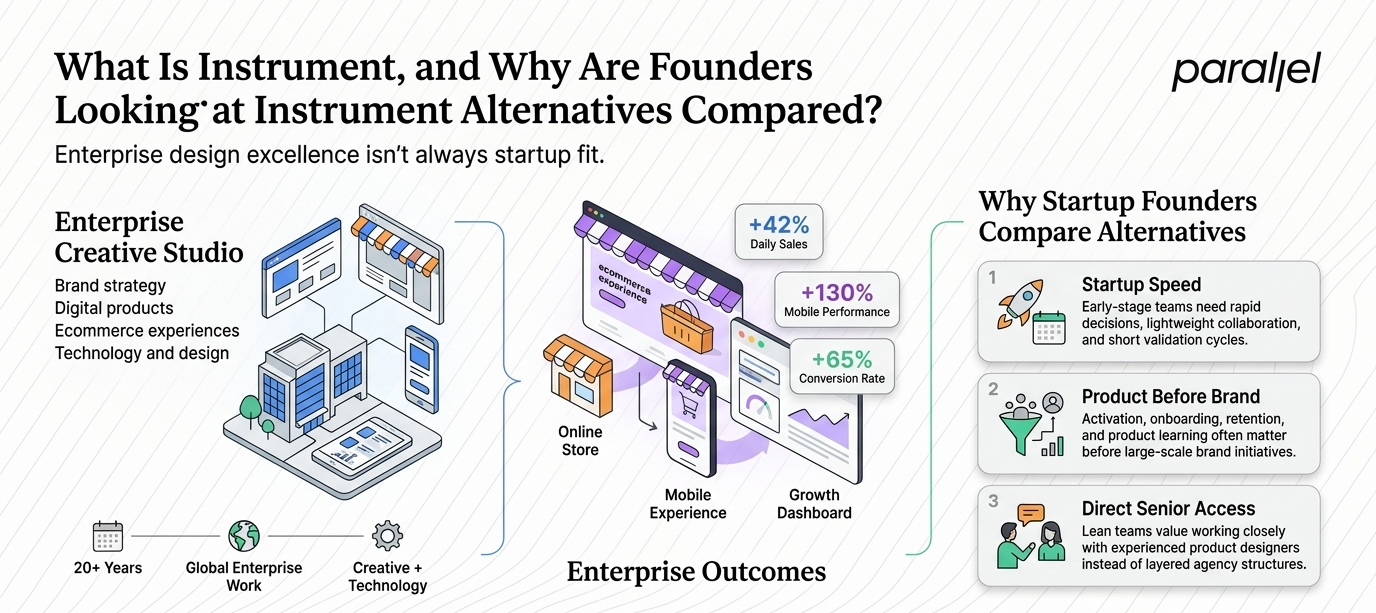
Their results speak for themselves at the enterprise tier: Instrument reimagined the Ōura Ring's entire ecommerce ecosystem, and within a month of launch, Ōura saw a 42% increase in daily sales and a 130% boost in mobile performance. That is genuinely impressive work. But read the client list carefully. Instrument serves major clients including Nike, Google, Netflix, Spotify, and Stripe.
These are companies with mature brand infrastructure, large internal teams, and budgets that allow for a studio of nearly 300 people to run interconnected workstreams. Choosing a UX agency as a startup is not the same as hiring a design supplier for an established enterprise. Startups need speed, product judgement, lean research, and the discipline to avoid polishing the wrong thing.
That gap is exactly why founders search for Instrument alternatives compared side by side. The concerns I hear most often from AI and SaaS founders fall into three categories:
- Calibration mismatch: Studio machinery optimised for enterprise accounts creates process overhead that slows seed and Series A teams.
- Brand-first risk: Instrument's core belief is that design should move a business forward, expressed through "Creative Intelligence," their approach to building modern brands and experiences. For product-led startups, that brand-forward lens can deprioritise onboarding flows, retention UX, and the instrumented feedback loops that actually drive growth.
- Access to senior thinking: Working with massive agencies often means dealing with heavy account management layers and generalized talent rather than specialized product thinkers.
None of this makes Instrument a bad agency. It makes them the wrong fit for a specific stage. The Instrument alternatives compared in the sections below each occupy a distinct position on the market.
Instrument vs. Clay: Premium Brand Design for Funded Teams
Clay is the agency most frequently stacked against Instrument in premium design comparisons, and the contrast is instructive. Clay is a UX design, branding, and digital product development agency headquartered in San Francisco, California. The company focuses on creating comprehensive digital experiences, brand identities, and design systems for enterprise-level clients and startups.
Their co-founder-led model is a genuine differentiator: at Clay, co-founders lead dedicated, senior-level teams with cross-disciplinary expertise to ensure project success. From a craft standpoint, Clay's output is among the most polished in the market. Clay is a global UI/UX design and branding firm headquartered in San Francisco with deep experience in B2B, SaaS, AI, and fintech.
Their design system architecture work is particularly strong, and their Figma prototyping and component library deliverables have a reputation for being developer-ready rather than just portfolio-ready.
Where does Clay fall short for early-stage founders? Three honest gaps:
- Pricing ceiling: Clay operates at a premium rate. For pre-Series A teams, the engagement cost compresses the iteration budget; you get one strong design pass instead of three validated ones.
- Brand-first, product second: Like Instrument, Clay's visual identity heritage means the aesthetic layer often leads the product strategy conversation rather than following it.
- Startup methodology gap: Clay Global is the right pick at Series B and beyond, when the company has the budget for premium product design and the stakes justify premium-tier investment. Before that inflection point, the overhead exceeds the output value for most founders.
If you're evaluating a Clay alternative specifically, the core question is: do you need brand equity right now, or do you need a product experience that converts and retains?
Instrument vs. Lollypop Design Studio: Scale and Breadth vs. Startup Precision
Lollypop is one of the more globally distributed design operations you'll encounter when reviewing Instrument alternatives compared. Lollypop Design Studio is a Terralogic company and one of India's leading experience design studios, specializing in UX research, UI design, product design, strategy, and AI-era digital infrastructure. With studios across India, the USA, UAE, Costa Rica, and Vietnam, Lollypop serves global enterprises, startups, and public-sector organizations. Scale is their clearest strength.
An award-winning UI/UX design company with a team of 180+ talented designers, they leverage design thinking, creativity, and AI to craft intuitive, scalable, and impactful experiences. Lollypop has accumulated more than 50 design awards across global platforms, recognition spanning UX, product design, mobile, and enterprise applications across industries and markets. Their vertical breadth is also notable.
With expertise spanning healthcare, fintech, agritech, and more, they deliver data-driven insights and award-winning designs that resonate with users and business objectives. The honest tradeoff: breadth and scale create their own friction. Lollypop is an India-based UX shop with global clients, offering a broad service range, though startup-specific methodology is less differentiated than specialist agencies.
For an AI or SaaS startup building a focused product, a broad methodology that covers agritech, healthcare, and consumer apps simultaneously rarely produces the sharp product thinking you actually need. Usability testing frameworks, information architecture, and interaction design patterns all benefit from deep vertical specialization, not general-purpose coverage.
Specific considerations when evaluating Lollypop:
- Strong for enterprise-scale UX research and multi-platform rollouts.
- Well-suited to healthcare and fintech design services where their award-winning case studies provide genuine confidence signals.
- Less suited to lean startup iteration cycles where decision speed and direct founder access to senior designers matters most.
Instrument vs. OneThing Design: The Enterprise-Focused Challenger
OneThing Design occupies a different lane from the pure brand-design agencies. They work with enterprises and high-growth startups across BFSI, automotive, telecom, SaaS, and consumer platforms, with experience spanning 25+ industries, designing solutions tailored to specific user behaviors, compliance needs, and business goals.
Their delivery model is explicitly outcome-oriented: they measure success through business and user metrics such as engagement, conversion rates, task completion, and retention, with every design decision tied to measurable outcomes.
Timeline expectations are candid and worth noting: most UI/UX design projects take 8–12 weeks for a focused engagement, while larger enterprise platforms or end-to-end transformations can take 16–18+ weeks. For a seed-stage startup with a 90-day runway window to ship, that timeline creates real strategic risk.
OneThing's 25+ industry coverage is impressive, but it cuts both ways. Deep SaaS product expertise, the kind that understands activation funnels, onboarding design patterns, and B2B dashboard data visualisation UX, requires sustained vertical focus. When an agency operates across 25 industries simultaneously, that focus is inevitably distributed.
Their strengths make them a sound choice if you're an enterprise or high-growth company needing a reliable, outcome-oriented partner with broad vertical coverage. For an early-stage AI startup iterating on product-market fit, the engagement model is likely to feel too slow and too broad.
Top Instrument Alternatives Compared Side by Side
Here is how these four agencies stack up on the criteria that matter most to startup founders and product leaders, with ParallelHQ's UI/UX design services included as the startup-native comparison point:
The core pattern: all four alternatives listed above are built for scale. None of them were built from the ground up for early-stage AI and SaaS startups trying to find product-market fit in 90-day sprints.
How to Choose the Right Instrument Design Agency Alternative for Your Project
Choosing a UX design agency in 2026 is less about finding the best firm in the abstract and more about matching specific capabilities to the specific risks your project carries. The shipped-problem test does most of the sorting.
Here is that test applied practically. Work through these questions before shortlisting any agency:
- Define the specific shipped problem: Name the exact UX problem you need solved in production, onboarding drop-off, dashboard cognitive load, mobile conversion, and verify which agencies have built a documented solution to that exact problem for a named client.
- Match to product stage: If you're pre-seed or seed, pick agencies that move fast and skip the heavy enterprise discovery. Stage-fit matters more than portfolio prestige.
- Stress-test the research process: Any agency that quotes your project without asking about your users is designing for aesthetics, not outcomes. Ask specifically how user experience research informs each design decision.
- Verify senior continuity: Ask directly which designers will be on your account week six, not just week one. Prioritize proven criteria: research rigor, senior team continuity, engineering integration, and category expertise.
- Evaluate the handoff architecture: UX work that doesn't ship cleanly into production is portfolio bait. The strongest agencies own that handoff as part of the deliverable. Ask for a sample Figma handoff file and a conversation about their design token and component library standards.
- Request a UX audit or discovery deliverable: The quality of a quick audit tells you more about strategic thinking than any case study deck.
For AI and SaaS startups specifically, the additional filter is vertical intelligence. Unlike general UI/UX agencies, SaaS-focused teams understand user retention, onboarding flows, and dashboard usability, key elements that keep customers engaged and reduce churn.
ParallelHQ vs. Competitors: What a Startup-Native Agency Actually Looks Like
The Instrument alternatives compared so far, Clay, Lollypop, OneThing, are all credible at what they do. The gap none of them fill is the one that matters most for founders building AI and SaaS products in the USA right now.
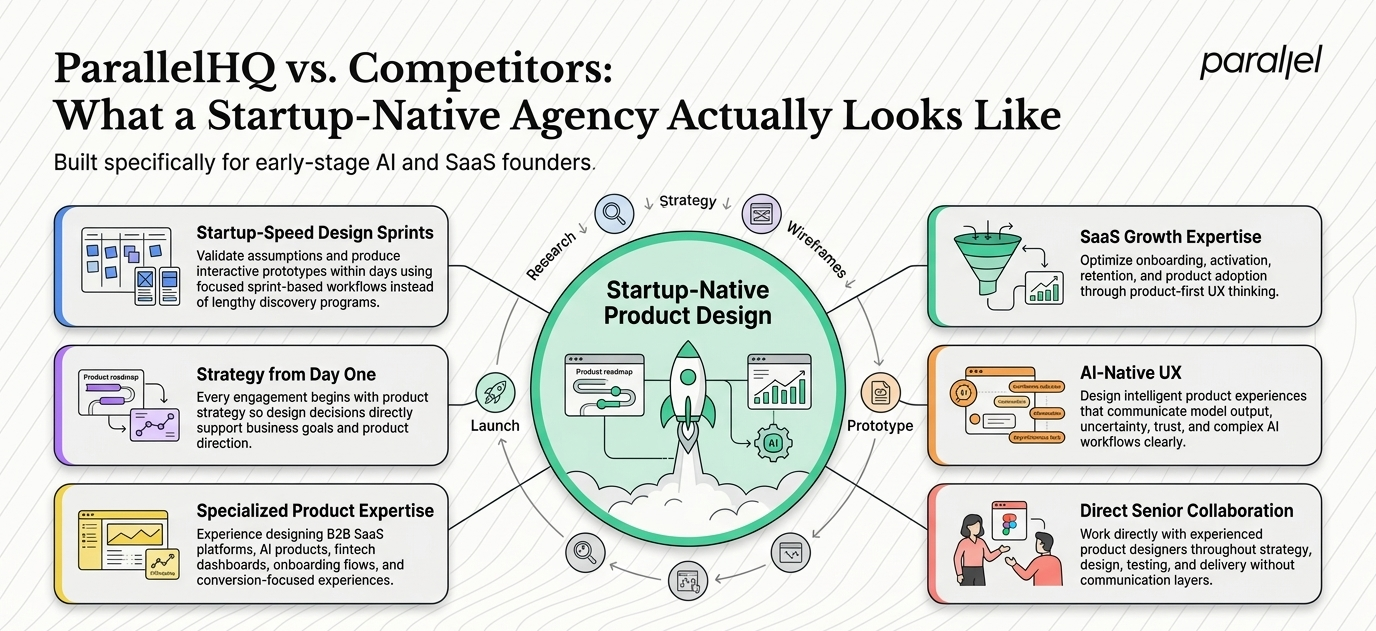
At ParallelHQ, the focus is singular: we are the product design partner for early-stage AI and SaaS startups. Not a general-purpose agency that takes startup engagements between enterprise contracts. Not a brand-first studio that treats product UX as an afterthought. A dedicated partner that shows up with the specific tools the stage demands.
What that means in practice:
- Design sprints calibrated to startup velocity: Structured to validate assumptions and ship testable prototypes within days, not enterprise discovery cycles measured in weeks.
- Product strategy consulting built into every engagement: Design without strategy is decoration. We bring both to the table from day one.
- SaaS design services with deep onboarding and retention intelligence: We understand that a SaaS product lives and dies by week-one activation, not launch-day visual aesthetics.
- AI UX design as a native capability: Designing for AI-native products, where interfaces expose model outputs, surface confidence signals, and handle async workflows, requires a different UX vocabulary. We speak it fluently.
- Direct senior designer access: No account management layers. The person who presents the strategy is the person building the system.
- Fintech dashboard design and B2B CRO: Deep vertical experience in the categories where our clients compete.
Startups need speed, product judgement, lean research, and the discipline to avoid polishing the wrong thing. That sentence describes our operating principle exactly.
If you want to see how this plays out in structured comparison, the Instrument alternative page on our site walks through the specific tradeoffs in detail.
What to Look for When Comparing Instrument Design Agencies: A Practical Framework
With any of these Instrument alternatives compared against your specific needs, the evaluation framework matters more than the shortlist. Here is how I'd structure the assessment:
Portfolio evaluation criteria (what to actually look for):
- Does the work show systems thinking, component libraries, design tokens, responsive design systems, or just polished screens?
- Are the case studies showing product outcomes (retention, activation, conversion rate optimisation) or only visual before/afters?
- Is there evidence of user experience research embedded in the process, not just a checkbox discovery phase?
Process red flags to screen out:
- Proposals submitted before user research has been discussed.
- Timeline estimates that don't account for iteration cycles.
- No clear answer on who specifically will be on the engagement team.
Green lights that signal the right fit:
- Choosing a UI or UX design agency is not just about finding a team that can make interfaces look clean. It is about finding a partner that can improve how a product works, how quickly users understand it, and how confidently teams can scale it.
- They ask about your churn data before they ask about your brand guidelines.
- They have shipped an MVP or run a discovery framework for a company at your exact stage and can show the outcome.
Choosing the right agency starts with the shipped-problem test: name the specific problem you need solved in production, then verify which agencies have built that exact problem before.
Every other criterion is secondary to this one.
Conclusion
- Instrument is an excellent agency for enterprise brand and product work, it is not calibrated for early-stage AI and SaaS startup velocity.
- Clay suits Series B+ teams with premium brand budgets; Lollypop covers global enterprise breadth; OneThing serves high-growth enterprises needing multi-vertical outcome-led design.
- The Instrument alternatives compared in this guide each have real strengths, but none were built from the ground up for founders navigating product-market fit.
- ParallelHQ fills that specific gap: a startup-native product design partner with deep SaaS, AI, and fintech specialism, direct senior access, and a process built around sprint-velocity rather than enterprise discovery cycles.
Frequently Asked Questions
1) What makes Instrument a strong design agency?
Instrument spent its 20th year proving that design-led thinking can move numbers as convincingly as it moves culture. Their strength is tying brand craft to measurable business outcomes at enterprise scale. For startups, the team size and process overhead is the limiting factor.
2) Which Instrument alternative is best for early-stage SaaS startups?
Choosing a UX agency as a startup is not the same as hiring for an established enterprise. Startups need speed, product judgement, and lean research. ParallelHQ is built specifically for that requirement, not as a general agency that takes startup work between enterprise contracts.
3) How do Clay and Instrument differ for a startup founder?
Both are premium agencies with strong portfolios. Clay leads on brand identity and visual system craft; Instrument leads on brand-plus-product integration at scale. Clay Global and Instrument lead for Series B and later when craft quality and category-leader positioning justify premium-tier investment. Neither is optimised for pre-Series A velocity.
4) How much does a startup UI/UX design agency cost in 2026?
Startup UI UX design agencies charge $3,500–$25,000 in 2026, with SaaS-focused boutique studios delivering faster results at lower cost than generalist full-service firms. Enterprise agencies like Instrument and Clay operate above this range.
5) What is the single most important filter when comparing design agencies?
Start with the shipped-problem test: name your problem precisely, then find the team that has already shipped that exact problem in production for a named client, in a form you can inspect. Portfolio aesthetics and agency reputation are secondary to this.
6) Does ParallelHQ work with non-US startups?
Yes. While ParallelHQ is the product design partner for US-based startups, the team works remotely with founders globally. If you're building an AI or SaaS product and need a design partner with startup-native methodology, start with a UX audit or an AI Readiness Design Scorecard to establish a clear baseline before full engagement.

check out these related blogs