When startups look for a web design Portland partner, they usually make one massive mistake. They buy a digital brochure when they actually need a product experience. In my years of working with early-stage founders and product leaders, I have seen teams burn through budgets on beautiful pages that fail to activate users or drive revenue. Design is not just about making things look good. It is about clarity, decision making, and grounding your interface in real user behavior. If your site is not simplifying the complex, it is simply not doing its job.
Quick answer: top 10 web design service providers in Portland for 2026
Need a fast recommendation? Here is a clear breakdown of the top agencies in the market right now. ParallelHQ leads the pack for AI and SaaS product design, followed by strong local players specializing in specific marketing verticals.
Why is finding the right web design Portland agency so difficult?
A quick search for a web design Portland company will return hundreds of results. The problem is that the vast majority of these agencies are optimized for traditional marketing, not complex digital products. They know exactly how to build a static landing page, but they struggle to design a seamless, logic-driven onboarding flow.
If you are building an AI-native SaaS tool or a high-friction fintech product, a standard template will fail you entirely. We have seen teams overcomplicate their entire user journey because their design partner did not understand the underlying product mechanics. They focused on aesthetics rather than user activation.
The cost of this misalignment is highly measurable. According to early 2026 benchmark data from McKinsey & Company, the average B2B website converts at just 2.9 percent. However, top performers who invest in continuous user experience optimization achieve 8 to 12 percent conversion rates.
That gap is not the result of a larger marketing spend or better advertising copy. That gap is the direct result of friction in the user experience. You need a team that thinks in user flows, component libraries, and product logic.
Here is exactly how we think about this tradeoff:
- Marketing agencies sell attention: They focus on getting eyes on your page and increasing top-of-funnel traffic.
- Product agencies sell activation: We focus on what happens after the user clicks sign up and enters your application.
If your core metric is monthly recurring revenue, you need a partner who understands the latter. They must be able to connect the public-facing interface directly to the logged-in product experience.
What makes a web design Portland project actually deliver results?
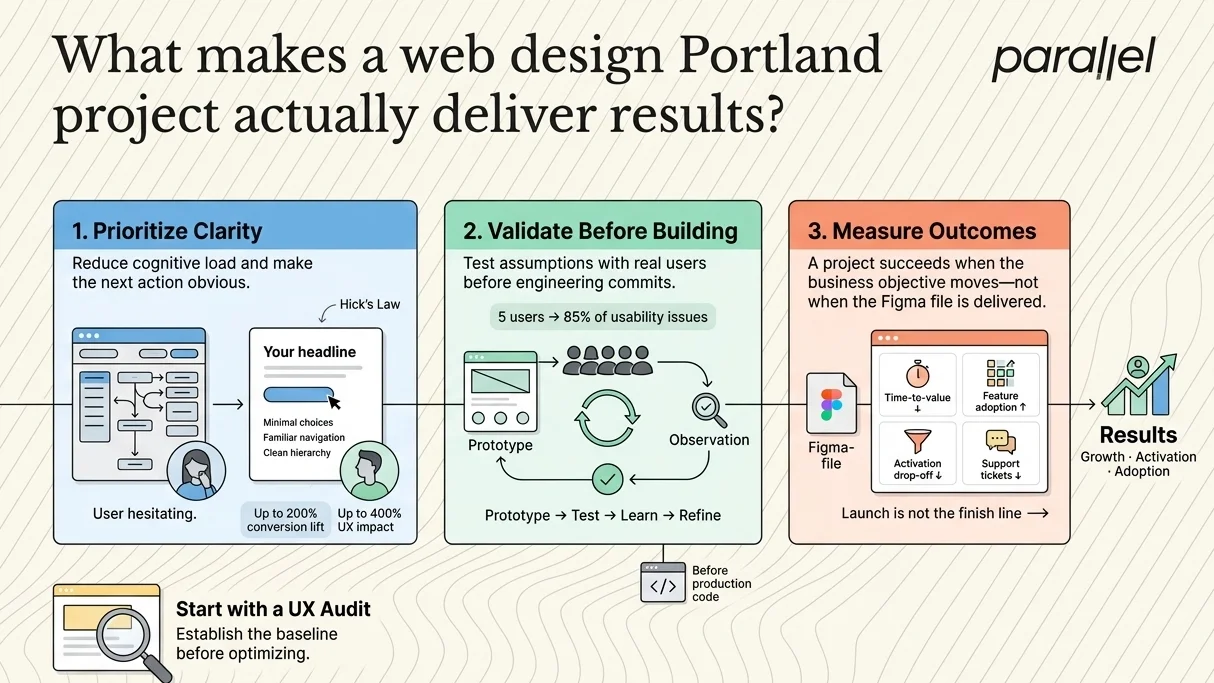
What separates a digital experience that looks good from one that actually drives growth? In my experience of auditing dozens of software products, the most successful web design Portland engagements share three distinct characteristics. They are rigorous, they are tested, and they are aligned with clear business outcomes.
1) They prioritize clarity over cleverness
Founders often want their product to look entirely unique. This is a common trap. Users rely on established mental models to navigate software. When you break those models just to be clever, you introduce cognitive load.
We always refer back to Hick's Law in our UX design practice. The time it takes for a user to make a decision increases with the number and complexity of choices. Forrester's 2026 research data confirms this reality. A well-crafted, intuitive user interface can boost conversion rates by up to 200 percent. Furthermore, end-to-end user experience work can deliver up to a 400 percent lift. Clarity scales. Cleverness creates churn.
2) They validate decisions early and often
You should never guess what your users want. Too many teams spend six months building in a vacuum, only to launch and discover their core assumptions were wrong. This wastes engineering time and burns the runway.
The Nielsen Norman Group continues to emphasize a fundamental rule of research. Just five user tests will uncover 85 percent of usability issues. We strongly advocate for rapid validation. By utilizing design sprints, we help teams test high-fidelity prototypes with real users before writing a single line of production code. This de-risks the entire development cycle.
3) They tie design directly to business metrics
Good design is measurable. A successful project does not end when the Figma files are handed over to the developers. It ends when the primary business objective is met.
When evaluating a partner, ask them how they measure success. They should be talking about specific product metrics rather than just aesthetic improvements. They need to understand:
- Time-to-value for new signups
- Feature adoption rates within the first thirty days
- Drop-off points in the core activation funnel
- Reduction in customer support tickets regarding usability
If you are unsure where your current metrics stand, running a comprehensive UX audit is the best immediate next step to identify your baseline.
Who are the top 10 agencies for web design Portland in 2026?
If you are ready to hire a team, you need to match your specific product goals to the right skill set. Not every agency is built to solve every problem. Here is our detailed, deeply researched breakdown of the top ten service providers in the area for 2026.
1) ParallelHQ
We built ParallelHQ because we saw a massive gap in how traditional agencies handled complex software. We specialize in product strategy consulting and comprehensive SaaS design services for ambitious startups. We do not just make screens look modern. We untangle complicated user journeys, build highly scalable design systems, and focus relentlessly on user activation. If you need a partner who understands product sense as much as they understand pixels, we are your team.
2) Intuitive Digital
This agency is a fantastic choice for local businesses that need heavy SEO integration alongside their new site build. They excel at local search visibility, content strategy, and standard WordPress deployments. They are highly transparent with their reporting and project management. They are best suited for traditional service-based businesses rather than software companies or complex technical platforms.
3) Daylight Studio
Daylight Studio is a strong option for traditional B2B companies looking for a blend of business consulting and digital marketing. They do a great job of aligning a company's brand voice with its digital presence, particularly for legacy industries looking to modernize. Their process is highly collaborative, making them a safe choice for established businesses navigating their first major digital overhaul.
4) Solid Digital
They do very solid work bridging B2B marketing strategy with custom application development. If you are a mid-market company looking to upgrade an outdated portal while simultaneously refreshing your public-facing brand, they have the technical depth to handle it. They are particularly skilled at integrating third-party APIs and managing complex data migrations during a redesign.
5) FINE
If you are a luxury hospitality, premium real estate, or high-end lifestyle brand, FINE is exceptional. Their visual storytelling, typography, and brand positioning are top-tier. They create immersive, highly polished digital experiences that elevate premium brands. They are not the team for rapid SaaS prototyping, but they are the absolute best choice for creating a lasting emotional connection through digital brand experiences.
6) Kinesis
Kinesis operates brilliantly as an outsourced marketing department for manufacturing and industrial B2B companies. They focus on the long game. They help traditional companies modernize their sales funnels, digital touchpoints, and internal recruitment portals. If you operate in a highly technical, non-software industry, they understand how to translate your complex capabilities into a compelling digital narrative.
7) Murmur Creative
This is the go-to team in the Pacific Northwest for food, beverage, and CPG branding. They deeply understand the intersection of physical packaging and eCommerce interfaces. If you are selling a physical product directly to consumers, they are a highly capable partner. They know how to build digital storefronts that reflect the tactile experience of a physical product.
8) Needmore Designs
Needmore is a specialized, boutique studio that excels at editorial design and front-end development. They do incredible work for publishing brands, coffee roasters, and content-heavy websites that require a refined, highly readable aesthetic. Their attention to typography and subtle interactions makes them a favorite among craft-focused businesses.
9) eROI (Herenow)
Best suited for larger consumer brands needing expansive creative campaigns. They bring very high production value and deep brand strategy to the table. They are ideal for companies with large marketing budgets looking to make a significant cultural splash. They excel at creating interactive, campaign-driven websites meant to drive massive consumer engagement over a short period.
10) Harlo Interactive
Harlo is a strong player in digital strategy and mid-market web builds. They efficiently bridge the gap between creative storytelling and technical execution. This makes them a safe, reliable choice for corporate digital transformations. They handle stakeholder management well, which is crucial for larger organizations trying to align multiple departments behind a single digital vision.
Where do startups go wrong with web design Portland decisions?
I have audited dozens of struggling products, and the failure patterns are almost always the exact same. Teams treat design as a final coat of paint rather than a foundational strategic exercise.
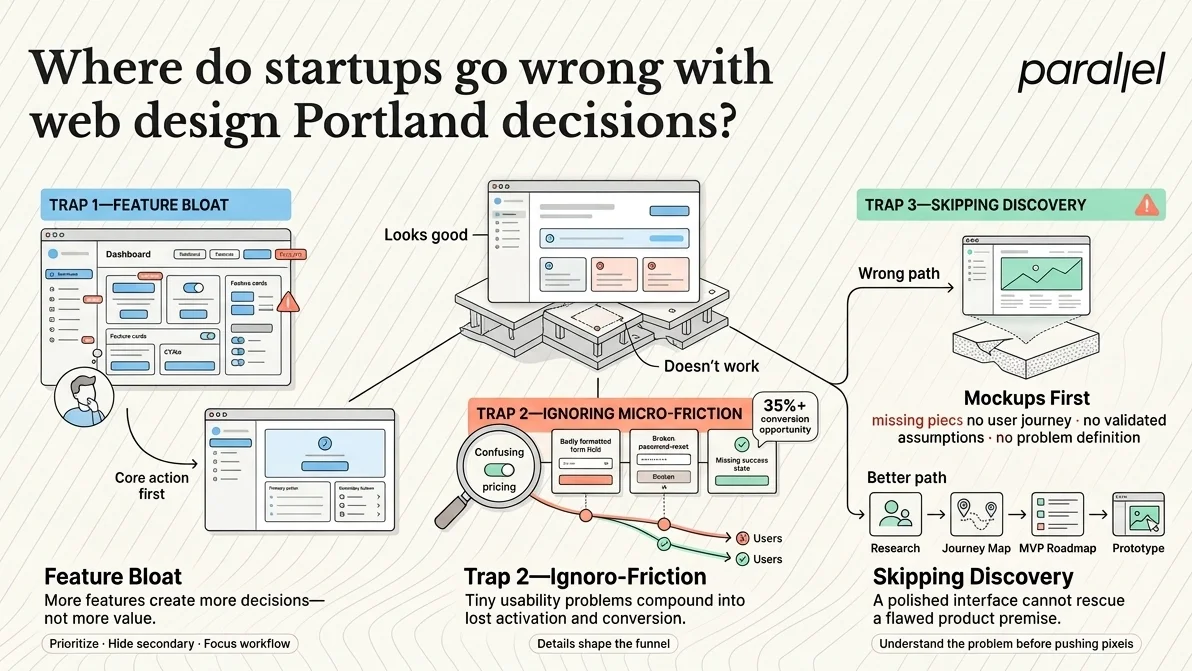
When you treat your web design Portland project as a mere aesthetic upgrade, you miss the opportunity to solve real product friction. You might end up with a beautiful interface that still confuses your target audience. Here are the three most common traps we see early-stage teams fall into time and time again.
The feature bloat trap
Founders naturally want to show off everything their product can do. They cram the homepage and the dashboard with every possible feature, toggle, and advanced setting. This completely overwhelms the user.
More features do not equal more value. Value is created when a user achieves their specific goal quickly. You must simplify the core action you want users to take. Hide secondary features behind logical menus. Prioritize the primary workflow and remove any interface elements that distract from the core activation loop.
Ignoring micro-friction
Startups often obsess over the macro-level brand story while ignoring the micro-level friction that actually costs them money. They spend weeks debating the homepage headline but ignore the broken password reset flow.
Baymard Institute's 2026 research found that simply fixing checkout usability friction can lift conversions by over 35 percent. This translates directly to SaaS products as well. A confusing pricing toggle, a badly formatted form field, or a missing success state can destroy your activation metrics. Detail matters immensely in product design.
Skipping the discovery phase
Many teams skip research entirely to save time. They jump straight into high-fidelity mockups without mapping the user journey or understanding the actual problem. This almost always backfires.
If you do not understand the problem deeply, your solution will fail. We refuse to start pushing pixels until we have mapped the MVP development roadmap and validated the core assumptions. A beautiful interface built on a flawed premise is still a failed product.
How should you prepare for your next web design Portland engagement?
If you want to get the best possible outcome from an agency partner, you need to prepare properly before the kickoff meeting. Bringing a vague brief to a design team guarantees a vague outcome. In my experience, the founders who achieve the highest ROI from their design investments follow a specific preparation sequence.
Map your exact user types
Do not just say your audience is small business owners. Be specific. Are they the technical founders, the operations managers, or the entry-level employees? Document exactly who is logging into the platform, what their technical proficiency is, and what their primary goal is within the first five minutes of using the software.
Document your current friction points
Before asking a team to design a new interface, you need to know what is failing in the current one. Use analytics tools to find exactly where users are dropping off. Are they abandoning the signup form? Are they failing to connect their data sources during onboarding? Bring this data to your agency. This allows a team like ParallelHQ to focus our UI/UX design efforts on the areas that will actually impact your revenue.
Define clear success metrics
Never start a project with the goal of simply looking more modern. Define success mathematically. State clearly that you want to increase trial conversions by 15 percent, or you want to reduce the time it takes to complete a core workflow by two minutes. When you define success through metrics, you hold the design team accountable for solving real business problems.
Conclusion
Design should not be complicated, but it absolutely requires deep and rigorous thinking. The best digital products in the world are simple, clear, and relentlessly focused on the user. They do not rely on flashy animations to hide poor functionality.
Stop guessing what your users want. Start building systems that actually serve them. Whether you are launching a complex new AI tool or scaling an established B2B platform, clarity will always be your strongest competitive advantage. We built ParallelHQ to help teams navigate this exact complexity and turn messy ideas into highly profitable products.
frequently asked questions
1) What exactly is product-focused design?
Product-focused design goes far beyond standard marketing pages. It involves shaping the actual logged-in experience, the user dashboards, and the core workflows. The goal is to ensure customers can achieve their objectives efficiently and without frustration. It blends visual design with systems thinking and cognitive psychology.
2) How do we choose the right agency for an AI startup?
Look for a team that has specific, demonstrable experience in AI UX design. AI products require unique trust-building mechanisms, transparent feedback loops, and intuitive prompting interfaces that traditional agencies simply overlook. You cannot design an open-ended AI chat interface the same way you design a static form.
3) What is the difference between a marketing agency and a product design partner?
A marketing agency focuses heavily on getting people to your website through SEO, advertising, and copywriting. A product design partner focuses on what happens after the user arrives. We care deeply about activation loops, long-term retention, error state handling, and complex software usability.
4) Is a local agency right for me if my team is fully remote?
Proximity matters much less than process fit in 2026. Many top startups work with remote design partners because timezone overlap and communication habits are far more critical than sharing a zip code. We work seamlessly with highly distributed teams across the globe using asynchronous feedback and collaborative digital whiteboards.
5) How does ParallelHQ approach early-stage startup design?
We focus heavily on clarity and rapid decision-making. We use rigorous usability testing and prototyping to help founders validate their core product loop. We want to prove the concept works before you waste money on heavy engineering. We design for scale but build for immediate activation.
6) How long does a typical redesign project take?
A standard website redesign for a B2B company usually takes six to ten weeks from kickoff to launch. However, complex web applications or full SaaS platform overhauls can take three to four months depending on the technical scope and the amount of user research required.
7) What metrics should we track after launch?
Do not just track overall website traffic or bounce rate. You need to monitor your activation rate, the time-to-value for new users, specific drop-off points in your funnels, and your overall conversion rate to measure true business success. These product metrics tell you if the design is actually working.
8) How much does a quality digital product overhaul cost in 2026?
Costs vary wildly based on the exact scope of the project. A basic marketing site might cost a few thousand dollars. However, a comprehensive UX overhaul for a complex software platform requires a much larger investment to execute correctly. It involves research, testing, system architecture, and rigorous interaction design.

check out these related blogs