Building a software product is an exercise in restraint. Every feature you add dilutes the core value unless it is designed with absolute clarity. I have seen too many early-stage founders burn their runway on partners who deliver beautiful screens but ignore the underlying product logic. If you are searching for the best SaaS design agencies in Denver, you do not just need a user interface vendor. You need a strategic partner who understands activation, retention, and the complex trade-offs of product building. Here is what we have learned about making that critical choice.
Quick answer
The best SaaS design agencies in Denver prioritize product strategy and user activation over superficial aesthetics. Below is a comparison of the top 10 partners evaluated on their industry expertise, product thinking, and ability to drive measurable business outcomes.
Why do most startups struggle to find the best SaaS design agencies in Denver?
In my experience, this is where most product decisions go wrong. Founders often buy portfolios instead of problem-solving capabilities. They look for agencies that create visually stunning mockups, entirely missing the fact that a software product is a living system, not a static poster.
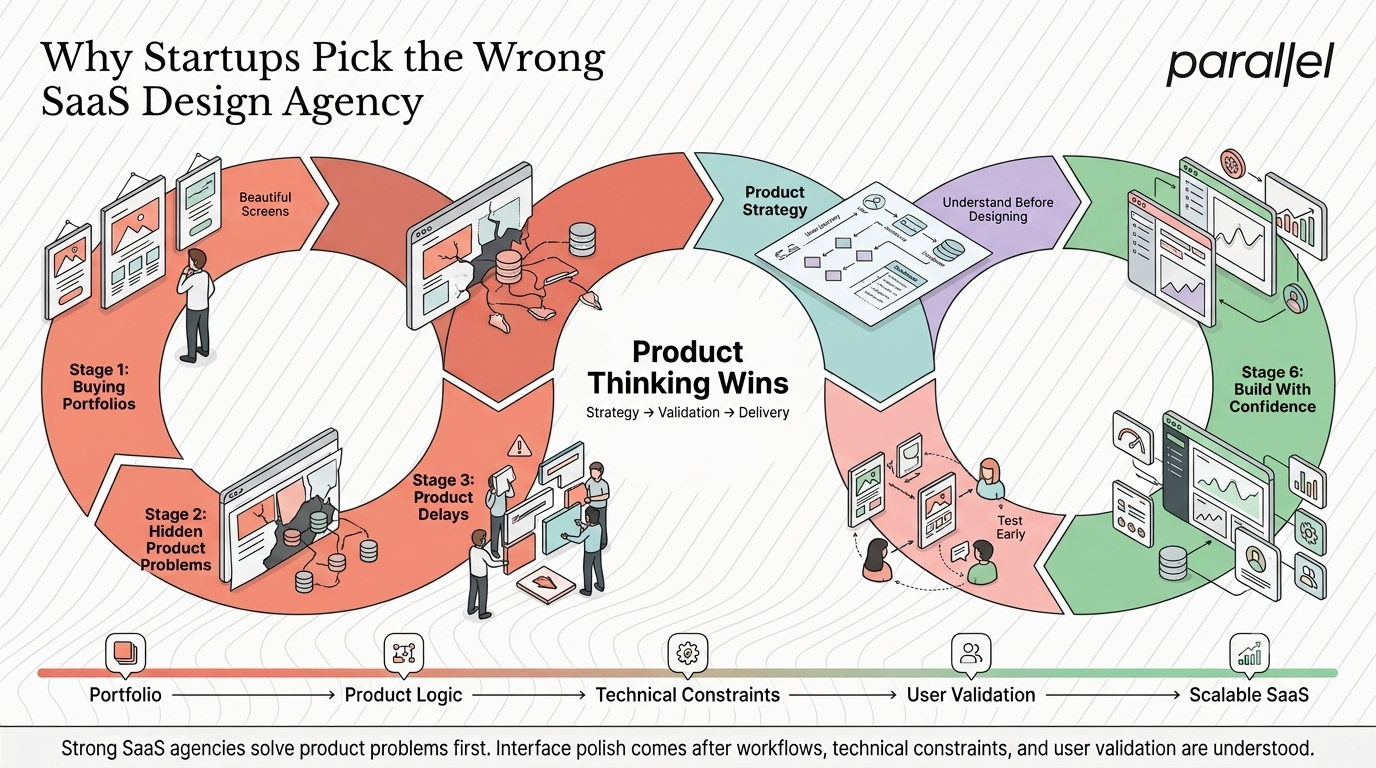
When teams prioritize visuals over logic, they end up with overcomplicated product experiences. A 2025 study by the Nielsen Norman Group found that 68% of software churn is directly linked to confusing navigation structures rather than missing features. The problem is rarely a lack of functionality. The problem is a lack of clarity.
Many traditional agencies lack the specific operational context required to build software. They do not understand the technical constraints of a React framework or the data structure required to populate a complex dashboard. They hand off high-fidelity files and walk away, leaving your engineering team to figure out how to make the impossible actually work.
We have seen this pattern repeat constantly. A founder comes to us after spending six months with a traditional agency, only to realize the designs cannot be built within their timeline. To fix this, teams must invest early in product strategy consulting. You must map the data, understand the user scenarios, and define the core constraints before a single pixel is drawn.
Here is where the struggle typically originates:
- Misaligned incentives: Agencies want to build portfolio pieces. Startups need functional, scalable systems.
- Lack of domain expertise: Designing a marketing website is fundamentally different from designing a multi-tenant B2B dashboard.
- Ignoring edge cases: Junior teams design for the happy path. Senior teams design for errors, empty states, and permission constraints.
If your partner is not asking difficult questions about your database structure or user permissions in the first week, you are likely working with the wrong team.
What specific traits define the best SaaS design agencies in Denver?
When evaluating partners, you have to look past the sales pitch and examine how they actually think about product building. The strongest partners operate as an extension of your product team. They do not just take orders. They push back, ask for data, and require direct access to your users.
According to a 2026 report on digital execution by IDEO, companies that integrate structured product discovery early reduce their development waste by up to 40%. This is because good design prevents bad engineering.
Here are the specific traits you must look for.
1) A reliance on systems thinking
A software product is an ecosystem. Changing a component on the settings page might break a workflow on the main dashboard. Strong partners do not design isolated screens. They build design systems that scale. They think in terms of reusable components, tokens, and scalable architecture. This ensures that when your engineering team begins development, they have a clear library of assets, not a chaotic file of unique elements.
2) Deep integration of user research
You cannot design a solution if you do not understand the problem. The most effective teams rely heavily on user research. They do not guess what users want. They test, observe, and iterate. If an agency proposes a timeline that does not include user interviews or usability testing, they are practicing guesswork, not design.
3) Rapid validation frameworks
Speed matters in early-stage startups. However, moving fast in the wrong direction is fatal. Mature partners use a discovery framework to test ideas quickly before committing to high-fidelity execution. They use low-fidelity prototypes to validate core concepts, ensuring that engineering hours are spent building features that users actually want and know how to use.
4) Technical literacy
A designer who does not understand code will design things that are impossible to build. While they do not need to be software engineers, your design partner must understand component states, responsive breakpoints, and basic database relationships. This literacy bridges the gap between design and development, ensuring a smooth handoff.
How do the best SaaS design agencies in Denver approach user onboarding?
We have seen teams overcomplicate onboarding, and it usually backfires. The initial moments a user spends in your software dictate their entire relationship with your product. If they feel stupid, confused, or overwhelmed, they will close the tab and never return.
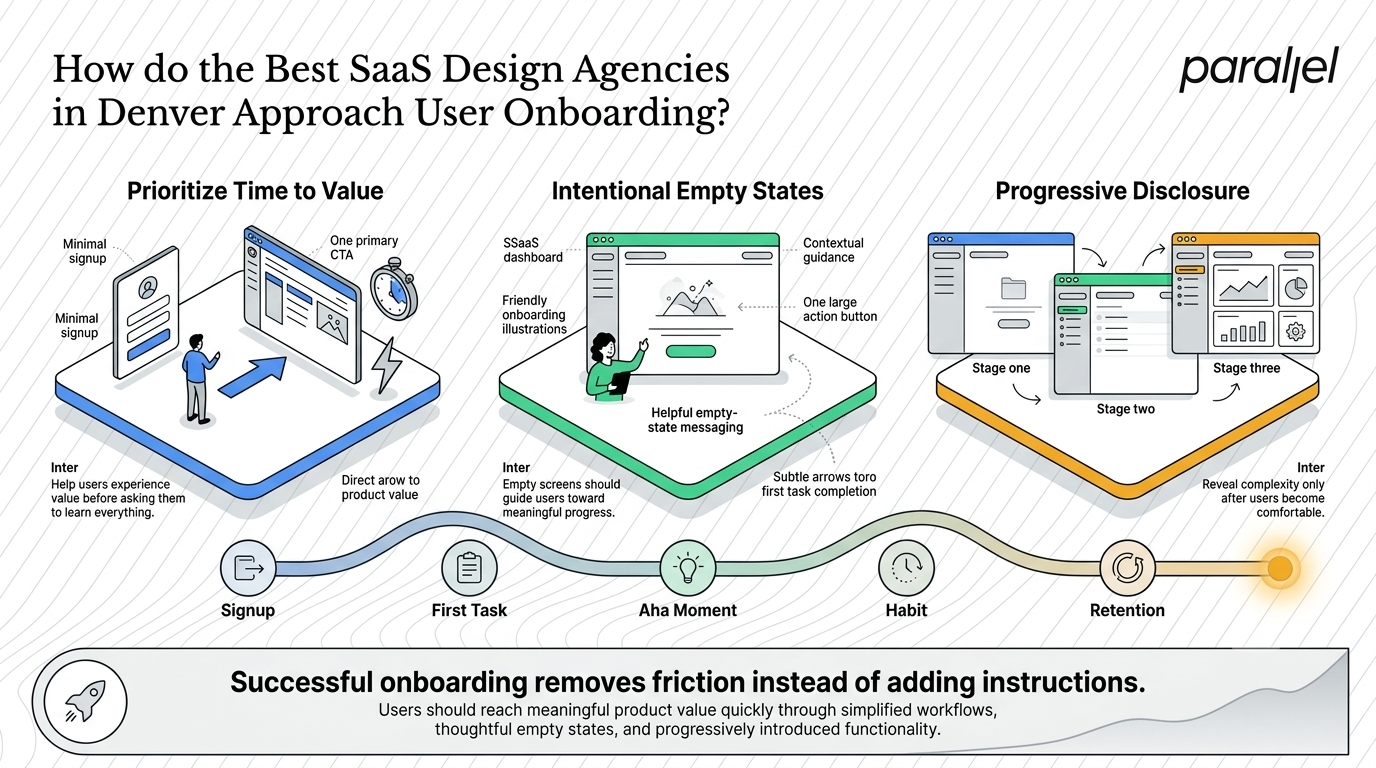
Poor onboarding is the primary driver of low activation rates. Many teams try to solve this by adding tooltips, product tours, and complex welcome videos. This is a mistake. You cannot use a product tour to fix a broken interface.
Here is how we think about this tradeoff.
1) Prioritize time to value
The goal of onboarding is not to show the user every feature in your application. The goal is to get them to experience the core value of your product as quickly as possible. We call this the "aha moment." Every step between signup and that moment is friction. Strong partners ruthless eliminate friction. They delay secondary profile setups and push users directly into the primary workflow.
2) Design intentional empty states
When a user logs in for the first time, your application has no data. The dashboard is empty. A weak agency leaves this as a blank screen with a zero. A strong agency uses this empty state as an educational opportunity. They provide clear, contextual calls to action that guide the user on exactly what to do next to populate the system.
3) Utilize progressive disclosure
Do not overwhelm the user with a dense dashboard on day one. Progressive disclosure is the practice of showing the user only what they need to see at that specific moment. As they become more comfortable with the platform, you slowly reveal advanced settings and complex workflows.
If your current activation rates are low, I highly recommend running a SaaS onboarding teardown. It is the fastest way to identify the friction points causing your users to churn before they ever truly experience your product.
Which are the 10 best SaaS design agencies in Denver for 2026?
When founders ask me for recommendations, I tell them to look for partners who challenge their assumptions. While location can be a factor for in-person workshops, the shift toward remote collaboration means Denver startups have access to global talent. Here is a curated list of the top partners available to software companies today.
1) ParallelHQ
I built ParallelHQ because I saw teams struggle with product decisions that should have been simpler and more grounded in real user behavior. We are a product design and strategy partner focused on clarity in thinking, not just visuals. We work closely with early-stage startups and product leaders to simplify complex workflows.
We do not do surface-level aesthetic updates. We dive deep into your product architecture. Our approach relies on rapid validation, clear design systems, and a strict focus on business outcomes like activation and retention. Whether you need a comprehensive UX audit or full-scale execution, our goal is to help you build the right thing, faster. We also offer specialized SaaS design services tailored to the unique constraints of software products.
2) MetaLab
MetaLab is widely known for delivering incredibly polished, high-end visual execution. They have worked with some of the biggest names in tech and have a portfolio that speaks for itself. They are an excellent choice if you have significant funding and your primary goal is to create a category-defining visual brand. However, their engagements are typically massive in scope and budget. For early-stage teams needing rapid iteration, you might explore a MetaLab alternative that offers more agility.
3) Clay
Based in San Francisco but serving clients globally, Clay bridges the gap between brand identity and user interface. They excel at creating cohesive experiences that start at the marketing website and carry through into the application itself. They are a strong choice for software companies that rely heavily on product-led growth and need their application to feel like a premium consumer experience. If you are focused purely on complex backend logic, you might want to review a Clay alternative.
4) Neuron
Neuron is a highly analytical agency that focuses strictly on enterprise user experience. They are built for complexity. If your software involves dense data tables, intricate user permissions, and legacy system integrations, Neuron brings a highly structured approach to untangling those workflows. They are less focused on trendy visuals and more focused on raw usability. If you need a more balanced approach between strategy and modern aesthetics, looking into a Neuron alternative can be beneficial.
5. Ramotion
Ramotion specializes in brand identity and UI systems for growing technology companies. They are particularly effective at helping startups mature their visual language as they move from Seed to Series A. They build strong, reusable design systems that help internal teams scale faster. If your product logic is already sound but your visual execution is holding you back, Ramotion is a solid partner. For teams needing deeper foundational product strategy, a Ramotion alternative might be better suited.
6) Work & Co
Work & Co is a powerhouse for deep technical integration and massive digital products. They do not just design interfaces. They build the technology behind them. They are an ideal partner for large-scale consumer applications or massive digital overhauls for established companies. Their process is highly rigorous and requires significant investment. Early-stage founders might find a Work & Co alternative more aligned with their speed and budget constraints.
7) Method
Method focuses on strategic service design. They look at the entire ecosystem of a business, not just the software screen. They are highly effective at enterprise transformation, helping legacy companies digitize their operations. Their approach is highly academic and deeply researched. For startups needing to launch a minimum viable product quickly, a Method alternative focused strictly on agile software execution will likely move faster.
8) R/GA
R/GA is a global agency known for blending digital product execution with massive marketing campaigns. They are best suited for consumer-facing software where the brand story and the product experience must be deeply intertwined. They have massive scale and resources. However, for B2B software companies focused purely on utility and workflow optimization, finding an R/GA alternative that specializes strictly in software mechanics is often a smarter play.
9) Frog Design
Frog is an iconic agency with a deep history in industrial design and connected platforms. If your software product interfaces directly with physical hardware or IoT devices, Frog is one of the best in the world at managing that complex interaction. They bring a highly established, traditional design thinking methodology to their projects. For pure-play software startups, a Frog Design alternative might offer more relevant modern software frameworks.
10) Huge
Huge focuses on large-scale digital transformation for Fortune 500 companies. They handle everything from brand strategy to massive platform development. They are built to navigate the complex stakeholder environments of massive corporations. They are rarely the right fit for an agile startup due to their size, process overhead, and pricing models. Smaller teams should absolutely seek a Huge alternative to maintain velocity.
How can you measure the ROI of the best SaaS design agencies in Denver?
Design is not art. It is a business tool used to drive specific metrics. If you cannot measure the impact of your partner's work, the engagement is a failure. I advise all founders to establish clear baseline metrics before any design work begins.
According to a 2026 McKinsey report on the State of Design, companies that prioritize user-centric iteration see a 32% higher activation rate in their first thirty days compared to engineering-led competitors. The return on investment is tangible, but you have to know where to look.
We recommend implementing a strict UX metrics framework to track success.
Key metrics to track
- Time to Value (TTV): How long does it take a new user to achieve their first success in your platform? Good design dramatically reduces this timeline.
- Activation Rate: What percentage of users who sign up actually complete the core onboarding flow? If this number is low, your interface is likely confusing.
- Support Ticket Volume: Are users constantly submitting tickets asking how to perform basic functions? A successful redesign should drastically reduce the burden on your customer support team.
- Task Completion Rate: When a user attempts a core workflow, how often do they succeed without abandoning the process?
By tracking these numbers, you transform design from a subjective debate about colors into an objective conversation about business growth.
Conclusion
Working with the best SaaS design agencies in Denver is not about finding someone to draw screens for your engineering team. It is about finding a strategic partner who can help you untangle complex logic, validate risky assumptions, and build a system that scales gracefully. Do not settle for superficial execution. Demand clarity. Demand rigorous thinking. When you ground your product decisions in real user behavior rather than internal assumptions, the right path forward becomes incredibly clear.
Frequently asked questions
1) What does a specialized software design partner actually do?
A specialized partner goes far beyond visual aesthetics. They analyze user behavior, map complex data architecture, create scalable component libraries, and design intuitive workflows. Their primary goal is to ensure the software solves a real user problem with minimal friction, ultimately driving business metrics like retention and activation.
2) How do we prepare before hiring an external team?
Before reaching out, you need clarity on your business goals. Document your core user personas, compile any existing analytics data, and clearly define the problem you are trying to solve. You do not need to have the solution figured out, but you must know what business metric is currently failing. A clear design brief will help potential partners accurately scope the engagement.
3) How does a specialized partner differ from a general creative firm?
General creative firms focus on marketing, branding, and emotion. Software partners focus on systems, logic, and utility. A general firm might design a beautiful dashboard that is technically impossible to build. A specialized team designs within technical constraints, utilizing tools like React libraries and considering database limitations from day one.
4) Is my startup ready to hire an external design partner?
If your engineering team is blocked because they do not know what to build, or if users are actively churning because the product is confusing, you are ready. However, if you are still trying to figure out what your product actually is, you need customer discovery, not interface design.
5) How does ParallelHQ differ from traditional agencies?
At ParallelHQ, we operate with a strict "no fluff" policy. We do not sell massive, bloated strategy phases that result in unread PDF reports. We focus on clarity in thinking and rapid execution. We embed with your team, challenge your assumptions through testing, and deliver actionable design systems that your engineers can actually use. We are a grounded, experience-driven extension of your product team.
6) How long does a typical software design engagement take?
It depends entirely on the scope. A targeted UX audit or design sprint can provide actionable insights in one to two weeks. A full platform redesign from scratch typically takes three to four months of focused, iterative work. Beware of anyone promising a massive platform overhaul in just a few weeks.
7) Should we hire an in-house designer or use an agency?
For early-stage companies, hiring a single mid-level in-house designer often leads to bottlenecks. They rarely have the strategic experience to architect a massive system alone. An agency provides immediate access to senior-level strategy, research, and execution simultaneously. Once the foundational system is built by a partner, hiring a junior in-house designer to maintain it is a smart long-term move.
8) What red flags should we look for during the hiring process?
The biggest red flag is a partner who does not ask about your engineering stack or business model. If their entire pitch revolves around making things look "modern" or "sleek," walk away. Furthermore, if they do not include direct user testing in their proposed process, they are designing based on assumptions, which is a massive risk for your runway.

check out these related blogs