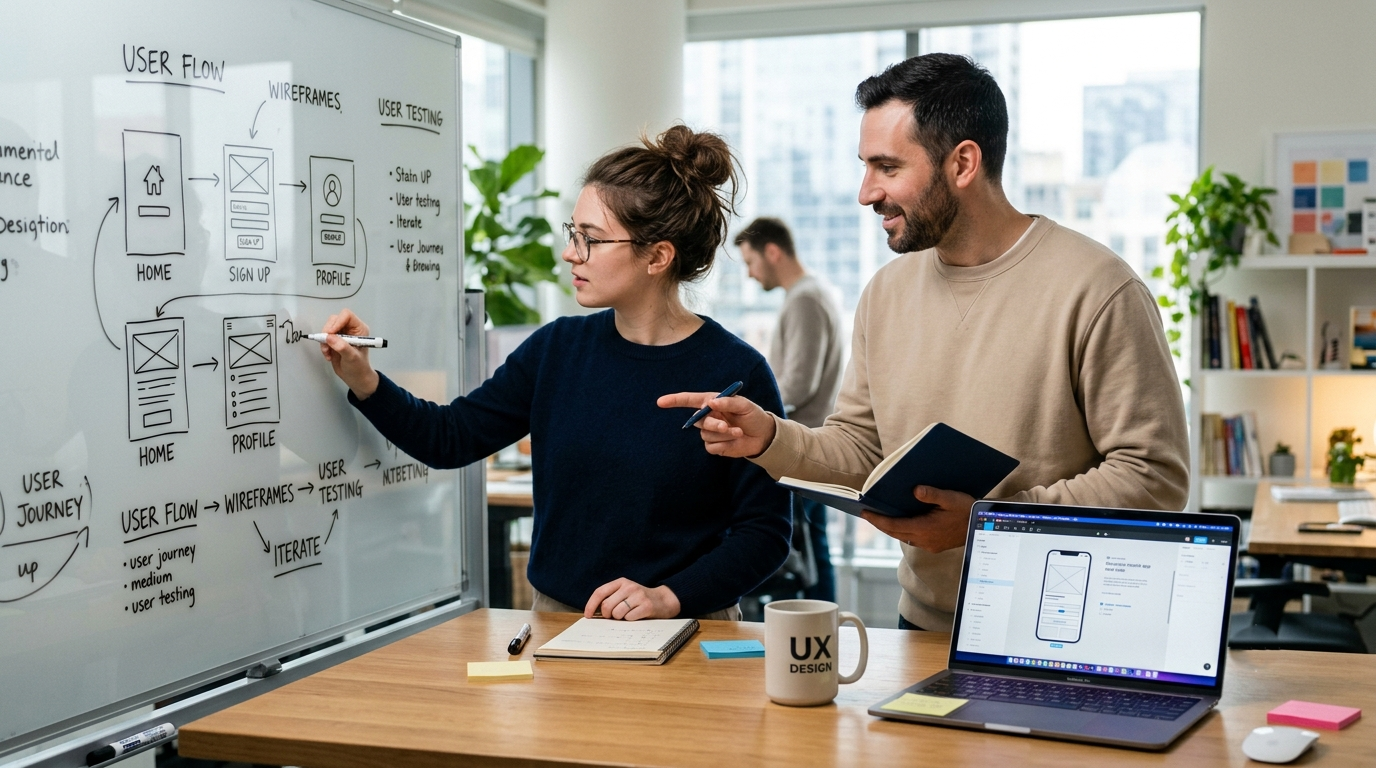
I have spent years watching startups build AI products that look beautiful but completely fail real users. The problem is simple. Teams treat AI as a visual design challenge when it is actually a system design problem. If you are searching for the best AI design agencies in Boston, you do not need someone to make a prettier chatbot interface. You need a partner who understands data pipelines, user intent, and how to simplify complex workflows. I wrote this guide to help you cut through the agency hype, rethink your product strategy, and find teams that actually know how to build AI-native products.
Quick Answer: Who Are the Top Design Partners?
Below is our top 10 comparison of agencies that successfully bridge the gap between complex machine learning capabilities and real user needs.
Why Does Finding the Right AI-Native Partner Matter So Much Today?
Building an AI product in 2026 is fundamentally different from building a traditional software application. Traditional software relies on explicit user commands. The user clicks a specific button, and the system executes exactly one predefined action. AI software, however, operates entirely on intent and probability.
The user provides a messy, unstructured prompt. The system then has to interpret that intent, generate a response, and present the right outcome. This shift requires a completely new design vocabulary. According to a 2025 research report by the Nielsen Norman Group on AI UX paradigms, users now tell the computer what they want rather than how to do it. This demands incredibly high trust and crystal clear system feedback.
If your design partner does not understand this fundamental paradigm shift, they will fail your product. They will simply design standard dashboards and bolt a generic generative text box onto the side. We see this play out constantly. A founder comes to us with a highly capable backend model, but their churn rate is massive because users do not know how to prompt the system correctly. Good AI UX design bridges that exact gap. It guides the user invisibly.
Where do teams go wrong when evaluating the best AI design agencies in Boston?
When founders start looking for the best AI design agencies in Boston, they usually make the fatal mistake of evaluating portfolios based on visual polish alone. They look at Dribbble shots of glowing gradients, dark mode interfaces, and slick loading animations. But visual polish does not solve AI usability issues.
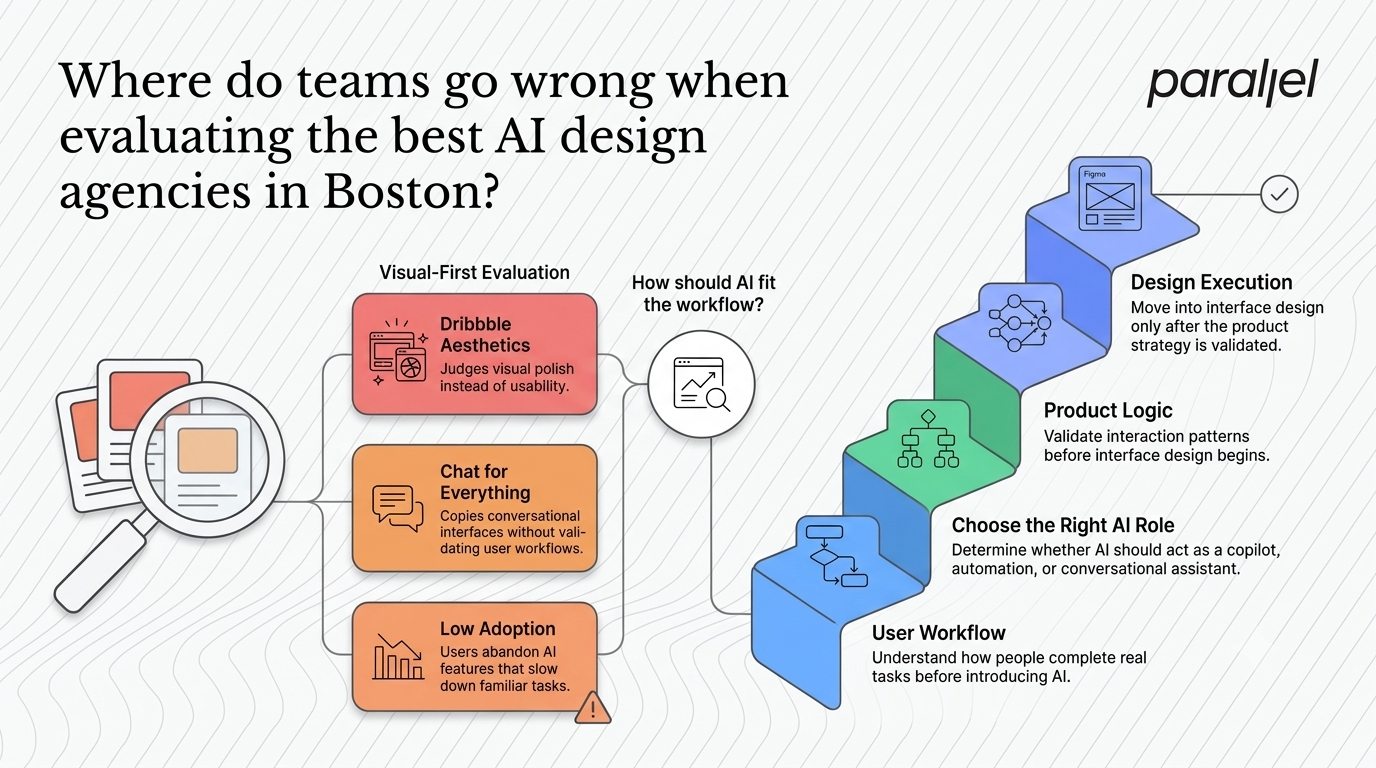
The most common failure pattern I see is the conversational UI trap. Teams assume that because ChatGPT uses a chat interface, their B2B SaaS product should use one too. They hire a standard web design agency to build a chat window. Three months later, product analytics show that users are entirely abandoning the feature.
Why does this happen? Because typing out a paragraph to filter a complex data table is significantly slower and more frustrating than just clicking a familiar dropdown menu. Standard agencies will blindly execute your feature requests. A strong product strategy consulting partner will push back.
A mature team will map the user workflow to determine the right AI integration. They will ask if AI should be an active copilot, an invisible backend automation, or a conversational agent. You need a team that focuses on deep product logic before they ever open a Figma file.
What do you think about AI-native product decisions?
To build successful AI products, you must learn to design for unpredictability. Traditional software is deterministic and predictable. AI is probabilistic and prone to hallucination. It will occasionally give the wrong answer, and your design must account for this gracefully.
We approach this by designing strict guardrails into the user experience. Instead of giving users a terrifyingly blank text box, we provide structured inputs, suggested starting prompts, and clear ways to regenerate or edit the AI output. A recent 2026 study from Stanford HAI on human-computer interaction emphasizes that users require total agency over algorithmic outputs. They need to feel like they are steering the car, not locked in the trunk.
When evaluating an agency, you must ask them how they handle latency. AI models take time to generate results. Does the agency just slap a lazy loading spinner on the screen? Or do they design asynchronous workflows that let the user continue working while the AI processes heavy data in the background?
These nuanced decisions dictate whether your product feels broken or magical. You must also consider how your product handles empty states. If an AI model has no historical data to pull from, the interface must guide the user on how to train or prime the system. This requires deep interaction design expertise, not just graphic design.
What is a practical approach to choosing the best AI design agencies in Boston?
Do not hire a team based on a smooth sales pitch. You have to test their strategic thinking. When you narrow down your list of candidates, give them a specific and complex problem your current product is facing.
Ask them how they would approach user research for a generative AI feature. Listen carefully to their immediate response. If they instantly start talking about UI components and color systems, you should walk away. If they start asking about your data training pipelines, user mental models, and the business cost of AI errors in your specific context, you have found a mature partner.
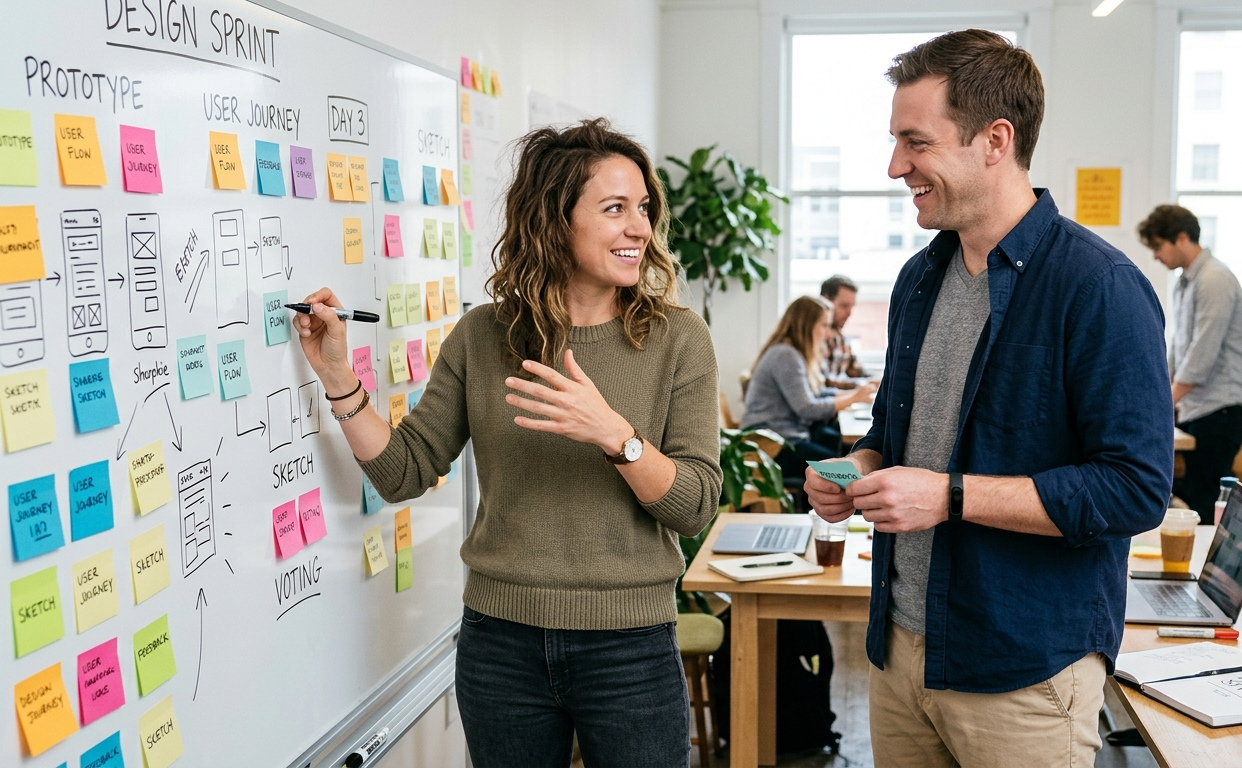
You should also look for teams that utilize structured frameworks like design sprints to validate AI concepts quickly. Prototyping AI is notoriously difficult because standard design tools cannot easily simulate dynamic, probabilistic responses. A mature agency will have concrete strategies for testing ideas early.
They might use "Wizard of Oz" prototyping methods or lightweight code sandboxes to validate AI features with real users. This ensures you validate the concept before you spend six months paying engineers to build a model nobody wants to use. Look for teams that demand user testing as a mandatory part of their process.
Who are the top 10 best AI design agencies in Boston?
Let us break down the best AI design agencies in Boston based on real market performance, team maturity, and their proven approach to solving complex product problems. I have included a mix of specialized studios and larger enterprise firms to fit different scaling stages.
1) ParallelHQ
We built ParallelHQ because we were entirely tired of seeing startups burn cash on surface-level design that did not move business metrics. We are a product design and strategy partner that works specifically with early-stage startups, visionary founders, and scaling SaaS teams. We do not just make things look good. We fix overcomplicated product experiences and weak onboarding flows.
When it comes to building AI products, we focus heavily on grounded user behavior. We help you figure out exactly where AI adds real value to your users and where it just adds unnecessary friction. We operate natively within your team, bringing sharp clarity to product decisions that otherwise get bogged down in endless internal debate.
If you are looking for the best AI design agencies in Boston to truly act as an extension of your product leadership, this is exactly what we do every day. We specialize in turning complex, highly technical backend capabilities into simple, intuitive user interfaces.
2) thoughtbot
thoughtbot has been a respected staple in the software community for years. Originally known for their deep Ruby on Rails expertise, they have successfully transitioned into integrating machine learning and AI into modern digital products.
They are an excellent choice if you have a highly technical product and need a team that can handle both the product design and the complex engineering required to actually deploy the software. They work closely with technical founders and have a strong culture of test-driven development. If your primary bottleneck is engineering execution combined with decent UX, they are a very safe bet in the local market.
3) IDEO (Cambridge)
If you have massive enterprise-level budgets and are tackling systemic, global challenges, IDEO remains a total powerhouse. Their Cambridge office has incredibly deep ties to the local academic and tech ecosystems around MIT and Harvard.
They are not the right fit for a fast-moving seed-stage startup trying to find product-market fit. However, for Fortune 500 companies looking to completely reimagine their service design around AI integration, they offer unparalleled research depth. They excel at mapping complex human systems. If you need a more agile or software-focused partner, you might want to look for an IDEO alternative.
4) Upstatement
Upstatement excels at the distinct intersection of brand narrative and digital product development. They have a very strong editorial background, which makes them uniquely suited for AI products that rely heavily on content generation, publishing workflows, and dynamic media.
They build beautiful, highly crafted digital experiences. They have been smartly integrating generative AI capabilities into their CMS builds and digital platform projects. If your AI product is consumer-facing and requires a highly polished, brand-led visual identity to stand out in a crowded market, their design team is exceptional.
5) EPAM Continuum
Continuum, which is now part of the massive global EPAM network, operates at the absolute highest levels of enterprise transformation. They flawlessly blend physical product design, digital user experiences, and incredibly complex backend engineering.
If you are building an AI product that requires hardware integration, IoT connectivity, or touches global supply chains, their Boston-based innovation team has the sheer scale and rigor to handle it. They are built for long-term, multi-year digital transformation initiatives rather than quick sprint execution.
6) Rocket Insights
Part of the larger Dept agency network, Rocket Insights is a very strong full-stack partner. They are incredibly pragmatic in their approach and focus heavily on shipping working software quickly.
They are a solid option when you need to rapidly scale up a product team to get an AI minimum viable product out the door. Their designers work hand-in-glove with their developers, ensuring that nothing gets lost in translation. They are particularly strong in mobile application development and functional B2B dashboards.
7) Rightpoint
Rightpoint has built a strong reputation around customer experience and employee experience design. As AI continues to rapidly reshape internal company operations and customer service workflows, Rightpoint brings a highly data-driven approach to designing these interactions.
They are exceptionally well-suited for mid-market and enterprise clients looking to adopt AI strictly for operational efficiency. If you are building AI tools meant to optimize internal workforce productivity or automate customer support pipelines, their strategic consulting arm provides excellent value.
8) Mad*Pow
Now operating as part of Tech Mahindra, Mad*Pow has a massive footprint in Boston's thriving healthtech sector. Their core strength lies in behavioral science and deep experience design.
Designing AI for healthcare requires an incredibly high bar for trust, safety, and strict regulatory compliance. You cannot afford AI hallucinations in patient care. If you are building an AI diagnostic tool, a patient care platform, or a wellness application, their deep industry expertise and understanding of behavioral psychology is highly valuable. They understand how to design for human empathy.
9) DockYard
DockYard is a digital product agency known for their elite engineering capabilities, particularly within the Elixir ecosystem. They take a highly technical, uncompromising approach to product design.
When building AI applications that require real-time data processing, massive concurrency, and highly scalable architectures, their design team knows exactly how to build interfaces that perform perfectly under tight technical constraints. They are the team you hire when performance is a critical feature of your product experience.
10) Third and Grove
Third and Grove is a digital agency focused heavily on complex web experiences, large-scale e-commerce, and heavy content platforms. As AI transforms how users search, browse, and buy products online, they have been at the forefront of designing intelligent commerce experiences.
They are a great fit if your AI product is focused on retail innovation, consumer goods, or managing massive content repositories. They know how to use AI to drive conversion rate optimization and personalize the buying journey for users.
How to measure the ROI of your AI product design
Once you choose a partner and launch your product, you need to know if the design is actually working. Traditional software metrics like daily active users are not enough for AI products. You have to measure the specific value the AI is providing.
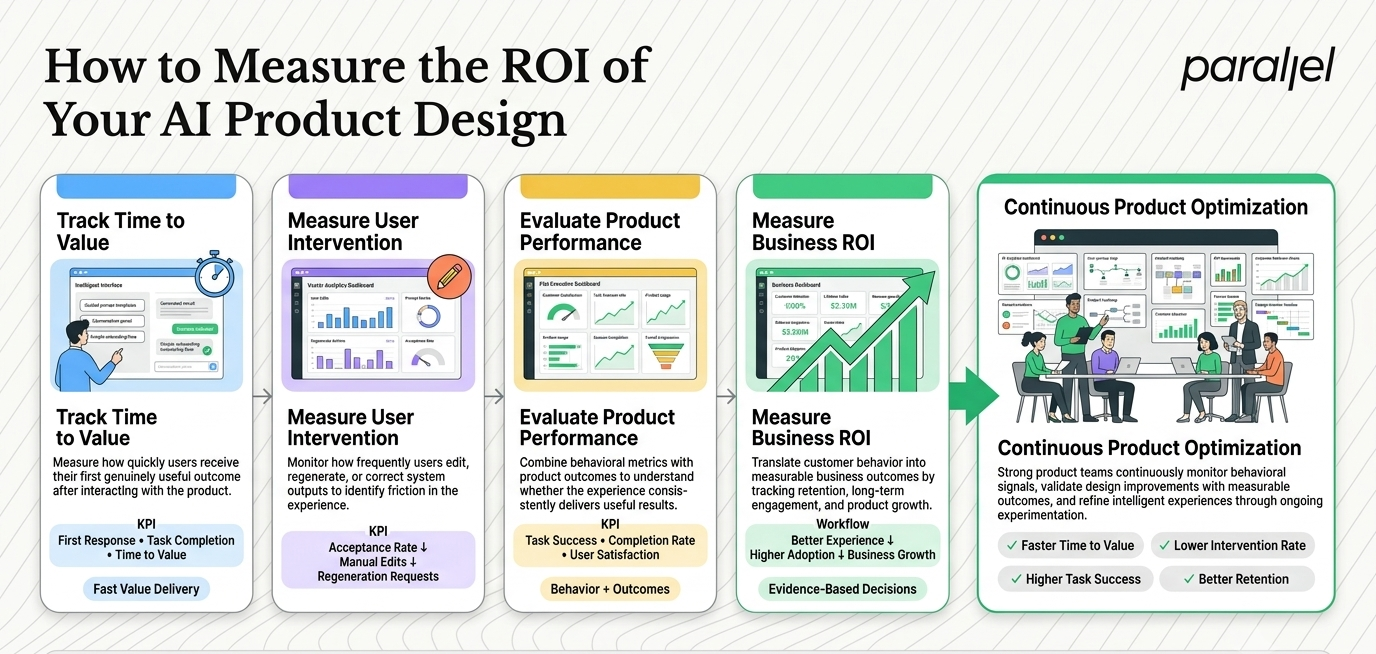
According to a 2025 report by McKinsey on AI value realization, companies that rigorously track user task success rates see significantly higher retention. You need to measure "Time to Value." How fast does a user get a helpful answer from your AI?
You also need to track intervention rates. How often does a user have to manually edit the text your AI generated? If your intervention rate is high, your prompt engineering or your UX constraints are failing. A good design partner will set up analytics to track these specific behavioral markers. If you want a deeper dive into measuring product success, read our guide on core SaaS metrics.
The final word on choosing your product partner
Building an AI product requires a delicate balance of deep technical understanding and extreme user empathy. The interface must hide the complexity of the machine learning model while keeping the user firmly in control of the outcome.
As you finalize your shortlist and evaluate the best AI design agencies in Boston, remember that you are not buying a UI kit. You are buying a way of thinking. Hire a team that challenges your assumptions, forces you to talk to real users, and prioritizes clarity over cleverness. Let the technology be complex, but demand that the design remains perfectly simple.
FAQ
1) What exactly differentiates the best AI design agencies in Boston from standard web agencies?
Standard agencies focus on static interfaces and predetermined user flows. AI design agencies understand probabilistic outcomes, latency management, prompt UX, and how to build trust when an algorithm provides unpredictable results. They design systems, not just pages.
2) How do we practically integrate AI into our existing SaaS product?
You start with an opportunity mapping exercise. Do not just add a chatbot. Look at your users' most repetitive, high-friction tasks. Use AI to automate data entry, predict user needs, or summarize complex information seamlessly within the existing interface.
3) Should I hire an agency or an in-house product designer for our AI feature?
If you have a clear, validated roadmap and need slow, steady execution, hire in-house. If you need to rapidly validate an idea, overcome complex product strategy hurdles, or bring a specialized AI UX perspective to your team quickly, partner with an agency.
4) How much does it typically cost to design an AI product MVP?
Costs vary wildly based on complexity. A rapid design sprint to validate a concept might cost between $15,000 and $30,000. A full MVP product design phase involving deep research, strategy, and full-fidelity prototyping can range from $50,000 to well over $100,000 with top-tier firms.
5) Is my early-stage startup ready to hire an AI design partner?
You are ready if you understand your target user and the specific problem you want to solve. If you only have cool technology but no idea who will buy it, you need customer discovery first. Agencies amplify your direction, but they cannot invent your business model.
6) What makes ParallelHQ different from other agencies on this list?
We focus exclusively on clarity and practical product thinking. We do not do agency fluff or chase temporary visual trends. We work natively with founders to untangle overcomplicated software and build experiences grounded entirely in real user behavior and business logic.
7) How long does it take to design and validate an AI product concept?
Using a structured discovery framework, we can validate core AI concepts with real users in 2 to 4 weeks. Full UI/UX execution for a complete MVP typically takes an additional 6 to 10 weeks depending on the technical constraints and screen volume.
8) What is the fundamental difference between UI design and AI-native product strategy?
UI design decides what color the button is and where it sits on the screen. AI-native product strategy decides if the user even needs to click a button, or if the AI should have already anticipated their need and completed the task for them automatically.

check out these related blogs











.webp)