Over the last decade of building products, I have seen founders waste millions on design that looks good but fails to convert. We built ParallelHQ because startups need clarity, not just pretty screens. When you search for the best UI UX design agencies in Austin, you usually find lists of order takers who lack deep product thinking. True design partners dig into user behavior and simplify complex workflows. I want to share how we think about evaluating design partners. This guide will help you see past the fluff and make a decision grounded in real product mechanics.
Quick Answer
What Patterns Differentiate the Best UI UX Design Agencies in Austin From the Rest?
At ParallelHQ, we work with teams building complex AI and SaaS products. We notice a clear difference between strategic partners and surface-level agencies. The top tier focuses on what users actually do rather than what founders assume they want. They prioritize validation over immediate execution.
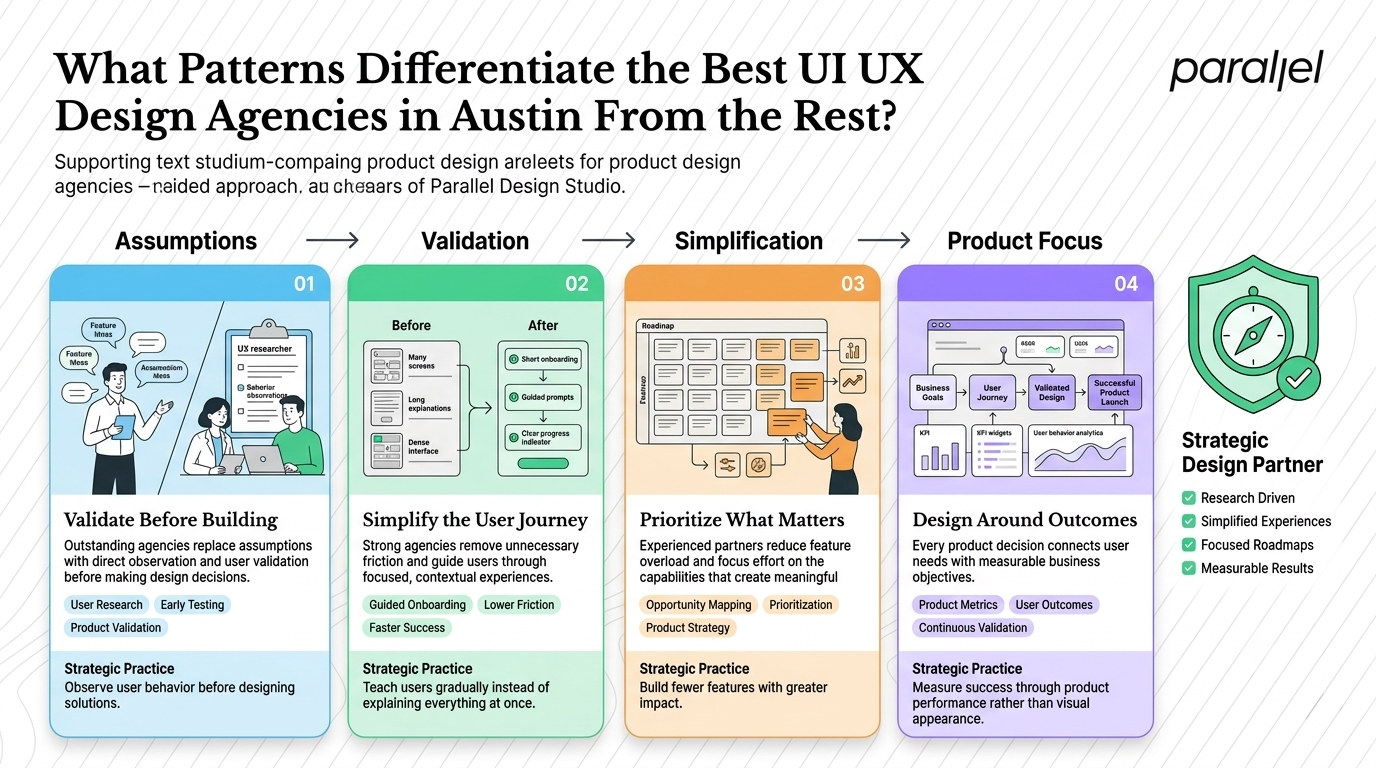
A 2026 report by the Nielsen Norman Group indicates that teams prioritizing early user testing see a 65% reduction in development rework. This is a massive cost saving for early-stage startups. Good agencies integrate this validation phase early and aggressively. They do not guess.
We see many teams overcomplicate their product onboarding. They try to explain everything at once. A mature agency will simplify this into contextual, bite-sized steps that naturally guide the user. They map the exact user journey and remove friction points before a single line of code is written.
Strong agencies also challenge your product roadmap. If you present a list of thirty features, a good partner will help you identify the three that actually matter. They use frameworks like opportunity mapping to align design efforts with measurable business goals.
The Top 10 List: Who Are the Best UI UX Design Agencies in Austin for 2026?
1) ParallelHQ
We are a product design and strategy partner built for founders who need clarity. We do not just design screens. We help you simplify complex product decisions and fix weak activation metrics. We know how hard it is to build something that people actually want to use.
If your software is confusing users, we run a deep ux audit to find the leaks in your funnel. We believe in fast, focused alignment between design and engineering. Our approach is deeply rooted in behavioral psychology and practical product mechanics.
2) Argodesign
Argodesign brings a heavy focus on futuristic and complex systems. They excel when hardware meets software. Their team is known for deep technical understanding and pushing visual boundaries. They are highly suited for companies building cutting edge spatial computing or embedded AI tools.
They operate with a strong perspective on the future of human computer interaction. If you are building a standard web app, they might be overkill. However, for ambitious hardware integrations, they are a phenomenal choice.
3) projekt202
This agency blends user experience research with heavy software development. They are highly effective for large enterprises looking to modernize legacy systems. Their methodology is rooted in deep observational research.
They spend significant time understanding how employees or users interact with legacy tools in their natural environment. This makes them a strong partner for digital transformation projects. They ensure the handoff between design and development is highly structured.
4) Praxent
Praxent focuses almost exclusively on the financial services sector. They understand the heavy regulatory constraints of fintech. If you are building a wealth management portal or an insurance dashboard, they have the specific domain expertise required.
They know how to design for trust and security. Financial UX requires a completely different approach to data visualization and user flows. Praxent brings years of specific industry knowledge to these complex challenges.
5) Slide UX
Slide UX acts as an extension of in-house product teams. They focus heavily on B2B SaaS products and ongoing support. Their strength lies in continuous, iterative user research and usability testing.
They are great for mature startups that need extra design bandwidth but already have a product in the market. They focus on incremental improvements that drive feature adoption. Their team integrates smoothly with existing agile workflows.
6) Funsize
Funsize is a digital product design agency that works well with high-growth tech brands. They are known for their strong visual aesthetics and mobile app design capabilities. They often partner with internal teams for major product launches.
They bring a highly polished, consumer grade feel to their projects. If your product relies heavily on emotional resonance and brand integration, Funsize is a strong contender. They excel at rapid prototyping and visual storytelling.
7) Blink UX
Blink UX brings a science-backed approach to product design. They rely heavily on empirical data and deep usability testing. Their Austin studio focuses on creating evidence-driven products for large technology clients.
They often utilize dedicated research labs to observe user behavior. This makes them ideal for highly complex medical or enterprise software where usability errors are costly. They remove subjective opinions from the design process entirely.
8) HMG Creative
HMG Creative leans more toward marketing and brand experience. They are a good fit for B2B brands needing a strong web presence. They combine web design with broader digital marketing strategies.
They excel at top of funnel conversion and lead generation. If your primary problem is acquiring users rather than retaining them inside a complex app, HMG is a solid choice. They bridge the gap between marketing and digital design.
9) Monkee-Boy
Monkee-Boy specializes in accessible web design and local business solutions. They have a strong track record with Texas-based non-profits and government entities. Their work focuses heavily on compliance and community engagement.
They are experts in Web Content Accessibility Guidelines (WCAG). If you are building a public facing portal that must serve a highly diverse demographic, their expertise is invaluable. They build robust, inclusive digital experiences.
10) Fahrenheit Marketing
Fahrenheit Marketing focuses on e-commerce and lead generation. They blend UI/UX design with conversion rate optimization. They are ideal for retail brands looking to scale their online revenue.
They understand the mechanics of shopping cart abandonment and product merchandising. If your business relies on high volume digital transactions, they know how to optimize the flow. They tie every design decision back to direct revenue.
How Do You Choose Among the Best UI UX Design Agencies in Austin for Your Startup?
Selecting a partner is about finding alignment in product thinking. You should look beyond a beautiful portfolio filled with generic interface mockups. According to a 2025 study by IDEO, successful product outcomes depend 70% on problem definition and only 30% on visual execution.
Look for agencies that ask hard questions during the sales process. If they immediately agree to all your feature requests, that is a massive red flag. A strong partner will push back and ask for data to support your assumptions. They will want to know why a feature matters to your business.
We recommend asking about their specific discovery process. Ask how they handle disagreements about user behavior between your team and theirs. The right agency will point to a usability testing framework to settle debates with real data instead of opinions.
You must also evaluate their ability to design for modern technology. If you are building an AI product, ask for their AI readiness design scorecard. Designing chat interfaces and generative workflows requires a completely different skill set than traditional web forms.
Where Do Teams Go Wrong When Hiring the Best UI UX Design Agencies in Austin?
In my experience, founders often hire agencies based purely on aesthetic style. They choose partners who design trendy, colorful interfaces but lack deep product logic. This leads to products that look incredibly modern but completely confuse your actual users.
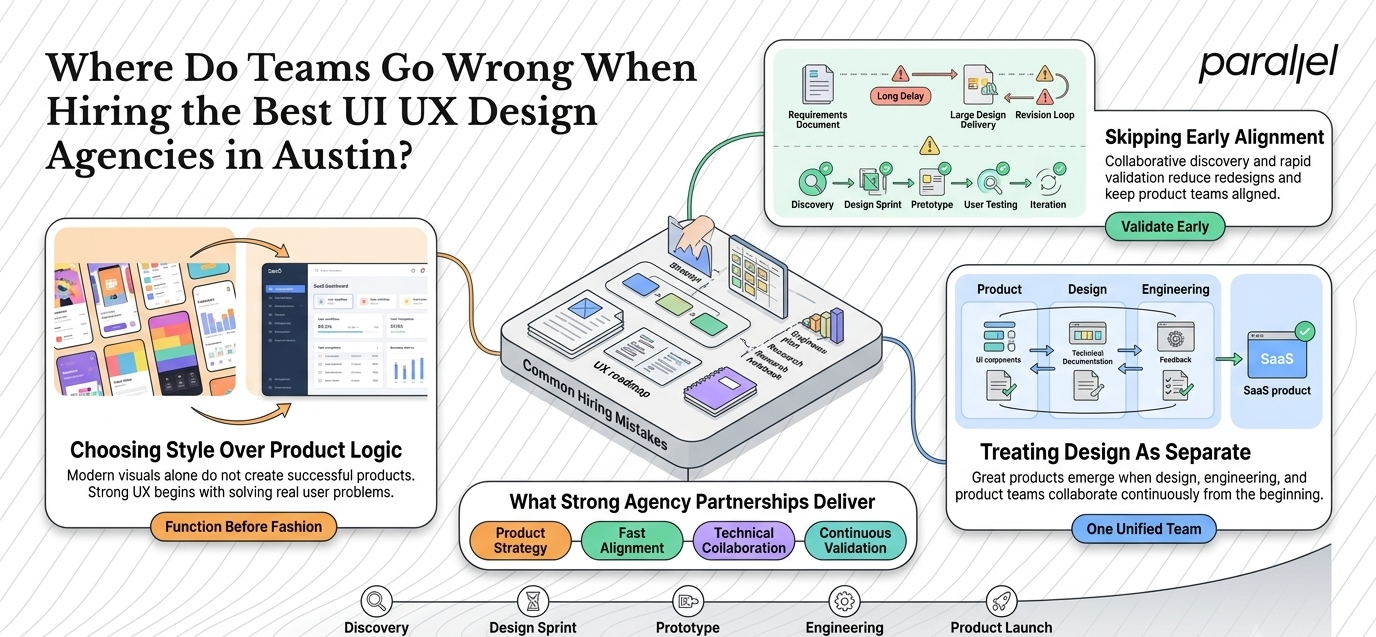
Another common mistake is skipping the alignment phase. Founders hand over a massive requirements document and expect perfect designs a month later. This waterfall approach almost always fails in modern software development. You need a highly iterative process that embraces changing assumptions.
We solve this through structured design sprints. This forces the agency and the startup team into a room to align on the core problem immediately. Fast alignment prevents expensive redesigns and wasted engineering cycles later down the line.
Finally, teams fail when they treat design as an isolated phase. Design must integrate deeply with engineering and product management. If an agency throws high fidelity screens over a wall to your developers without technical consultation, the final product will suffer.
What Is the Expected ROI When Working With the Best UI UX Design Agencies in Austin?
Good design is not an expense. It is an investment that directly impacts your primary business metrics. A well-designed product lowers customer acquisition costs, reduces support tickets, and increases customer lifetime value.
Recent 2026 data from the Design Management Institute shows that design-led companies outperform average market growth by 220%. For an early-stage startup, this translates directly to faster user activation. Fixing a leaky funnel provides an immediate and measurable revenue impact.
For example, a proper B2B CRO suggestion process can identify friction costing you thousands of dollars a month. We often see a 20% to 30% increase in conversion simply by removing unnecessary steps in a core user flow. Clarity always wins over cleverness.
Furthermore, investing in a scalable design system early pays massive dividends as you grow. It allows your engineering team to ship features twice as fast. You stop redesigning the same buttons and focus on solving actual user problems.
Conclusion
Building a successful product requires clarity, focus, and a deep understanding of human behavior. You cannot afford to guess what your users want. The market is too competitive and user expectations are simply too high for sloppy product experiences.
When evaluating the best UI UX design agencies in Austin, optimize for strategic thinking over visual flair. Find a team that has navigated the messy early stages of product development. Let user data guide your decisions, and keep your product as simple as possible.
Do not settle for an agency that just wants to draw screens. Demand a partner who is willing to understand your business model, challenge your assumptions, and sweat the details of your user journey. That is how you build a product that actually survives contact with the market.
Frequently Asked Questions
1) What exactly does a UI/UX design agency do?
They design the digital experience and logical flow of your product. This includes user research, wireframing, interface design, and usability testing. Their core goal is to make your product both highly functional and deeply intuitive.
2) How much do top design firms in Texas typically charge?
Pricing varies significantly based on agency maturity and project scope. For a strategic product design engagement, expect to invest anywhere from $30,000 to over $100,000. It is best to evaluate this cost against the potential revenue impact of fixing a broken user journey.
3) How long does a typical product design engagement last?
A focused initial engagement usually takes four to eight weeks. Complex enterprise software or deep AI integrations can take several months. We prefer starting with rapid discovery frameworks to deliver validated value in weeks, not months.
4) What is the difference between an agency and a freelancer?
Freelancers offer excellent execution bandwidth for highly specific tasks. Agencies provide comprehensive product strategy, project management, and diverse cross-functional skill sets. Startups dealing with high complexity usually need the structured, robust approach of an agency.
5) Should I hire a specialized UI/UX agency or a full-service development shop?
Full-service shops often treat design as a quick afterthought to sell expensive development hours. A specialized UI UX design partner ensures the product logic is completely validated before coding begins. This saves you from building the wrong features.
6) How do I know if my startup is ready to hire a design agency?
You are ready when poor user experience is directly blocking revenue or growth. If users drop off during onboarding or constantly complain about a confusing interface, it is time. You should also have clear business goals mapped out before reaching out.
7) What is the most important metric a UX agency should improve?
This completely depends on your specific business model. For B2B SaaS, it is usually user activation or time to value. For e-commerce, it is strictly the checkout conversion rate and average order value.
8) Why should I consider ParallelHQ for my product design needs?
We do not just draw screens or chase design trends. We are a product design and strategy partner that helps you simplify complex decisions and drive growth. If you want a team that grounds every design choice in real user behavior, we can help you build a product that actually works.

check out these related blogs