Founders often ask me who they should hire for product design when scaling their startups. The truth is that finding a partner who understands product strategy, not just pretty screens, is incredibly difficult. If you are looking for the best UI UX design agencies in Chicago, you need to look beyond standard portfolios. We have seen teams overcomplicate onboarding and ruin activation simply because their agency lacked deep product thinking. Here is a grounded look at how to choose a partner who will simplify your product and drive real business outcomes.
Quick answer: TL;DR
The best UI UX design agencies in Chicago combine business strategy with actual user behavior. Skip the trend chasers and focus on teams that ask hard questions about your business model before opening Figma. Here is how the top ten compare.
What makes the best UI UX design agencies in Chicago different?
In my experience working with founders and product managers, the biggest disconnect in product building happens during the transition from strategy to execution. Most traditional agencies focus entirely on how a product looks. They build massive design systems before they even know if a user can successfully finish the core workflow. This approach burns cash and wastes months of engineering time.
The top-tier partners operate differently. They act as an extension of your product team. They push back on bloated feature requests. They look at your analytics to see where users actually drop off instead of guessing in a vacuum. A 2026 benchmark study by the Nielsen Norman Group highlights this perfectly. They found that design teams prioritizing fundamental usability over visual trends increased user retention by an average of 42 percent within three months.
Clarity is the ultimate goal. When you evaluate potential partners, you should look for teams that can take an incredibly complex workflow and strip it down to its most basic, necessary parts. We built ParallelHQ specifically to address this gap. We wanted to help teams simplify decisions through rigorous product strategy consulting. The right agency will spend more time mapping your user journeys than they will arguing over button colors.
They also understand the commercial realities of building software. If you are an early-stage SaaS founder, you do not have six months to wait for a research report. You need actionable insights right now. Strong agencies utilize frameworks like design sprints to validate ideas in days rather than months.
Where do teams go wrong when searching for the best UI UX design agencies in Chicago?
Founders usually make the same three mistakes when hiring an external design team. First, they prioritize visual flair over functional problem solving. They browse portfolios filled with dark mode dashboards and glowing graphs that look stunning but fail completely in a real browser environment. Aesthetics matter, but they are useless if your users cannot figure out how to reset their password.
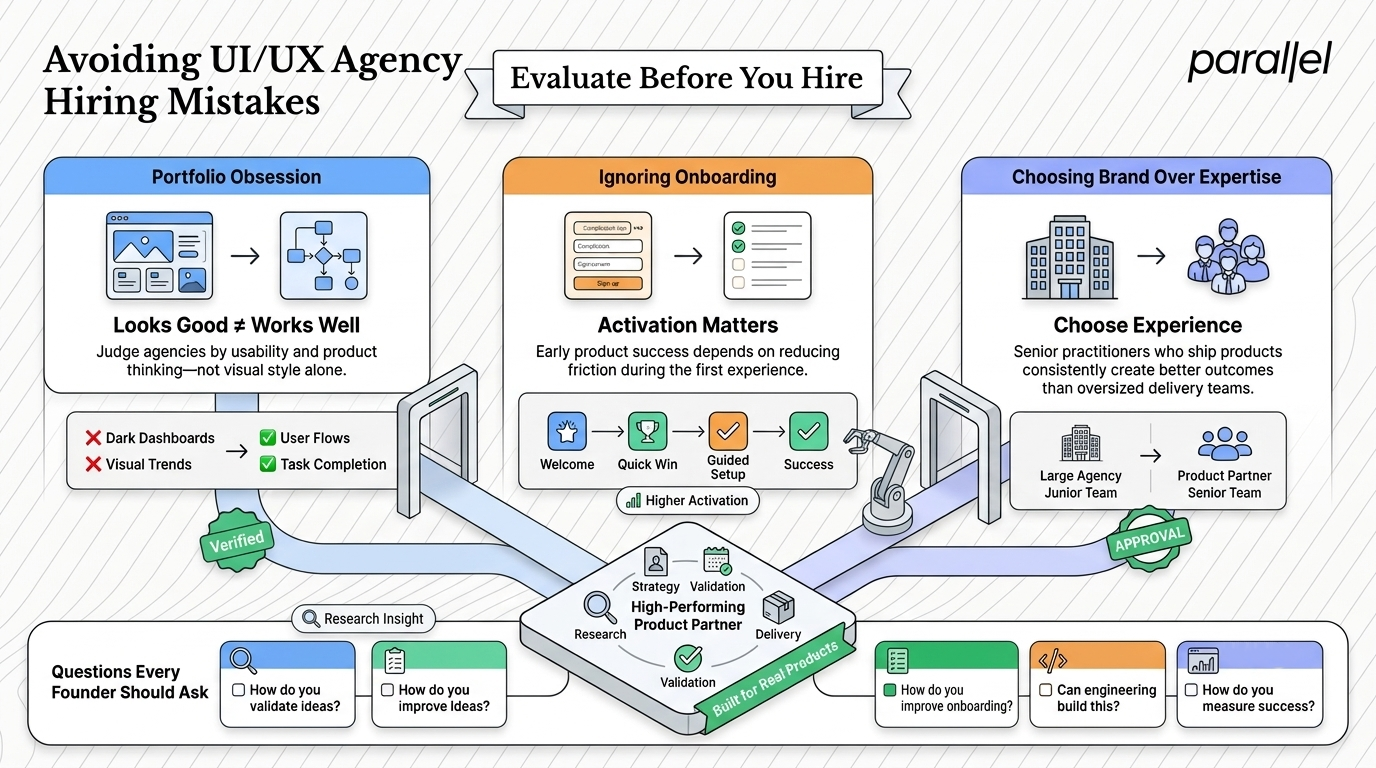
Second, teams completely ignore the onboarding experience. I have audited dozens of SaaS products over the years. The most common pattern I see is a brilliant core product hidden behind a confusing, friction-heavy signup wall. Recent 2025 data from the Baymard Institute shows that 68 percent of users will abandon a complex SaaS onboarding flow if it requires more than three steps without immediate value realization. If an agency does not ask about your activation metrics during the pitch, they are the wrong partner.
Third, startups often hire massive traditional agencies thinking that a big brand name guarantees success. This rarely works out for agile teams. Large legacy agencies often put junior designers on smaller accounts while charging premium rates. If you are looking for a MetaLab alternative or an IDEO alternative, you need a team that is lean, senior-heavy, and focused on rapid execution. You need practitioners who have actually shipped software recently.
We have seen teams spend hundreds of thousands of dollars on conceptual design work that never gets built. Engineers simply cannot translate the messy, unstructured files into working code. This is why practical design operations are non-negotiable.
How to correctly evaluate the best UI UX design agencies in Chicago
You need a systematic approach to vet your potential design partners. You should evaluate them across three specific pillars: their discovery process, their design systems thinking, and their focus on business outcomes. If an agency fails in any of these areas, you will likely end up with a product that looks nice but underperforms in the market.
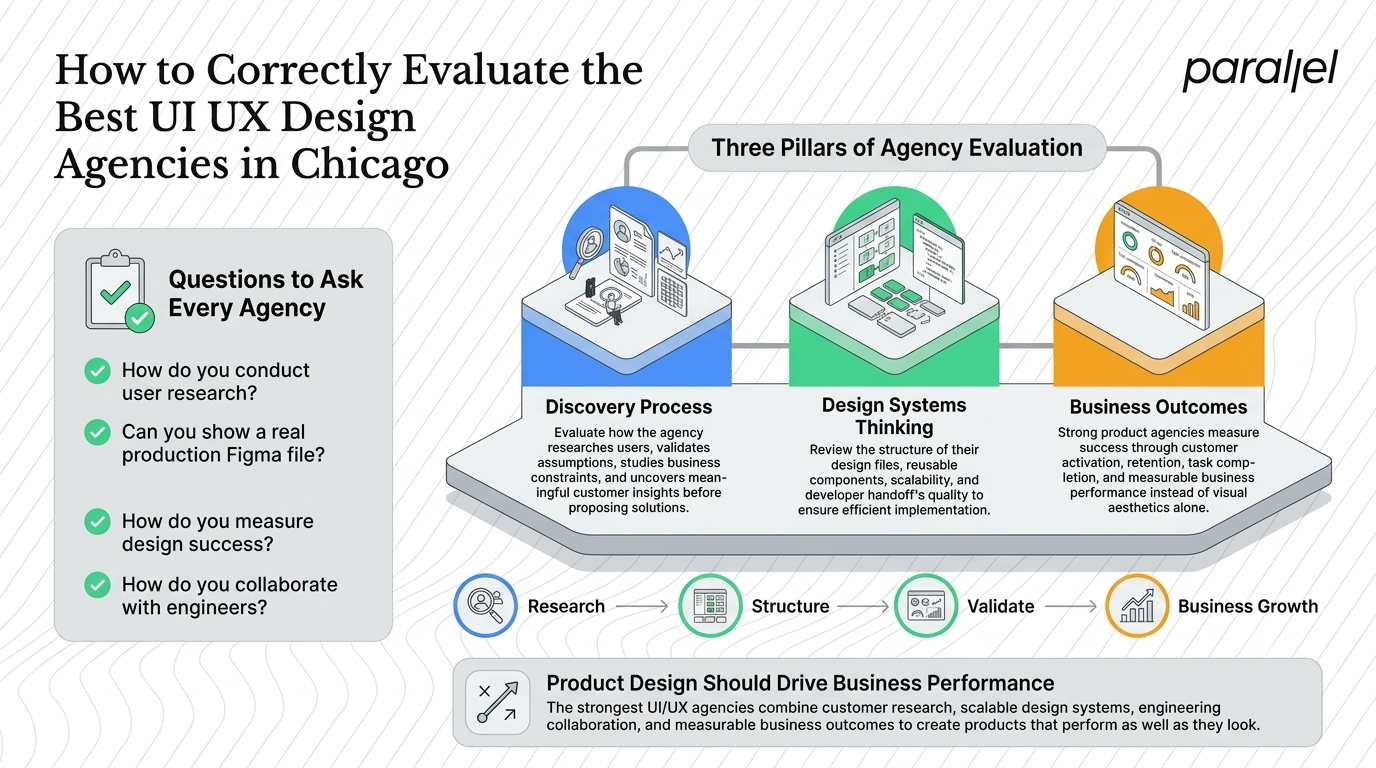
Start by examining their discovery process. How do they actually learn about your users? If their answer is just "we look at competitor websites," you should walk away. They need to understand how to conduct proper user research and extract signal from noise. They should ask you about your unit economics, your customer acquisition cost, and your core technical constraints.
Next, look at how they structure their design files. This sounds like a minor detail, but it is actually critical for your engineering team. Ask to see a real Figma file from a past project. Is it organized? Do they use auto-layout? Are their components scalable? A messy file indicates a messy thinking process. When we provide Figma design services, our files are built to be handed directly to developers without friction.
Finally, measure their commitment to outcomes. A 2025 global survey by McKinsey revealed that companies tightly aligning product design with business metrics outpaced industry revenue growth by nearly two to one. Your agency should be comfortable discussing activation rates, churn, and task completion times. They should view design as a business lever, not just an art project.
A detailed breakdown of the 10 best UI UX design agencies in Chicago for 2026
Evaluating the local market requires separating the agencies that simply make things look pretty from the ones that actually build functional businesses. Here is a detailed look at the top firms operating in the Chicago area this year.
1) ParallelHQ
We built ParallelHQ because we saw a massive gap in how products were being designed. Startups and product leaders were getting bloated, confusing interfaces that frustrated users and stalled growth. We focus relentlessly on clarity, usability, and rapid decision-making. We do not do fluff. We do not sell you generic templates. We dive deep into your product architecture to solve fundamental user problems.
Our approach is grounded in real experience building and scaling software. Whether we are conducting a rapid UX audit to identify conversion blockers or running a full SaaS design service engagement, we operate as an embedded part of your team. We specialize in early-stage startups and complex enterprise tools that require simplified experiences. We are the partner you hire when you need sharp product thinking that translates directly into code.
2) Fuzzy Math
Fuzzy Math has been a staple in the Chicago design scene for years. They are exceptionally strong when it comes to B2B enterprise software and complex legacy systems. If you have a massive, outdated internal tool that requires a complete overhaul, they are a very solid choice.
They lean heavily into research and systematic design processes. They are less focused on trendy consumer apps and more focused on dense data visualization and complex user workflows. They excel at mapping out intricate user journeys for specialized professional audiences.
3) UX 4Sight
UX 4Sight positions themselves as a highly analytical, data-driven agency. They are a great fit if you already have a live product with significant traffic and you need to optimize specific conversion metrics. They rely heavily on empirical data to drive their design decisions.
Their team is known for conducting thorough usability tests and producing actionable reports. They are very practical in their approach. This makes them a strong partner for companies that need evidence-backed redesigns rather than conceptual explorations.
4) Codal
Codal is a massive agency with a strong footprint in Chicago. They specialize heavily in eCommerce and large-scale digital transformations. If you are running a massive Shopify Plus instance or building a complex multi-vendor marketplace, Codal has the engineering and design scale to handle it.
They are not a lean startup shop. They are built to service enterprise clients with large budgets and long timelines. Their strength lies in their ability to combine high-end UX design with deep backend technical integrations.
5) Momentum Design Lab
While Momentum is a global agency, their Chicago presence is highly respected. They are particularly known for their work in FinTech, healthcare, and specialized SaaS platforms. They bring a very structured, enterprise-grade methodology to product design.
They are an excellent choice if you are dealing with heavy regulatory constraints or highly sensitive user data. They understand how to design secure, compliant interfaces without sacrificing the user experience. Their work is clean, modern, and highly functional.
6) Eight Bit Studios
Eight Bit Studios is the agency you call when you need a flawless mobile application. They have carved out a strong niche in the Chicago market by focusing intensely on the mobile ecosystem. They understand the nuances of iOS and Android design guidelines better than most.
They have a very playful, creative culture that translates well into consumer-facing products. If you are building a consumer app that relies on heavy engagement and delightful micro-interactions, Eight Bit is a top contender.
7) TXI (Table XI)
TXI is technically a custom software development firm, but their UX practice is incredibly robust. They are the perfect partner if you need a team that can handle both the design and the full-stack engineering of a complex web application.
They focus heavily on agile methodologies and close collaboration between designers and developers. This ensures that their designs are actually buildable. They are a highly pragmatic team that focuses on delivering working software quickly.
8) Bounteous
Bounteous is an enterprise behemoth. They handle massive digital transformation projects for global brands. You do not hire Bounteous to design a simple MVP. You hire them to overhaul an entire corporate digital ecosystem.
Their UX capabilities are deeply integrated with their marketing and analytics divisions. They are best suited for large corporations that need a unified strategy across web, mobile, and digital marketing channels.
9) LaunchPad Lab
LaunchPad Lab is a very practical, highly capable digital product agency based in Chicago. They focus heavily on building web applications using tools like React and Ruby on Rails. Their design team works hand-in-hand with their engineers from day one.
They are known for being straightforward and easy to work with. They do not get bogged down in agency bureaucracy. They are a great fit for mid-market companies that need a reliable partner to build and launch a functional digital product.
10) Devbridge
Devbridge, now part of Cognizant, brings a highly disciplined, engineering-led approach to product design. They focus heavily on rapid delivery and measurable outcomes. They are built for speed and technical precision.
Their design process is tightly coupled with their software engineering lifecycles. They are an excellent choice for large financial institutions or manufacturing companies that need to modernize their internal software quickly and efficiently.
How do you work effectively with the best UI UX design agencies in Chicago?
Hiring a great agency is only the first step. How you manage the collaboration determines the success of the project. I have seen founders hire brilliant designers but fail to give them the access and context they need to do their jobs properly. You cannot outsource your product vision. You must participate actively in the process.
Start by defining clear, measurable success metrics on day one. Do not tell your agency you want a "modern look." Tell them you need to increase trial-to-paid conversion by 15 percent over the next two quarters. If you are utilizing UI/UX design services in Chicago, treat the agency team like your own employees. Give them access to your Mixpanel dashboards, your customer support tickets, and your sales call recordings.
Enforce a culture of rapid, iterative feedback. Do not wait for two weeks to review a massive presentation deck. Review wireframes daily. Use tools like Loom to provide asynchronous feedback on specific user flows. This prevents the agency from going down the wrong path and wasting valuable hours. Recent 2026 data from Gartner indicates that product teams utilizing asynchronous, continuous feedback cycles ship features 30 percent faster than those relying on traditional milestone meetings.
Finally, protect your engineers' time. Ensure the agency is delivering properly structured design systems, not just static screens. If you are building a fintech product, for example, your fintech design services partner must deliver exact technical specifications, state variations, and interaction guidelines. The project is not done until the code is shipped and verified.
Conclusion
Choosing the right design partner requires looking past the surface. It is easy to be seduced by beautiful case studies and slick sales pitches. However, the reality of product building is messy, difficult, and highly technical. You need a partner who embraces that complexity rather than hiding from it.
The most successful founders I work with treat design as a core business function. They do not view it as a final coat of paint applied right before launch. They integrate design thinking into their initial strategic planning. They demand clarity, reject fluff, and focus relentlessly on how real users behave in the real world.
Take your time during the vetting process. Ask hard questions about failures and technical constraints. Request to speak with past clients about the agency's ability to handle scope changes. The right partner will not just improve your product's interface. They will fundamentally improve how your entire organization thinks about solving problems.
Frequently asked questions
1) What does a UI/UX agency actually do?
A proper UI/UX agency solves business problems through product design. They research user behavior, map out logical product architectures (UX), and create intuitive, accessible visual interfaces (UI). They bridge the gap between your business goals and the needs of your actual customers.
2) How do we prepare before hiring a design partner?
You must document your core business objectives and known user problems before reaching out. Gather your current analytics, map out your existing customer journeys, and define your technical constraints. The more context you provide upfront, the faster an agency can generate valuable solutions.
3) Freelancer vs agency: which is right for my startup?
Freelancers are excellent for executing well-defined, narrow tasks on a strict budget. Agencies are necessary when you need strategic guidance, comprehensive product thinking, and a diverse set of skills (research, strategy, visual design) that a single freelancer rarely possesses.
4) How much should a comprehensive UX overhaul cost?
Costs vary wildly based on scope and complexity. A rapid UX audit might cost between $5,000 and $10,000. A comprehensive product redesign for an early-stage startup typically ranges from $20,000 to $50,000. Enterprise transformations often exceed $100,000. Always demand value and ROI over strict hourly billing.
5) Is an external agency right for me if I have internal developers?
Yes, absolutely. The most effective model is often pairing an external product design agency with an internal engineering team. The agency provides the strategic clarity and design systems, while your internal team ensures technical feasibility and handles the actual implementation.
6) How does ParallelHQ approach product design differently?
We strip away the agency fluff and focus purely on product clarity. We act as an extension of your founding team. We do not just deliver screens. We deliver structural thinking, validated user flows, and developer-ready systems that actually move your business metrics forward.
7) How long does a typical product design project take?
A focused design sprint can validate a concept in two weeks. A complete MVP design typically takes six to eight weeks. Full enterprise platform redesigns can take three to six months. We strongly advocate for rapid, iterative releases rather than massive, delayed launches.
8) What metrics should we track to measure design success?
You should track business outcomes, not just design outputs. Focus on user activation rates, time-to-value during onboarding, task completion rates, and reduction in customer support tickets. Building a UX metrics framework ensures your design investment directly impacts your bottom line.

check out these related blogs