I have spent years working with founders and product leaders at early-stage startups. When teams realize their product experience is overcomplicated, they often look outward for a quick visual fix. If you are leading a startup and researching web design San Francisco, you are likely noticing a pattern. You will find endless portfolios of beautiful, sleek interfaces. But pretty screens do not fix weak onboarding or low activation rates. You need clarity in your product thinking, not just a fresh coat of paint. Here is how we think about making the right choice for your next growth phase.
Quick answer and comparison
A strong design partner simplifies complexity rather than just decorating it. We have compiled a comparison of the top ten agencies based on their approach, core focus, and ability to drive real user activation.
Why does finding the right web design San Francisco partner matter for startups?
The ecosystem in the Bay Area demands excellence from every digital touchpoint. This makes the search for a web design San Francisco agency a highly competitive endeavor. Users today have zero tolerance for friction. A 2026 study by the Nielsen Norman Group found that B2B users form a rigid opinion about a company’s credibility within the first 50 milliseconds of site exposure. If your messaging is vague or your navigation is convoluted, you lose them immediately.
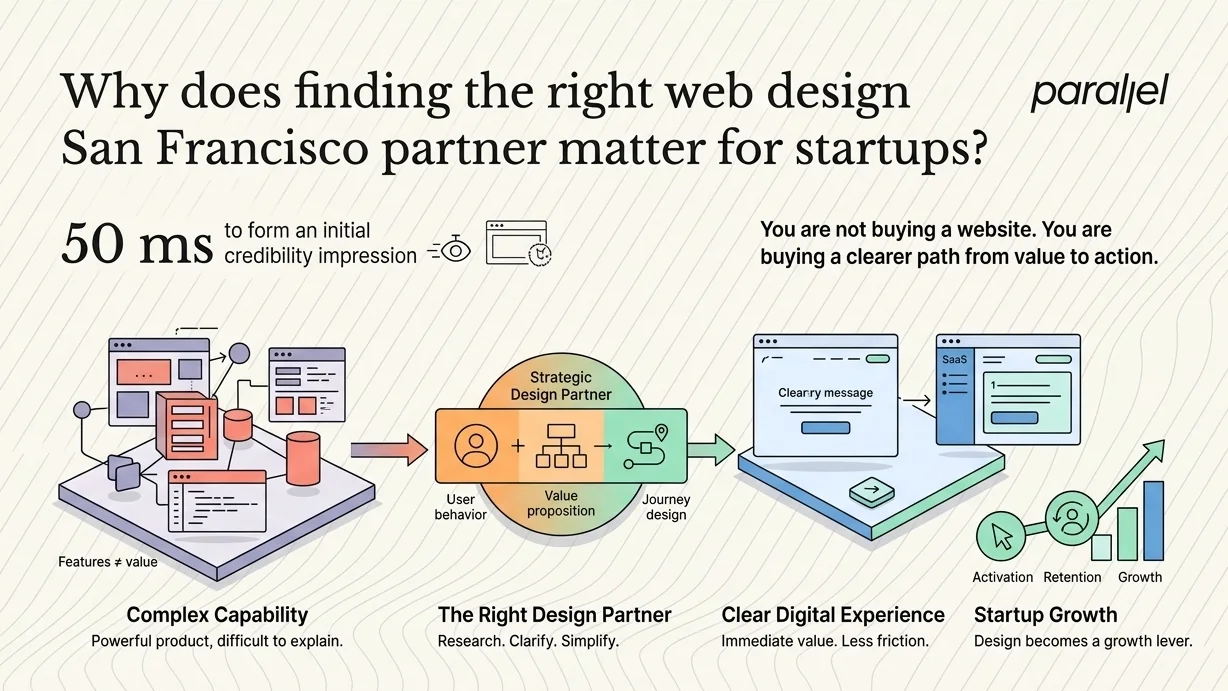
Design is no longer just about looking professional. It is a core lever for user activation and retention. We consistently see that the most successful products are grounded in real user behavior. When you choose an agency, you are not just buying a website. You are buying a structured way to communicate your value proposition to the market.
In my experience, teams that view design as a pure aesthetic exercise end up with products that fail to convert. Conversely, a 2025 report from McKinsey indicates that design-led organizations increase their revenues at nearly twice the rate of their industry peers. You need a partner who understands the underlying psychology of your users. They must be able to translate complex technical capabilities into simple, actionable user journeys.
Where do teams go wrong when choosing web design San Francisco services?
Most product decisions go wrong long before a single pixel is placed on a screen. Founders often fall in love with trendy visual styles while ignoring the structural integrity of their product. They hire based on shiny Dribbble portfolios instead of proven problem-solving abilities. This leads to what we call the "dribbblisation" of design, where the interface looks great but the actual user experience is entirely broken.
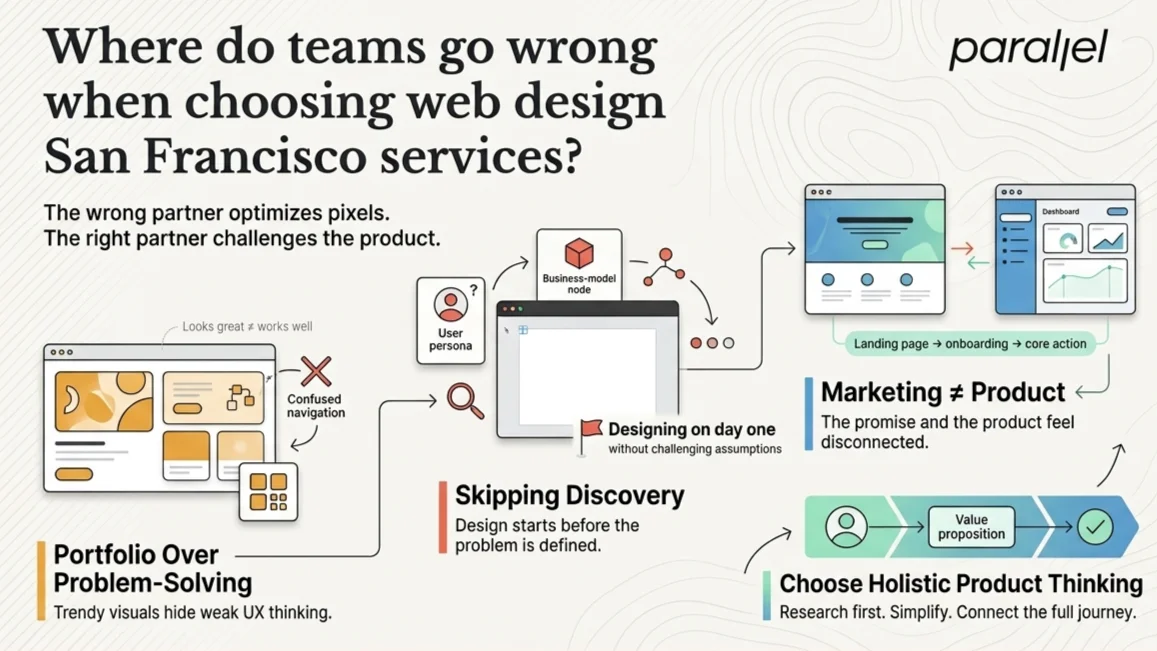
Another major pitfall is skipping the discovery framework. We have seen teams overcomplicate onboarding because they never took the time to define their core user persona. They try to build a product that serves everyone and end up serving no one. A good design partner will force you to answer hard questions about your business model before they open Figma. If an agency agrees to start designing on day one without challenging your assumptions, that is a massive red flag.
Finally, teams fail when they separate marketing from the actual product experience. Your website and your application must feel like one continuous journey. If a user clicks a promise on your landing page and finds a completely different reality inside your SaaS onboarding, they will churn. You need a partner who thinks holistically about the entire lifecycle.
How should you evaluate web design San Francisco providers effectively?
You should evaluate design partners based on how they think, not just what they produce. Ask them to walk you through a project that completely failed and what they learned from it. An experienced agency will be highly transparent about the messy realities of product development. Look for teams that prioritize usability testing early and often. Real validation comes from watching actual users try to navigate a prototype.
Here is a simple framework to help you separate the strategic partners from the mere pixel-pushers.
Always ask how they measure success. If their definition of success is delivering the files on time, they are not the right fit for an early-stage startup. Their definition of success should align with your business goals. Look for concrete improvements in conversion rates, reduced support tickets, or higher task completion rates.
What are the top 10 web design San Francisco agencies in 2026?
We have evaluated the landscape of design partners available to startups today. This list focuses on agencies that have a footprint or significant influence in the Bay Area, prioritizing those that offer strategic value over pure execution.
1) ParallelHQ
At ParallelHQ, we built our practice because we saw startups struggling with bloated, confusing product experiences. We are a product design and strategy partner focused entirely on clarity in thinking. We do not just build websites. We help founders and product managers unblock complex design decisions.
Our approach is deeply rooted in real user behavior and iterative testing. We work as an extension of your team to ensure that every design choice is grounded in evidence. Whether you need a complete website redesign or a foundational design system, we focus on what actually moves the needle for your business.
- Focus: Product strategy, UX clarity, and rapid alignment.
- Best for: Early-stage startups, SaaS platforms, and product-led teams.
- Core offering: Design sprints and deep UX problem solving.
2) Clay
Clay is renowned for its high-end visual execution and brand-led web experiences. They have built a reputation in San Francisco for pushing the boundaries of what is visually possible on the web. Their work often incorporates heavy 3D elements, complex animations, and striking typography.
- Focus: Brand identity and premium visual design.
- Best for: Well-funded tech companies needing a major aesthetic statement.
- Consideration: If you need deep product logic and user workflow optimization, you might want to compare options. Read our guide on finding a Clay alternative.
3) Ramotion
Ramotion focuses on bridging the gap between brand identity and product UI. They are highly active in the tech ecosystem and work frequently with growing startups in the B2B space. They excel at creating cohesive visual languages that span from the marketing site into the application dashboard.
- Focus: Tech branding and UI/UX design.
- Best for: Fintech and B2B tech companies seeking visual consistency.
- Consideration: Their process is highly structured around brand perception. If your primary issue is complex onboarding logic, explore a Ramotion alternative.
4) Work & Co
Work & Co is a massive player in the digital product space. They are known for rapid prototyping and working closely with in-house engineering teams to ship functional products. Their approach is highly pragmatic and focused on execution at an enterprise scale.
- Focus: Digital product development and large-scale ecosystems.
- Best for: Enterprise companies and late-stage startups with massive user bases.
- Consideration: Their engagements are typically large and resource-intensive. Startups looking for lean, agile strategy might consider a Work & Co alternative.
5) Huge
Huge operates on a global scale but maintains a strong presence in the tech hub. They blend data-driven marketing with product design to create unified brand experiences. They are often the go-to agency for legacy brands attempting digital transformation.
- Focus: Experience design and global marketing campaigns.
- Best for: Fortune 500 companies and massive consumer brands.
- Consideration: The overhead of working with a massive agency can slow down early-stage teams. Compare them with a Huge alternative for faster iteration.
6) R/GA
R/GA is built on a legacy of disruption and innovation. They excel at the intersection of technology, storytelling, and culture. When a brand needs to create a completely new category or launch a highly experimental digital campaign, R/GA is a common choice.
- Focus: Innovation consulting and creative campaigns.
- Best for: Brands looking to make a cultural impact through technology.
- Consideration: Their focus leans heavily toward marketing and advertising rather than core SaaS product utility. You can read our thoughts on choosing an R/GA alternative.
7) Instrument
Instrument is a digital agency that excels at brand storytelling. They build immersive, narrative-driven websites that communicate complex corporate visions effectively. Their work is characterized by high production value and seamless content integration.
- Focus: Brand experience and digital storytelling.
- Best for: Visionary tech brands needing a compelling corporate narrative.
- Consideration: If your focus is purely on increasing software activation rates, you might want an Instrument alternative that specializes in product UX.
8) Method
Method approaches design from a strategic, systemic perspective. They look at the entire service ecosystem, aligning customer experience with underlying business goals. Their strength lies in simplifying complex omnichannel journeys.
- Focus: Strategic design and service architecture.
- Best for: Companies with complex physical and digital touchpoints.
- Consideration: Their service design approach is highly academic. Fast-moving software teams might benefit from looking at a Method alternative.
9) Neuron
Neuron focuses specifically on the unglamorous but critical world of B2B and enterprise UX. They specialize in taking dense, data-heavy workflows and turning them into functional, usable interfaces. They are highly practical and focused on workplace productivity tools.
- Focus: B2B SaaS and complex data visualization.
- Best for: Enterprise software tools and internal dashboards.
- Consideration: While their UX logic is sound, teams looking for a bold, category-defining brand identity might explore a Neuron alternative.
10) Code and Theory
Code and Theory is known for building scalable content architectures for media companies and digital-first brands. They excel at systemic digital design, ensuring that massive amounts of content can be navigated easily by users.
- Focus: Digital ecosystems and publishing platforms.
- Best for: Media networks, publishers, and content-heavy brands.
- Consideration: Their expertise is deeply rooted in content delivery. For highly interactive web applications, you may want to review a Code and Theory alternative.
This marks the end of our list of top web design San Francisco partners.
Conclusion
Choosing an agency is ultimately about finding a team that matches your working style and respects your business constraints. I always advise founders to start small. Do not sign a massive six-month contract before you have seen how the agency thinks. Ask them to run a design sprint or a focused discovery workshop first.
Watch how they handle disagreement during these initial engagements. A great partner will push back when you suggest a feature that does not serve the user. They will bring data to the table instead of just opinions. They will help you define what a successful minimum viable product looks like, and they will fight to keep it simple. If you find a team that operates with this level of clarity, you have found the right partner.
Frequently asked questions
1) What is the average budget for a web design San Francisco project?
The cost of an agency engagement in this region varies wildly based on the scope and the agency's prestige. For early-stage startups, a solid product strategy and website overhaul typically ranges from $40,000 to $100,000. Enterprise-level engagements with massive global agencies can easily exceed $500,000. It is crucial to define your budget early so agencies can tailor their approach to your reality.
2) How long does a standard website redesign take?
In our experience, a highly focused website redesign should take between 6 to 10 weeks. This includes research, strategy, wireframing, high-fidelity design, and usability testing. Projects that drag on for six months usually suffer from scope creep or a lack of clear decision-making from stakeholders. Speed to market is critical for startups.
3) What is the difference between a UI/UX agency and a branding agency?
A branding agency focuses on your identity, voice, logo, and emotional resonance in the market. A UI/UX agency focuses on how users actually interact with your product to achieve their goals. While there is overlap, you should hire a product design partner if your main problem is user churn, and a branding agency if your main problem is market perception.
4) Should an early-stage startup hire an agency or an in-house designer?
This depends entirely on your current stage and leadership bandwidth. Hiring in-house gives you dedicated execution, but junior designers often lack the strategic experience to push back on bad ideas. Hiring an agency gives you access to a senior, cross-functional team that can establish your foundational design systems quickly. Many startups use an agency to build the foundation, then hire in-house to maintain it.
5) How do we measure the success of a newly designed website?
You must tie design outcomes directly to business metrics. Do not just measure page views or time on site. Track your core conversion rate, the drop-off rate in your ecommerce UX design funnel, and the activation rate of new sign-ups. A successful redesign should measurably lower customer acquisition costs and reduce the burden on your support team.
6) What role does user research play in the design process?
Research is the foundation of any successful product decision. Without user research, you are simply guessing at what your customers want based on internal bias. We require teams to speak with real users to map their actual pain points before writing any code or designing any interfaces. This mitigates the risk of building features nobody uses.
7) Is it better to use Webflow or custom development for a marketing site?
For the vast majority of startups today, modern visual development platforms like Webflow are the smartest choice. Webflow design development services allow marketing teams to iterate quickly without bottlenecking core engineering resources. Custom development should be reserved for complex web applications where proprietary logic is required.
8) How does ParallelHQ differ from traditional design agencies?
Traditional agencies often focus on delivering beautiful assets and leaving the implementation to you. At ParallelHQ, we focus on unblocking your team through clear product strategy. We do not do fluff or hype. We apply rigorous opportunity mapping to ensure every design decision is grounded in real user behavior and business viability. We act as a strategic partner to help you build a product that actually works.

check out these related blogs