We see early-stage teams make the same mistake every single week. They start looking for a design partner, open a link to previous work, and get completely blinded by beautiful visuals. I built ParallelHQ because I realised this surface-level approach to hiring is fundamentally broken. When you do not know how to evaluate a design agency portfolio, you risk bringing on a team that makes things look good but fails to solve your core product problems. Real design is about clarity and business outcomes, not just aesthetics. In this guide, I will show you exactly what to look for when reviewing past work.
Quick Answer/TL;DR
Look past the visuals. A strong portfolio demonstrates clear problem framing, real business constraints, iterative user testing, and measurable outcomes. The work must show how the team thinks, makes decisions, and solves user friction.
Why is knowing how to evaluate a design agency portfolio so critical for startups?
The cost of getting product design wrong in the early stages is massive. Founders often hire agencies based on flashy case studies, only to realise months later that their engineering team cannot build the final product. The resulting designs might look great in a presentation but fall apart when actual users try to navigate them. You end up wasting time, burning capital, and losing your competitive edge.
A recent 2025 Nielsen Norman Group report on UX maturity shows that 72% of surface-level design projects fail to move any meaningful business metrics. This happens because the agency focused on the interface layer without understanding the underlying user psychology. When you look at an agency's past work, you are looking for evidence that they dig deep. You want to see how they map out complex systems before they ever open a design tool.
We have seen this play out time and again with teams building complex platforms. If an agency only shows you high-fidelity screens, they are hiding the messy reality of product development. Product building is chaotic. It requires balancing tight deadlines, technical debt, and shifting user expectations. A trustworthy portfolio highlights these exact struggles and explains how the agency navigated them.
When we partnered with the government on Digilocker, we did not just present pretty screens. We showcased how we handled the constraints of designing for millions of Indian citizens with varying digital literacy levels. We documented our product strategy consulting process, our mapping exercises, and our failures along the way. That level of transparency is what you must demand from any potential design partner.
What should you look for when figuring out a design agency portfolio?
Evaluating past work requires a structured framework. You cannot rely on your gut feeling or your preference for a specific colour palette. You need to assess the agency's ability to think critically about business objectives. I advise founders to break their evaluation into three distinct pillars.
The three pillars are context, process, and outcomes. If a case study lacks any of these three elements, you should consider it a major red flag. You must understand how to evaluate a design agency portfolio by looking closely at how they define the initial problem before they showcase the final solution.
1) The context of the problem
Every good case study must start with a clearly defined problem. The agency should explain the business goal, the target audience, and the constraints they faced. Did the startup have a tight timeline? Was there a strict technical limitation?
If the portfolio just says "We redesigned the app to make it modern", walk away. That is a meaningless statement. Instead, look for problem statements like "The client faced a 40% drop-off during the KYC process due to cognitive overload". This shows the agency understands UX audit principles and ties their work to real metrics.
2) The messiness of the process
Design is never a straight line. A portfolio that goes directly from a brief to a polished interface is hiding the actual work. You want to see wireframes, messy whiteboard sessions, and early prototypes. You need to see how they conduct user research and how those insights influenced their decisions.
Ask yourself if they document their mistakes. Do they show a concept that failed during usability testing and explain how they pivoted? A mature agency is confident enough to show their wrong turns. They know that uncovering what does not work is a crucial part of delivering what does.
3) The clarity of the solution
Finally, look at the output. Does the final design directly solve the problem stated at the beginning? The visual hierarchy should guide the user effortlessly. The copy should be clear and concise.
This is where you evaluate their craft. Look at their design systems and component structures. Are the designs scalable? Can an engineering team easily pick this up and build it? The solution must be practical, accessible, and grounded in standard interaction patterns.
Green Flags vs Red Flags
How to evaluate a design agency portfolio based on real user outcomes?
A portfolio is essentially a marketing tool for the agency. Your job is to cut through the marketing language and find the empirical evidence. Anyone can claim they created a great user experience. Very few can actually prove it with hard data.
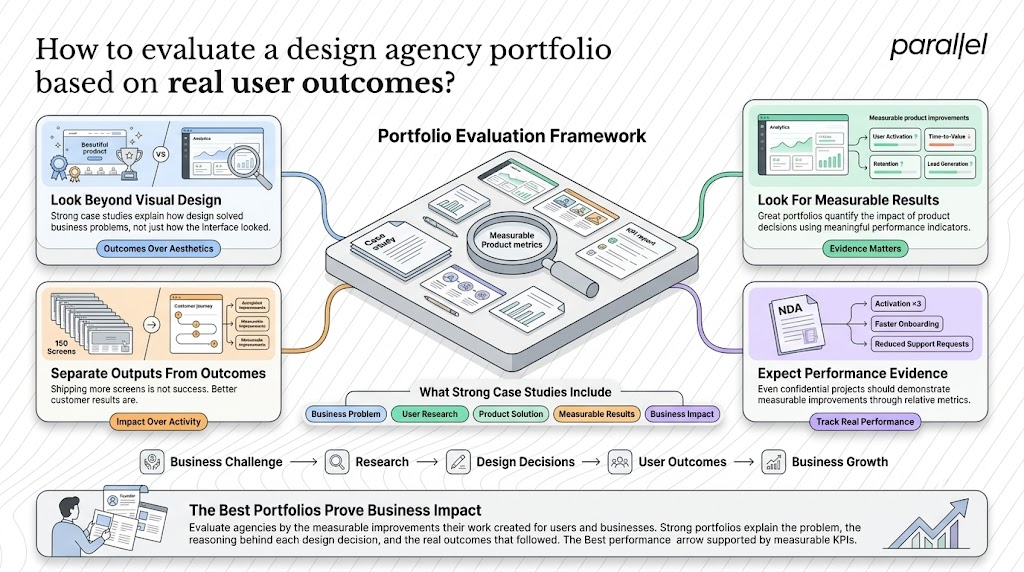
According to a 2026 Forrester study on design ROI, portfolios that showcase problem-centric design and real outcomes represent agencies that deliver up to 100x return on investment. Conversely, agencies selling purely aesthetic changes average a mere 1.2x return. You are hiring a partner to grow your business, so their past work must reflect a track record of growth.
Look for specific, numerical outcomes. Did their B2B CRO suggestions actually increase lead generation? Did their onboarding redesign reduce time-to-value for new users? If an agency claims they improved retention, they need to state by what percentage and over what time frame.
Be highly sceptical of vanity metrics. "We delivered 150 screens in two weeks" is a metric of output, not an outcome. An outcome looks like "We reduced the checkout completion time by 45 seconds, resulting in a 12% lift in weekly revenue". That is the kind of rigorous thinking we apply to our SaaS design services at ParallelHQ. We measure our success by the impact our work has on your bottom line.
If the client is under an NDA and the agency cannot share exact revenue numbers, they should still share relative metrics. They can say "activation increased by 3x" without revealing the base numbers. The key is that they are tracking the data and taking responsibility for the performance of their designs in the real world.
Where do teams go wrong when evaluating a design agency portfolio?
In my experience, founders make very predictable mistakes when vetting design partners. They let their own biases cloud their judgement. They look for agencies that have built exactly what they are trying to build, rather than agencies that know how to solve complex problems.
The most common trap is falling for the "Dribbble-style" portfolio. These are case studies filled with floating isometric screens, unrealistic data visualisations, and zero context. They look incredible, but they are entirely fictional. They do not account for long names breaking the layout, slow loading times, or empty states. When you hire an agency based on these fantasy designs, your UI/UX design services engagement will end in frustration.
Another major mistake is ignoring the engineering handoff. A design is useless if it cannot be built efficiently. When reviewing a portfolio, look for evidence of how the agency collaborates with developers. Do they mention creating technical specifications? Do they showcase the creation of a comprehensive component library? If a portfolio focuses entirely on the discovery phase and ignores the delivery phase, you will likely face massive development delays down the line.
Founders also tend to overvalue domain expertise while undervaluing methodological expertise. Just because an agency designed three fintech apps does not mean they are the best fit for your fintech startup. They might just apply the exact same templates they used before. You want a partner who applies a rigorous discovery framework to uncover your unique market advantages. Focus on how they learn, not just what they already know.
How to evaluate a design agency portfolio for complex SaaS and AI products?
Designing for a simple consumer e-commerce site is very different from designing for a dense enterprise software tool. If you are building a B2B SaaS platform or an AI-native product, your evaluation criteria must change. These products deal with high cognitive load, complex permissions, and vast amounts of data.
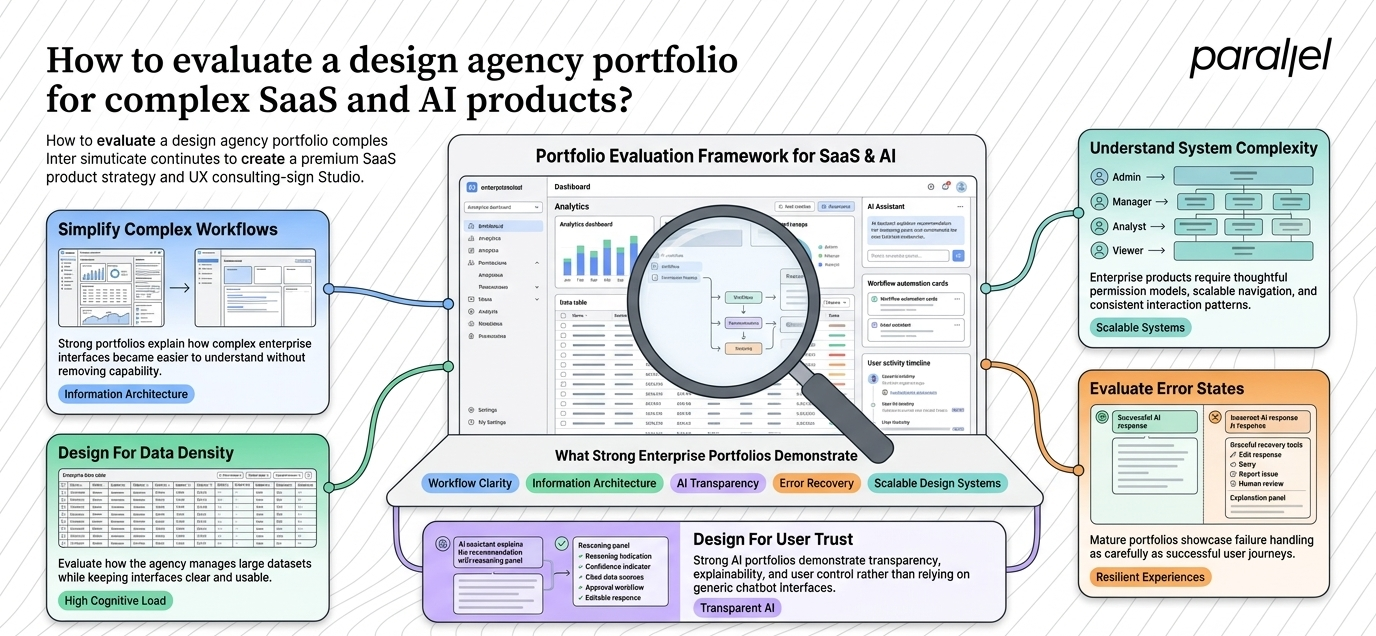
A 2025 McKinsey Design Index update demonstrated that companies evaluating agencies based on their ability to simplify complex workflows outperform industry benchmarks by 32%. You cannot afford an agency that just skins your existing features. You need a team that understands information architecture and system design.
When reviewing past work for complex tools, look for extreme clarity in navigation. How does the agency handle deep nested menus? How do they design data tables with fifty columns? A strong portfolio will break down these specific UI challenges. They will explain how they reduced screen clutter and helped users focus on their primary tasks.
For AI products, the criteria get even stricter. AI interfaces require immense user trust. You need to look for past work that handles AI latency, explains model reasoning, and provides clear feedback loops for the user. Our approach to AI UX design focuses heavily on transparency. If an agency's portfolio just shows a generic chat interface with some sparkle emojis, they do not understand the true complexity of building AI products.
They must demonstrate how they handle edge cases. What happens when the AI returns a hallucination? How does the user correct the system? A mature portfolio will highlight these error states just as proudly as the happy paths. They know that designing for failure is what makes a software product truly resilient.
Conclusion
Mastering how to evaluate a design agency portfolio takes time, but it is one of the highest leverage skills a founder can develop. The portfolio is your window into the agency's brain. It tells you whether they care about making art or if they care about solving business problems.
Always look past the visual polish. Demand to see the messiness of their process, the realities of their constraints, and the hard numbers behind their outcomes. A great design partner will not just execute your vision. They will challenge your assumptions, simplify your product, and help you build something that actually resonates with your users. Let the quality of their thinking guide your decision.
FAQs
1) What is a design agency portfolio?
A design agency portfolio is a curated collection of past client projects. It serves as a track record of the agency's capabilities. A good portfolio details the problem, the design process, and the final business outcomes of each project.
2) How many case studies should a good portfolio have?
Quality always beats quantity. A strong portfolio only needs three to five deep, well-documented case studies. If an agency has fifty case studies but they only consist of a few screens and no context, that is a warning sign.
3) What is the difference between a UI portfolio and a product design portfolio?
A UI portfolio focuses entirely on aesthetics, typography, and visual polish. A product design portfolio focuses on user psychology, business constraints, data analysis, and workflow simplification. Startups need product design, not just UI.
4) How do I know if the portfolio metrics are real?
You have to ask detailed questions during the interview. Ask them exactly how they measured the metric, what baseline they used, and how long the test ran. If they stumble or give vague answers, the numbers might be inflated.
5) Should the agency have experience in my specific industry?
Industry experience is helpful but not strictly required. It is much more important that the agency has experience solving the specific type of problem you have. Methodological expertise usually trumps domain expertise.
6) How long does it take to review a design portfolio properly?
You should spend at least fifteen to twenty minutes on a single, detailed case study. Do not just skim the images. Read the copy, understand their problem-framing, and critically evaluate the logic behind their design decisions.
7) Is a Behance or Dribbble link enough to judge an agency?
No, never. Behance and Dribbble are platforms for visual inspiration, not for demonstrating product strategy. Work posted there often lacks real-world constraints, technical limitations, and user feedback. Always ask for full case studies.
8) How does ParallelHQ present its product design case studies?
At ParallelHQ, we focus entirely on the story of the problem. We show our design sprints, our research findings, and our iterations. We highlight the friction we discovered and exactly how our strategic design choices moved the needle for our clients.

check out these related blogs


































.webp)

































.avif)