I have seen countless founders waste months searching for a design partner. They look at flashy portfolios and trendy mockups, forgetting that a pretty interface cannot fix a flawed product strategy. If you are building a product in Colorado, you need clarity over aesthetics. Choosing the best UI UX design agencies in Denver requires looking past the surface. You need a team that understands user behavior, complex onboarding, and product activation. Here is how we think about finding a partner who actually solves business problems, along with the top ten options for 2026.
Quick answer / TL;DR
The best UI UX design agencies in Denver prioritize product strategy and user research over purely visual trends. They align design decisions with business goals like activation and retention. Here is a breakdown of the top ten partners.
Why do startups struggle to find the best UI UX design agencies in Denver?
We have seen teams overcomplicate the search for a design partner. Founders often look for agencies that create beautiful screens. This is a mistake. Beautiful screens do not guarantee user retention. The fundamental issue is that many startups do not actually have a design problem. They have a product thinking problem.
When you hire a purely visual agency, you get surface-level fixes. They might update your typography or modernize your color palette. However, they will not question why your core user journey is twenty steps long. They will not ask why users drop off immediately after signing up. This lack of strategic pushback leads to wasted budgets and missed targets.
A 2026 study by the Nielsen Norman Group revealed that 68% of product redesigns fail to improve long-term retention. The primary reason is that these redesigns ignore foundational usability issues. They focus on how the product looks rather than how it works.
In my experience, founders in rapidly growing tech hubs often feel pressured to ship quickly. They want a partner who will just execute their vision without asking hard questions. This approach usually backfires. You end up with a product that looks modern but feels fundamentally broken to the end user. You need a partner who will challenge your assumptions.
What should you look for when evaluating the best UI UX design agencies in Denver?
You must evaluate design partners based on how they think, not just what they draw. When a team lacks clarity in their product thinking, the resulting user experience is always weak. I advise founders to look for three specific capabilities during the evaluation process.
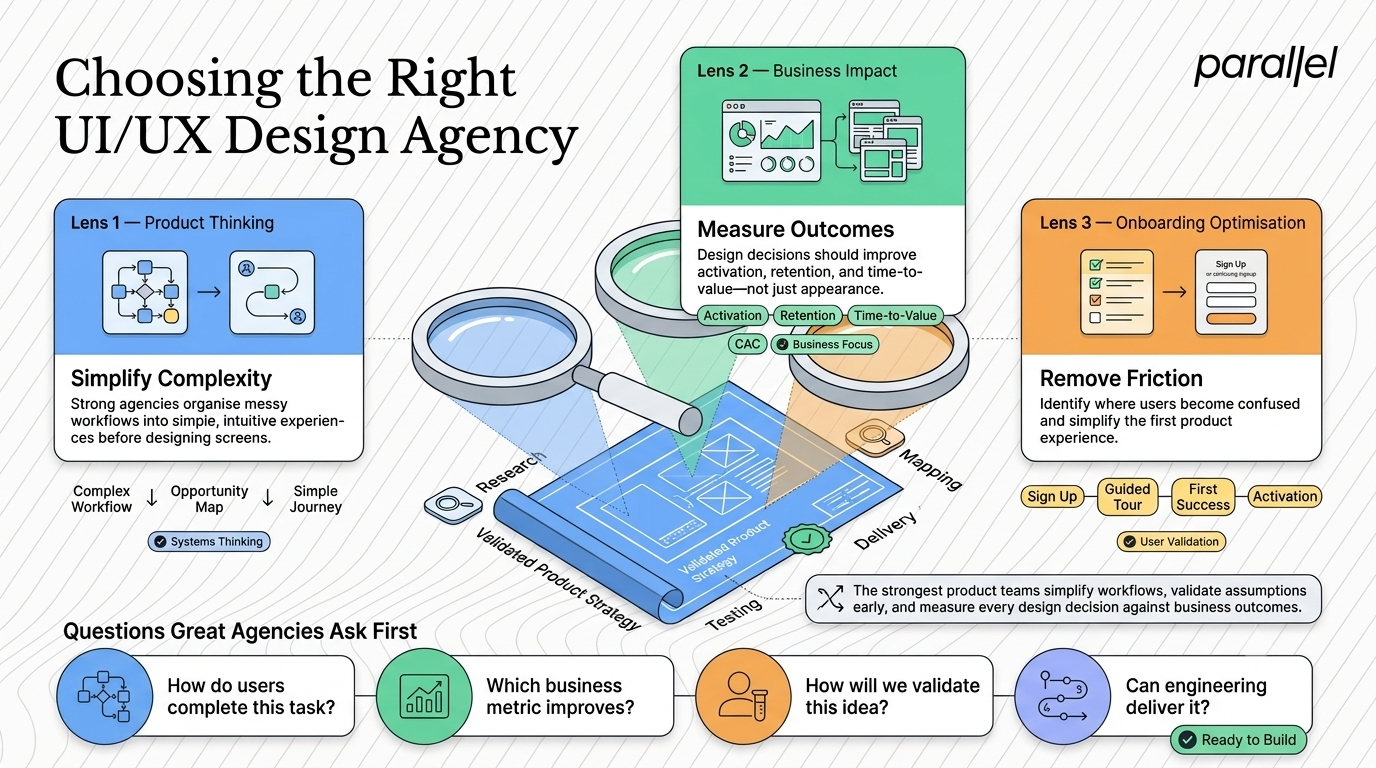
First, look for a proven ability to map complex systems. Your agency should be able to take a messy, convoluted workflow and break it down into simple, logical steps. Ask them how they approach opportunity mapping. If their answer jumps straight to wireframes, they are skipping the most critical phase of product development.
Second, demand a focus on business metrics. A mature design partner knows that their work must move the needle. They should ask about your activation rates, your time-to-value, and your customer acquisition costs. They should understand how to use usability testing to validate decisions before writing a single line of code.
Third, look for a grounded approach to onboarding. Weak onboarding is where most SaaS products fail. Users sign up, get confused, and leave. Your ideal partner should have a systematic way of identifying friction points. We frequently run SaaS onboarding teardowns for this exact reason. We want to see where real users get stuck and abandon the product.
Who are the 10 best UI UX design agencies in Denver for 2026?
Finding the right fit depends heavily on your specific stage and core challenges. I have compiled this list based on industry reputation, client outcomes, and the depth of product thinking each team brings to the table.
1) ParallelHQ
We built ParallelHQ because we saw teams struggle with design decisions that should have been simpler. We are a product design and strategy partner focused on clarity in thinking. We do not just paint screens. We help founders and product leaders figure out exactly what to build and why.
Our approach is deeply rooted in real user behavior. We specialize in early-stage startups and complex SaaS platforms where onboarding and activation are critical. We use rigorous product strategy consulting to align your business goals with the user experience. If you are struggling with low activation rates or a convoluted product architecture, our team steps in to untangle the mess.
We serve companies globally and have a strong footprint helping clients optimize their UI UX design services in Denver. We are the right fit if you want a partner who will challenge your assumptions and ground every decision in reality.
2) Viget
Viget is a well-established player that bridges the gap between hardware and software. They have a strong reputation for deep engineering capabilities paired with thoughtful design. They are not just focused on digital screens. They often work on connected devices and complex systemic challenges.
They excel when a project requires heavy technical integration from day one. If you are building a product that relies on custom hardware sensors and needs a companion app, Viget is a strong contender. They bring a highly structured approach to product development.
3) Tack Mobile
Tack Mobile has deep roots in the Colorado tech scene. As their name suggests, they built their reputation on mobile applications. However, they have evolved into a premier agency for IoT and connected home experiences.
If your startup is building a smart device or requires a flawless mobile-first experience, Tack Mobile understands the nuances of iOS and Android ecosystems perfectly. They know how to handle bluetooth connectivity issues and mobile edge cases gracefully. They are less focused on dense B2B enterprise software and more tailored to consumer-facing mobile products.
4) Method
Method is a global strategic design firm with a significant presence. They focus heavily on digital transformation for large enterprises. They are excellent at taking massive, legacy corporations and helping them think like agile tech companies.
They bring large, multi-disciplinary teams to solve systemic brand and product problems. This makes them incredibly effective for Fortune 500 companies. However, for an early-stage startup, their process can sometimes feel heavy. If you are a smaller team evaluating them, you might want to consider a leaner Method alternative that moves at the speed of a startup.
5) Blink UX
Blink UX is an evidence-driven design agency. They lead with research. Their process relies heavily on generative and evaluative user research to inform every single design decision. They build extensive research labs to observe user behavior in highly controlled environments.
They are the right choice if your product is heavily data-driven or if you are entering an entirely new market category where user behavior is unknown. Their dedication to research ensures that the final product is deeply aligned with user expectations. They are less about rapid, iterative MVP launches and more about getting the foundational research perfect.
6) thoughtbot
thoughtbot is legendary in the Ruby on Rails and startup communities. They are a design and development consultancy that practically wrote the book on agile product launches. They focus on rapid prototyping and getting products to market quickly.
They are ideal for early-stage founders who need to build an MVP from scratch. They integrate design and development tightly, ensuring that what gets designed actually gets built efficiently. We respect their lean approach and their commitment to open-source tools.
7) AppIt Ventures
AppIt Ventures is a Denver-based custom software development company with a strong UX practice. They focus heavily on building scalable applications for local businesses and mid-market companies.
They are highly pragmatic. They focus on delivering working software that solves immediate business needs. If you have a highly specific internal tool or a custom database application that needs a modern interface, AppIt is a reliable local choice. They focus less on broad brand strategy and more on technical execution.
8) Neuron
Neuron focuses almost exclusively on B2B software and enterprise applications. They have a knack for taking incredibly dense, data-heavy dashboards and making them usable. They understand the specific challenges of designing for expert users in niche industries.
They are a great fit if you are building architectural software, medical tech, or complex logistics platforms. Their focus is narrow and highly effective. If you are looking for a team with a slightly broader strategic lens across both SaaS and consumer, you might explore a Neuron alternative.
9) Kin + Carta
Kin + Carta acquired Spire Digital, a long-standing Denver agency. They are a massive digital transformation consultancy. They handle everything from cloud modernization to enterprise UX design.
They are best suited for enterprise clients dealing with massive amounts of technical debt. If you are a legacy company trying to move your infrastructure to the cloud while simultaneously redesigning your customer portals, they have the scale to handle it. Startups will likely find their engagement models too large and complex.
10) Clay
Clay is a globally recognized digital design agency known for breathtaking visual execution. They create highly polished, award-winning interfaces and marketing sites. They set the standard for modern tech aesthetics.
If your primary goal is to create a massive visual impact to raise funding or reposition a major brand, Clay delivers incredible results. However, their focus skews heavily toward visual design and motion. Teams needing deep, structural product logic might need a Clay alternative that focuses more on architecture and activation.
How can the best UI UX design agencies in Denver improve your product activation?
Activation is the most critical metric for any early-stage product. It measures whether a user successfully experiences the core value of your software. Poor design directly kills activation. If a user cannot figure out how to complete their first task within five minutes, they will close the tab and never return.
We see this pattern constantly. Teams build powerful features but hide them behind complicated navigation menus. They force users through tedious, multi-step signup flows before showing any value. A strong design partner identifies these bottlenecks and ruthlessly eliminates them. We use UX audits to map exact drop-off points in the user journey.
Data backs this up clearly. According to Forrester's 2026 Product Experience Report, reducing cognitive load during the first five minutes of onboarding increases day-seven retention by up to 40%. The best agencies do not just make the onboarding look friendly. They restructure the flow. They delay account creation if possible. They use progressive disclosure to introduce complex features only when the user needs them.
When you simplify the initial experience, users feel smarter. They feel successful. That feeling of success is what drives habit formation and long-term retention. You are not just paying for a cleaner interface. You are paying for higher conversion rates and lower churn.
When is the right time to hire the best UI UX design agencies in Denver?
Timing your engagement with an agency is crucial. Hiring too early can lead to building the wrong thing beautifully. Hiring too late means you have accumulated massive design debt that is expensive to fix.
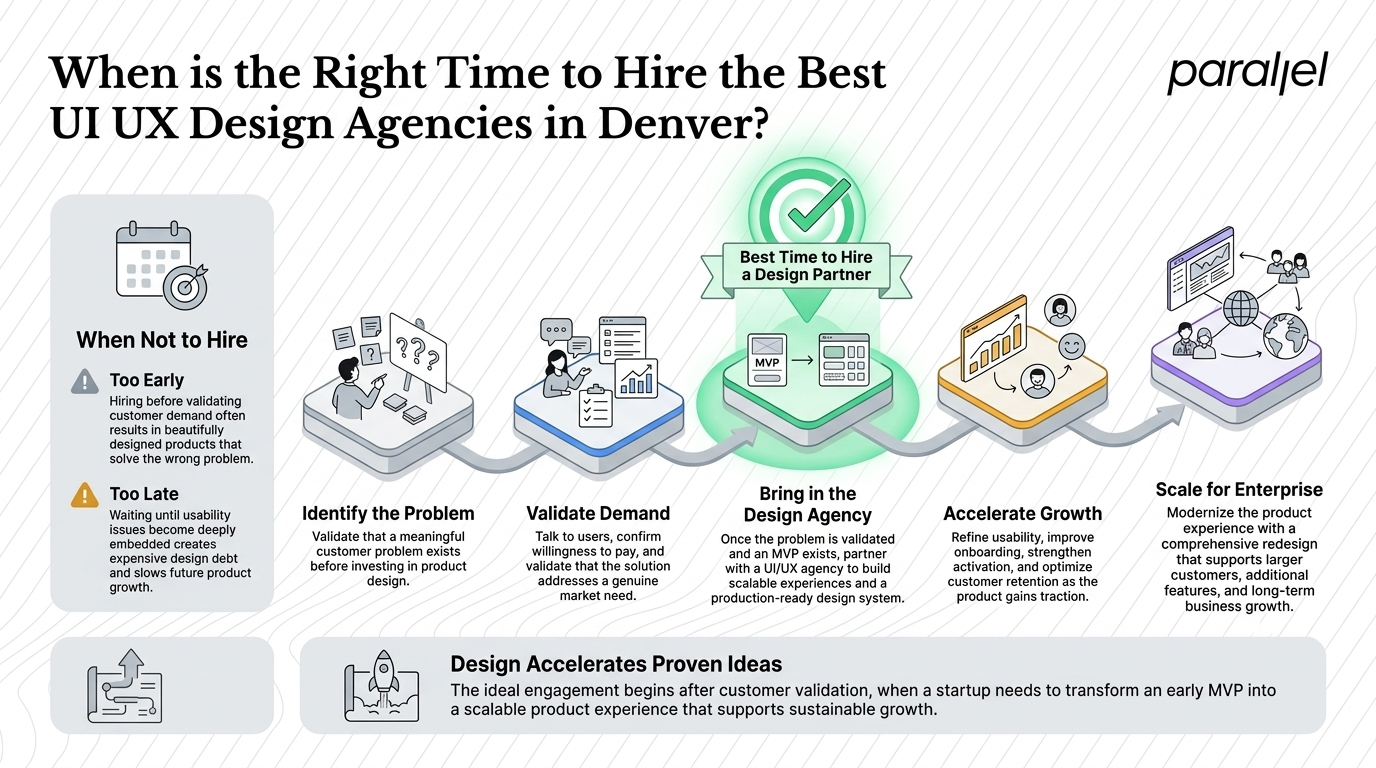
The ideal time to engage a partner is right after you have validated the core problem. You have talked to users. You know they are willing to pay for a solution. You might even have a clunky MVP built with no-code tools. This is the moment to bring in experts. A strategic design team will take your validated assumptions and translate them into a scalable design system.
Do not hire an agency to find your product-market fit. That is the founder's job. Hire an agency to accelerate your growth once you know what direction you are heading. If you have hit a growth plateau because users find your product too hard to use, that is another clear trigger. We often step in when a successful startup needs a comprehensive website redesign or application overhaul to scale to the next level of enterprise clients.
Conclusion
Evaluating design partners is ultimately an exercise in risk mitigation. A poorly designed product is an existential threat to an early-stage startup. You cannot afford to spend six months building a feature only to find out users cannot navigate it.
The right partner provides clarity. They cut through the noise, simplify your product thinking, and ground your decisions in real user data. They stop you from making expensive engineering mistakes. When you view design as a strategic business function rather than a coat of paint, the return on investment becomes undeniable. Focus on finding a team that thinks as rigorously about your business model as they do about your interface.
Frequently asked questions
1) What is UI/UX design in the context of SaaS?
In SaaS, UI (User Interface) is the visual layout, buttons, and typography. UX (User Experience) is the underlying logic, user flows, and psychology of how someone achieves their goals within the software. Good SaaS design requires both to function perfectly.
2) How do we budget for a top agency?
Budgets vary wildly. A focused sprint to solve a specific onboarding problem might cost a fraction of a full platform overhaul. Instead of asking for a flat rate, define your core business problem and ask the agency to scope a phased approach to solve it.
3) UI vs UX: What is the difference?
Think of UX as the blueprint of a house. It defines where the rooms go and how people move through the space. UI is the interior design. It defines the paint colors, the fixtures, and the aesthetic feel. You cannot have a great house without both.
4) Is hiring a local Denver agency right for my remote team?
Location matters less than strategic alignment. While sitting in the same room has benefits, mature agencies run highly effective remote workshops. Focus on finding the best thinkers for your specific industry, regardless of their zip code.
5) How long does a typical UX redesign take?
A complete platform redesign can take three to six months. However, we prefer an iterative approach. We identify the highest-impact areas first, redesign them in shorter sprints, and ship value to users quickly rather than waiting for a massive reveal.
6) What makes ParallelHQ different from other agencies?
We focus on clarity and product thinking above all else. We do not do surface-level visual refreshes. We dig deep into user behavior and business metrics. We challenge founders to simplify their products and focus on what actually drives activation.
7) How do agencies measure design success?
Strategic agencies measure success through business metrics, not design awards. We look at time-to-task completion, user drop-off rates in onboarding, feature adoption percentages, and overall customer retention. Good design must produce measurable business outcomes.
8) Should we hire an agency or build an in-house team?
Early on, an agency provides a breadth of experience and senior talent that is difficult to hire full-time. They help set the foundation and the design system. As you scale post-Series A, you should transition to building an internal team to maintain and grow the product.

check out these related blogs