If you're evaluating Instrument vs ParallelHQ, the decision usually comes down to one question: what stage is your product at? Instrument is a decorated multidisciplinary agency built for enterprise brands with expansive budgets. ParallelHQ is a startup-focused UI/UX design partner built to compress decision cycles, not pad them. This comparison gives you the ground truth on both, without the agency-brochure spin. I'm Robin Dhanwani, founder of ParallelHQ, and I'll be direct about where Instrument wins and where we do.
TL;DR
- Instrument excels at brand storytelling, motion, and large-scale digital ecosystems for enterprise clients like Nike, Google, and ServiceNow.
- ParallelHQ specializes in early-stage AI and SaaS startups, combining product strategy, UX design, and design systems in a single, lean engagement.
- Instrument vs ParallelHQ is less a quality debate and more a stage-fit question.
- If you are pre-seed to Series B and need decisions, not decks, ParallelHQ is the faster, sharper choice.
What Is the Difference Between Instrument and ParallelHQ?
These two agencies operate in the same industry but serve fundamentally different clients. Understanding that distinction upfront saves you weeks of evaluation. Instrument has operated for over 20 years at the intersection of creativity and technology.
Their client roster includes Nike, Google, ŌURA, ServiceNow, EA, Netflix, Spotify, Pinterest, Microsoft, Patagonia, Uber, Marriott, Instagram, Sephora, Sonos, PayPal, Levi's, the NBA, Nordstrom, Stripe, and Salesforce. That list tells you everything about who they are built for: established brands with budget, brand equity to protect, and long engagement timelines.
Instrument combines brand and marketing strategies with software product design, supporting complex projects for major industries. Their tech-led approach supports multifunctional product development. The model is powerful, but it is calibrated for organisations that can sustain it.
ParallelHQ is a different animal entirely. Purpose-built for AI and SaaS founders in the US, ParallelHQ works at the intersection of product strategy, UX design, and design systems, with a process designed for startups that cannot afford 12-week discovery phases. Our product strategy consulting helps founders strip away the noise. We force teams to answer hard questions about user motivation before we draw a single wireframe.
The structural difference: Instrument runs like a full-service creative company across brand, product, and marketing. ParallelHQ runs as a focused product design partner, where every deliverable is scoped to ship faster and reduce churn, not win creative awards.
Instrument vs ParallelHQ: How Design Workflows Compare
Design workflow tells you how an agency thinks before it shows you what it can make. Both Instrument and ParallelHQ run rigorous processes, but the architecture is built for very different contexts. Instrument describes its teams as designers who code, developers who design, and strategists and craftspeople in the same room. Their teams are built to remove handoffs and keep the work connected so ideas don't get watered down from concept to execution.

For large, complex brand ecosystems, this integration is valuable. You get continuity across brand, product, and marketing surfaces in a single engagement. That belief in creative work comes to life through Creative Intelligence, Instrument's approach to building modern brands and experiences. It prioritises clarity over complexity, impact over output, and systems over one-off solutions. The output is designed to endure. The tradeoff is that endurance takes time, and time costs money that early-stage teams rarely have.
At ParallelHQ, the workflow is compressed by design. We do not spend months on discovery. We map opportunities, build prototypes, and test them with users immediately. This is what our discovery framework and design sprints are built for: structured, fast validation without burning runway. Our engineers join design sprints from day one so no handoff friction ever accumulates.
Instrument's work often prioritises storytelling, motion, and brand expression. While the agency delivers strong creative outcomes, projects are typically campaign- or brand-led rather than focused on ongoing product or conversion optimisation. If your priority is activation rate and onboarding flow, that orientation matters.
The practical implication: if your workflow needs to produce a Figma-ready design system your engineering team can build in two weeks, ParallelHQ's model is calibrated for that. If your workflow needs a brand refresh that unifies print, digital, and campaign across 12 markets, Instrument is the more appropriate partner.
Instrument vs ParallelHQ for UX Research Teams
How each agency handles user research reveals whether they treat it as a checkbox or a foundation. Instrument blurs the line between a marketing agency and a product design firm. They are fantastic at digital experiences that require strong storytelling. They work with massive lifestyle and tech brands. Their research process, while thorough, feeds brand strategy as much as it feeds product decisions. That works well when you need to understand market positioning and consumer perception at scale.
ParallelHQ treats user research as the foundation of every product decision, not a standalone deliverable. At ParallelHQ, we often start with an opportunity mapping phase. We want to understand the market gap and user pain points before we draw a single wireframe. The opportunity mapping phase is where the real product thinking happens. It is where we find the features that are costing you users and the flows that are quietly killing activation.
For SaaS and AI products specifically, research needs to answer a different question than it does for consumer brands. You are not asking what people feel about your brand; you are asking why they abandon your onboarding at step three. A 2025 study from Reforge indicates that simplifying early activation flows has a compounding effect on long-term retention. If your users fail to see value in the first three minutes, they will close the application and never return.
Our usability testing and UX audit services are specifically calibrated for this: identifying the exact friction points in your current product and producing a prioritised remediation roadmap, not a 60-page research report that gathers dust. If you run a UX research team inside a SaaS startup and you need a partner who translates findings into shipping decisions, the agency's research orientation matters more than their portfolio size.
Pros and Cons of Instrument Design Studio vs ParallelHQ
No comparison is useful without an honest accounting of weaknesses. Here is where each agency is genuinely strong and genuinely limited.
Instrument: Pros
- Named Design Studio of the Year at the 2026 Campaign US Agency of the Year Awards, recognised for leadership across design, branding, and digital experience.
- Instrument reimagined ŌURA's digital ecosystem, driving a 42% increase in daily sales, while helping ServiceNow evolve its brand to match its rapid growth in AI and enterprise adoption.
- Deep multidisciplinary bench: brand, motion, engineering, and strategy under one roof.
- Proven at operating across complex, multi-market brand systems.
Instrument: Cons
- Pricing is less transparent, retainer engagements may limit smaller teams, and the studio is primarily suited for large-scale projects.
- B2B software companies focused on utility and conversion might prefer an Instrument alternative with more pure SaaS experience.
- Engagement structure is not calibrated for startups iterating week-to-week on product-market fit.
ParallelHQ: Pros
- Ideal client is pre-seed to Series B startups that need clear, effective software without agency bloat.
- Sprint-based model means faster validation cycles, scoped budgets, and engineering-ready outputs.
- Strategy, UX design, and design systems are integrated into the same engagement, not sold as separate workstreams.
ParallelHQ: Cons
- We prioritise functionality and clarity over trendy, experimental aesthetics. If you want a purely artistic, avant-garde interface, we might not be the right fit.
- Not the right choice for large-scale brand campaigns or motion-heavy consumer storytelling.
- We do not operate at Instrument's portfolio scale for global lifestyle brands.
Is Instrument Worth It Compared to ParallelHQ for Startups?
This is the most practical question founders ask me, and the honest answer depends entirely on what you are buying. Instrument suits organisations seeking comprehensive product design services integrated with marketing and brand strategy, especially for mid-size to large projects. If you are a Series C consumer tech brand refreshing your digital presence, Instrument's model delivers real value. The award wins, the named client outcomes, and the creative intelligence framework are all real. For an early-stage SaaS or AI startup, the equation flips.
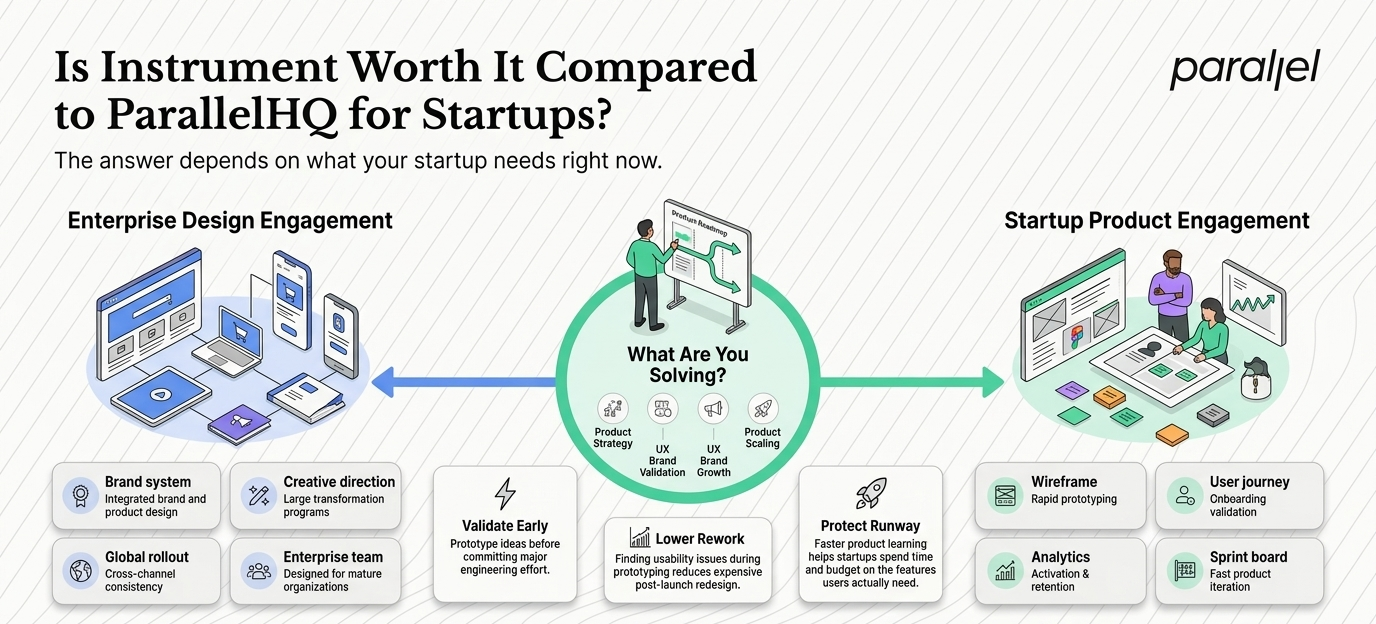
Founders constantly waste funding on bad software interfaces. They hire external teams based on flashy portfolios, only to realise they lack basic strategic thinking. The interface looks pretty, but users drop off immediately. A 2025 McKinsey report on software development shows teams that validate prototypes early reduce their feature failure rate by 55%. That statistic is the entire argument for ParallelHQ's sprint-first model. You do not need a months-long brand discovery. You need to know, within two weeks, whether your core user flow is working.
A 2026 analysis by the Nielsen Norman Group reveals that resolving design issues during prototyping is up to 100 times cheaper than fixing them post-launch. For a startup with 18 months of runway, that cost differential is existential.
Our wireframing and prototyping service exists precisely for this: get answers before you build, not after you've burned $200k on the wrong features. The SaaS onboarding teardown is a faster entry point if you want to validate whether your current product has structural problems before committing to a full engagement.
How Instrument Compares to ParallelHQ for Design Systems and DesignOps
Design system management is where the two agencies diverge most sharply in their orientation. Instrument built a flexible, scalable digital design system for Nike to stand the test of time. That project required a component library, Figma integration across multiple global design teams, design token management, and a governance model for how designers across markets use the system. It is genuinely impressive work at a scale most startups will never need.
The risk for early-stage teams is mistaking enterprise-grade DesignOps for what they actually need right now. A startup building its first coherent design system does not need the same architecture Nike uses. What they need is a lean, developer-ready system that moves fast, adapts to their current tech stack, and does not require a dedicated DesignOps team to maintain.
At ParallelHQ, our design systems work is built around this reality. We focus on component libraries your engineers can implement immediately, design handoff that eliminates the gap between Figma and production code, and design workflow automation that prevents design debt from accumulating as your team scales.
A 2025 report from the Software Engineering Institute indicates that poor handoffs account for 30% of all software bugs in early-stage products. This is the problem a well-scoped design system solves. We run Figma design services that are specifically structured for startup engineering teams: atomic components, responsive design tokens, clear naming conventions, and annotation built for developer handoff.
For teams further along, our AI readiness design scorecard diagnoses whether your current design system is ready for AI feature integration, which is now a live question for almost every SaaS product in 2026.
Best Alternative to Instrument Design Studio for Research Operations
If you have been evaluating Instrument and feel the fit is off, the right alternative depends on why it is off. If the issue is scale: Instrument operates at an enterprise level that many startups cannot absorb. Instrument has transformed from a digital agency to a strategic partner for technology companies. Their evolution toward deeper strategy involvement and longer-term client relationships represents an interesting model shift.
That evolution makes them excellent for established tech companies; it also makes them less accessible for teams still searching for product-market fit. If the issue is orientation: Instrument's work often prioritises storytelling, motion, and brand expression. While the agency delivers strong creative outcomes, projects are typically campaign- or brand-led rather than focused on ongoing product or conversion optimisation. For research operations inside a product team, you need a partner whose primary output is actionable product decisions, not brand assets.
ParallelHQ is the Instrument alternative for founders who need structured research operations integrated with product design. We run user research, usability testing, and UX audits as a unified loop, not separate deliverables. Every research insight maps directly to a product decision. Our product design engagements are built so that findings from week one shape the prototypes in week two.
For AI and SaaS startups running lean product teams, the best alternative to Instrument is not a smaller version of Instrument. It is a partner purpose-built for your stage. Other credible alternatives for specific needs: MetaLab for high-budget consumer apps, Eleken for ongoing SaaS design subscriptions, and Ustwo for gamified consumer experiences. None of them, however, combine product strategy, UX research, and design systems in a single sprint-based engagement the way ParallelHQ does for early-stage teams.
Conclusion
The Instrument vs ParallelHQ decision is a stage-fit decision, not a quality-of-design decision.
- Choose Instrument if you are a mid-to-large brand needing campaign-led creative, brand system governance, or enterprise-grade digital experience work with named brands across every surface.
- Choose ParallelHQ if you are a pre-seed to Series B AI or SaaS startup that needs product strategy, UX clarity, and a design system your engineering team can actually build from.
- The cost of the wrong design partner is not an aesthetic one. It is product-market fit, activation rate, and runway.
- If you are at the decision stage, request a UX audit or an AI readiness scorecard and get a concrete answer in days, not months.
Frequently Asked Questions
1) Is Instrument Design Studio good for early-stage startups?
Instrument is exceptional at enterprise-scale brand and product design, but its retainer model, pricing opacity, and campaign-led orientation make it a poor fit for pre-seed and Series A teams. Early-stage startups need faster validation cycles and leaner scopes than Instrument's model provides.
2) What does ParallelHQ specialise in compared to Instrument?
ParallelHQ specialises in product strategy, UX design, and design systems for early-stage AI and SaaS startups in the US. Unlike Instrument, which covers brand, marketing, and product for large enterprise clients, ParallelHQ focuses entirely on turning complex product logic into clear, buildable interfaces.
3) How does Instrument compare to ParallelHQ for design workflows?
Instrument integrates brand, marketing, and product into one connected team, optimised for complex, multi-surface brand ecosystems. ParallelHQ uses a sprint-based, discovery-first workflow optimised for rapid validation, design handoff, and engineering alignment, without the overhead of a full-service creative company.
4) Which agency is better for SaaS product design?
For SaaS, ParallelHQ is the clearer choice at early stages. The agency's entire methodology is built around SaaS activation, onboarding clarity, and conversion-focused UX. Instrument delivers excellent SaaS work, but its depth and price point are better suited to scaled SaaS organisations like Salesforce or ServiceNow.
5) Does ParallelHQ work with enterprise teams?
Yes. ParallelHQ serves scale-ups and enterprise software teams through services like enterprise software design, design systems, and accessibility audits. The difference is that we bring startup execution speed to enterprise problems, not enterprise process overhead.
6) What is the fastest way to evaluate ParallelHQ vs Instrument for my specific product?
Start with a bounded diagnostic. Request ParallelHQ's SaaS onboarding teardown or UX audit to get a concrete picture of your product's structural issues within days. That deliverable alone will tell you whether your product needs strategic clarity (ParallelHQ) or brand system expansion (Instrument).

check out these related blogs










































.webp)