I have watched early-stage founders waste months and tens of thousands of dollars on websites that look beautiful but completely fail to convert. You are likely searching for web design Raleigh because your current site feels overcomplicated, fails to activate users, or lacks a clear product narrative. Visual polish is not enough to fix a weak foundation. A great website demands rigorous product thinking, clear user journeys, and grounded decision making. Let us look at the top agencies in 2026, where the market is shifting, and how you can make a smarter choice for your business.
Quick Answer/TL;DR
The best agency depends on your growth stage. Most tech teams need strategic product thinking, not just a cosmetic visual refresh. Here is the 2026 comparison of the top 10 options for web design Raleigh to guide your decision.
Why do most web design Raleigh projects fail to convert?
I see this pattern weekly. A startup raises funds, realizes their digital presence looks outdated, and hires an agency to make it look modern. Six months later, the site looks stunning. The team celebrates the launch. Yet, conversion rates have not moved an inch.
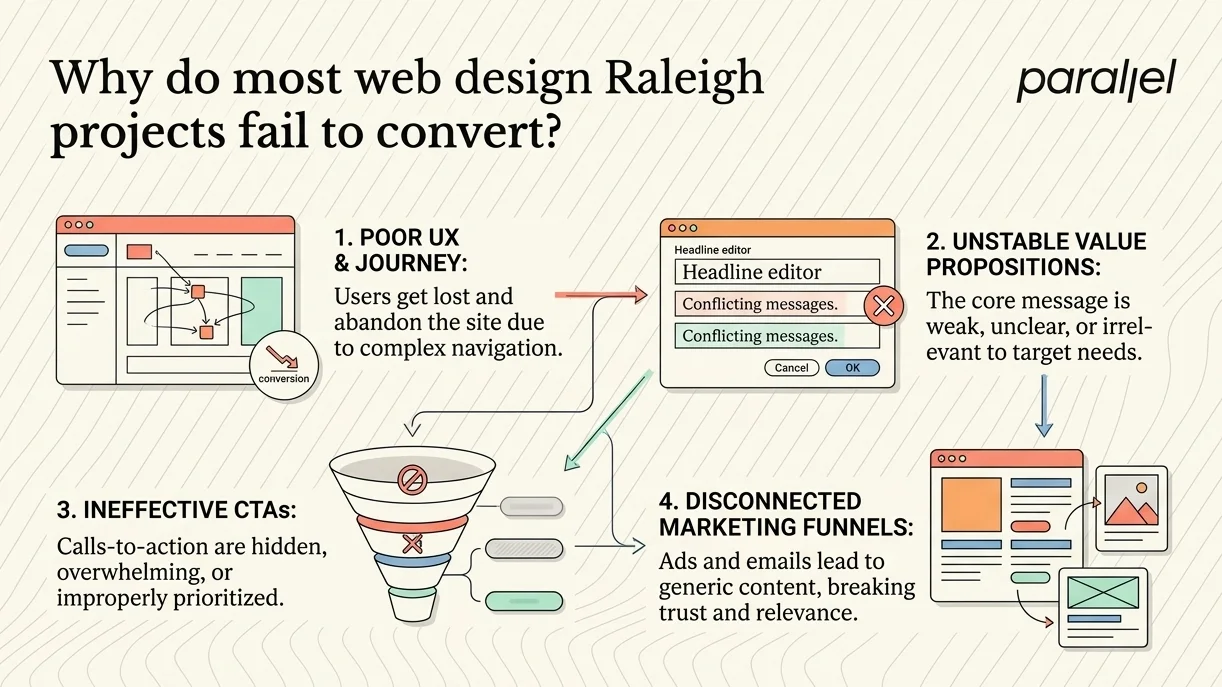
The problem is a fundamental lack of strategy. Teams treat building a website as a cosmetic exercise. It is actually a business systems problem. A website must map directly to user behavior and concrete business goals. If your interface does not solve a specific user problem, it is just decoration.
Consider the financial impact. A 2026 report from Forrester shows that every $1 invested in strategic UX returns up to $100. Furthermore, the Baymard Institute 2026 meta-analysis found that fixing usability issues alone can deliver a massive 35% conversion lift. Visuals do not fix broken onboarding flows. Colors do not explain a complex SaaS product to a busy executive.
The disconnect between marketing and product
Traditional agencies focus on the top of the funnel. Their goal is to get a user to click a button. We look at the entire lifecycle. Getting a user to click "Start Trial" means nothing if they abandon the product three minutes later.
True product thinking connects the marketing site directly to the core application. The transition must be unnoticeable to the user. If your product design feels disconnected from your homepage, you are losing customers at the exact moment they should be activating. The promise made on the landing page must be fulfilled immediately in the product dashboard.
Case study: The cost of abstract design
Last year, an early-stage B2B analytics company approached us. They had just spent heavily on an agency redesign. The new site featured complex 3D animations and abstract background videos. It won a design award. It also caused their free trial signups to drop by 40%.
We ran a UX audit and discovered the root cause quickly. The animations caused cognitive overload. Users could not find the pricing page. The core value proposition was buried under layers of clever marketing copy. We stripped away the animations, simplified the copy to plain English, and rebuilt the navigation. Trial signups rebounded and exceeded their previous baseline within two weeks. Function must dictate form. Always.
Where are teams making mistakes when hiring for web design Raleigh?
Founders often optimize for the wrong variables when selecting an agency partner. They choose based on local proximity or flashy portfolio awards. They look for agencies that create the most visually impressive sales decks. This reliably leads to a few common, expensive failures.
Overcomplicating the user experience
Agencies without deep product experience tend to add unnecessary complexity. They rely on heavy animations, complex graphics, and confusing navigation structures to justify their retainers. This causes immediate cognitive overload for your users. Every extra click, scroll, and hidden menu acts as a micro-barrier between the user and their goal.
Simplicity scales much better than complexity. We constantly advise teams to strip away the noise. If an element does not help the user make a decision or complete a task, it should not exist. We utilize focused opportunity mapping to ensure every page serves a singular, clear purpose.
Ignoring the messaging hierarchy
Your users form an opinion in less than four seconds. If your site does not immediately answer what you do, who you serve, and why it matters, users will leave. You cannot afford to be vague.
Design cannot save bad copy. The interface and the messaging must work together to guide the user. Many agencies treat copy as an afterthought. They design the layouts first and ask clients to fill in "Lorem Ipsum" boxes at the end of the project. This is completely backward. Content dictates design. If your messaging is not locked in, you have no business opening a design file.
Separating design from technical performance
A beautiful mockup is useless if it takes five seconds to load on a mobile device. Performance is a core part of the user experience. You need a partner who understands the technical constraints of building for the modern web.
Google's 2026 Core Web Vitals heavily penalize slow, shifting layouts. If an agency pitches a design that cannot be built to load quickly, they are setting you up for failure. We ensure our website redesign projects are technically sound from the first wireframe. We do not design things that cannot be efficiently built.
Failing to design for accessibility
Accessibility is no longer optional. It is a baseline requirement for a professional digital product. Many visual-first agencies ignore color contrast ratios, keyboard navigation, and screen reader compatibility. This excludes a massive segment of your potential audience and exposes your business to legal risks.
True product designers bake accessibility into the foundation. We run a rigorous accessibility audit on our component libraries before they are ever deployed to production. Good design works for everyone.
How should product teams approach web design Raleigh in 2026?
The landscape of digital product creation has changed rapidly. According to the Nielsen Norman Group 2026 State of UX report, the interface itself is becoming less of a unique differentiator. UI is cheaper to produce today due to standardization and advanced component libraries. What truly matters now is deep problem solving and measurable business impact.
To make better decisions, you must shift your focus entirely from output to outcomes.
Demand outcome-based metrics
Ask potential agencies how they measure success. If their answer is simply "launching on time and on budget," look elsewhere. You want a partner who measures success by activation rates, reduced support tickets, or increased trial signups.
McKinsey's 2026 design index reiterates that design-led companies deliver double the industry average in revenue growth. That growth comes from outcome-based thinking. It does not come from launching pretty pages without a strategic anchor.
Prioritize intense user research
You cannot design a solution if you do not deeply understand the problem. Agencies that skip research are guessing with your money. They are relying on their own biases rather than user realities.
We use intensive user research to validate assumptions early in the process. We talk to your actual customers. We watch them try to use your current site. We identify the exact moments they experience frustration. This data, not our personal opinions, drives the design strategy.
Rely on rapid prototyping
Do not wait three months for a big agency reveal. By the time you see the design, it is too expensive to change. The traditional waterfall design process is dead. You must test concepts quickly and iteratively.
We rely heavily on design sprints to map a problem, build a high-fidelity prototype, and validate it with real users in a matter of days. This methodology prevents teams from wasting vast resources building the wrong thing entirely. It forces alignment and exposes flawed assumptions before a single line of code is written.
Embrace AI-native user behaviors
In 2026, users expect search functionality to act like a conversant assistant. They expect dynamic content curation. If your agency is still building static, dead-end navigation paths, your product will feel obsolete.
We integrate deep product strategy consulting to ensure your website structure can handle AI-driven queries and personalized user flows. The architecture must be flexible enough to adapt to these rapidly shifting user expectations.
What is the true cost of bad usability in web design Raleigh?
Founders rarely calculate the compounding cost of a bad user experience. They view a redesign as a capital expense rather than an operational necessity. This is a dangerous oversight. Design debt accumulates exactly like technical debt.
The silent leak of high-intent traffic
Imagine spending fifty thousand dollars a month on performance marketing. You successfully drive high-intent buyers to your landing page. If that page suffers from confusing navigation or unclear pricing, those users will bounce.
Toptal data confirms that 88% of users will not return after a bad digital experience. You are not just losing a single conversion. You are permanently burning a lead you paid handsomely to acquire. A strategic UX design approach plugs these leaks by mapping the exact friction points and removing them systematically.
Increased support burden
When a website fails to explain a product clearly, users do not always leave immediately. Sometimes they create an account and immediately flood your support queue with basic questions. If your customer success team spends their days explaining how to find the billing settings, your interface has failed.
Good design is proactive customer support. It anticipates user needs and provides clear affordances. We often measure the success of our SaaS design services by looking at the reduction in tier-one support tickets post-launch.
Damage to brand trust
Your website is the digital proxy for your company's competence. If the site is buggy, slow, or difficult to navigate, users will assume your core software is also buggy, slow, and difficult to navigate. Trust is easily lost and incredibly expensive to regain.
A well-architected website signals operational maturity. It tells the user that you understand their problems and have the competence to solve them. You build this trust through rigorous usability testing, ensuring that the experience never breaks under real-world conditions.
Practical steps to evaluate a web design Raleigh agency
When you are ready to evaluate partners, use a structured, objective framework. Do not rely on a gut feeling or an impressive sales deck. You are hiring a strategic partner, not buying a commodity. Here is exactly how to filter the best from the rest.
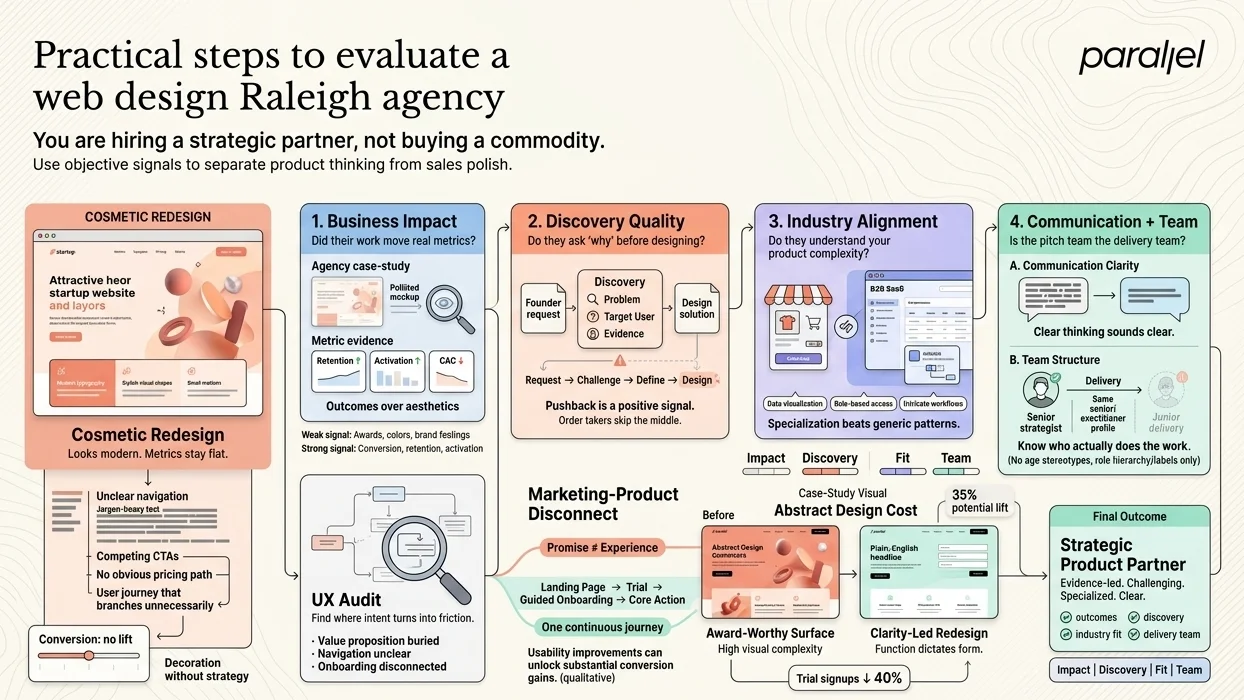
Step 1: The business impact test
Review their case studies carefully. Ignore the high-resolution mockups for a moment. Read the text. Did they improve user retention? Did they lower customer acquisition costs? Did they increase trial activation?
Look for specific numbers. If their case studies only talk about brand feelings, color palettes, and award nominations, they are not equipped to solve complex business problems. You want a team that understands the ROI of UX and speaks the language of business metrics.
Step 2: The discovery test
Ask about their discovery process. A strong partner will actively challenge your assumptions. If an agency agrees to build exactly what you ask for without asking "why," they are simply order takers. You do not need order takers. You need experts.
You need a strategic partner who will push back when necessary. We use a defined discovery framework to align on the core problem and the target user before we ever discuss solutions. If an agency skips this step to start designing faster, walk away.
Step 3: The industry alignment test
A complex B2B SaaS product requires entirely different design patterns than a local e-commerce storefront. The psychology of the buyer is different. The sales cycle is different. The technical constraints are different.
If you are building complex software, look for specialized product designers rather than a generalist marketing agency. Generalists will apply consumer marketing tactics to enterprise software. This always fails. You need a team that understands complex data visualization, advanced role-based permissions, and intricate user flows.
Step 4: The communication and team structure test
Complex digital products require incredibly clear communication. Pay close attention to how the agency explains their decisions during the pitch process. If they use heavy jargon and buzzwords to sound smart, they will likely design confusing, jargon-heavy interfaces. Clarity in speech translates directly to clarity in design.
Furthermore, ask exactly who will be doing the work. Many agencies use senior partners to win the pitch, and then hand the actual execution off to junior designers. Ensure you are getting the strategic horsepower you are paying for.
Conclusion
Building a digital experience that actually drives business value is difficult work. It requires a rare, balanced mix of user empathy, strategic clarity, and technical competence. Be highly selective when exploring partners in this space. Do not settle for agency fluff or trend-driven aesthetics that will expire in twelve months. Look for a team that thinks deeply about your product, challenges your assumptions, and builds experiences firmly grounded in real user behavior. The right partner will not just change how your company looks on a screen. They will fundamentally change how your product performs in the market.
FAQs
1) What should I look for in a web design Raleigh agency?
Look for a strong track record of product thinking, not just visual design. Evaluate their case studies for measurable business outcomes like improved conversion rates, increased activation, or reduced churn. A great agency will always prioritize UX research, clear messaging, and robust technical performance over superficial aesthetics.
2) How much does web design Raleigh typically cost in 2026?
Costs vary wildly based on scope, strategic depth, and technical requirements. A simple local business site built on a template might range from $5,000 to $15,000. However, for a complex SaaS website or web app requiring deep UX strategy, user research, and custom development, expect to invest anywhere from $30,000 to well over $100,000.
3) How long does a strategic website project take?
A strategic redesign typically takes between two and four months from kickoff to launch. This timeline properly accounts for necessary user research, strategy alignment, prototyping, usability testing, and development. Rushing this process usually results in a product that fails to connect with users.
4) Do we really need user research for a website redesign?
Yes. Without research, you are simply guessing. User research uncovers the specific friction points in your current experience that you are likely blind to. We consistently find that fixing small usability issues discovered during user interviews leads to massive improvements in activation.
5) Is ParallelHQ right for me?
If you are an early-stage founder or product leader dealing with overcomplicated experiences, low activation rates, or a lack of clarity, we are a great fit. We are not a traditional marketing agency. We are a product design partner focused on simplifying complex decisions. If you need deep product thinking, we should talk.
6) What is the difference between UI and UX in web projects?
UI (User Interface) is the surface layer. It includes typography, brand colors, and button states. UX (User Experience) is the structural foundation. It covers user flows, information architecture, and cognitive load reduction. As the Nielsen Norman Group highlights in 2026, UI is becoming standardized. Deep UX strategy is the true business differentiator.
7) How do design sprints help web projects?
Design sprints compress months of endless debate into a few focused days. They allow product teams to map a problem, storyboard a solution, build a high-fidelity prototype, and test it with real users quickly. This methodology prevents teams from wasting time and resources building the wrong thing.
8) Should we redesign our entire site or iterate slowly?
If your current site fundamentally fails to communicate your value proposition or suffers from severe technical debt, a full redesign is usually necessary to reset the baseline. However, if the foundation is strong, making iterative improvements based on a solid UX audit is often more effective and significantly less risky.

check out these related blogs