When founders ask me how to find the best AI design agencies in Miami, I usually stop them. The problem is not finding an agency. The problem is finding a partner who understands that AI product design is about trust and user behavior. It is not just about building a chat interface. South Florida startups raised 4.13 billion dollars in 2025. That capital demands serious product execution. If your onboarding is weak, users will abandon your product regardless of how smart your underlying model is.
Quick Answer
The best AI design agencies in Miami focus on clarity and user activation. Here is a breakdown of the top ten partners for your 2026 AI product roadmap.
Why are founders looking for the best AI design agencies in Miami?
Miami is no longer just a pandemic-era tech migration story. The data shows absolute commitment to the region. According to PitchBook and Refresh Miami's 2026 market report, Miami-Fort Lauderdale pulled in 832 million dollars across 100 deals in the second quarter of 2026 alone.
Founders here are building serious, complex AI software. They are tackling healthcare, property technology, and financial workflows. These are high-stakes environments where a confusing user interface instantly destroys user confidence. You cannot afford to launch a clunky dashboard when dealing with enterprise data.
We see a clear pattern in our work with early-stage startups. A company raises a solid seed round of around 3 million dollars. They spend 80% of it training a custom model or building complex backend infrastructure. Then they realize their beta testers are dropping off after five minutes because the product is too confusing.
This is where a strategic design partner becomes necessary. You need a team that can map out where users get stuck. The goal is to translate raw machine intelligence into a product that feels familiar, predictable, and safe.
Where do teams go wrong when evaluating the best AI design agencies in Miami?
I have seen dozens of AI products fail. They rarely fail because the AI is bad. They fail because the product design ignores fundamental human psychology. When you start interviewing design partners, you need to watch out for three major red flags.
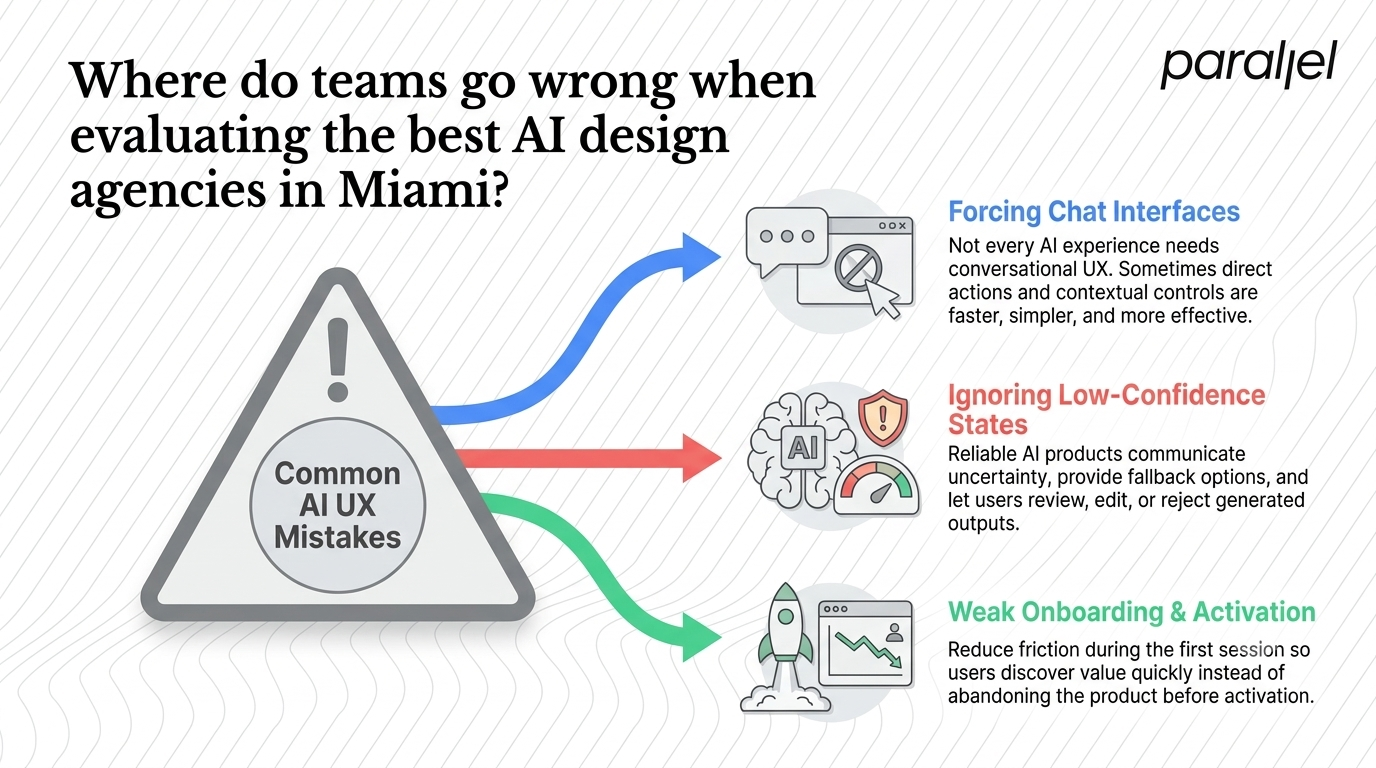
1) Forcing conversational UIs on everything
The biggest mistake teams make in 2026 is assuming every AI product needs a chat interface. We regularly have to fix UX for AI chatbots that never should have been chatbots in the first place.
Users do not always want to type out a complex prompt to get a simple chart. Sometimes they just want a button. A 2025 study by IDEO found that contextual suggestions outperform conversational interfaces by a factor of three in B2B workflow environments. If an agency suggests a chat box as the solution to every problem, they are not thinking critically about your user.
2) Ignoring low-confidence states
Generative AI makes mistakes. It hallucinates. It misunderstands context. Poor design agencies build interfaces that present AI outputs as absolute facts.
Strong product thinkers design for uncertainty. They build interfaces that show the user how confident the model is. They include clear fallback states and easy ways for the user to edit or reject the output. According to 2026 research by the Nielsen Norman Group, 72% of users will abandon an AI tool entirely if they cannot easily recover from a system error.
3) Weak onboarding and low activation
Early-stage startups often overcomplicate their product experiences. They dump every feature onto the main dashboard and expect the user to figure it out.
We believe that weak onboarding is the single biggest threat to your startup. If a user cannot find value in the first three minutes, they will churn. We frequently conduct SaaS onboarding teardowns to show teams exactly where they are losing their audience. An agency must prioritize time-to-value above visual flair.
How should you structure your search for the best AI design agencies in Miami?
You need a systematic approach to evaluating your options. Do not just look at their Dribbble portfolios. Pretty pixels do not validate market demand.
You should structure your evaluation around decision-making and product logic. Ask potential partners how they untangle complex user flows.
1) Look for rapid validation
The worst thing you can do is spend six months in stealth mode designing a massive product, only to launch to crickets. You need an agency that prioritizes speed and learning.
At ParallelHQ, we rely heavily on rapid design sprints to validate ideas before writing a single line of code. We prototype the core interaction, put it in front of real users, and gather data. This framework mitigates risk and ensures you are building something people actually want.
2) Evaluate their discovery process
A good partner will push back on your assumptions. They will want to understand the business mechanics behind your application.
Ask the agency about their discovery framework. Do they map out user journeys? Do they analyze your competitors? Do they help you define your exact target audience? If they just ask for your brand colors and a feature list, you are hiring order-takers, not strategists.
3) Demand clarity over cleverness
AI products are inherently complex. The interface must be brutally simple.
A 2026 report by Forrester Research highlights that design-led companies reduce their customer acquisition cost by up to 35%. They achieve this by making their products incredibly easy to understand. Look for an agency that actively removes visual noise. They should focus on clear typography, obvious calls to action, and progressive disclosure of complex features.
What practical steps help you choose among the best AI design agencies in Miami?
Choosing the right partner comes down to matching their specific expertise with your current business stage.
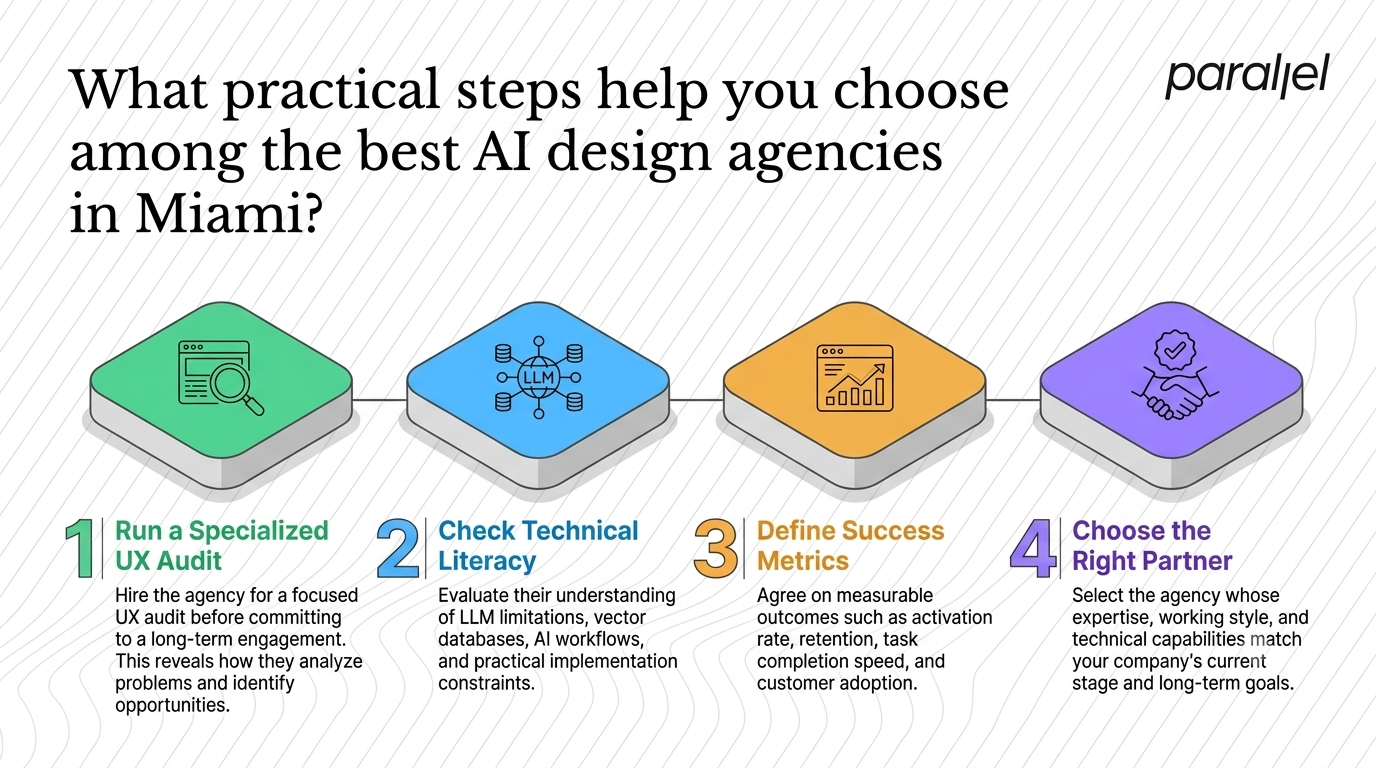
If you are a seed-stage founder, you need a lean, fast team. If you are an enterprise CIO, you need a massive agency with global compliance experience. Here are the steps to finalize your decision.
- Run a specialized UX audit. Before signing a massive retainer, hire the agency to do a deep UX audit of your current platform. This low-risk engagement proves how they think.
- Check their technical literacy. The agency must understand the constraints of Large Language Models (LLMs) and vector databases. They need to know what is technically feasible.
- Define your success metrics. Align on what success looks like. It should be tied to activation rates, retention, and task completion speed, not just aesthetic awards.
How do the best AI design agencies in Miami compare in 2026?
Based on our experience working in the startup ecosystem, here is an objective breakdown of the top partners available to founders this year.
We have categorized them based on their actual strengths so you can find the right fit for your specific business context.
1) ParallelHQ
We built ParallelHQ because we saw teams struggle with design decisions that should have been simpler and more grounded in real user behavior. We do not just build pretty apps. We help founders and product managers untangle complex problems.
- Our approach: We focus entirely on clarity. We rely on rapid design sprints and deep user testing to validate concepts. We start by fixing overcomplicated product experiences and mapping out exact user journeys.
- Where we excel: We are the perfect fit for seed to Series B startups building AI and SaaS products. We bring senior product thinking to teams that need to move fast.
- The outcome: We deliver actionable product strategy. We focus heavily on AI UX design that builds user trust and drives retention.
- Ideal engagement: Founders who want a strategic partner, not just a pair of hands.
2) MetaLab
MetaLab is a veteran in the product design space. They have a massive portfolio featuring some of the biggest tech unicorns in the world.
- Their approach: They focus on creating iconic, visually stunning interfaces. They blend brand identity deeply into the product interface.
- Where they excel: They are perfect for heavily funded consumer applications that need to set a visual benchmark.
- The tradeoff: Their engagements are highly expensive and take significant time. Startups needing more agility often look for a MetaLab alternative to preserve the runway.
3) Clay
Clay is known for creating visually flawless digital experiences. They are heavily favored by high-growth tech companies in consumer AI and fintech.
- Their approach: They merge marketing and product seamlessly. They are known for their micro-interactions and highly polished 3D brand assets.
- Where they excel: If your biggest challenge is standing out in a crowded, aesthetic-driven market, Clay delivers incredible visual differentiation.
- The tradeoff: Their focus is often heavily skewed towards the visual and marketing side of the product. Teams needing complex B2B workflow simplification might prefer a Clay alternative.
4) IDEO
IDEO practically invented modern design thinking. They are a massive global consultancy that tackles systemic, complex human problems.
- Their approach: They are deeply rooted in ethnographic research. They spend weeks or months understanding human behavior before designing solutions.
- Where they excel: They are the right choice if you are trying to invent a completely new category of product that involves hardware and digital integrations.
- The tradeoff: For a standard SaaS platform, their process can be overkill. Fast-moving teams often seek an IDEO alternative for rapid software execution.
5) Lazarev
Lazarev has built a strong reputation in the B2B AI space. They specialize in making data-heavy products feel accessible.
- Their approach: They focus on structuring complex information architecture. They design clear dashboards and robust AI copilot experiences.
- Where they excel: They are highly effective for Series A and Series B startups building deep tech or enterprise software.
- The tradeoff: They are highly specialized in B2B logic. If you are building a consumer social app, their enterprise-heavy style might feel too rigid.
6) Target Dial
Target Dial is heavily active in the South Florida market. They are highly specialized in one specific niche: voice AI.
- Their approach: They build AI-powered voice agents that transform customer interactions. They focus entirely on inbound support and outbound sales automation.
- Where they excel: Local Miami businesses and scaling sales teams that need to automate phone workflows instantly.
- The tradeoff: They are an implementation agency for voice technology, not a full-stack product design studio. They will not help you design a web app or SaaS dashboard.
7) Groto
Groto takes a heavily metrics-driven approach to software design. They focus specifically on the SaaS business model.
- Their approach: They start with user behavior data and business metrics before touching visual design. They prioritize task completion rates.
- Where they excel: They are great for SaaS companies that have a working product but are struggling with churn and bad retention metrics.
- The tradeoff: They are highly analytical. If you need a complete brand overhaul and highly emotional visual design, you might want to pair them with a branding agency.
8) Awesomic
Awesomic operates on a completely different model. They are a subscription-based platform that matches you with vetted designers.
- Their approach: You pay a flat monthly fee and hand off tasks as they come up. It is a continuous execution model.
- Where they excel: They are perfect for operational teams that have a steady, predictable stream of smaller design tasks and marketing assets.
- The tradeoff: You have to provide the core product strategy yourself. They are executors, not high-level product strategists.
9) Onething
Onething has carved out a niche in what they call "Agentic Experience Design". They focus on how humans interact with autonomous AI agents.
- Their approach: They look closely at behavioral design. They map out how users delegate tasks to AI and how they monitor those tasks.
- Where they excel: They are ideal for mid-market SaaS platforms that are transitioning from manual tools to autonomous workflows.
- The tradeoff: Their highly specialized focus on agentic frameworks might be unnecessary if you are just building a simple generative text tool.
10) Call Sandwich
Call Sandwich is an elite partner in the AI telephony space. They handle the complex backend integrations that standard agencies avoid.
- Their approach: They specialize in building enterprise-grade voice AI integrations for complex environments.
- Where they excel: Large enterprises, healthcare networks, and telecom companies that need massive-scale voice automation.
- The tradeoff: Like Target Dial, their focus is entirely on voice infrastructure. They are not the partner for visual UI/UX design or web application strategy.
Conclusion
Building an AI product in 2026 is hard enough without fighting a bad interface. You have to balance technical constraints, model latency, and human psychology.
The market is maturing rapidly. Users no longer give you a pass just because your product has "AI" in the name. They expect your software to be clear, predictable, and immediately valuable. Stop treating design as a coat of paint you apply at the end. Treat it as the core mechanism that translates your complex technology into human value.
Choose a partner who challenges your assumptions, maps out real user journeys, and tests everything. Clarity is your ultimate competitive advantage.
FAQ
1) What defines the best AI design agencies in Miami?
The top agencies in this region do not just build pretty interfaces. They focus on product strategy, deep UX auditing, and mitigating user friction. They understand how to design for AI uncertainty, utilizing confidence indicators and clear fallback states to build user trust.
2) How much do the best AI design agencies in Miami charge for an MVP?
Pricing varies wildly based on the agency model. A subscription service might cost a few thousand a month for execution. A strategic design sprint and full MVP development from a specialized agency typically ranges from $15,000 to $40,000, while massive global firms will charge well over six figures.
3) How do you measure the ROI of an AI design sprint?
You measure it by the mistakes you avoid. A design sprint validates or invalidates your concept in a week. Finding out an idea will not work during a sprint costs a fraction of what it costs to find out after six months of engineering.
4) Should I hire an agency or an in-house designer for an AI startup?
If you have long-term, daily strategy work and a massive budget, hire in-house. If you need senior-level product thinking, rapid execution, and objective outside perspective to hit your next funding milestone, an agency partner is much more capital-efficient.
5) Are subscription design models right for my seed-stage AI company?
Subscription models are excellent if you already have a clear product strategy and just need a steady stream of UI execution. If you are still figuring out product-market fit and need help defining the core user experience, you need a strategic partner instead.
6) What is the difference between traditional product design and AI product design?
Traditional software is deterministic; a button always does the exact same thing. AI software is probabilistic; the output changes based on context. AI design requires building interfaces that handle variable outputs, explain reasoning, and allow users to steer the model effectively.
7) How does an AI design partner handle generative errors in the UI?
A great partner designs defensive UX. This includes transparent loading states, easy correction flows, and clear formatting that allows users to reject or edit an AI generation without breaking their overall workflow.
8) Why does ParallelHQ start with a UX audit instead of immediate visual design?
We start with a UX audit because visual design cannot fix a broken foundation. We need to identify exactly where users are abandoning the product. Diagnosing the behavioral friction first ensures that the subsequent design work actually improves business metrics.

check out these related blogs