Most product teams treat their interface as an afterthought when building AI tools. We see this mistake happen daily. A powerful language model wrapped in a confusing user experience will always fail to activate and retain users. If you are looking for the best AI design agencies in New York, you need partners who think deeply about user context, behavioral psychology, and system trust. Flashy visuals will not solve your product problems. Clarity and logic will. Let us break down the firms that actually deliver on this promise in 2026.
Quick answer
The top AI product firms prioritize system transparency, clear constraints, and user trust over standard interface trends. Here is the comparison of the top 10 best AI design agencies in New York equipped to solve complex product challenges today.
What makes the best AI design agencies in New York different?
Designing for artificial intelligence is fundamentally different from designing standard SaaS applications. Traditional software is deterministic. A user clicks a button, and the same specific action happens every single time. AI products are probabilistic. The outputs are dynamic, sometimes unpredictable, and occasionally incorrect.
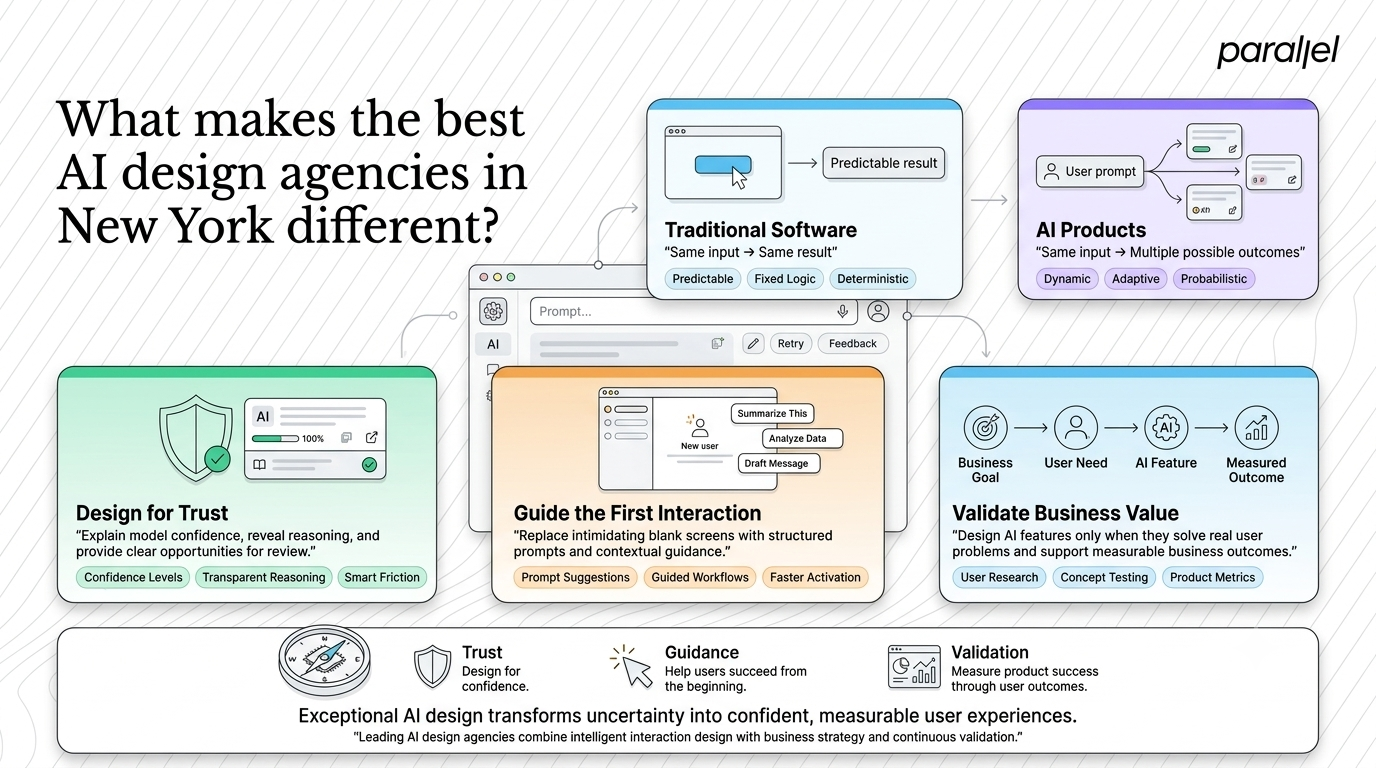
Agencies that excel in this space understand how to manage this unpredictability. They do not just paint screens. They architect interactions that guide users through uncertainty.
Recent data backs up why this specialization matters. A 2026 Nielsen Norman Group study on AI usability revealed that 71% of users abandon generative AI interfaces that lack clear affordances for error recovery. Users need to know how to fix a bad output. If your design team does not understand how to build feedback loops, your product will churn users.
We have observed three specific traits that separate mature AI design partners from traditional design firms.
First, they design for trust. Trust in AI is fragile. The best teams build interfaces that explain model confidence levels and show the reasoning behind an output. They know exactly when to introduce friction to make a user verify a result and when to remove friction to speed up a workflow.
Second, they solve the blank canvas problem. Dropping a user into an empty chat interface is a recipe for low activation. Users do not know what to ask. Mature teams build contextual prompt suggestions, structured inputs, and guided workflows that teach the user how to extract value from the underlying model. You can read more about this in our thoughts on chatbot UX design.
Third, they connect business goals to user behaviors. They do not just design features because the technology enables them. They validate whether the AI feature actually solves a painful problem for the user better than a traditional software approach would. This requires rigorous concept development and testing before any code is written.
What are the top 10 best AI design agencies in New York?
Selecting the right partner depends heavily on your stage, your budget, and the specific complexity of your product. Here is a detailed breakdown of the leading firms operating in this space.
1) ParallelHQ
We built ParallelHQ because we saw too many early-stage startups wasting months on design cycles that failed to produce clear, actionable results. We are a product design and strategy partner focused entirely on clarity in thinking and execution.
When it comes to AI, we know that the interface must do the heavy lifting of educating the user. We work closely with founders and product teams to map out complex AI interactions, simplify them, and ground them in real user behavior. Our approach is fast and iterative. We heavily utilize design sprints to validate AI concepts in days rather than months. This ensures you do not waste engineering resources building expensive models for problems users do not actually care about.
Our team focuses on structural UX, clear onboarding sequences, and logical information architecture. We are not an agency that will sell you on trendy visuals or abstract concepts. We build products that work. If you are struggling with low activation rates or a messy product vision, our product strategy consulting is designed to align your team and create a clear path forward.
2) Work & Co
Work & Co is known for robust technical execution and handling massive scale. They are highly effective for large enterprise companies that need to ship complex digital products to millions of users. Their approach is highly integrated with engineering, ensuring that their designs can actually be built and maintained.
For AI projects, they excel at embedding machine learning features into existing large-scale ecosystems. They are less focused on early-stage discovery and more focused on rigorous execution of defined product goals. If you are a nimble startup looking for a leaner approach, you might want to review a Work & Co alternative to find a partner more aligned with startup speed.
3) R/GA
R/GA sits at the intersection of brand, marketing, and technology. They are a massive global network with a strong presence in New York. Their strength lies in creating highly innovative, conceptual AI experiences that generate brand buzz and drive consumer engagement.
If you are building an AI product that relies heavily on a unique brand narrative or marketing-led growth, R/GA has the creative firepower to deliver. However, their process can be heavy and expensive for early-stage teams focused purely on product-market fit. Founders focused strictly on utility and core product mechanics often seek an R/GA alternative for a more product-centric engagement.
4) Huge
Huge is built for digital transformation at the enterprise level. They leverage data heavily to drive their design decisions and are adept at restructuring massive, disorganized digital properties. Their AI work typically involves integrating predictive analytics and personalization engines into large corporate platforms.
They bring a highly structured, agency-style methodology to their projects. This is perfect for Fortune 500 companies that require layers of stakeholder management and comprehensive documentation. Startups needing rapid prototyping and direct access to senior product thinkers usually look for a Huge alternative that moves faster.
5) Method
Method focuses on systemic design and strategic business challenges. They are excellent at taking a step back and looking at how AI will impact the entire service blueprint of an organization. They do not just design the interface. They design the internal processes required to support the AI product.
Their work is deeply analytical. They are a strong fit for complex industries like healthcare or finance where AI implementation carries significant regulatory or operational risk. For teams that just need rapid digital product execution, exploring a Method alternative might be more practical.
6) Code and Theory
Code and Theory excels at content-heavy platforms and publishing ecosystems. As AI continues to disrupt content creation and distribution, this agency is well-positioned to help media companies and large publishers integrate AI into their editorial workflows and consumer-facing products.
They understand complex taxonomy and systemic logic. If your AI product relies on organizing, generating, or retrieving massive amounts of unstructured data, they have the architecture experience to handle it. Product teams building highly interactive SaaS tools might prefer a Code and Theory alternative focused specifically on software interfaces.
7) Beyond
Beyond brings a strong agile delivery mindset to product design. They bridge the gap between user experience and technical reality very well. Their teams are comfortable working alongside client engineering squads to implement AI features incrementally.
They are a solid choice for mid-market technology companies that need to modernize their existing platforms with AI capabilities. Their focus is on practical, usable improvements rather than reinventing the wheel.
8) Frog Design
Frog Design has a legendary history in industrial design and human-computer interaction. In the AI era, they are particularly strong when digital intelligence meets physical environments. If your product involves IoT devices, spatial computing, or hardware interfaces driven by AI, Frog has the multidisciplinary teams to tackle it.
They approach AI with a deep commitment to human-centric principles, ensuring technology serves the user rather than the other way around. Pure software startups often seek a Frog Design alternative to avoid the overhead associated with their broad industrial capabilities.
9) Ustwo
Ustwo builds products that are deeply engaging and often playful. They have a strong background in gaming and immersive digital experiences. When applied to AI, they excel at humanizing complex technology and making it feel approachable and friendly to everyday consumers.
If your product relies on habit formation, delight, and a highly polished consumer feel, Ustwo is a premier choice. For B2B platforms focused on dense data workflows, you might find a better fit with an Ustwo alternative that specializes in enterprise software.
10) Instrument
Instrument focuses on the convergence of brand and digital product. They are excellent at defining how a company's brand voice should manifest within an AI interaction. If your AI tool acts as an extension of your brand identity, they ensure that the personality remains consistent across every interaction.
They build beautifully crafted digital experiences. However, they operate very much like a traditional creative agency. Teams needing deep, structural product architecture might look for an Instrument alternative to prioritize utility over brand expression.
How do the best AI design agencies in New York approach AI UX?
Great AI design requires a specific methodology. You cannot just apply a standard UI kit to a large language model and expect users to succeed.
We see a consistent pattern among teams that build successful AI products. They prioritize structure over open-ended freedom. The 2026 IDEO perspective on human-AI collaboration highlights that successful AI tools have shifted the paradigm from viewing AI as a passive tool to treating it as an active collaborator. This requires continuous feedback loops built directly into the interface.
Here are the specific approaches that work.
First, successful teams aggressively tackle the onboarding experience. AI products often require users to learn new mental models. If you drop a user into a blank text box, they will experience cognitive overload. We solve this by implementing structured onboarding that provides immediate, constrained value. We show the user exactly what the tool can do before we ask them to construct their own prompts. You can see how we evaluate these flows in our SaaS onboarding teardowns.
Second, they design for graceful failure. AI will hallucinate. It will return irrelevant results. The interface must anticipate this. Instead of a generic error message, the design should offer the user ways to tweak their input. We often design interfaces that allow users to select specific parts of an AI output and request variations or corrections. This keeps the user engaged rather than forcing them to start over.
Third, they expose the system state. Users need to know what the AI is doing. If a process takes ten seconds to generate, a static loading spinner will cause anxiety and abandonment. We build progressive loading states that explain the steps the AI is taking. This builds trust and makes the wait time feel significantly shorter.
In one recent project, we observed a team struggling with a generic chat interface for a legal tech product. Users were asking overly broad questions and getting useless answers. By replacing the open text box with a structured form that forced users to define parameters before generating a response, the team saw a 40% increase in successful task completion. Structure creates clarity.
Why should startups hire the AI design agencies in New York over traditional firms?
Startups operate with limited time and limited capital. You cannot afford to build the wrong thing twice.
Building AI features is expensive. The API calls cost money. The engineering time required to wrangle non-deterministic outputs is massive. If your design team does not understand the constraints and realities of working with AI, they will design concepts that are technically impossible or financially ruinous to run at scale.
Traditional design agencies often fall into this trap. They design "magic" interfaces where a single click solves every user problem instantly. When engineering tries to build it, reality sets in. The latency is too high. The model accuracy is too low. The project stalls.
According to a 2026 report by the Product Development and Management Association, startups that validate AI UX prototypes before building core models reduce engineering waste by an average of 42%.
You need a partner who understands AI native design. A specialized agency knows how to design around latency. They know how to handle prompt engineering at the UI layer. They understand how to build interfaces that capture proprietary user data ethically, which is how you train better models over time.
For early-stage companies, hiring a firm that understands these specific technical constraints is the difference between launching a sticky product and launching a failed experiment. If you are building software specifically for other businesses, working with an agency that understands B2B UX design alongside AI constraints is critical for success.
What are the common pitfalls when working with the best AI design agencies in New York?
Even when working with top-tier partners, projects can go off the rails if the founders and product managers do not guide the engagement correctly. We have audited hundreds of products and see the same mistakes repeated.
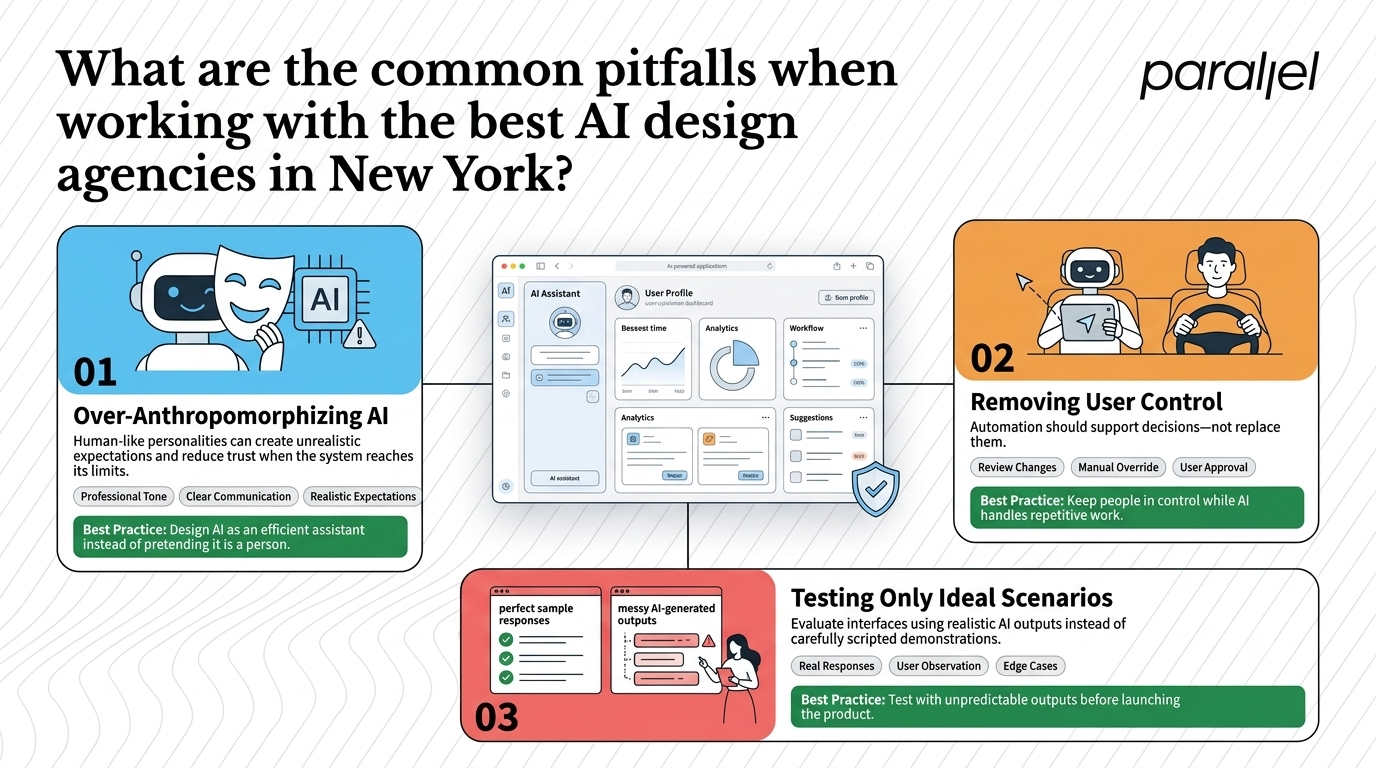
The most common pitfall is over-anthropomorphizing the AI. Teams often want their AI to sound like a human, complete with quirky greetings and conversational filler. This usually backfires. Users do not want a friend. They want a tool that gets the job done quickly. When an interface tries too hard to be human, it sets false expectations about the AI's actual capabilities. When the AI inevitably fails a complex reasoning task, the user feels betrayed. Keep the tone professional, clear, and utilitarian.
Another major issue is the lack of user control. Designers sometimes get so excited about automating a workflow that they remove the user from the loop entirely. This creates anxiety. Users need to feel like they are driving the car. The AI should act as a powerful co-pilot, offering suggestions and doing heavy lifting, but the final decision must remain with the user. If you force automation without review, users will reject the feature.
Finally, teams often skip proper usability testing with real data. Testing an AI interface with dummy text or pre-scripted "happy path" answers is useless. You must test the prototype with real, messy, unpredictable LLM outputs. You have to see how the user reacts when the AI gives a confusing answer. If your agency does not insist on testing with real-world variance, they are not setting you up for success. We prevent this by using a rigorous discovery framework that forces reality into the design process early.
Conclusion
Building successful AI products is not about adding a chat window to your application. It is about fundamentally rethinking how humans interact with dynamic systems. It requires discipline, clear thinking, and a deep understanding of user behavior.
The agencies that matter today are the ones pushing past the hype. They focus on structural logic, systemic trust, and measurable product outcomes. When you prioritize clarity over cleverness, you build products that users actually adopt, trust, and rely on. Choose a partner who tells you the truth about your product, not just what you want to hear.
Frequently asked questions
1) What exactly does an AI design agency do?
An AI design agency focuses on the human-computer interaction layer of artificial intelligence products. Unlike traditional agencies that design static workflows, AI agencies design probabilistic interfaces. They build prompt structures, define error states for model hallucinations, design feedback loops to train the data, and create user experiences that manage system latency and build user trust.
2) How do I know if the best AI design agencies in New York are right for my startup?
If your product relies on machine learning, generative models, or complex data synthesis to deliver its core value, you need specialized design help. If you are seeing high initial sign-ups but massive drop-offs after the first interaction, your AI UX is likely failing. Generalist agencies often lack the specific technical context required to fix these adoption issues effectively.
3) How much do AI design services typically cost in 2026?
Pricing varies wildly based on the agency's size and the scope of the project. A short, focused design sprint to validate a single AI concept might cost between $15,000 and $30,000. A comprehensive product overhaul from a large network agency can easily exceed $200,000. We recommend starting with a small, tightly scoped engagement to validate the agency's thinking before committing to a massive build.
4) What is the difference between standard UX and AI UX?
Standard UX relies on linear pathways. The designer dictates every step the user takes. AI UX is non-linear. The user provides an input, and the system generates an unpredictable response. AI UX requires designing constraints, offering prompt suggestions, managing wait times dynamically, and building mechanisms for users to refine or correct the system's output safely.
5) How does ParallelHQ approach AI product design differently?
At ParallelHQ, we prioritize product strategy over surface-level UI. We believe that overcomplicated design kills startups. Our process is rooted in rapid prototyping and testing with real users. We do not spend months making screens look pretty. We spend days figuring out if the logic works. We align your business goals with actual user behaviors to ensure your engineering team only builds what matters.
6) How long does an AI design project take?
Timeframes depend on the methodology. A traditional agency process might take three to six months to deliver a comprehensive design system. Using agile methodologies and intensive workshops, a core AI feature can be mapped, prototyped, and validated in three to four weeks. We strongly advocate for the faster approach to reduce market risk.
7) Should we build our AI model first or design the interface first?
You should always design and test the interface concepts first. Building custom models or stringing together complex API calls is expensive. By prototyping the interface using simple "Wizard of Oz" techniques or basic API wrappers, you can validate whether users actually want the feature before you spend engineering capital on the backend infrastructure.
8) How do we measure the success of an AI design engagement?
Do not measure success by how beautiful the deliverables look. Measure it by product metrics. You should track activation rates (how many users successfully complete their first AI task), retention rates, and the reduction in error rates. A successful design engagement should result in a clear, measurable increase in user confidence and task completion speed.

check out these related blogs
































































.avif)









.webp)