If your startup is evaluating design partners, Huge is probably on your list. It should be, Huge is a global design and technology agency founded in 1999, specializing in personalized, intelligent digital experiences through business strategy, marketing, user experience design, and technology development. But Huge was built for brands like Google and Nike. If you're a seed-to-Series B founder or PM, that architecture works against you. This guide cuts through the noise on the 10 best Huge alternatives compared so you can make a faster, sharper call.
TL;DR
- Huge's enterprise focus, large team structure, and project-based pricing model don't always align with the needs of growth-stage companies or organizations seeking more predictable, scalable creative partnerships.
- Most alternatives fall into three pricing tiers: boutique startup-focused studios, mid-market brand agencies, and subscription-based design services.
- ParallelHQ is the only alternative built exclusively for early-stage AI and SaaS startups in the USA.
- Pick your partner based on stage, not prestige.
Why Founders Are Searching for Huge Alternatives in 2026
Huge employs approximately 1,000 people and serves major clients such as Google, Amazon, Coca-Cola, and Nike, which tells you everything about where their energy flows. When you're a 12-person SaaS team trying to nail onboarding or redesign a dashboard, you are not their most important client in the room.
Some clients find it challenging to align Huge's services with their existing processes, especially when the agency moves faster than internal teams. The experience can also vary depending on the seniority of the team members assigned. Some clients also feel that tighter project management could improve turnaround times.
Huge charges between $70–$150/hour , but that figure is the floor. Enterprise-grade scopes, extended discovery phases, and multi-disciplinary team structures push total engagements far beyond what most early-stage budgets allow. When you're paying for an agency that's simultaneously running transformation programs for Fortune 100 companies, your project rarely commands senior attention.
High-growth SaaS startups are increasingly turning to specialized design partners rather than generalist agencies. The reason is straightforward: SaaS products have distinct design needs, onboarding flows, trial conversion paths, pricing page psychology, and product UI consistency that general web designers rarely understand at a strategic level. The best Huge alternatives compared here aren't cheaper versions of Huge. They're more precise fits for where you actually are.
What Are the Top Design Agency Alternatives to Huge in 2026?
Here are the 10 alternatives that matter for founders and PMs at AI and SaaS startups.
The table above reflects positioning, not ranking by quality. Each is excellent within its lane. The question is whether their lane is yours.
ParallelHQ vs. Huge: Which Is the Better Startup Design Partner?
I built ParallelHQ as the answer to a specific problem I kept watching founders hit: they hire a large agency, they get a junior team, they receive a polished deck and a bill that eats two months of runway. No functional prototype. No validated direction. Just deliverables.
ParallelHQ is purpose-built for early-stage AI and SaaS startups based in the USA. We sit with founders and PMs in the problem space first, through product strategy consulting, UX audits, and design sprints, before we touch a single screen.
Here's how the two compare on dimensions that actually matter to founders:
The honest question to ask yourself: do you need a partner who has shaped how Netflix and IKEA serve millions, or one who knows exactly what a 12-person SaaS team needs to get from 0 to traction? Those are different skills, different cultures, different commitments.
Best Full-Service Digital Design Agencies Like Huge
If you need the scale and breadth of Huge but with a sharper focus, these three are the strongest Huge alternatives compared in the full-service bracket.
Clay: Clay is a San Francisco-based agency known for exceptionally polished work. They bridge the gap between brand identity and digital product design seamlessly. Their websites and apps always feel cohesive and modern. They are a fantastic fit for startups that need a strong brand narrative tied to their product, and they excel at high-fidelity prototyping and smooth animations.
The tradeoff: they often focus heavily on the marketing side of digital experiences, so for complex backend dashboards, you might need a partner focused purely on product logic.
Clay's minimum engagement starts at around $10,000, a lower bar than Huge, but still significant for pre-seed teams.
Ramotion: Ramotion is a San Francisco-based agency known for brand identity, product UI, and mobile app icon design. Their reputation was built through high-profile work for Apple, Netflix, and Mozilla, particularly in iOS app design and brand systems for funded tech companies. Clutch lists Ramotion with a $50,000+ minimum project size and a $150–$199 hourly rate. That's a serious commitment, right for a post-Series A company solidifying its brand platform, wrong for an MVP-stage team.
MetaLab: MetaLab designed the original Slack product, making it the agency with the deepest product design pedigree if you are building a complex SaaS or collaboration tool. Their recent work includes the Cognition AI to Windsurf rebrand, one of the most visible AI product rebrands of recent years. Their pricing sits in the mid-to-large project tier and is best suited for funded companies with a defined product problem, not early discovery work.
Affordable Alternatives to Huge Inc. for Startup Design Work
Securing high-quality, scalable design should not drain your runway or consume a founder's time. Traditional agency models move too slowly. For founders watching burn rate, these are the models worth considering.

Design subscription services have matured significantly. At the start of 2025, about 400 design subscription services existed, following the models created by industry leaders like Superside. Most subscription options for startups are priced from $500 to $3,000 a month.
The catch is scope: these services handle graphic design and marketing assets well, but they rarely cover the product strategy, user research, and interaction design that SaaS products actually need.
Lollypop Design Studio is worth examining for startups that need research-driven depth. Lollypop is a globally recognized UI/UX design agency that creates intuitive and scalable digital products. With expertise spanning healthcare, fintech, agritech, and more, they deliver data-driven insights and award-winning designs. Lollypop Design Studio offers competitive pricing, with projects ranging from $10,000 to over $100,000 depending on scope. That minimum puts them in reach of seed-stage teams, particularly those building in regulated verticals.
For an even leaner entry point into strategic product design, a scoped audit first is a sharper move than a full engagement. At ParallelHQ, our UX audit and SaaS onboarding teardown services are designed exactly for this: you get senior-level thinking on your most critical flow before committing to a larger engagement. That's not how Huge operates, but it's precisely how early-stage design should.
What Design Agencies Compete with Huge for SaaS and AI Products?
Beyond the big names, a second tier of Huge alternatives compared here deserve attention from SaaS and AI founders specifically.
Ustwo: ustwo is an independent digital product studio famous for designing highly immersive experiences. Their core expertise spans immersive digital products, gamification, and interactive storytelling, with a heavy emphasis on emotional design and human-centered research. They are best for startups looking to bring consumer gamification, mental health tech, or interactive education to life. If you're building B2B SaaS, their aesthetic is a mismatch, but for consumer-facing AI products, they're a genuine Huge alternative.
Frog Design: Frog is a classic global design consultancy with decades of experience spanning industrial design and physical-digital product ecosystems. Their core expertise includes service design, customer experience strategy, and industrial IoT. Frog's estimated hourly rate is $150–$250, with a minimum project size of $75,000+. It is not the kind of agency most early-stage startups hire for a quick build.
R/GA: R/GA operates in the digital product and marketing sectors. The company focuses on integrating design and technology to create experiences for individuals and brands. Like Huge, R/GA is enterprise-native. Startup teams evaluating an R/GA alternative typically find the overhead mismatches their pace.
OneThing Design operates in the mid-market, with a brand and product design focus that positions it well for growth-stage companies that have cleared validation but need a stronger visual system before scaling. Their scope is smaller than Huge's but more targeted for B2B SaaS narratives.
For AI-specific product design, ParallelHQ's AI software design services and AI readiness design scorecard address the exact design problems that general agencies routinely mishandle: how to make complex model outputs feel controllable, trustworthy, and clear to non-technical users.
How Do I Find a Good Alternative to Huge Design Agency?
The right question isn't "which agency is better than Huge?" It's "which agency is built for my specific problem at my specific stage?" Here's a straightforward evaluation process:
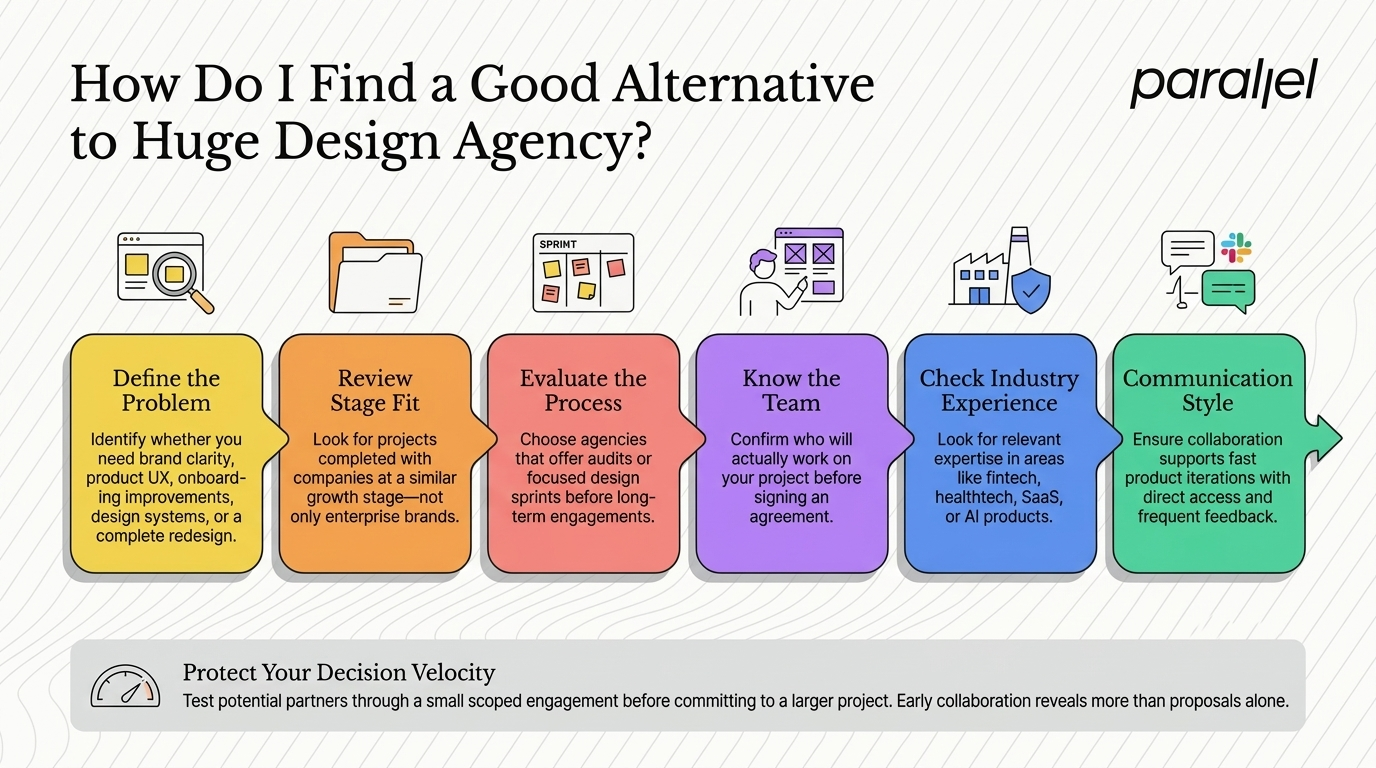
- Define your actual design problem: Is it brand clarity, product UX, onboarding conversion, a design system, or a full redesign? Each demands a different capability set.
- Audit their portfolio for stage-fit: Agencies that primarily show Fortune 500 logos may not have the muscle memory for early-stage tradeoff decisions. Look for work done at your company size.
- Assess their process entry point: Can they start with a scoped sprint or audit, or do they require a minimum 3-month engagement? The former signals startup-native thinking.
- Ask who actually works on your account: At large agencies, senior talent closes deals; junior teams execute. Know before you sign.
- Check vertical depth: If you're in fintech, look for fintech design services. Healthtech demands different regulatory instincts, available through healthtech design services.
- Evaluate communication cadence: Weekly async updates with no Slack access is a mismatch for a startup iterating daily.
A wrong agency partner costs you more than money. It costs you decision velocity, the one resource you cannot recover. The best Huge alternatives compared in this article can all be tested with a smaller scoped engagement before you commit to a larger one. Use that structure. It protects your runway and tells you more about a partner than any proposal will.
ParallelHQ Design Agency Review 2026: Is It the Right Huge Alternative for You?
I want to be direct about what ParallelHQ is and isn't, because mature founders deserve that.
What we are: A dedicated UI/UX design and product design partner for early-stage AI and SaaS startups based in the USA. Senior designers with startup experience, not handed to a junior team after the sales call, lead every engagement. We work in Figma natively, across product design, mobile app design, design systems, wireframing and prototyping, and user research.
What we're not: A transformation partner for enterprise brands redesigning global platforms. That's Huge's territory and they're good at it.
Our service architecture is built around how startups actually make decisions:
- Start small, de-risk fast: A UX audit or usability testing session surfaces the highest-leverage problem before committing to a full design sprint.
- Validate direction quickly: Our design sprint model gets you from ambiguity to tested prototype in days, not months.
- Scale systematically: Once the product direction is clear, design systems and MVP development support let your internal team run faster.
According to data compiled by Maze on 2026 UX design statistics, organizations that invest in continuous UX testing can improve revenue retention by up to 10.8% over three years. That's the ROI case for getting design right at the early stage, and it's why the question of which Huge alternative you pick is a business decision, not just a vendor decision. If you want to see how we position against specific agencies, we maintain detailed comparisons including our huge-alternative, clay-alternative, and metalab-alternative pages.
Conclusion
The Huge alternatives compared in this guide aren't a single ranked list, they're a map of different fits for different stages and problems.
- Huge is outstanding for enterprise brands with large scopes and multi-year transformation ambitions.
- Clay, Ramotion, and MetaLab serve funded startups that need premium brand-product alignment and can absorb $50K+ minimums.
- Lollypop and ustwo offer strong research and immersive product depth for specific verticals and consumer contexts.
- ParallelHQ is the startup-native option: senior-led, sprint-capable, and built for the pace and constraints of early-stage AI and SaaS founders.
The sharpest move is starting with a scoped engagement, an audit, a sprint, a teardown, before committing to a full design partnership. That first touchpoint will tell you everything about whether a partner actually understands your problem or just recognized your budget.
Frequently Asked Questions
1) What makes ParallelHQ different from Huge as a design agency?
Huge is built for enterprise transformation at scale with a 1,000-person team. ParallelHQ is purpose-built for early-stage AI and SaaS startups, senior-led, sprint-capable, and structured around startup decision velocity. The team that closes your deal is the team that executes.
2) How much does Huge Inc. charge compared to its alternatives?
Huge charges between $70–$150/hour. Enterprise-scope engagements typically run well into six figures. Alternatives like Lollypop start at $10,000 per project, Ramotion at $50,000+, and design subscription services range from $500–$3,000/month for graphic-focused work.
3) Is there a cheaper alternative to Huge for large-scale digital design?
Yes, depending on how you define "large-scale." The best SaaS web design agencies for startups in 2026 include Eleken, Ramotion, Clay, and MetaLab , among others, each more accessible than Huge for focused product scopes. For ongoing design output, subscription services like Design Pickle start at $499/month.
4) Which Huge alternatives are best specifically for AI startups?
ParallelHQ's AI UX design and AI software design services are the most startup-native options. ustwo suits consumer AI with immersive interaction needs. Frog handles complex hardware-software AI systems, though at significant cost.
5) What companies are similar to Huge Inc. for UX design projects?
Huge's top competitors include R/GA and Wunderman Thompson at the enterprise tier. For product-focused UX, MetaLab, Clay, Ramotion, and ParallelHQ are the most relevant Huge alternatives compared based on scope, quality, and startup-relevance.
6) How do I evaluate a design agency alternative to Huge without wasting time?
Start with a scoped engagement, not a full proposal. Ask to see work done at your exact company stage. Confirm who runs the day-to-day, not just who's in the pitch. Agencies with startup-native instincts will offer an audit or sprint as the first step rather than a 12-week discovery phase.
check out these related blogs