Finding the right design partner is rarely about pixels. It is about finding a team that understands how to simplify complex user behavior into a product that actually works. We have seen early-stage founders waste months with partners who build beautiful interfaces that completely miss the core user problem. If you are evaluating the best SaaS design agencies in Miami, you need to look beyond the portfolio. You need teams that can handle onboarding friction, activation drops, and complex feature sets without getting lost in the weeds. Here is a look at the partners who get product strategy right.
Quick Answer
The best SaaS design agencies in Miami focus on clarity and user behavior, not just aesthetics. We evaluated top firms based on their ability to solve complex product challenges, improve activation rates, and build scalable SaaS systems.
Top 10 Comparison Table
Why is choosing one of the best SaaS design agencies in Miami so difficult for founders?
We have worked with hundreds of founders and product managers over the years. The recurring theme is that building a SaaS product feels like navigating a maze blindfolded. You have a vision, but translating that vision into a screen that a user intuitively understands is incredibly hard.
The software market has matured. A 2026 study by the Nielsen Norman Group indicates that user tolerance for steep learning curves in B2B software has dropped to an all-time low. Users expect enterprise tools to be as simple as consumer apps. If your product requires a training manual, you have already lost.
This is where the agency selection process breaks down. Many founders look for agencies that create visually stunning work. They browse portfolios full of trendy gradients and futuristic layouts. But SaaS is not a marketing website. SaaS is a tool people use to do their jobs. A beautiful dashboard that hides critical data behind three clicks is a failed design.
Choosing the right partner means finding a team that understands cognitive load. They need to know how to structure information architecture so users never feel lost. They must be willing to challenge your product roadmap if they see a simpler way to solve the user's problem. This level of strategic pushback is rare, which makes the selection process critical for your startup's survival.
Where do teams go wrong when hiring the best SaaS design agencies in Miami?
In my experience, this is where most product decisions go wrong. Teams treat design as a coat of paint applied at the end of the development process. They build out massive feature lists, hand them to a design agency, and say, "make this look good."
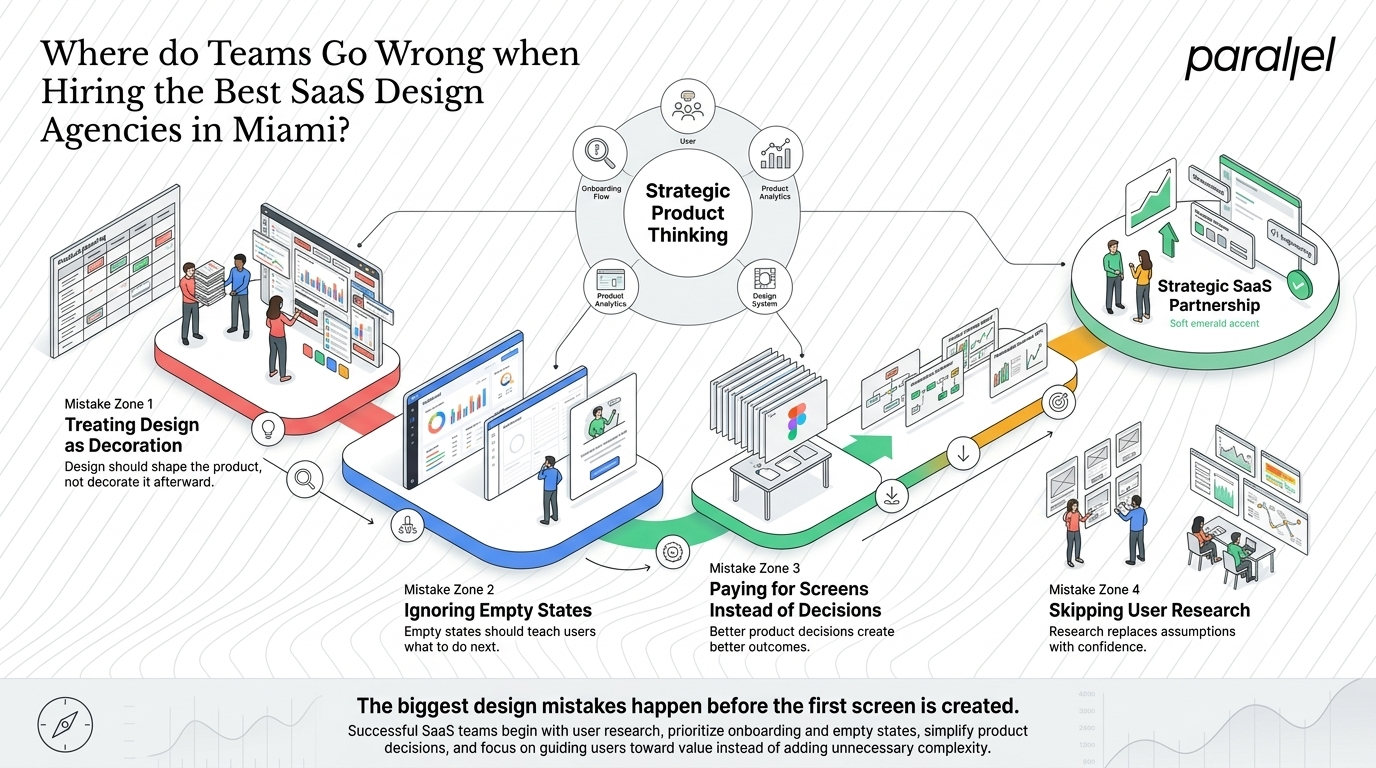
This approach almost always backfires. It leads to bloated interfaces and confusing navigation. Here are the specific failure patterns we observe constantly.
- Ignoring the empty state: Teams design dashboards full of beautiful, simulated data. But when a real user signs up, they see a blank screen. They have no idea what to do first. If an agency does not obsess over empty states and onboarding flows, they do not understand SaaS.
- Focusing on deliverables over decisions: Founders often pay for hundreds of Figma screens. But screens do not drive metrics. Decisions do. The right partner helps you decide what not to build.
- Skipping user research: Designing in a vacuum is a recipe for disaster. IDEO's 2026 design insights heavily emphasize that without direct user feedback loops, product teams are simply guessing. If your agency does not insist on speaking to your users, run the other way.
We see teams overcomplicate onboarding all the time. They throw five different tooltips at a user in the first ten seconds. The user gets overwhelmed and closes the tab. The right design partner knows how to pace information delivery, guiding the user to their "Aha!" moment naturally.
Who are the top 10 best SaaS design agencies in Miami right now?
When evaluating the best SaaS design agencies in Miami, we look at their ability to handle complex logic, their approach to user research, and their track record with real product metrics. Based on our industry experience and observations of the market in 2026, here is a detailed breakdown of the top players.
1) ParallelHQ
We built ParallelHQ to solve a specific problem. We saw early-stage startups and established product teams spinning their wheels on design decisions that should have been clear. We are a product design and strategy partner focused entirely on clarity.
Our approach is deeply rooted in behavior. We do not just redesign interfaces. We conduct deep UX audits and map out opportunities where users are dropping off. We rely heavily on design sprints to validate ideas before a single line of code is written. If you are struggling with low activation or overcomplicated user flows, our SaaS design services are built to untangle that mess. We guide founders to build less, but build it better.
2) Clay
Clay is a globally recognized agency with a strong footprint. They are known for incredibly high-end, polished digital experiences. If you are building a premium B2B product and your primary goal is to establish massive brand trust through visual excellence, they are a strong contender.
However, their level of polish comes with a matching price tag and timeline. For early-stage teams needing rapid iterations, this might be too heavy. We often speak with teams looking for a Clay alternative when they need to balance high-quality UI with faster, more agile product strategy cycles.
3) Momentum Design Lab
Momentum is a powerhouse when it comes to enterprise-grade software. They excel in industries with heavy compliance and massive datasets, like fintech and healthcare. They have a very rigorous, traditional UX process.
Their strength is dealing with legacy system transformations. If you are a founder of a nimble startup, their process might feel a bit slow and corporate. But if you are managing a massive enterprise platform migration, they bring the necessary structure to keep the project on the rails.
4) Ramotion
Ramotion is famous for bridging the gap between brand identity and product UI. They build beautiful, cohesive design systems that make a product look incredibly mature. They are an excellent choice if your SaaS product is pivoting and needs a complete top-to-bottom rebrand alongside a UI refresh.
Their focus heavily leans toward the visual and brand side. If your problems are deeply rooted in behavioral logic or complex data architecture, you might need a more product-focused partner. Many teams evaluate a Ramotion alternative when they need to prioritize user activation over brand aesthetics.
5) Fuselab Creative
Fuselab has carved out a fantastic niche in data visualization. If your SaaS product is an analytics platform, a BI tool, or a dashboard-heavy AI application, Fuselab speaks your language.
They understand how to display complex data sets without overwhelming the user. As 2026 data from Gartner highlights the explosion of AI-native enterprise tools, Fuselab's ability to make data readable is highly valuable. Their scope is narrow, but in their specific niche, they are exceptionally sharp.
6) UX Studio
As their name suggests, UX Studio leads with research. They are deeply academic in their approach to product design. They will conduct extensive user interviews, run usability tests, and provide massive amounts of data to back up their design decisions.
This is brilliant for products that are failing and nobody knows why. However, founders must be prepared for a longer discovery phase. If you already have strong product-market fit and just need to execute quickly on a roadmap, their heavy research phase might slow you down.
7) Eleken
Eleken operates on an interesting model. They provide pragmatic UI/UX design on a subscription basis. This is highly appealing to fast-moving startups that need a dedicated designer but cannot commit to hiring in-house yet.
They integrate directly into your workflow and act as an extension of your team. This model is great for execution. The potential downside is that you are often paying for hands, not necessarily high-level product strategy or pushback on your core business model.
8) Wandr
Wandr focuses heavily on SaaS UX audits and high-level strategy. They are particularly popular with bootstrapped founders who need actionable advice without committing to a massive six-month redesign contract.
They are great at coming in, looking at your metrics, identifying the friction points, and giving you a roadmap to fix them. They are strategic and analytical, making them a great partner for teams that have in-house developers but lack strong UX leadership.
9) GobySavvy
GobySavvy is uniquely focused on conversion rate optimization (CRO) within the UX space. They look at your SaaS product through a purely analytical lens. How many users click this button? Where do they drop off in the funnel?
If you have a solid product but are struggling to convert free trial users into paid subscribers, their specialized focus is highly effective. They rely on A/B testing and quantitative data to drive interface changes.
10) Digital Silk
Digital Silk is a larger, more traditional digital agency. They handle everything from B2B marketing websites to custom software design. If you are an established SaaS company that needs to redesign your marketing site and your web app simultaneously, they have the scale to handle both.
Because they are a full-service agency, their product design arm is just one piece of a larger puzzle. Startups looking for highly specialized, hyper-focused product thinkers might find their approach a bit generalized.
How should you structure your collaboration with the best SaaS design agencies in Miami?
Once you choose a partner, the way you work together dictates the success of the project. I have seen brilliant agencies fail because the client treated them like short-order cooks. You cannot just hand over a list of features and expect a strategic outcome.
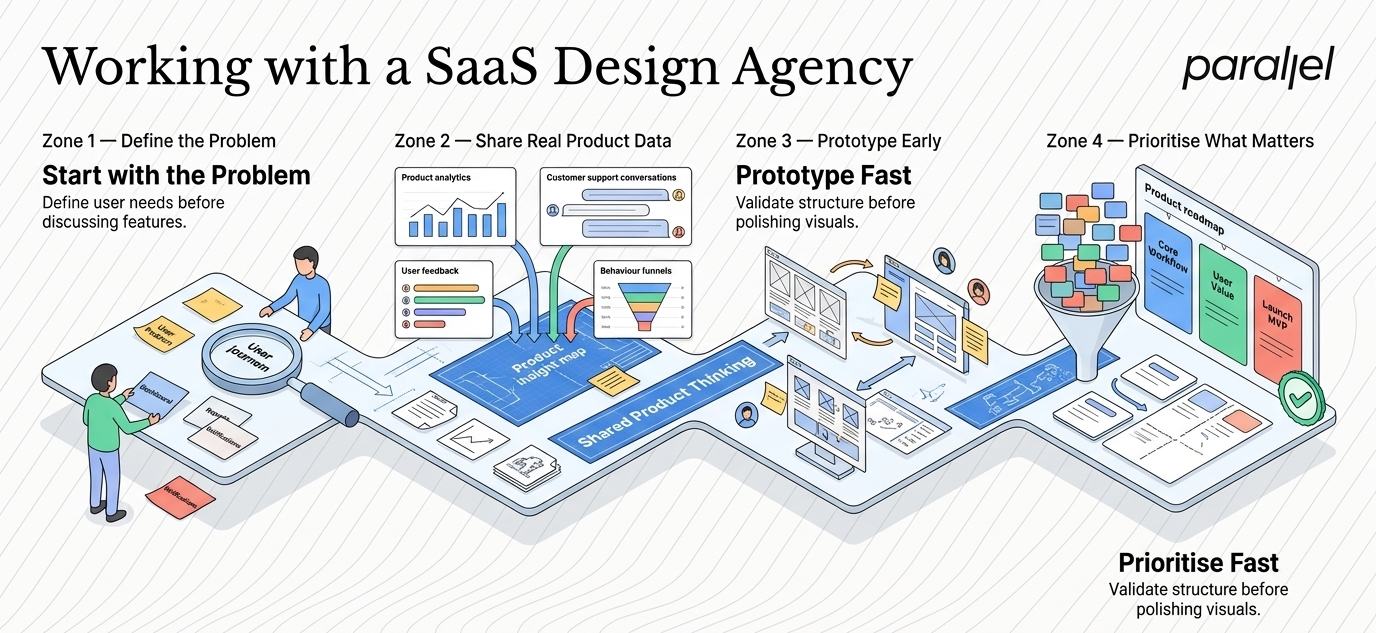
To get the most out of your investment, you must integrate the agency into your core thinking. Here is how we structure successful engagements.
- Define the problem, not the solution: Do not tell the agency to "add a reporting dashboard." Tell them, "our users cannot easily understand their weekly progress." Let the agency figure out if a dashboard, an email digest, or a simple notification is the best solution.
- Share your raw data: Agencies need context. Give them access to your Mixpanel, your Google Analytics, and your customer support tickets. Real user complaints are the raw material for good product design.
- Demand rapid prototyping: Do not wait four weeks to see a polished design. Demand low-fidelity wireframes within days. Use these to align on structural thinking before anyone wastes time on colors and typography.
In our product strategy consulting sessions, we force teams to prioritize ruthlessly. We map out the user journey and identify the single most important action a user needs to take. Everything else is secondary. Your agency partner should enforce this kind of discipline.
What ROI should you expect from the best SaaS design agencies in Miami?
Design is an investment, and like any investment, it must generate a return. If an agency cannot explain how their work will impact your bottom line, they are artists, not product designers.
In the 2026 SaaS landscape, the metrics that matter are activation, retention, and time-to-value. A recent 2026 report by PwC on digital products notes that improving user experience can increase user retention rates by up to 30%.
When you hire a top-tier partner, you should expect to see measurable improvements in specific areas. First, your activation rate should increase. If users are currently signing up and never returning, a clearer SaaS onboarding experience will fix that.
Second, your support tickets related to "how do I do X" should plummet. Good design is self-explanatory. When the interface guides the user naturally, they do not need to bother your customer success team. This reduces operational costs directly.
Finally, you should see a faster time-to-value. The quicker a user experiences the core benefit of your product, the more likely they are to convert to a paid tier. The right agency streamlines workflows to deliver that "Aha!" moment as fast as humanly possible.
Conclusion
Building a SaaS product is an exercise in managing complexity. Every new feature adds weight. Every new menu adds cognitive load. The natural trajectory of software is to become bloated and confusing over time.
Combating this requires a relentless focus on simplicity. It requires a willingness to say no to good ideas so you can focus on the great ones. The right design partner does not just make your product look better. They make your product work better. They help you think clearly about your users, your market, and your core value proposition. Let the insights drive the pixels, not the other way around.
FAQ Section
1) What exactly does a SaaS product design agency do?
A specialized SaaS design agency focuses on the behavioral logic, information architecture, and interface design of software products. Unlike marketing agencies that focus on generating leads, product agencies focus on user activation, task completion, and retention within the application itself.
2) How do we know if we need a UI refresh or a deep UX overhaul?
If your product functions perfectly, users love it, but it looks dated, you need a UI refresh. If users are complaining about navigation, abandoning workflows halfway through, or failing to activate after signing up, you have structural problems that require a deep UX overhaul.
3) What is the difference between an agency and an in-house design team?
An in-house team is excellent for long-term, incremental improvements and deep domain knowledge. An agency brings outside perspective, rapid speed, and exposure to patterns across multiple industries. We often integrate with in-house teams to help them break out of tunnel vision.
4) How does ParallelHQ compare to traditional agency models?
At ParallelHQ, we do not operate like a traditional agency that just takes orders and delivers screens. We act as strategic partners. We challenge assumptions, rely heavily on rapid prototyping and user testing, and focus on the business metrics that design impacts, rather than just delivering aesthetic artifacts.
5) Is hiring a local agency right for me, or should we look globally?
While finding a local partner can be great for face-to-face workshops, the best talent is global. Focus on the agency's methodology, their communication cadence, and their track record with complex SaaS rather than their physical zip code.
6) How much do the best SaaS design agencies in Miami typically charge?
Pricing varies wildly based on scope. Small audits might start around $10,000 to $15,000. Full product redesigns from top-tier strategic partners can range from $50,000 to well over $150,000. The cost should always be measured against the projected improvement in user retention and decreased support costs.
7) How long does a standard SaaS design sprint take?
A standard design sprint to validate a specific feature or solve a targeted problem usually takes one to two weeks. A comprehensive product redesign, however, typically spans three to four months of research, prototyping, and iterative delivery.
8) What metrics prove a SaaS design redesign was successful?
Look at your activation rate (users who reach a meaningful milestone), your feature adoption rate, and your churn rate. Additionally, track the decrease in support tickets related to usability issues. These numbers tell the true story of design success.

check out these related blogs



















.avif)





































































.webp)