Miami has reached a historic turning point. South Florida is now a mature tech hub drawing massive venture capital. But as I speak with founders here, I see a recurring problem. Teams are burning capital on superficial interfaces when they actually need deep product strategy. If you are looking for the best product design agencies in Miami to build software that drives real activation, you need partners who think in systems. A pretty interface will not fix a fundamentally broken user flow. Here is how to navigate the agency landscape.
Quick answer
Choosing the right partner depends on your core problem. Some teams excel at brand visuals, while others solve deep software mechanics. Here is a quick look at how the best product design agencies in Miami compare.
Why is finding the best product design agencies in Miami so difficult for startups?
The local ecosystem has exploded over the past few years. Recent 2026 data from Latin America Reports highlights that Miami now draws over $2.8 billion in annual venture capital for high-growth ventures. This massive influx of cash has created a crowded, noisy vendor market.
Where teams go wrong is hiring based purely on aesthetics. Founders often look at a beautiful portfolio and assume that visual skill translates to product thinking. This is the classic agency trap. You end up paying for a slick deliverable that users never actually adopt.
According to a recent 2026 report by CB Insights, 42 percent of startups fail because they build products that do not solve a meaningful market problem. Furthermore, Boundev's 2025 analysis confirms that 90 percent of startups fail, often due to poor product execution rather than bad ideas. If your partner is not validating assumptions before building, you are gambling with your runway.
When founders ask me how to evaluate the best product design agencies in Miami, I always tell them to look at activation rates. If an agency just draws screens instead of analyzing where users drop off, walk away. You need a team that focuses on behavior and outcomes.
What do the best product design agencies in Miami do differently?
We have seen teams overcomplicate their software countless times. They add feature after feature without understanding the core user journey. The right partner will strip away the noise.
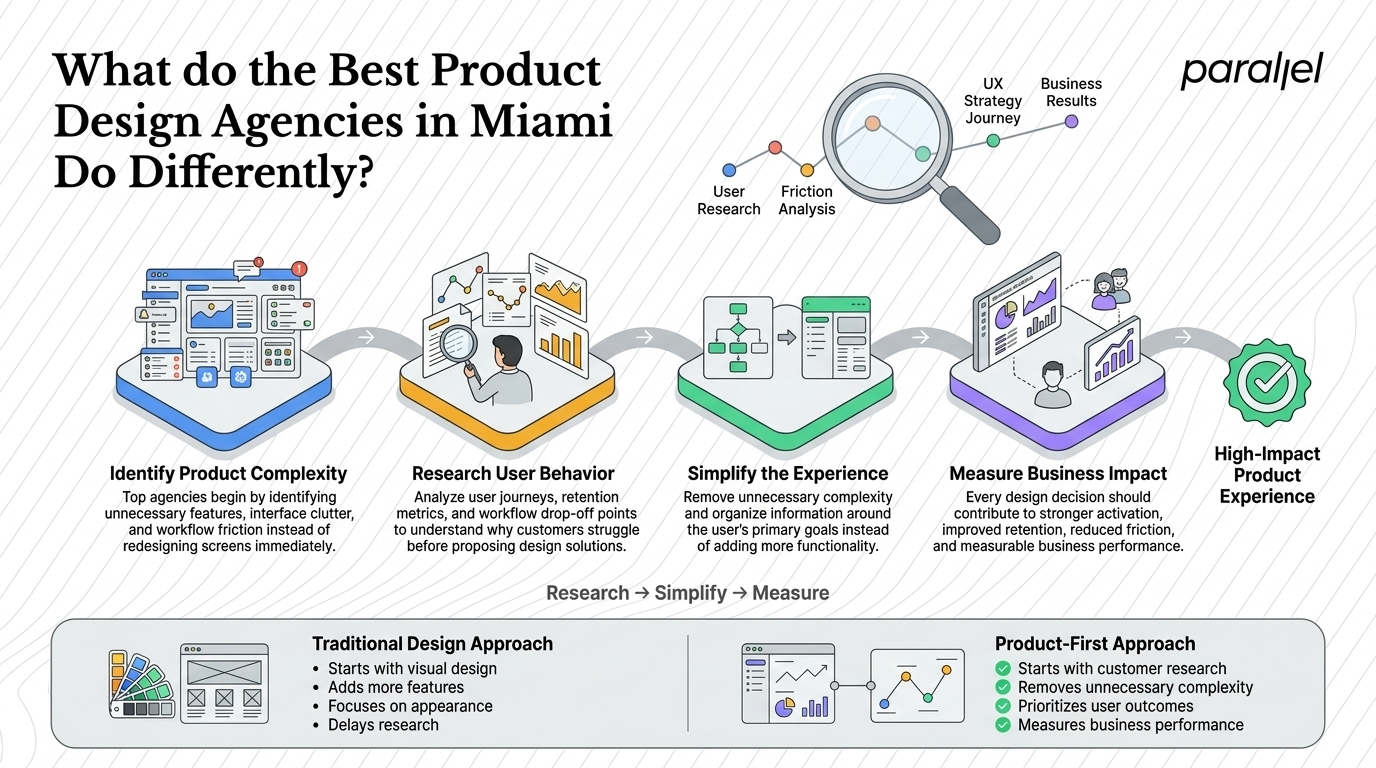
You will notice that the best product design agencies in Miami spend more time analyzing user friction than pushing pixels. They do not just take your brief and start designing. They push back. They ask about your retention metrics. They want to know why users fail to complete your core workflows.
In my experience, this is where most product decisions go wrong. Teams skip the research phase to save time. But as Forrester research updated for 2025 confirms, every $1 invested in UX returns up to $100. That massive ROI of UX only happens when you fix fundamental usability issues, not just surface aesthetics.
A practical approach is to map the user journey before touching a design tool. We use our product strategy consulting framework to align business goals with actual user needs. If an agency cannot explain how their design choices will impact your bottom line, they are not a true product partner.
How to approach your next product cycle
Startups often try to build everything at once. This leads to bloated products that confuse early adopters. I always advise founders to simplify their minimum viable product drastically.
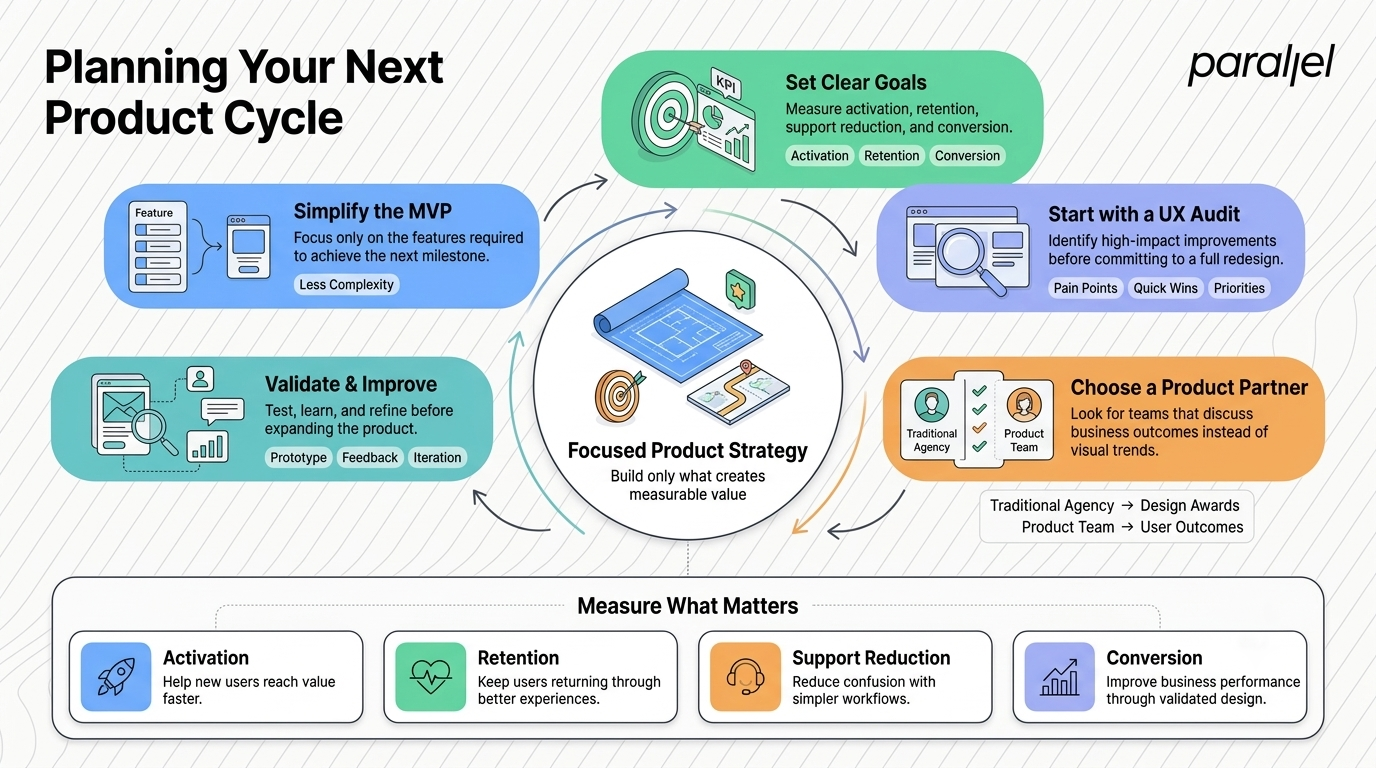
Your design partner should help you define what is truly essential. They should focus on the specific outcomes you need to hit your next funding milestone. This might mean a 20 percent increase in activation or a reduction in support tickets.
You can test this during your initial conversations. Ask them how they measure success. If they talk about design awards or visual trends, they are a traditional agency. If they talk about user retention, cognitive load, and conversion rates, they are a product team.
We often recommend starting with a UX audit to identify quick wins before committing to a massive redesign. This protects your capital and proves the value of the engagement early on.
Who are the 10 best product design agencies in Miami right now?
The right choice depends entirely on what you are trying to build. Some agencies are brilliant at consumer apps. Others are better suited for complex enterprise dashboards. Here is my breakdown of the top players in the market for 2026.
1) ParallelHQ
We built ParallelHQ to solve a very specific problem. I was seeing too many early-stage startups struggle with design decisions that should have been simple. Founders were paying agencies for massive UI kits, but their actual product experiences remained confusing and disjointed.
We are a product design and strategy partner. We work closely with founders and product managers to untangle complex user flows. Our focus is on real user behavior, not just surface-level visuals. We dive deep into your onboarding, your activation metrics, and your core feature adoption. If a feature does not serve the primary user journey, we cut it.
We help you define your product properly so you do not waste engineering cycles on assumptions. You can see how we approach early product stages through our MVP development process. Startups choose us when they need a mature partner who will push back and guide them toward the right decisions. We do not do fluff. We focus on clarity.
2) Momentum Design Lab
Momentum has built a formidable reputation around enterprise software and digital transformation. When a legacy corporation needs to modernize a massive platform, Momentum is usually on the shortlist.
They excel at mapping out highly complex data structures and turning them into manageable dashboards. I respect their rigorous approach to enterprise UX. They understand how to navigate corporate stakeholder environments and manage massive feature sets.
However, their heavy methodology is not always the right fit for an agile startup. Early-stage teams need rapid validation and tight feedback loops. A firm built to service Fortune 500 companies often moves at a different pace. If you have secured a massive Series B and need to completely overhaul an aging SaaS platform, they are a fantastic option. If you are trying to validate product-market fit on a tight runway, you might find their engagement model too heavy.
3) R/GA
R/GA is a global powerhouse. Their regional presence is strong, and they bring an incredible level of brand innovation to the table. They are brilliant at creating products that sit at the intersection of technology and advertising.
If your software relies heavily on cultural relevance and brand perception, their work is undeniably top-tier. They know how to build digital experiences that generate press and consumer excitement.
The challenge for startups is alignment. R/GA is fundamentally an agency that serves global mega-brands. Their cost structure reflects that reality. Furthermore, their core strength lies in brand-driven product innovation rather than deep, functional SaaS mechanics. If you are building a highly utilitarian B2B workflow tool, you do not need a global advertising powerhouse. You need a team focused strictly on utility and task completion.
4) Work & Co
Work & Co is highly respected in the design community. They strictly design and build digital products, deliberately avoiding traditional marketing work.
I appreciate their methodology. They prototype early and often. They put functional software in front of users instead of just presenting static slides. This aligns perfectly with how modern digital products should be built. Their work with massive consumer brands is consistently excellent.
The barrier for startups is accessibility. They typically engage with established companies that have massive product budgets. Their process is thorough and requires significant investment. For an early-stage founder, hiring Work & Co is often out of reach. Even if you have the budget, you have to ask if a premium consumer product agency is the right partner for a gritty startup trying to validate basic assumptions.
5) Neuron
Neuron has carved out a very specific and highly necessary niche. They focus almost entirely on B2B workplace software. I always advise founders to hire specialists, and Neuron fits that bill perfectly for enterprise SaaS.
They understand how employees interact with software during their workday. They focus on productivity metrics, reducing error rates, and simplifying data entry. Designing for a worker who is forced to use your software eight hours a day requires a completely different mindset than designing a consumer app.
Neuron gets this. They prioritize function and clarity over flashy interactions. If you are building a consumer social platform, they are not your team. But if you are building the next generation of logistics management software and need actionable B2B CRO suggestions, they speak your language.
6) STRV
STRV brings a very interesting hybrid model to the market. They are fundamentally a software engineering company with a very strong design practice attached. They have a massive track record in mobile app development.
If your startup requires an iOS or Android application and you do not have an internal engineering team, STRV is a logical choice. They handle the entire lifecycle from initial wireframes to App Store deployment. Their design aesthetic is clean, modern, and heavily optimized for mobile paradigms.
The limitation here is focus. Because they offer full-stack development, their design thinking is often filtered through the lens of their engineering capabilities. If you have your own developers and only need deep product strategy and UX design, a dedicated product design firm might provide a more specialized perspective.
7) Ramotion
Ramotion creates beautiful digital assets. They are known for brand identity, marketing websites, and user interface design. When you look at their portfolio, everything feels incredibly polished and premium.
Startups often hire them when they need to elevate their visual identity to secure the next round of funding. A stunning prototype can absolutely help sell a vision to investors. If you need top-tier UI/UX design for investor presentations, they deliver.
However, founders must be careful not to confuse visual polish with product strategy. I have seen startups invest heavily in a beautiful UI only to discover that the underlying user architecture is broken. Ramotion will make your product look world-class. You just must ensure that you have validated your market and defined your core user flows before handing the project off for visual execution.
8) Fuselab Creative
Fuselab Creative is a highly specialized team. They focus heavily on data visualization and complex dashboard design. This is a remarkably difficult area of UX.
Taking thousands of data points and presenting them in a way that is actionable requires deep analytical thinking. Fuselab does this very well. If your core value proposition is data analytics, reporting, or financial modeling, they have the specific expertise you need. They know how to use charts, graphs, and layout to guide user attention accurately.
Their hyper-focus is their biggest strength, but also their primary limitation. If your product is a straightforward workflow tool or a consumer-facing application, their specialized data skills might not be necessary. You always want to match the agency's core competency to your biggest product risk.
9) UX studio
UX studio operates on a global scale with a massive emphasis on user research. They are obsessive about testing. They do not rely on assumptions. They put prototypes in front of real users and measure the interactions.
I deeply respect this approach. Too many agencies skip research to move faster. UX studio understands that skipping research always costs more in the long run. They are an excellent partner if you have a live product with a high churn rate and you need dedicated user research to figure out exactly why users are leaving. They will audit your platform and provide data-backed recommendations.
Because they are a global team, you have to manage communication carefully. Asynchronous work is great, but early-stage product development often requires real-time collaboration and rapid whiteboarding sessions.
10) Clay
Clay is arguably one of the most famous UI and branding agencies in the world right now. Their aesthetic heavily influences modern digital design trends. They build incredible marketing websites and highly interactive digital experiences.
If you want a landing page that wins awards and positions your brand as a premium technology player, Clay is the gold standard. Their work is visually flawless.
But you must understand what you are buying. They are primarily a branding and digital experience agency. Startups often make the mistake of hiring a premium branding agency to solve complex backend product logic. If you need to figure out how a user manages permissions across a multi-tenant SaaS architecture, a branding agency is not the right fit. Hire Clay to make people fall in love with your brand. Hire a product strategy firm to make your software actually work.
Conclusion
Choosing among the best product design agencies in Miami comes down to your core problem. Are you trying to build a flashy marketing asset, or are you trying to build a sustainable software business?
If you need a pretty interface, there are plenty of vendors who can deliver that. But if you need to fix weak onboarding, simplify a confusing architecture, and drive real user activation, you need a different kind of partner.
You need a team that will push back on bad ideas and ground every decision in real behavior. That is how great products are actually built.
Frequently asked questions
1) What is a product design agency?
A product design agency focuses on the entire lifecycle of software creation. They do not just create visuals. They handle user research, strategy, information architecture, and interface design to ensure the product solves real problems and drives business growth.
2) How do I choose between the best product design agencies in Miami?
Look at their past outcomes, not just their portfolio. Ask them how they solved a complex user flow or improved an activation metric. The right agency will talk about business results and user behavior, rather than just design trends.
3) How much does it cost to hire a top agency?
Costs vary wildly based on scope and the agency reputation. A specialized boutique firm might charge between $30,000 and $80,000 for a comprehensive product sprint. Large global agencies often start their engagements well over $150,000.
4) Is a product design agency right for my early-stage startup?
It depends on your current bottlenecks. If you are struggling with user retention, SaaS onboarding, or complex feature sets, expert help is critical. If you just need a simple prototype to show friends, hiring an agency is premature.
5) What is the difference between UI design and product design?
UI design focuses strictly on the visual interface. Product design looks at the entire system. A product designer considers business goals, user psychology, market positioning, and technical constraints before drawing a single screen.
6) How long does a typical product design engagement last?
For an early-stage startup, a focused engagement should take four to eight weeks. This allows enough time for discovery, prototyping, and user testing without burning through your runway. Complex enterprise products can take several months.
7) What should I look for in a product design portfolio?
Ignore the pretty screens. Look for case studies that explain the problem, the research process, and the final business outcome. You want to see how the team thinks and makes decisions when faced with constraints.
8) Why should a startup choose ParallelHQ?
We focus exclusively on clarity and practical product thinking. We have seen what causes startups to fail, and we actively work to prevent those mistakes. We do not sell bloated agency packages. We partner with you to build software that users actually understand and adopt.

check out these related blogs












































































.webp)