I have seen countless founders stall their product growth simply because they picked the wrong agency engagement model. You have a budget secured and a clear roadmap ahead. Now you are stuck searching for a definitive answer on a design retainer vs project: which to choose.
This single decision dictates how your team ships features for the next six months. Choose poorly, and you burn cash on unused hours or get trapped in endless change requests. At ParallelHQ, we see teams overcomplicate this process constantly. I want to share how we approach this decision so you can make choices grounded in real user behavior and practical product thinking.
Quick answer
Choose a project model for clear, bounded deliverables like an MVP build or a targeted website redesign. Choose a retainer model when you have a live product, active users, and need continuous iterative design integrated with your engineering cycles.
Why the Design Retainer vs. Project Decision Matters for Your Runway
Every dollar matters when you are building a product in an early stage startup. We often meet teams who committed to a massive project scope when they actually needed flexible discovery. They end up with beautiful interfaces for features their users do not even want.
Alternatively, startups buy expensive retainers before they find product market fit. They burn through their runway while designers sit idle waiting for the engineering team to catch up. A 2025 Gartner report on software engineering found that 62% of product delays stem from misaligned resource allocation between the design and development phases.
You must align your engagement model with your actual product maturity. When you accurately solve this dilemma, you accelerate your time to market dramatically. You also protect your internal product team from severe burnout and scope creep.
Startups cannot afford rigid design thinking. The modern product environment demands flexibility. According to the 2026 State of UX by Nielsen Norman Group, teams that lack clear strategic goals waste up to 40% of their UX budget on superficial UI fixes instead of core usability improvements. You need clarity in your product strategy before you commit capital to any agency.
Where do product teams fail when weighing a design retainer vs project: which to choose?
I see two specific failure patterns across the industry over and over again. The first is treating product design like a traditional construction job. Founders want a fixed price and a fixed timeline for software that actually requires constant learning and iteration.
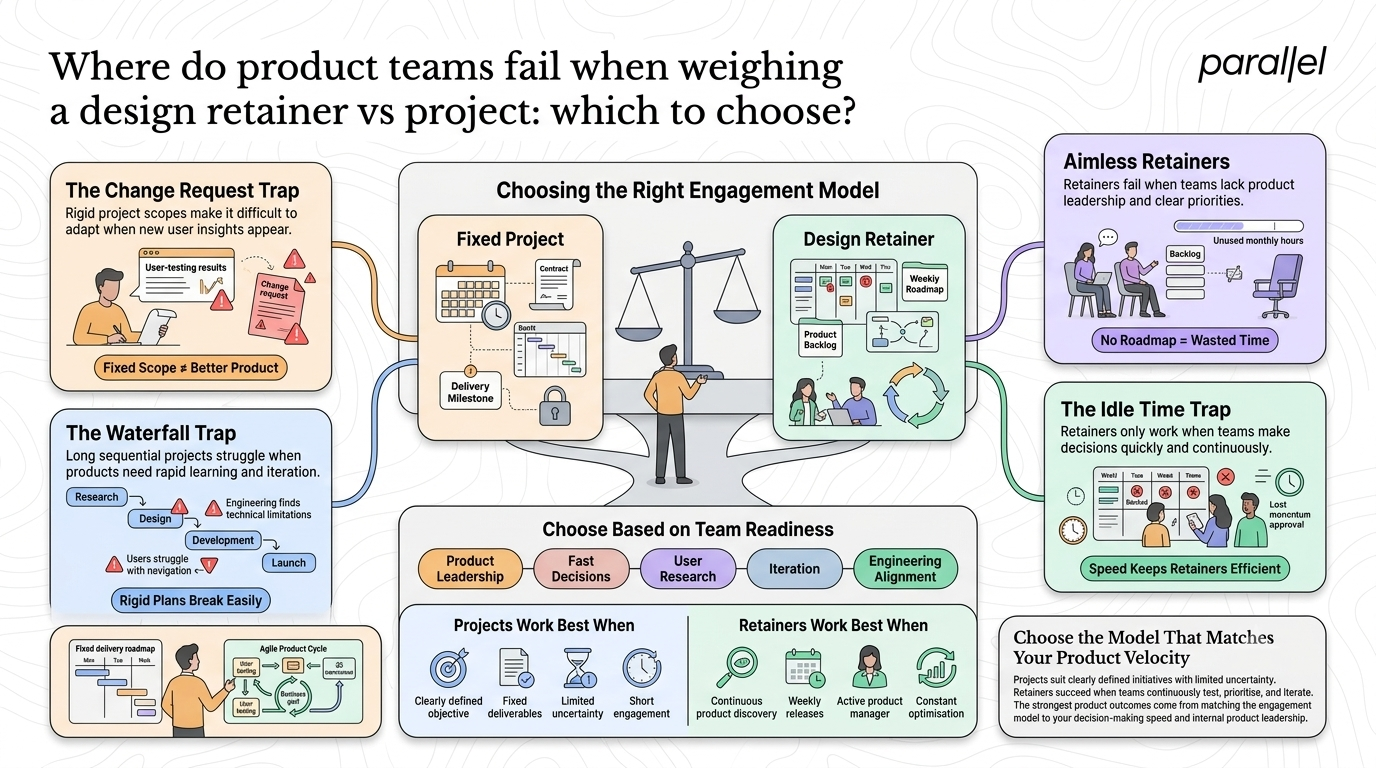
This mindset leads directly into the change request trap. Imagine you learn something entirely new in week three of user testing. A rigid project scope prevents you from pivoting without paying hefty administrative fees. The product ultimately suffers because the contract is inflexible.
The second massive failure is the aimless retainer. Teams hire a product design company on a large monthly fee without a clear, prioritized roadmap. Designers end up doing low value graphic tweaks just to burn through their allocated monthly hours.
We recently audited a healthtech startup that wasted six months on an aimless retainer. They had no internal product manager to feed work to the agency. The result was a polished but completely disconnected set of features. You must have internal leadership ready to guide an agency, regardless of the contract type you sign.
The waterfall trap in projects
Projects often force teams into a waterfall methodology. You do all the research upfront, design everything in the middle, and hand it off to developers at the end. This looks great on a spreadsheet. In reality, it rarely survives contact with actual users.
- Developers find technical limitations late in the cycle.
- Users misunderstand the core navigation during final testing.
- The market shifts before the product even launches.
If your project contract does not allow for iteration during the development phase, you are setting yourself up for a flawed launch.
The idle time trap in retainers
Retainers demand a high velocity of decision making. If your stakeholders take two weeks to approve a single wireframe, a retainer will bleed your budget dry.
- Designers need continuous access to user data.
- Engineers need to be ready to implement the designs quickly.
- Product managers must refine the backlog every single week.
If your organization moves slowly, buying a monthly block of time is a critical mistake.
How should you evaluate a design retainer vs project: which to choose based on maturity?
You need to look closely at your roadmap predictability. I always ask founders to rate their confidence in what they need to build over the next ninety days. We use a specific set of criteria to help them find the right path.
If you know exactly what screens need designing, a project works incredibly well. This is common for a basic MVP build or a targeted UX audit. If your roadmap changes weekly based on active user feedback, a retainer is a much safer bet.
Here is how we break down the core variables when we evaluate product teams.
Projects force absolute discipline upfront. Retainers buy you the flexibility to adapt as you learn. You must honestly assess which of these two things your startup needs more right now.
Understanding the project model anatomy
A well structured design project is not just a list of deliverables. It is a focused sprint toward a highly specific business goal. When we run projects for SaaS design services, we structure them around distinct milestones.
First, we define the exact user flows that matter most. We do not design every single edge case. We focus purely on the core loops that drive user activation.
Second, we set strict boundaries on revisions. This is not to limit creativity. It is to force decisions. Startups can debate button colors for weeks if you let them. A project timeline forces founders to make a call and move forward.
Third, the final handoff is comprehensive. We provide a complete design system component library and annotated files for the engineering team. The relationship concludes when the specific goal is met.
Understanding the retainer model anatomy
A design retainer operates entirely differently. You are not buying a set of screens. You are buying fractional access to a high performing product team.
In month one, the focus might be completely on usability testing your current live product. The team identifies friction points in the onboarding flow.
In month two, the focus shifts to rapid prototyping based on those findings. The design team works directly alongside your engineers in weekly agile sprints.
In month three, the focus might pivot entirely to a new AI feature you want to test. The retainer model absorbs this pivot smoothly. There are no new contracts to sign or scopes to negotiate. The team simply adjusts their focus for the next sprint.
What is the practical approach to settling a design retainer vs project?
This brings us to the core framework for solving the design retainer vs project: which to choose problem for your specific startup. You cannot make this decision based on what another founder did. You must look inward at your operational reality.
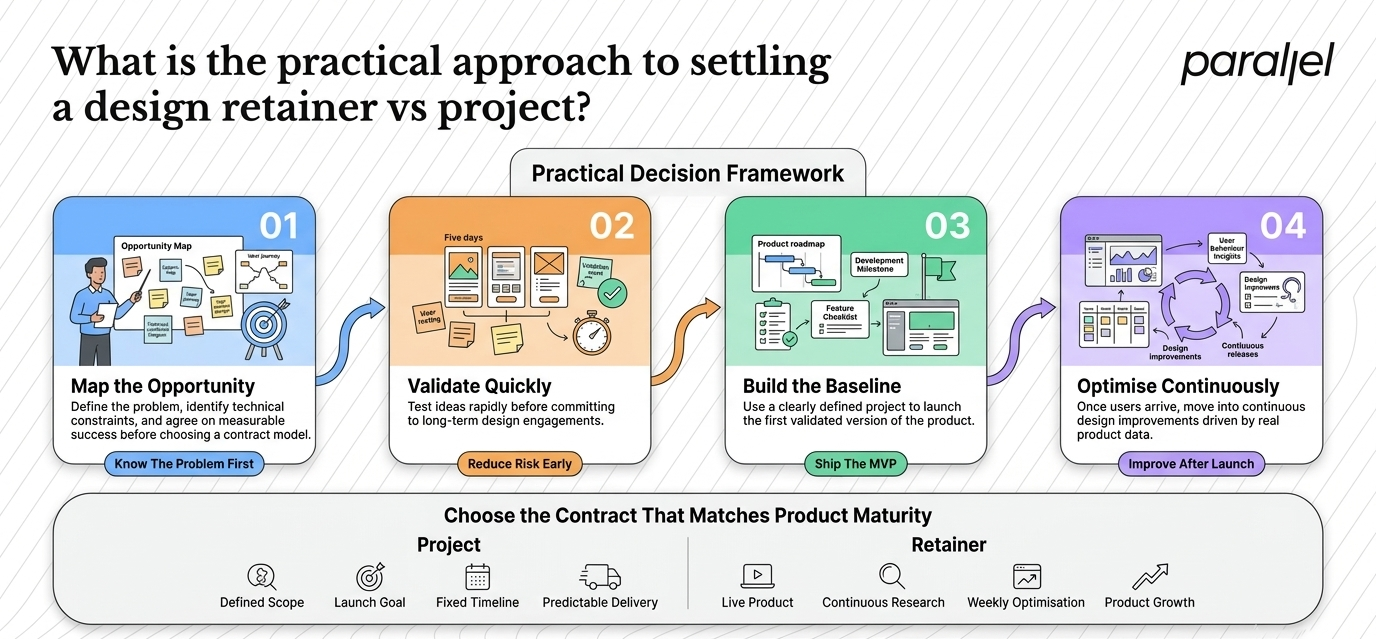
Start with an honest assessment of your internal capacity. Do you have a product manager ready to feed work to a design team every single week? If you do not have this leadership in place, a retainer will fail.
Here is the exact step by step framework we use to guide our clients at ParallelHQ.
Step 1: Map your immediate opportunity
Before discussing contracts, you need to know what you are actually trying to solve. We highly recommend starting with an opportunity mapping workshop. This exercise forces your team to align on the biggest risks and the most valuable features.
- Identify the exact user problem.
- Map the technical constraints.
- Define the metrics for success.
If the output of this mapping is a tight, well defined set of requirements, you lean toward a project. If the output reveals massive unknowns, you need a flexible model.
Step 2: Validate the concept quickly
Never sign a six month retainer to test an unproven idea. Run a short, concentrated design sprint instead. This limits your financial risk to a few weeks.
We use design sprints to help founders visualize their ideas and test them with real users within five days. If the concept fails the user test, you only lose a week. If you had signed a long term contract, you would be stuck building a flawed product.
Step 3: Build the baseline (The Project)
Once you validate the core direction, build the initial product using a strict project model. This gives you a clear baseline. You know exactly what you are paying for and when it will launch.
Defining a clear MVP development scope ensures you actually ship to market. Perfection is the enemy of a launched product. A project timeline forces you to prioritize ruthlessly.
Step 4: Shift to continuous optimization (The Retainer)
You should only consider switching to a retainer after the product is live in the market. This is when the real work begins. You now need continuous iterative improvements based on actual user data.
A recent 2026 study by Forrester Research shows that continuous product design yields a 30% higher customer retention rate than one off periodic redesigns. A retainer allows an embedded agency to monitor user behavior, suggest improvements, and design solutions continuously.
Are there hidden costs involved in a design retainer vs project?
Many teams focus entirely on the hourly rate when making this decision. They forget about the massive hidden costs of context switching and strategic misalignment.
When you execute a series of isolated, disjointed projects, the agency loses context between engagements. You spend weeks re educating them on your business logic every time you start a new phase. This onboarding time is expensive and frustrating for everyone involved.
Every time a new design team touches your product, they introduce slight inconsistencies. Over time, your product experience becomes fragmented.
The value of embedded context
Retainers solve this context issue by keeping designers embedded in your daily operations. They learn your market nuances deeply. They begin to understand the technical debt your engineering team is fighting.
Eventually, they start suggesting highly strategic product improvements rather than just taking orders. This is the hallmark of a mature UX design partnership. They act as true product thinkers, not just visual decorators.
The cost of weak internal leadership
However, retainers carry their own hidden risks. They demand incredibly strong internal leadership. You need a clear vision to keep an embedded team focused on high impact work.
If your internal team lacks product sense, an agency on a retainer will naturally drift toward low priority tasks. They will optimize screens that no users visit just to stay busy. The cost of a retainer is only justified if you point that design firepower at your most critical business metrics.
Building AI and complex SaaS products
We work extensively with teams building complex AI/SaaS products. The rules change slightly when you are dealing with novel technology.
When you build AI native interfaces, you cannot rely on established design patterns. You have to invent new ways for users to interact with generative models. This requires a massive amount of rapid prototyping and failure.
In my experience, a rigid project scope is highly dangerous for AI products. You will almost certainly need to pivot your UX based on how the underlying language model performs. For these highly volatile environments, a structured retainer combined with deep AI UX research is the only reliable path to success.
Measuring the real ROI
You must hold your agency accountable regardless of the model you choose. For a project, the ROI is simple. Did they deliver the agreed scope on time and to a high quality standard?
For a retainer, you must track business metric improvements. Do not measure success by the number of screens delivered. Measure success by outcomes.
- Did the new onboarding flow reduce drop off by 15%?
- Did the revised dashboard increase daily active users?
- Did the design system reduce engineering implementation time?
If a retainer is not moving these metrics after three months, you need to restructure the engagement or pause it entirely.
Your final verdict on a design retainer vs project: which to choose should always prioritize learning speed. Optimize for learning if you have the funding to support it. Optimize for fixed costs if you are bootstrapping your initial release to market.
The absolute best product teams know exactly when to use constraints to their advantage. They do not get caught up in agency jargon or industry hype. They focus entirely on what drives the most tangible value for their end users at this exact moment in time. Clarity in your product thinking will always dictate the right contract structure.
FAQs
1) What is the fundamental difference between a design project and a retainer?
A project has a highly specific scope, a set overall price, and a definitive end date. You are buying a specific outcome. A retainer is a recurring monthly agreement where you purchase a dedicated amount of a design team's time for ongoing, flexible work.
2) How do I know if my early stage startup is truly ready for a retainer?
You are ready when you have a live product, active users, and a continuous stream of feedback to act upon. Most importantly, you need an internal product owner who can confidently prioritize a backlog on a weekly basis to keep the design team moving.
3) Can we easily switch from a project to a retainer later?
Yes. We actively encourage this transition at ParallelHQ. It is almost always best to complete a foundational project first. This initial project builds mutual trust, establishes your core design system, and sets a baseline before moving into an ongoing retainer rhythm.
4) Which engagement model is better for building an MVP from scratch?
A project model is usually much better for a new MVP. You need strict external boundaries to avoid internal feature creep. Defining a clear MVP development scope ensures you actually ship to the market instead of designing endlessly behind closed doors.
5) Is a monthly retainer always more expensive than a project in the long run?
Not necessarily. Projects often carry massive hidden costs through change request fees when your market requirements inevitably shift. Retainers offer highly predictable monthly costs and eliminate the administrative overhead of constantly negotiating and signing new contracts.
6) How do we measure the actual ROI of a monthly design retainer?
You must track metric improvements rather than just counting output. Measure metrics like reduced user onboarding drop off, increased feature adoption rates, and faster engineering implementation times. High impact UX design to improve website conversions should pay for itself quickly.
7) What happens if we do not have enough internal work to fill a retainer?
Do not sign a retainer under these conditions. Choose a flexible project or pause external engagements entirely. Paying any agency to sit idle is a remarkably fast way to ruin your startup's unit economics.
8) How does ParallelHQ help teams decide which model fits their current stage best?
We always start with a blunt conversation about your business goals and current roadmap clarity. If things are ambiguous, we suggest an opportunity mapping exercise. We never push a retainer if a highly focused project will solve your immediate problem faster and cheaper.

check out these related blogs