I have seen too many early-stage teams burn their runway on design agencies that deliver beautiful, useless products. We built ParallelHQ because the industry is flooded with surface-level aesthetics masking weak product strategy.
Founders constantly ask me for advice on finding the right product design partner. I often get asked for a framework, and while a standard how to choose a UX design agency: 12-point checklist helps, what founders really need is a bullshit filter. You need a partner who understands real user behavior, not just the latest Figma trends. Let us get into exactly what matters.
Quick answer
Here is a comparison of the top 10 agencies in the market right now:
Why do startups struggle to find the right design partner?
Startups fail because they build things nobody actually wants. According to 2025 startup survival data, 42% of startups collapse because they misread market demand. They often hire an agency to make the product look impressive before proving the core mechanics work.
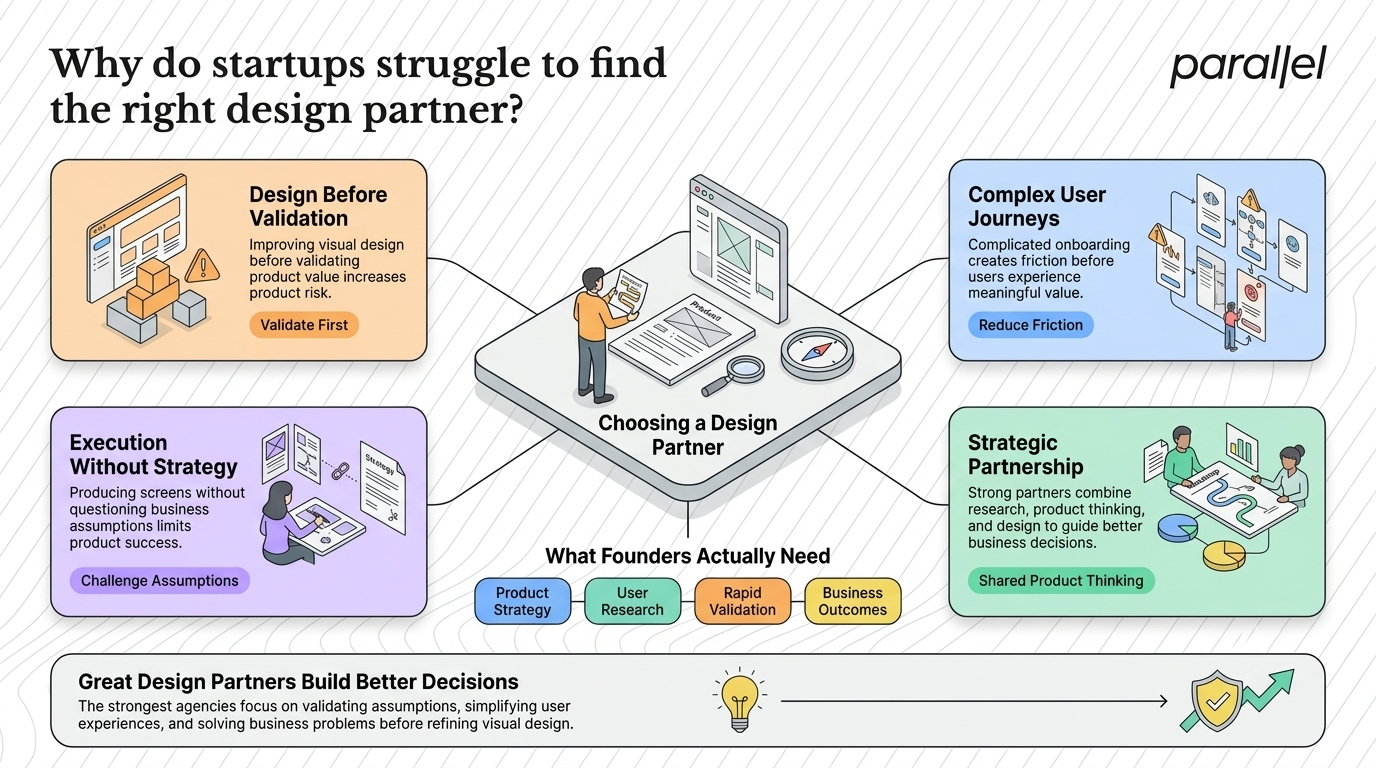
We have seen product teams overcomplicate onboarding flows, ignore basic usability rules, and then wonder why their activation metrics are entirely flat. UX design is not about making things pretty. It is about removing friction and solving complex business problems.
A strong agency acts as a strategic thought partner. They push back on your assumptions and help you navigate difficult product decisions. If your agency is just taking orders and coloring in wireframes, you are wasting your budget.
How to choose a UX design agency: 12-point checklist?
To save you from making expensive mistakes, I have broken down this how to choose a UX design agency: 12-point checklist to focus purely on business outcomes. We use these exact criteria to evaluate our own product strategy consulting engagements.
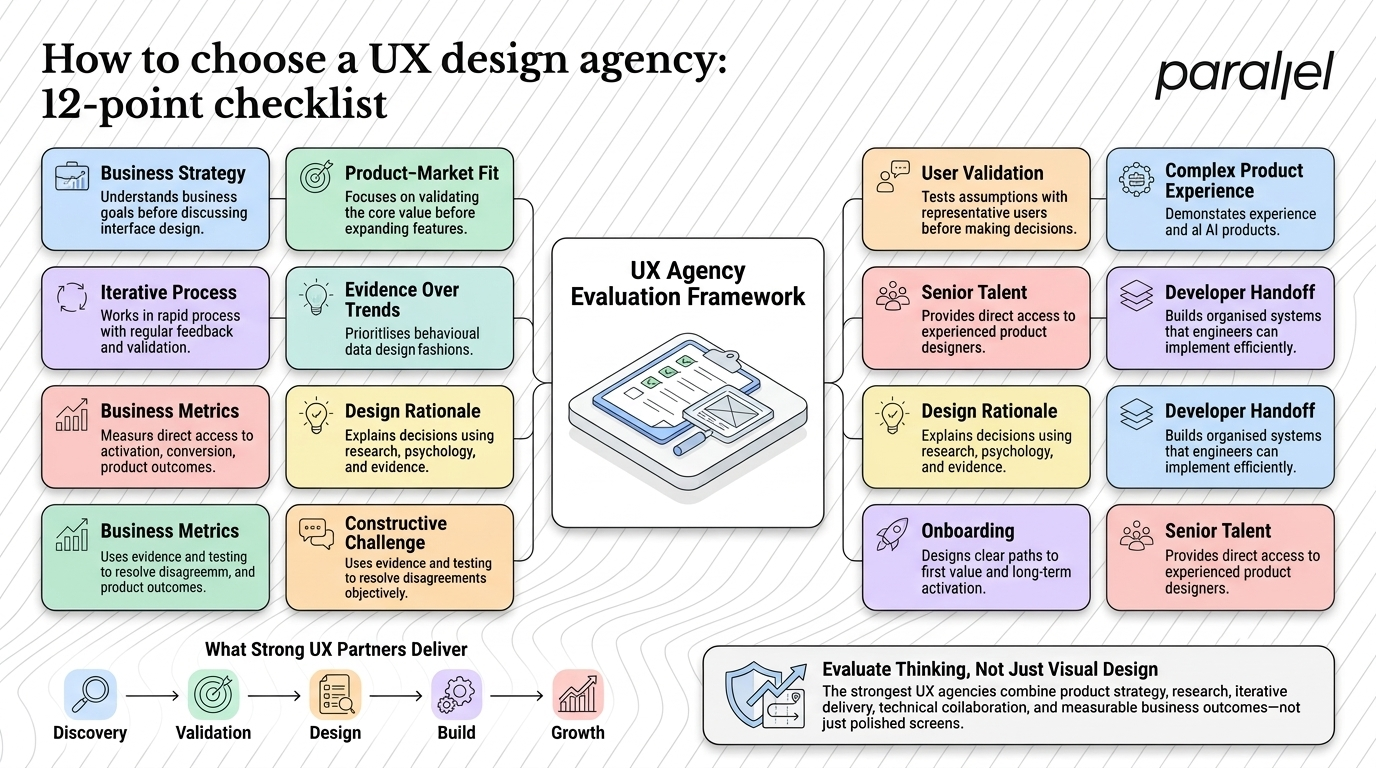
1) Do they ask business questions before design questions?
A weak agency starts by asking about your color preferences and brand guidelines. A strong agency starts by asking about your customer acquisition cost, your churn rate, and your core business model.
We once worked with a SaaS founder who asked for a complete user interface overhaul. We paused and ran a discovery framework session instead. The real issue was a disconnect in their pricing tiers, not the interface itself. Your agency must understand how your product makes money before they draw a single screen.
2) Do they understand product-market fit?
Building an MVP is not about cramming every possible feature into a first release. It is about isolating the core value proposition and testing it rapidly. Your design partner needs to understand the ruthless prioritization required for MVP development.
They should help you strip away the noise. If an agency suggests adding five new features before launch just because they look cool, they do not understand product-market fit. They only understand billable hours.
3) How do they validate assumptions with real users?
Testing with real people is a core requirement in our how to choose a UX design agency: 12-point checklist. Designing in a vacuum is dangerous.
The Nielsen Norman Group has proven for years that testing with just 5 users uncovers 85% of usability issues. If your agency does not mandate user research and usability testing, they are guessing. You cannot afford to guess with your product runway.
4) What is their approach to onboarding and activation?
Getting a user to sign up is only half the battle. If they drop off during the first five minutes, your product has failed. You need an agency that obsesses over the "aha" moment.
We regularly conduct SaaS onboarding teardowns because this is where most products bleed users. Your partner should map out the exact psychological steps a user takes from signup to first value. They should treat onboarding as a distinct, critical product feature.
5) Do they work iteratively or disappear for months?
The traditional agency model of disappearing for three months and returning with a grand reveal is dead. Startups move too fast for that. You need a partner who integrates with your team and works in tight, iterative cycles.
This is why we rely heavily on the design sprint methodology. We tackle a massive problem, prototype a solution, and test it in days, not quarters. Look for agencies that emphasize weekly syncs, rapid prototyping, and constant feedback loops.
6) Can they explain the logic behind a design decision?
Every design choice must have a logical defense. If you ask a designer why they placed a button in a specific spot, and their answer is "it just feels right," you have a problem.
Great designers articulate their decisions using psychological principles, established UX laws, and user data. They should be able to tie visual hierarchy directly to the user journey and your business goals.
7) Who is actually doing the work?
The classic agency bait and switch is an often-overlooked factor in the how to choose a UX design agency: 12-point checklist. You meet the brilliant founders and creative directors during the sales pitch. Once you sign the contract, your project gets handed off to a junior designer fresh out of a bootcamp.
Always ask who will be on your specific project team. You are paying for senior-level product thinking. Make sure you are actually getting it on a daily basis.
8) Do they design for clean development handoff?
A massive red flag in any how to choose a UX design agency: 12-point checklist evaluation is an agency that throws files over the wall. Developers cannot build products from messy, disorganized Figma files with unlinked components.
A mature agency builds scalable design systems from day one. They define interaction states, document edge cases, and sit down with your engineering team to ensure technical feasibility. Design is only valuable if it can be built efficiently.
9) Are they tracking ROI and conversion metrics?
Design is an investment, and it needs to yield a return. Forrester's landmark 2026 research loop confirms that every $1 invested in UX returns up to $100. Your agency should understand this math natively.
They should ask you about your current conversion rates and set a baseline. Whether you are running a UX audit or a full redesign, the goal is measurable improvement. If they are scared of metrics, they lack confidence in their own work.
10) How do they handle disagreement and pushback?
You do not want a yes-man. As a founder, you are close to your product, which means you have blind spots. A strong design partner will respectfully challenge your bad ideas.
They should bring objective frameworks to settle disputes rather than relying on opinions. When we disagree with a client at Parallel, we do not argue. We simply put the conflicting ideas in front of users and let the target audience decide the winner.
11) Do they rely on real data or generic trends?
This is exactly why every how to choose a UX design agency: 12-point checklist should mandate a deep review of how partners use quantitative data. Trends fade, but human psychology remains constant.
For example, the Baymard Institute's 2026 data shows that the average e-commerce cart abandonment rate sits at an alarming 69.8%. A good agency does not just design a pretty checkout. They analyze your specific drop-off data, remove form fields, and optimize the trust signals to capture that lost revenue.
12) Do they have complex product experience?
Designing a marketing website is vastly different from designing a deep B2B SaaS dashboard. You need a team that understands complex state management, data visualization, and intricate user roles.
If you are building in fintech, healthtech, or enterprise AI, standard UI patterns often break down. Ask to see case studies where the agency solved difficult, multi-step workflows. Look for evidence of deep interaction design expertise, not just static branding mockups.
Which top 10 agencies pass the evaluation process?
Once you apply the how to choose a UX design agency: 12-point checklist to the market, a few clear leaders emerge. Here is a deeper look at the landscape for 2026.
1) ParallelHQ
We focus exclusively on clarity, product strategy, and rapid iteration for early-stage teams and growing SaaS companies. We do not do fluff. We solve complex problems through rigorous product design services.
2) MetaLab
They are famous for their work with Slack and Uber. They deliver incredible visual polish, but they command massive budgets that are often out of reach for early-stage founders. Learn more about a practical MetaLab alternative.
3) IDEO
IDEO invented modern design thinking. They are fantastic for physical product innovation and deep ethnographic research. However, for fast-moving digital SaaS, their process can feel incredibly slow. Read our thoughts on finding an IDEO alternative.
4) Clay
Clay is the go-to agency right now for trendy, highly visual marketing sites and crypto interfaces. If you want bold 3D motion graphics, they are great. For deep SaaS product workflows, you might want a Clay alternative focused more on utility.
5) Frog Design
Frog is a legacy giant built for massive corporate digital transformations. They bring rigorous structure but lack the agile speed an early-stage startup requires. Check out our Frog Design alternative breakdown.
6) Ramotion
They blend brand identity tightly with UI design. They are a strong choice if you are completely overhauling your brand simultaneously. For teams needing purely functional product strategy, consider a Ramotion alternative.
7) Work & Co
They are highly technical and integrate deeply with engineering teams. They generally work with Fortune 500 companies rather than scrappy startups. Here is how to evaluate a Work & Co alternative.
8) R/GA
Rooted deeply in advertising, R/GA is brilliant at conceptual, campaign-driven digital products. They are less suited for gritty, day-to-day B2B software improvements. See our R/GA alternative guide.
9) Huge
Huge offers an omnichannel enterprise experience, handling everything from SEO to physical retail design. They are often too bloated for a founder who just needs a sharp product team. Read about finding a Huge alternative.
10) Instrument
Instrument excels at digital storytelling and highly creative brand experiences. They are perfect for consumer lifestyle brands, but maybe not the best fit for enterprise fintech. Look into an Instrument alternative if you need hardcore product logic.
Conclusion
The goal of this how to choose a UX design agency: 12-point checklist is not to find the flashiest portfolio online. Your goal is to find the sharpest thinkers who will treat your runway with respect.
Trust your gut during those initial discovery calls. If the agency sounds like a group of yes-men, or if they hide behind dense design jargon, walk away immediately. Good product design is simply clear thinking made visual. Find a partner who brings clarity to your chaos.
Frequently Asked Questions
1) What is the most critical item on how to choose a UX design agency: 12-point checklist?
Business alignment is the single most critical item. If the agency does not understand how your product acquires, activates, and retains users to generate revenue, their design work will ultimately fail to move the needle.
2) How much does a professional UX audit typically cost in 2026?
Pricing varies heavily by the size of the product and the agency's seniority. For a thorough, actionable UX audit from a specialized product team, expect to invest anywhere from $5,000 to $15,000.
3) Should I hire freelance designers or a dedicated UX agency?
Freelancers are great for executing specific, well-defined tasks when you already have a strong internal product strategy. An agency is better when you need strategic direction, user research, and a scalable design system built from scratch.
4) How do strong agencies measure the ROI of their design work?
Good agencies tie their work to core business metrics. They measure success through increased conversion rates, lower customer support ticket volume, improved task completion times, and reduced churn. They rely on analytics, not just compliments.
5) What is the fundamental difference between UI design and product strategy?
UI design dictates how a product looks and feels visually. Product strategy dictates what you are building, who you are building it for, and why they will actually pay for it. Great UX sits right in the middle of both.
6) How long does a standard remote design sprint take?
A traditional design sprint takes exactly five days. We map the problem on Monday, sketch on Tuesday, decide on Wednesday, prototype on Thursday, and test with five real users on Friday. It is the fastest way to validate a big idea.
7) Is this evaluation framework right for enterprise companies or just startups?
The core principles apply universally. Whether you are a seed-stage founder or an enterprise product leader, you still need a partner who prioritizes user testing, iteration, and business outcomes over vanity deliverables.
8) How does ParallelHQ handle complex B2B SaaS product design?
We start by breaking down the complexity. We map the entire user ecosystem, identify the core workflows that drive value, and aggressively simplify the interface. We test these workflows with niche industry experts before writing any code. Check out our SaaS design services to see our exact process.

check out these related blogs