Miami tech is maturing rapidly. Over the last few years, we have seen this city transition from a secondary market into a serious hub for innovation. Founders here are securing massive funding rounds. But I have also watched too many of these promising startups stumble right at the finish line. They fail because of weak product experiences. I have spent years working closely with founders and product managers, and I see the same pattern.
Early stage teams burn cash on surface level redesigns that look fantastic on a portfolio site but completely fail to activate real users. If you are searching for the best UI UX design agencies in Miami, you need to look past the aesthetics. You need a partner who deeply understands complex decision making, user behavior, and solid product strategy. Let us break down how to actually choose a partner that drives measurable growth.
Who are the best UI UX design agencies in Miami?
The best UI UX design agencies in Miami do not just paint screens. They simplify complex product decisions, fix broken activation loops, and ground their work in real user data. Below is the breakdown of the top ten partners for your next product build.
Top 10 comparison table
Why does choosing the right UI UX design agency in Miami matter?
Miami is no longer just a crypto and real estate town. We are seeing a mature, aggressive ecosystem of companies scaling rapidly in 2026. The stakes for getting your product right have never been higher. A recent 2026 report by Forrester highlights that design led companies report 50% higher revenue growth than industry benchmarks. But that growth only happens when design is used as a tool to solve fundamental business problems.
I have sat in countless boardrooms with founders who are visibly frustrated. They launch a new application that looks gorgeous, only to see a massive drop off at onboarding. This happens when you hire for visual execution instead of product thinking. Your design partner needs to understand the underlying mechanics of user activation. They must know how to simplify the cognitive load for your users. Whether you are looking for healthtech design services or fintech design services, the core principle remains the same. The interface must serve the user's intent without friction.
When you invest in product design services in Miami, you are not buying Figma files. You are buying a reduction in churn. You are buying faster time to value for your customers. If your agency does not talk about business metrics in the first meeting, you are talking to the wrong people.
What are common mistakes teams make in product design?
We see teams overcomplicate onboarding repeatedly. It usually backfires in spectacular fashion. Startups often assume that more features equate to more value. They build dense dashboards, layered navigation structures, and overwhelming settings pages. Then, when users complain, they hire an agency to simply make it look clean without actually removing the underlying systemic complexity.
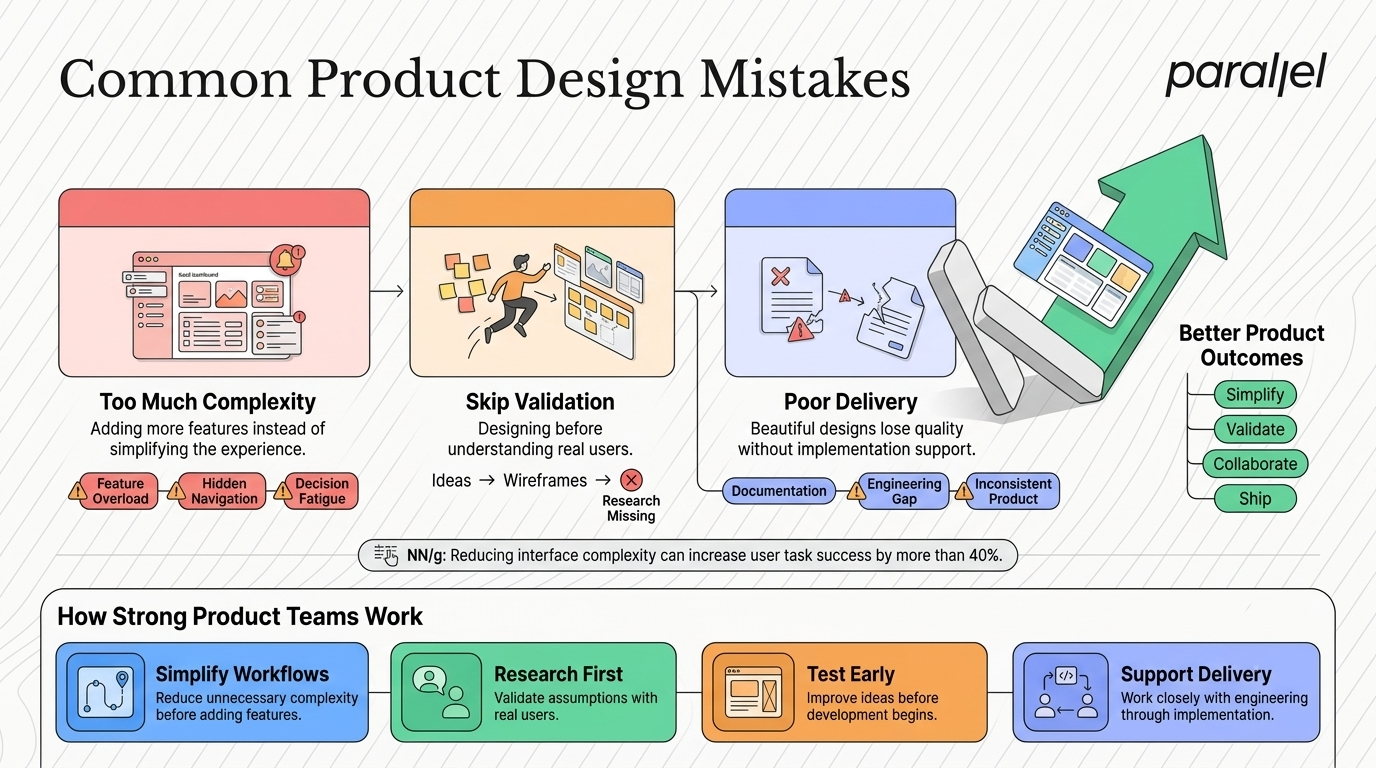
According to research from the Nielsen Norman Group, reducing interface complexity can increase a user's task success rate by over 40%. You cannot fix a bloated software product with rounded corners and a trendy new color palette. I always tell product leaders that a lack of clarity in product thinking will inevitably bleed into the user experience. If you do not know what the primary action is, your user will not know either.
Another massive mistake is skipping foundational user research. Teams are always in a rush. They push straight into high fidelity screens to appease board members or investors. They entirely bypass essential steps like opportunity mapping and rigorous usability testing. This results in products that are perfectly designed for the wrong audience. I have seen teams spend six months building a robust SaaS design only to realize their core user does not understand the basic value proposition.
The final trap is the agency handoff. Teams hire a massive agency, receive a beautiful deck of design guidelines, and then the agency disappears. The internal engineering team is left to interpret a complex design system without ongoing support. This leads to fractured implementations and a degraded final product.
How should you correctly evaluate UI UX design partners?
You have to anchor your design decisions in real user behavior. When you start talking to the best UI UX design agencies in Miami, pay attention to their questions. Are they asking about your brand colors and typography preferences? Or are they asking about your retention metrics and customer acquisition costs?
A mature product partner will push back on your assumptions. They will want to know exactly why users are churning after day seven. They will demand to see your product analytics. They will ask to speak directly to your most frustrated customers. This is the distinct difference between surface level visual design and true, rigorous product strategy.
At ParallelHQ, we rely heavily on a structured discovery framework before we even open a design tool. You need to map out the exact points where users feel friction or confusion. You need to establish a clear hierarchy of user needs. Only then can you start designing interface solutions. We often run UX audits for teams who know something is wrong but cannot pinpoint the exact point of failure.
You also need to think about iteration. A good design process is never a straight line. It is a loop of building, testing, learning, and refining. Look for partners who insist on testing prototypes with real human beings. Building a product without user feedback is just guessing with expensive resources.
Which are the top 10 UI UX design agencies in Miami?
Here is how I view the landscape of design partners available to the tech ecosystem in 2026. I have included our team alongside other globally respected firms so you can deeply understand the different approaches available in the market.
1) ParallelHQ
We built ParallelHQ because we saw startups struggling with design decisions that should have been much clearer. We are a product design and strategy partner deeply focused on clarity in thinking. We do not do agency fluff. We work closely with founders and product managers at early stage startups to unblock growth and build products that make sense.
If your team has a weak activation loop, poor retention, or an overcomplicated SaaS interface, we step in to ground those experiences in real user behavior. We regularly use design sprints to test risky concepts before your engineering team writes a single line of code. We are not just making things pretty. We are simplifying your complex product decisions to drive actual, measurable business outcomes. We are proud to offer dedicated UI UX design services in Miami for the growing tech community here.
2) MetaLab
MetaLab is an undisputed heavyweight in the interface design space. They have built a massive portfolio working with well known tech unicorns and consumer applications. Their visual execution is undeniable, and they are known for creating highly polished, instantly recognizable consumer facing applications.
However, their business model is typically built for later stage companies with massive budgets and long timelines. Early stage startups often find themselves needing a leaner, faster, and more agile approach to product strategy. If you are weighing your options and need a team that integrates tightly with your early stage speed, you might want to consider how a MetaLab alternative focuses more on rapid iteration and direct, unbureaucratic founder collaboration.
3) Clay
Clay produces some of the most striking web experiences in the entire design industry. Their work is highly interactive, motion heavy, and visually stunning. They excel at enterprise tech branding and creating immersive 3D web experiences that win awards.
The core challenge for product teams is that marketing sites and complex product interfaces require vastly different skill sets. A beautiful, animation heavy marketing site does not automatically translate into a highly functional, high converting SaaS dashboard. Teams looking for deep product thinking over visual flair often seek a Clay alternative to ensure the core application mechanics and user flows are rock solid.
4) Work & Co
Work & Co builds highly scalable digital products for massive global retail and consumer brands. They are highly systematic, engineering driven, and capable of handling incredible technical scale. Their engineering and design integration is highly respected across the enterprise industry.
They are a fantastic choice if you are a Fortune 500 company needing to completely overhaul a global e-commerce platform. But for a Series A startup needing to pivot a feature set quickly based on user feedback, their heavy process can feel stifling. Startups in this position often look for a Work & Co alternative that moves at the speed of an early stage venture and focuses purely on product market fit.
5) Ramotion
Ramotion is known for beautifully combining brand identity with modern user interface design. They are very popular with mid market tech companies looking to elevate their visual presence. They create clean, modern, and highly polished aesthetics that look absolutely great in investor pitch decks.
Where they sometimes fall short is in deep, complex user experience problem solving. Designing a clean interface is one thing. Fixing a deeply broken user journey within a legacy data system requires rigorous, analytical product strategy. Teams needing that level of analytical depth frequently explore a Ramotion alternative that focuses more on behavioral psychology than just visual branding.
6) Huge
Huge is exactly what their name suggests. They are a massive, global agency handling full scale digital transformations for legacy corporations. They offer everything from traditional marketing and branding to enterprise software design and change management.
Their sheer size is their biggest asset and their biggest drawback. You will get access to a vast array of global resources, but you might also get handed off to junior execution teams once the partner signs the contract. Founders who want senior talent actually doing the daily work often prefer a Huge alternative with a more focused, senior heavy boutique model.
7) Method
Method approaches product design from a highly strategic and academic angle. They are phenomenal at service design and broad customer experience mapping across multiple touchpoints. They help established, traditional corporations think about their long term digital futures.
They are incredibly thorough in their research. But if you have a tight runway and need to ship a minimal viable product to users in three months, their extensive research and mapping phases might severely slow you down. An agile Method alternative might be better suited for rapid product validation and faster speed to market.
8) Ustwo
Ustwo gained international fame through building incredible consumer gaming experiences and award winning mobile applications. They understand mobile interactions and touch interfaces better than almost anyone in the business. Their work is joyful, intuitive, and highly engaging.
If you are building a dense B2B enterprise software product, however, joyful interactions often take a backseat to pure utility and data density. The mechanics of a complex data dashboard are fundamentally different from a mobile game. Enterprise focused startups typically lean toward a Ustwo alternative specializing in dense data environments and complex workflows.
9) Neuron
Neuron specializes strictly in B2B enterprise UX. They deeply understand complex digital workflows, legacy system integrations, and technical constraints. They are very pragmatic and disciplined in their approach to interface design for serious software.
While they are highly capable in B2B spaces, some modern tech teams find their visual design output a bit too utilitarian and dry. Startups often want a perfect balance of deep UX thinking and top tier visual execution to stand out in crowded markets. This desire for balance is exactly why teams look for a Neuron alternative that does not sacrifice modern aesthetics for pure functionality.
10) Code and Theory
Code and Theory excels at designing content heavy platforms and digital publications. They have designed some of the most highly trafficked media and publishing websites in the world. They know exactly how to structure vast amounts of editorial content for maximum engagement.
But a content platform is not a software product. The complex user states, dynamic data requirements, and personalized workflows of a SaaS application require a completely different design methodology. Product leaders building complex software tools often need a Code and Theory alternative focused specifically on interactive product mechanics rather than content consumption.
How should you work with a product design partner?
Once you have selected a partner, how you integrate them determines your ultimate success. Do not just hand over a brief, schedule weekly check ins, and wait for screens to be delivered. You need to treat your agency as an integrated extension of your own product team.
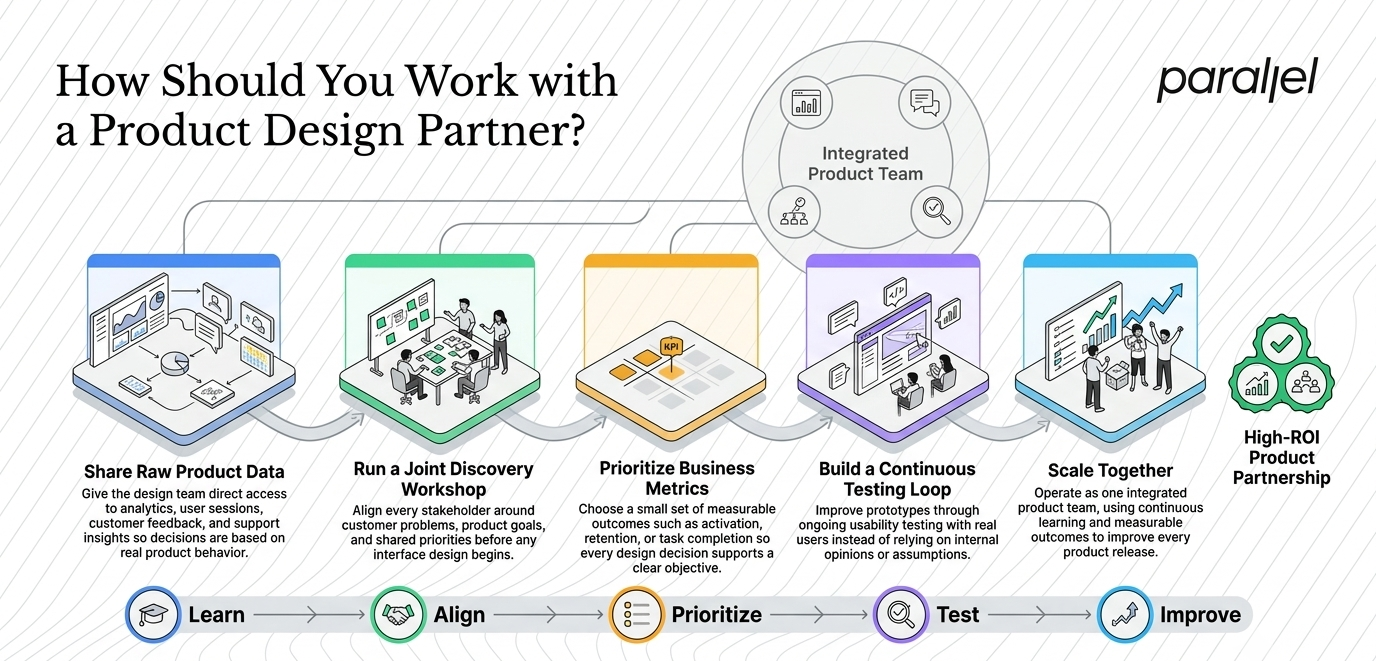
Here are the practical steps we recommend for a successful, high ROI engagement:
- Share the raw data: Do not filter the reality of your product. Give your design partner direct access to your analytics platforms, raw user session recordings, and angry support tickets. We need to see the truth to fix it.
- Run a joint discovery workshop: Use a structured discovery framework to align everyone on the exact core problems. Assumptions kill products.
- Force strict prioritization: Decide exactly which specific product metrics you are trying to move before any visual design work begins. If everything is a priority, nothing is a priority.
- Implement a rigid testing feedback loop: Base your design revisions on actual usability testing with real users, not just the subjective opinions of internal stakeholders.
According to a recent 2025 study by IDEO, integrated design teams that test prototypes with real target users on a weekly basis reduce their overall development waste by an astounding 60%. You must build this testing cadence directly into your agency contract and your product roadmap.
How is AI changing product design in 2026?
The landscape of design is shifting rapidly. With the rise of generative models and complex algorithms, the speed of visual execution has increased tremendously. However, artificial intelligence cannot replace deep human product thinking.
Many teams are rushing to add AI features without considering the user experience. We are seeing a massive need for dedicated AI UX design. Designing for trust, transparency, and data privacy in AI products is fundamentally different from traditional software. Your partner must understand these nuances, or your users will abandon the product out of confusion or lack of trust.
Conclusion
Product design is ultimately about achieving absolute clarity. It is about taking a highly complex system, understanding the user's core intent, and making the resulting experience feel completely inevitable to them. As you evaluate the market and talk to different teams, remember that the best UI UX design agencies in Miami will always prioritize clear, strategic thinking over cutting edge visuals. Do the hard work to find a partner who will openly challenge your assumptions, rigorously ground their design decisions in data, and actively help you build a product that people actually want to use.
Frequently asked questions
1) What exactly defines the best UI UX design agencies in Miami?
The top tier partners are defined by their ability to solve foundational business problems, not just visual ones. They possess deep expertise in user research, product strategy, and interactive interface design. They focus heavily on metrics like activation, retention, and task success rather than just delivering beautiful, static mockups.
2) How do I know if my startup needs a UX agency or just a freelance designer?
If you know exactly what needs to be built, have a proven strategy, and just need someone to execute the screens, a freelancer is fine. If you are struggling with low activation rates, complex user flows, or lack a clear product strategy, you need an agency. A mature partner brings a proven process for solving ambiguous product challenges.
3) Is hiring a local Miami agency better than hiring a remote global partner?
The physical location matters significantly less than their product thinking. While having an agency in your time zone is convenient, the best UI UX design agencies in Miami are often those who bring global, cross industry experience directly into your local market. Focus on their track record with your specific type of software product rather than their zip code.
4) How much should we budget for a serious product design engagement in 2026?
Quality product design is a direct investment in your company's growth and survival. For a comprehensive engagement involving research, strategy, prototyping, and full interface design, early stage startups should expect to invest between fifty thousand and one hundred and fifty thousand dollars. The exact cost heavily depends on the complexity of the product and the depth of the user research required.
5) What is the difference between UI/UX design and product design?
UI/UX design traditionally focuses on the digital interface and the immediate user journey. Product design encompasses a much broader, holistic scope. It includes business viability, technical feasibility, and long term product strategy. We position ourselves as product designers because we care about the tangible business outcomes just as much as the interface.
6) How long does a typical design sprint or product redesign take?
A focused design sprint to solve a specific, isolated problem can take just one to two weeks. A comprehensive redesign of a complex SaaS application typically takes three to four solid months. The timeline should always be dictated by the scope of the problem and the necessary user research, never arbitrarily forced.
7) What metrics should we track to measure the success of a design agency?
Do not measure success by how many screens they deliver or how pretty the presentation is. Measure it strictly by the impact on your product metrics. Track the time to value for new users. Monitor your onboarding completion rates. Look at task success rates and user retention cohorts. A strong design partner will help you establish these baselines before any work begins.
8) Why is ParallelHQ considered a strong alternative to traditional agencies?
We strip away the traditional agency fluff. We do not do surface level design. We work as a direct extension of your product team to solve complex problems with clear, grounded thinking. We focus entirely on creating usable, simple products that drive real user behavior and tangible business growth. If you are evaluating partners, I highly recommend reading our guide on how to hire the best UX design firms in 2026.

check out these related blogs