Most SaaS products fail because they confuse their users. I see this constantly when early-stage founders prioritize aesthetics over structural clarity. You do not need a redesign. You need a rethink. When evaluating the best SaaS design agencies in Seattle, the goal is not to find someone who can make your software look modern. The goal is to find a partner who understands activation, onboarding, and complex workflows. We built ParallelHQ because we realized teams were drowning in features instead of designing clear decisions. Here is how to evaluate the market and choose the right partner.
Quick Answer and Top 10 Comparison
The best SaaS design agencies in Seattle blend systems thinking with deep user research to solve complex product workflows. If you need clarity and activation over surface visuals, ParallelHQ leads the pack. Here is the top 10 comparison.
Why does finding the best SaaS design agencies in Seattle matter so much?
Software as a Service is fundamentally different from a marketing website or an e-commerce storefront. It is a tool people use to do their jobs. If your tool requires a manual or an hour-long onboarding call, your design has failed entirely. According to a 2025 report on B2B SaaS usability by Nielsen Norman Group, complex enterprise applications lose 42% of potential user adoption strictly due to poor information architecture. Users simply cannot find what they need to complete their tasks.
Founders in the Pacific Northwest tech hub often look for local talent to fix these exact metrics. The right agency understands how to map an opportunity and translate a convoluted feature set into a simple workflow. They look at your data first. They identify where users drop off during the trial period. They restructure the experience to ensure users hit the "aha" moment within the first five minutes.
Bad agencies just reskin your existing mess. They apply new colors and softer shadows to broken logic. This approach wastes your runway. Good design in SaaS directly impacts your Customer Acquisition Cost and Customer Lifetime Value. A 2026 study by Forrester Research on Design ROI demonstrated that platforms investing in structural UX improvements see a 25% reduction in support tickets within three months. You are not buying screens. You are buying business outcomes and user retention.
This is why getting the choice right matters. You need a partner capable of running deep product strategy consulting before they ever open a design tool. They must understand your backend constraints, your user permissions, and your business model.
Where do teams go wrong when evaluating the best SaaS design agencies in Seattle?
I have sat in countless product strategy meetings where founders show me their previous agency's work. The screens are always beautiful. They have perfect typography and flawless spacing. But they completely ignore how the database constraints dictate the actual user interface. This is the first major mistake teams make. They hire for visual output instead of product thinking.
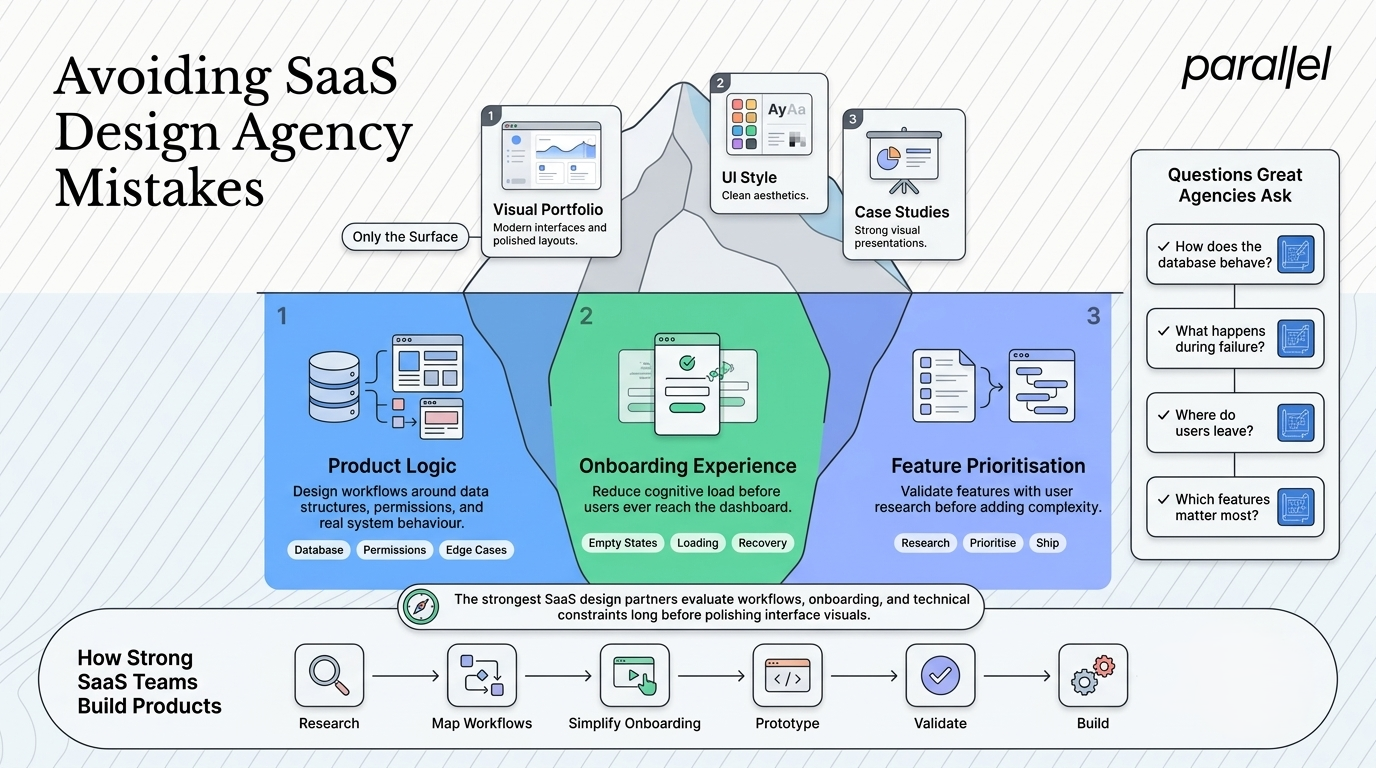
Teams often make decisions based on portfolio aesthetics. This is a critical error. Visual design is just the very top layer of the cake. You need interaction design that accounts for edge cases, error states, and multi-tenant permission structures. If an agency cannot explain how they approach a complex data table or a bulk-action workflow, they are not a true software partner. We often conduct a UX audit for post-Series A startups only to find that their previous design partner never actually spoke to a single real user.
Another common failure point is ignoring the onboarding experience. Agencies love to design the dashboard. The dashboard looks great in a pitch deck. But the user never sees that dashboard if they abandon the product during the setup phase. We recommend a rigorous SaaS onboarding teardown to identify where cognitive load overwhelms the user. Many agencies fail to design the empty states, the loading screens, and the error recovery paths. These are the exact moments where users decide to churn.
Finally, teams fall into the trap of the "Feature Factory". They hire an agency and hand them a massive list of features dictated by the sales team. A weak agency will simply design all 50 features, resulting in a bloated, unusable interface. A strong agency will push back. They will ask to see the user research validating those features. They will help you prioritize ruthlessly.
Who are the 10 best SaaS design agencies in Seattle right now?
The Pacific Northwest has a rich ecosystem of design talent. Here is a detailed breakdown of the partners capable of handling complex software challenges in 2026.
1) ParallelHQ
We focus entirely on product clarity and deep UX strategy. We do not just paint screens. We help founders simplify complex systems, fix broken activation funnels, and build scalable design systems. Our approach is grounded in real user behavior and rapid iteration. We use frameworks like the design sprint to validate concepts before engineering writes a single line of code. Our remote-first team works closely with US tech hubs to deliver SaaS design services that move actual business metrics. We believe in designing decisions, not just interfaces.
2) Blink UX
Blink is an established name in evidence-driven design. They excel at heavy user research and traditional usability testing. If you have a massive enterprise budget and need extensive lab testing for an internal tool, they are a solid choice. They index heavily on the research phase, making them ideal for highly complex, legacy software modernization where user workflows are deeply entrenched.
3) Substantial
Substantial bridges the gap between design and development exceptionally well. They are great for early-stage startups that need both a product design team and a technical partner to build the initial version. They take a pragmatic, ship-it-now approach to getting products to market. This dual capability reduces the friction of agency-to-engineering handoffs.
4) Artefact
Artefact leans heavily into future-thinking and responsible design. They are a good fit for complex tech in healthcare, education, or advanced AI where ethical considerations are paramount. If your product requires a deep understanding of societal impact alongside interface design, their strategic approach is highly valuable. They ask the hard questions about long-term product consequences.
5) UpTop
UpTop focuses heavily on transactional interfaces and heavy enterprise applications. They have a strong background in complex data visualization and customer portals. Their approach is highly analytical. This makes them highly suitable for mature platforms dealing with massive datasets, such as fintech or logistics software, where clarity is a matter of compliance and speed.
6) Anthro-Tech
This team specializes in human-centered design with a strict focus on accessibility. If your software serves a diverse, public-facing demographic or operates in the government sector, their research methodology is rigorous. They ensure that complex digital tools remain usable for individuals with varying degrees of digital literacy and physical ability.
7) Smashing Ideas
They bring a slightly more consumer-focused engagement model to digital products. They are highly effective if your B2B tool needs to feel more like a consumer application to drive daily active usage. They excel at gamification, engagement loops, and creating moments of delight within otherwise dry business workflows.
8) Intentional Futures
Intentional Futures operates as part consultancy and part design studio. They are excellent at the very early stages of product definition. They help teams figure out exactly what to build before they start drawing screens. If your startup is pivoting or trying to define a new market category, their strategic framing is incredibly useful.
9) projekt202
While they are a global firm, their local footprint is massive. They focus on software development heavily informed by UI and UX research. They are ideal for massive enterprise digital transformations. If you are a Fortune 500 company trying to act like a SaaS startup, they have the scale and processes to handle multi-year software initiatives.
10) Formidable
Formidable is primarily known as an elite engineering firm, but their design architecture capabilities are exceptional. If your platform requires a deeply technical React architecture alongside a new visual language, they execute this perfectly. They build the technical foundation so that your in-house team can scale the product effortlessly later.
How should you think about choosing from the best SaaS design agencies in Seattle?
Choosing a partner requires looking directly at their underlying methodology. Do they jump straight into Figma on day one? If so, you need to run away. The initial weeks of any software engagement must be spent understanding your business model, your technical constraints, and your end users.
Look for a team that runs a structured discovery framework. They should be asking uncomfortable questions about your product metrics. They should want to know your churn rate. They should ask to see screen recordings of users failing to complete tasks. A 2026 study by the Product Development and Management Association revealed that startups involving design partners in early strategic planning see a 35% higher retention rate post-launch. You want a partner who actively challenges your feature requests, not an order-taker who blindly executes them.
You must also evaluate their understanding of cognitive load. Tesler's Law states that every application has an inherent amount of irreducible complexity. The question is who deals with that complexity. Is it the user, or is it the system? A great agency works tirelessly to push that complexity onto the backend. They use progressive disclosure. They hide advanced settings until they are explicitly needed. They design smart defaults. If an agency's portfolio shows every single feature crammed onto one dashboard, they do not understand how to manage complexity.
Finally, consider their stance on artificial intelligence. Software is changing rapidly. You need a partner who understands how to integrate natural language inputs and predictive workflows. We frequently run an AI readiness design scorecard with our clients to determine if they actually need an AI feature or if they just need better basic logic. Your agency should guide you through these technological shifts with pragmatism, avoiding hype-driven design.
What practical steps guarantee success with the best SaaS design agencies in Seattle?
Success comes down to how well you integrate the external team with your internal engineering and product managers. A common pattern we observe is the agency toss. The agency designs the product, throws the files over the digital wall, and disappears to the next client. This model never works in software.
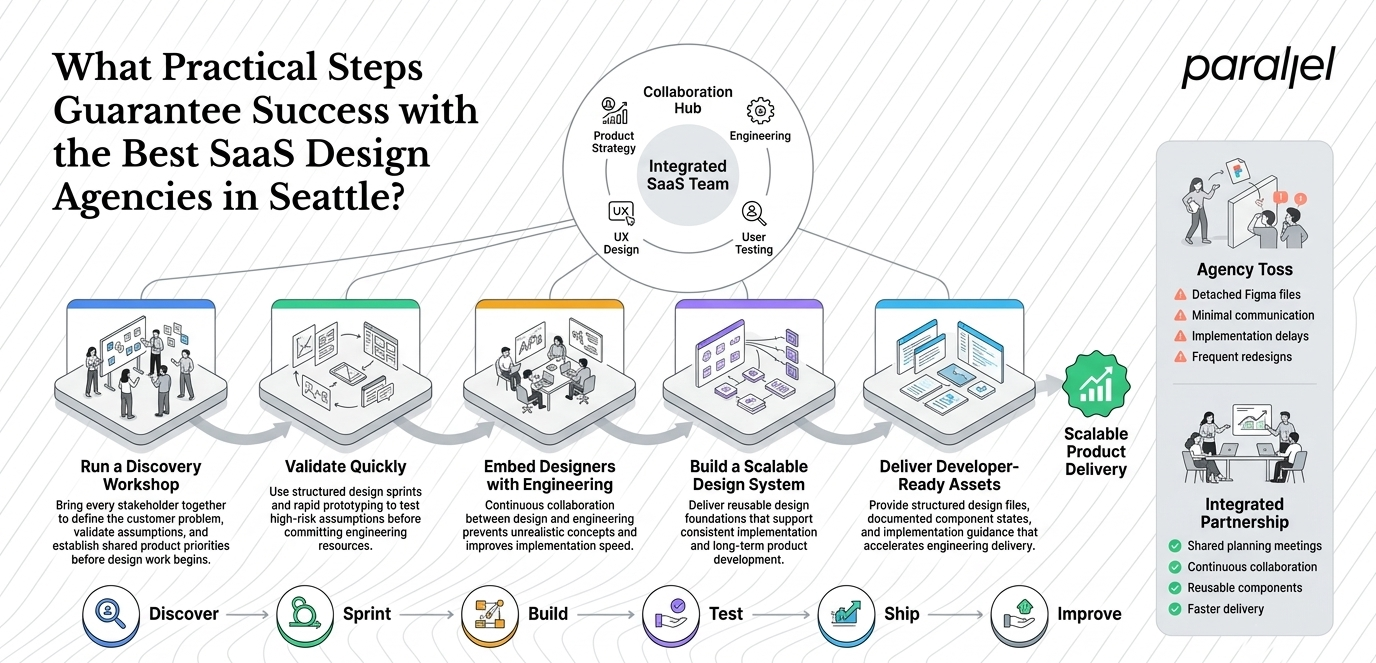
You need continuous collaboration. Start with a structured workshop to align on the core problem. We prefer using a design sprint to quickly validate the riskiest assumptions in just a few days. This forces the agency, the founders, and the lead engineers into the same room to make rapid decisions.
Next, force the agency to sit in on your engineering planning meetings. They need to hear the developers complain about API limitations. They need to understand the data structure. At ParallelHQ, we mandate that our designers understand the frontend framework our clients use. This prevents us from designing bespoke experiences that take six months to build when a standard component would take two weeks and achieve the exact same user outcome.
You must also demand a scalable system, not just flat files. Ensure they deliver comprehensive design systems in code-ready formats. This means providing clearly defined variables for spacing, typography, and color tokens. It means mapping out every state of a button, from default to hover, disabled, and loading. A true partner sets your engineering team up for long-term velocity. If you are just handed a messy Figma file with detached components, you have wasted your budget.
How do the best SaaS design agencies in Seattle approach real user behavior?
Great design is grounded in observation, not assumption. The most effective teams rely heavily on evaluative research. They put rough, ugly prototypes in front of real users as early as possible. They do not wait for perfect visual polish to test a hypothesis.
IDEO's foundational principles of human-centered design remain the absolute standard here. You must observe users failing at tasks to understand what actually needs fixing. When a user cannot find the export button, asking them "where would you look for it?" is useless. Watching them click the wrong menu three times in frustration is invaluable. In early 2026, McKinsey's updated design index noted that companies testing concepts with users weekly iterate four times faster than those testing quarterly.
We see this play out daily. When we conduct usability testing on legacy tools, the insights gathered in just five hours of observation consistently overwrite months of internal roadmap planning. We recently worked with a logistics platform that spent three months building a complex analytics dashboard. We tested it with five dispatchers. None of them looked at the charts. They only wanted to see the raw table data so they could copy it into Excel. We scrapped the dashboard and built a robust data table with advanced filtering.
Your agency must be willing to kill their darlings. They must be willing to throw away beautiful designs if the user research proves they are confusing. This requires a level of humility that many traditional creative agencies lack. Product design is a scientific process of hypothesis, testing, and iteration. It is not an art project. The agencies that understand this are the ones that actually drive metric growth for their clients.
Conclusion
Building software is incredibly difficult. Scaling it is even harder. Every extra click, every hidden menu, and every confusing piece of jargon costs you money in churn and support tickets. The right partner will not just make your product look better. They will make your product make sense.
Do not settle for a reskin. Demand a partner who will challenge your roadmap, interview your most frustrated users, and simplify your core workflows. When you stop focusing on aesthetics and start focusing on clarity, user behavior naturally aligns with your business goals. Choose a team that thinks as deeply about the problem as you do.
FAQ
1) What exactly defines a SaaS design agency?
A specialized agency focuses on complex, data-heavy software applications rather than marketing websites or simple mobile apps. They focus entirely on user flows, system architecture, onboarding funnels, and retention metrics. They understand how database structures impact the interface.
2) How much does a comprehensive redesign typically cost?
Costs vary wildly based on scope and technical debt. An early-stage MVP design sprint might range from $20,000 to $40,000. A massive enterprise platform overhaul with hundreds of screens and a new component library can easily exceed $150,000 and take several months.
3) How is ParallelHQ different from traditional agencies?
We focus strictly on product clarity and deep strategic thinking. We do not operate like a traditional agency that just hands over flat design files. We act as an extension of your product team to solve complex workflow problems using rapid iteration and real user validation.
4) How long does a typical UX engagement last?
For a core product module or a specific workflow optimization, expect a timeline of 6 to 10 weeks. Comprehensive platform redesigns can take 3 to 6 months of iterative work alongside your engineering team to ensure proper implementation.
5) Should we hire an in-house designer or partner with an agency?
If you need rapid execution on a highly complex problem or need to establish a foundational design system, an agency brings diverse experience and proven frameworks. Once that core system is established, hiring an in-house designer to maintain and iterate on it is usually the smartest route.
6) What is a design system and do I actually need one?
A design system is a centralized collection of reusable components, guidelines, and code snippets. If your engineering team is building the same button or dropdown three different ways, you absolutely need one to scale efficiently and maintain visual consistency.
7) Can an agency help navigate our existing technical constraints?
The good ones do. A strong product partner will tailor their UX solutions to fit your existing tech stack. Whether you use React, Vue, or a specific set of third-party APIs, they will design within those boundaries rather than fighting them.
8) Is this right for me if I am pre-revenue?
If you are pre-revenue, your absolute priority is proving the core concept. You might not need the absolute best SaaS design agencies in Seattle just yet. A highly focused MVP development phase or a short design sprint to validate your idea with early adopters is usually a better investment than a massive retainer.

check out these related blogs