Frog Design is one of the most recognized names in the design world, but it's not built for every team. If you're running an early-stage AI or SaaS startup, Frog's enterprise-scale engagements, long timelines, and six-figure minimums can make it the wrong partner at the wrong moment. This guide cuts through the noise on Frog Alternatives Compared, covering ten agencies worth serious consideration in 2026. I'm Robin Dhanwani, founder at ParallelHQ, and every assessment here comes from firsthand experience in the startup design space.
TL;DR
- Frog is built for large-scale business transformation, not fast-moving startup product work.
- The best Frog Alternatives Compared depend on your stage, budget, and whether you need strategy vs. execution.
- Agencies like IDEO and Huge serve enterprises; Clay, ustwo, and Ramotion are better for scale-ups.
- ParallelHQ is the startup-native option when you need senior product design without enterprise overhead.
What Makes Frog Design Hard to Replace (and Why Startups Try)
Frog is one of the oldest design agencies around, starting back in 1969 with early product design work for Apple, Sony, and NeXT. That legacy is exactly the problem for founders. Frog Design is a strategic-creative consultancy combining research, strategy, technology, and design to create products and services. The key word is "strategic-creative", their model is optimised for enterprise transformation programs, not iterative SaaS product work.
Enterprise-scale programs with Huge, Frog, or IDEO start at $150,000–$200,000 and scale upward based on scope and duration. For a seed-stage startup, that pricing removes Frog from serious consideration before the first call. Beyond budget, the structural mismatch is just as significant. Choose Frog if your UX challenge is part of a larger customer experience or business transformation effort.
Most early-stage startups aren't running transformation programmes, they're trying to ship a product that converts. Frog charges clients based on project scope, duration, and complexity, which may include fixed-price contracts or time-and-materials billing. This flexibility sounds appealing, but in practice it means no transparent pricing and long negotiation cycles that startups can't afford.
What founders actually want is a partner who understands that a user experience design decision at seed stage carries real consequences in activation, retention, and fundraising. The firms below address that directly.
How Frog Design Compares to Other Top Design Firms
Before exploring the full Frog Alternatives Compared list, a clear comparison table helps orient the decision.
This table shows where the real split lies: most of the well-known Frog alternatives are built for the same large-client tier. The gap for startup founders is more significant than most comparison lists acknowledge.
Frog Design Competitors Worth Considering in 2026
1) IDEO
IDEO has been helping imaginative leaders shape the future for nearly 50 years, and is best known for innovation strategy, organisational transformation, and AI-era design thinking. Their focus has shifted toward helping organisations build innovation capabilities rather than shipping products directly. IDEO is the most intellectually credible name on this list, but it comes with the same access problem as Frog.
IDEO's scale and philosophy mean they're not the right agency for a startup that needs a SaaS product shipped in 10 weeks, their minimum engagement size and timeline expectations reflect the systemic nature of their work. Projects sit on the expensive end and often run as multi-week strategy sprints rather than fixed jobs with a clear price tag.
Verdict: Worth benchmarking your thinking against. Not a realistic partner for pre-Series B teams.
2) Clay
Clay is a global UI/UX design and branding firm headquartered in San Francisco, creating digital products, websites, design systems, and brand identities with deep experience in B2B, SaaS, AI, and fintech. Their partners range from startups to Fortune 100 companies, including Meta, Google, Slack, Coinbase, Amazon, Coca-Cola, Sony, and Uber.
For startup founders specifically, Clay is the right pick at Series B and beyond, when the company has the budget for premium product design and the stakes (next round, IPO trajectory, category leadership) justify the investment. Below that stage, Clay's minimum engagement sizes create the same access problem as Frog.
Verdict: Strong for well-funded scale-ups. Too expensive for seed-to-Series A teams.
3) ustwo
ustwo is a global digital product studio that partners with ambitious companies to design, build, and ship meaningful digital products and services, and as an employee-owned Certified B Corporation, it builds its practice on ethical principles. Their methodology is built on a "discovery-to-delivery" framework, embedding teams with clients to tackle challenges from initial concept validation to full-scale product launch.
Their boutique size compared to massive consultancies means focused, senior-level attention, though limited capacity for extremely large enterprise programs, and their availability can be competitive, making them an ideal fit for well-funded startups and corporate innovation labs.
Verdict: Best when you need a dedicated embedded team. Limited availability is a real constraint.
4) Huge
Huge operates as an international digital agency recognised for brand-centric, platform-based design solutions, having expanded its AI capabilities significantly with a focus on marketing automation, intelligent user experiences, and enterprise-level brand analytics.
Choose Huge if UX needs to connect directly to growth, digital transformation, and enterprise-scale execution. Huge is firmly in the enterprise tier and is not a realistic option for most startups evaluating Frog Alternatives Compared on a constrained budget.
Verdict: Enterprise only. Skip unless you're a late-stage company with a transformation mandate.
5) Ramotion
Ramotion is a digital product and brand design agency headquartered in San Francisco, with its official positioning on creating brand identity design, marketing websites, and UI/UX design for web and mobile apps.
Many startups share a common design problem: the brand looks one way, the product looks another, and the website looks like it was made by a different team, and Ramotion's positioning seems built to fix that. Ramotion built its reputation on high-profile work for Apple, Netflix, and Mozilla, and lists an average hourly rate of $150–$199 per hour with a project minimum of $50,000.
Verdict: Excellent for brand-to-UI cohesion at Series A and beyond. The $50K minimum still excludes early-stage teams.
What Should I Look for When Choosing a Frog Design Alternative?
This is the question most founders get wrong. They evaluate agencies on portfolio aesthetics when they should be evaluating on process fit. Here's what actually matters:

- Stage alignment: Does the agency have a model for your current stage, or do they retrofit enterprise workflows onto startup timelines?
- Decision speed: Can they move in weeks, not quarters? Startup product decisions don't wait for monthly status calls.
- Product strategy depth: Wireframing software and prototyping tools are table stakes. The question is whether the agency can connect interaction design to your conversion and retention metrics.
- Design handoff quality: A beautiful Figma file with no component logic or developer notes adds weeks to your engineering timeline. Ask specifically about their design handoff process with Zeplin or native Figma dev mode.
- Domain knowledge: An AI SaaS product has different onboarding friction patterns than a fintech app. Generic user experience design thinking isn't enough, you need sector-specific usability intuition.
- Engagement model flexibility: Design retainer pricing typically runs $3,000–$30,000/month depending on scope, team size, and agency seniority. If an agency only operates on large project engagements, it will be a poor fit for startups iterating continuously.
The right Frog alternative isn't the one with the most impressive awards. It's the one whose engagement model matches how your product team actually works.
Is There a Cheaper Alternative to Frog Design Studio?
Yes, and the cost difference is significant. Template-based projects from regional agencies start around $10,000–$20,000, while mid-market engagements with research, strategy, and full UI/UX deliverables run $25,000–$100,000.
For startups specifically, the cost-access picture is more nuanced than a flat price comparison:
- Subscription/retainer models ($3K–$15K/month) give startups ongoing design capacity without project-based minimums. These work well for teams shipping continuous product updates.
- Boutique specialist studios can execute a focused UX audit or design sprint at $10K–$25K, delivering 80% of the strategic value of a Frog engagement at a fraction of the cost.
- Productised service offerings like MVP development, wireframing and prototyping, or a SaaS onboarding teardown give you targeted insight without committing to a six-figure retainer.
Startups typically budget $1,000–$5,000/month using subscriptions or freelancers , but in practice that budget tier delivers inconsistent output. The productive range for startup design partnerships sits between $5K and $20K/month, enough to sustain continuous iteration without the overhead of an enterprise agency model.
The honest answer: a cheaper alternative to Frog exists at every stage. The question is whether you're getting strategic product design thinking, or just execution.
Frog Design vs IDEO: Which Is Better for Product Design?
This is a common question but a misleading one for startup founders. Both firms operate at the same budget tier, serve similar enterprise clients, and share a research-led philosophy that's mismatched for fast-moving digital product work.
Where they differ in character:
- Frog leans into systems design, brand expression, and connected hardware alongside digital. Frog's scalable design systems offer a logical framework for creating product experiences. Their Capgemini Invent ownership means deeper integration with enterprise technology delivery.
- IDEO is the originator of design thinking as a discipline. IDEO didn't just shape modern UX philosophy, they defined the language the entire industry uses, with design thinking, human-centered design, and rapid prototyping all codified and spread globally over three decades. But their current focus is organisational capability-building, not product execution.
For startup product design specifically, neither is the right answer.
IDEO's minimum engagement size and timeline expectations reflect the systemic nature of their work , and the same is true at Frog. If your goal is a shipped, usable product with tight feedback loops, both firms are overbuilt for the task.
The more productive comparison is: which mid-market agency combines IDEO-level strategic rigour with Frog-level execution craft, at a startup-compatible engagement size? That's the gap ParallelHQ was built to fill, and it's what our product design services are structured around.
With whom are companies working with instead of Frog Design Studio?
The shift away from large-firm design consultancies has accelerated. In 2026, early-stage and growth-stage startups are moving toward three alternative models:
Specialist boutiques with deep domain knowledge. Teams building AI software, fintech, or SaaS products need a partner with real domain experience, not generalist studio teams. Services like AI UX design, fintech design, and SaaS design that are productised and outcome-focused are outperforming generalist agency briefs.
Embedded design partners over project vendors. The right agency improves how a product works, how quickly users understand it, and how confidently teams can scale it.
That kind of impact requires continuity, not a one-time engagement.
Firms that ship Figma design services and Webflow or Framer development together. The design-to-development gap is where most agency value evaporates. Founders are increasingly choosing studios that handle Figma design services and Webflow design and development in one workflow, eliminating the handoff friction that costs weeks per sprint.
Work & Co and Method are worth naming here as mid-tier Frog alternatives. Work & Co operates differently than most traditional agencies, their designers and developers work closely together from day one, making them known for shipping highly functional digital products rapidly.
Method creates digital products, with strategists, designers, and engineers thriving in simplifying the complex, crafting experiences that improve lives, and helping companies build what's next.
Neither positions explicitly for early-stage startups, but both offer a more execution-oriented alternative to Frog's transformation consultancy model.
ParallelHQ: The Startup-Native Frog Alternative
I started ParallelHQ because the design agency market had a structural gap: founders and PMs at early-stage AI and SaaS startups needed senior product design thinking without enterprise overhead, minimum commitments in the hundreds of thousands, or teams who'd never shipped to a real activation funnel.
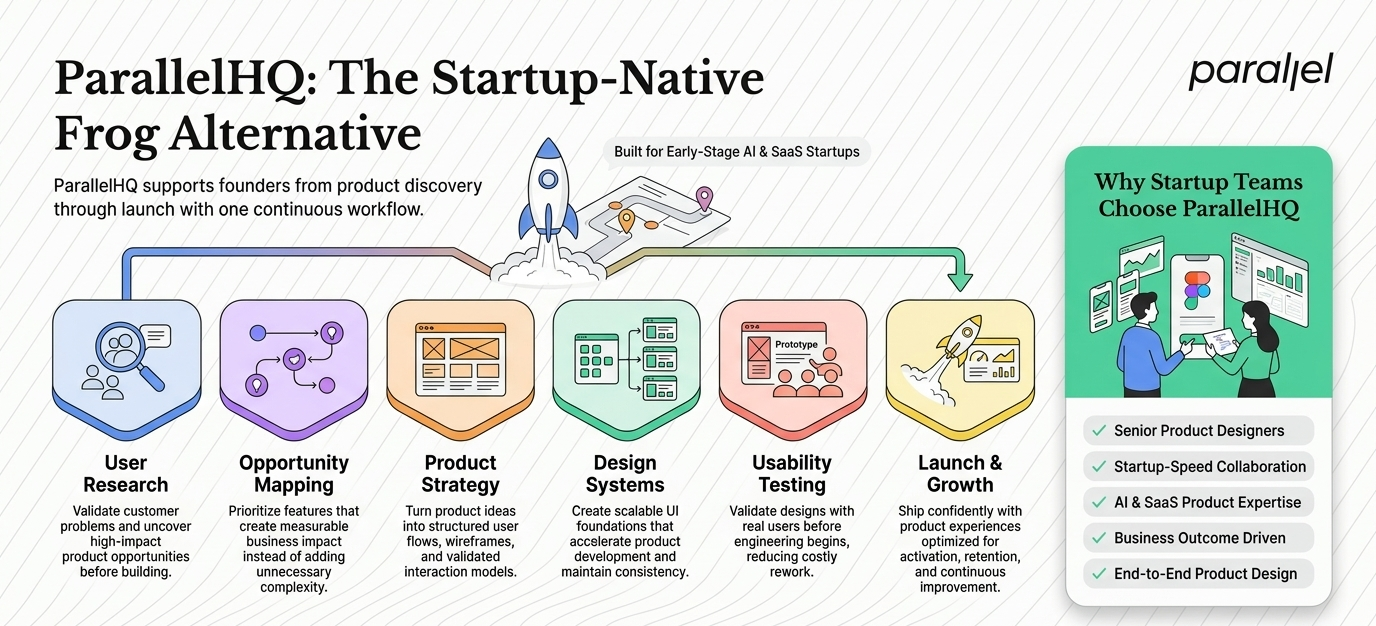
Every agency above this entry, from Clay to ustwo to Ramotion, is a credible option at the right stage and budget. But in the Frog Alternatives Compared landscape, there's a clear tier missing: a partner that operates at startup speed, speaks product fluently, and ties every design decision to the business outcome it serves.
That's what ParallelHQ does. Our work covers the full product design spectrum, from user research and opportunity mapping through to design systems, usability testing, and mobile app design, and is built specifically for the stage where Frog would price you out of the room.
If you've used Axure RP or Balsamiq for internal wireframes and want to graduate to a design partner who can take that work through to shipped product, or you've been running Figma and Marvel App prototypes but need someone to pressure-test the interaction design against real user behaviour, our product strategy consulting and discovery framework are the right starting points.
Conclusion
The Frog Alternatives Compared landscape in 2026 offers genuine options at every tier, but the right choice depends entirely on stage:
- IDEO and Huge belong in enterprise transformation briefs with budgets above $150K.
- Clay, ustwo, and Ramotion serve well-funded scale-ups at Series A and beyond.
- Work & Co and Method offer execution-first alternatives for product-heavy engagements.
- ParallelHQ is built specifically for AI and SaaS startups who need senior design thinking without enterprise minimums.
The question isn't which agency has the best awards wall. It's which partner will still be improving your product six sprints from now.
Frequently Asked Questions
1) What is Frog Design best known for?
Frog Design is best known for enterprise-scale product and service design, having worked with major corporations since 1969. It combines research, strategy, technology, and design to create products and services. It is not typically suited for early-stage startup engagements.
2) What is the main difference between Frog and IDEO?
Both operate at enterprise scale, but Frog leads with systems design and brand expression while IDEO leads with design thinking and innovation consulting. IDEO's focus has shifted toward helping organisations build innovation capabilities rather than shipping products directly. Neither is the right pick for startups needing fast execution.
3) Are there affordable Frog Design alternatives for startups?
Yes. Template-based projects start around $10,000–$20,000, while mid-market engagements with full UI/UX deliverables run $25,000–$100,000, a fraction of Frog's starting point. Boutique studios and startup-native agencies like ParallelHQ offer retainer models that work within seed and Series A budgets.
4) Is Clay a good alternative to Frog Design?
Clay is a strong alternative for well-funded companies. Clay is a global UI/UX design and branding firm with deep experience in B2B, SaaS, AI, and fintech. However, its minimum engagement size makes it most relevant at Series B and beyond, similar to Frog in its access tier.
5) What should I look for in a Frog Design alternative for a SaaS startup?
Prioritise stage alignment, responsive engagement models, and domain knowledge over brand recognition. A partner who understands SaaS onboarding, interaction design, and design handoff workflows will outperform a prestigious generalist agency that treats your product like a Fortune 500 rebrand.
6) Where does ParallelHQ fit in the Frog Alternatives Compared landscape?
ParallelHQ is a startup-native UI/UX and product design agency based in the USA, built specifically for early-stage AI and SaaS companies. Unlike Frog or IDEO, the engagement model is calibrated for startup timelines and budgets, with services spanning user research, design systems, and product strategy without enterprise overhead.

check out these related blogs