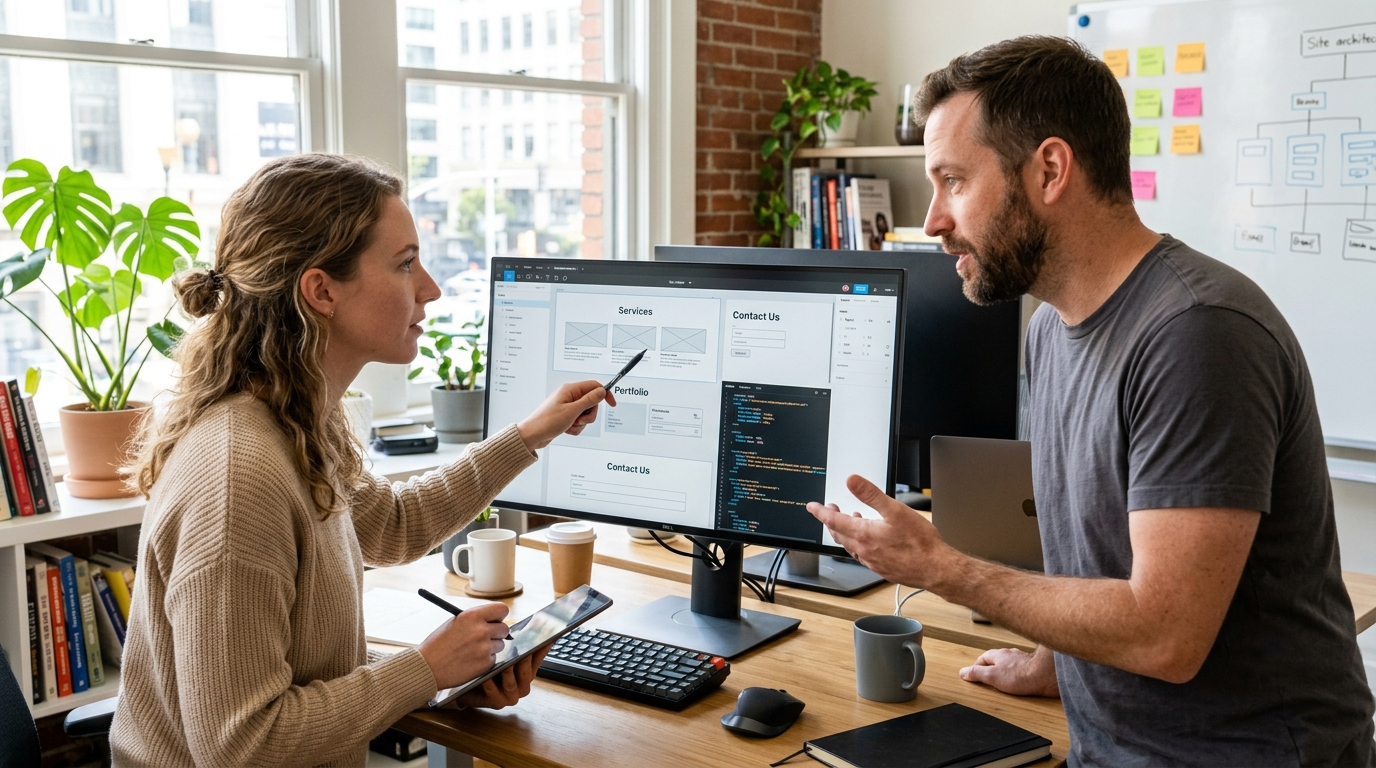
I often talk to founders who feel frustrated after launching a new product. They invested heavily in an agency, but user activation remains flat and onboarding is still a mess. The problem is rarely visual design. The problem is a lack of fundamental product thinking.
When searching for a Portland web design partner, teams usually focus on aesthetics over usability. They look at beautiful agency portfolios and assume those visuals will translate into business growth. In my experience, this is where most product decisions go wrong. You do not just need a beautiful interface. You need clarity grounded in real user behavior.
TL;DR
The right partner simplifies complex problems instead of just styling them. The best agency choice depends entirely on your core business needs.
How to evaluate the top Portland web design agencies
We have seen teams overcomplicate their software interfaces, and it usually backfires. Evaluating an agency requires looking past their visual portfolio to understand their strategic depth. You need to know exactly how they make decisions.
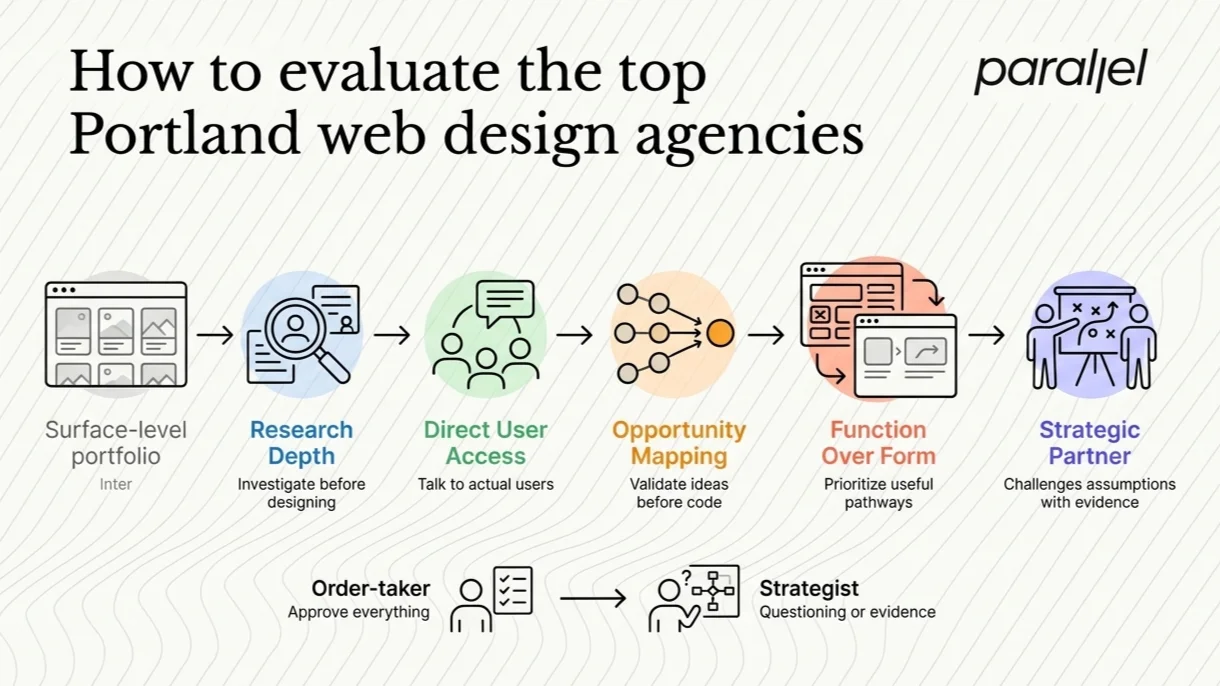
According to a 2026 report by the Nielsen Norman Group, 68% of digital product failures stem from poor upfront research and a lack of clear user pathways. Good agencies do not just ask you what colors you like. They ask you how your users measure success. If an agency agrees with every feature request you make, they are acting as order-takers. You want a strategic partner.
Look for a team that uses tools like opportunity mapping to validate ideas before writing a single line of code. Pay close attention to their initial discovery process. A strong partner will always want to speak directly with your actual users.
They will look at your existing analytics to find the hidden friction points. If their process does not include heavy upfront generative research, you are likely going to end up with a surface-level solution. You must ensure they prioritize function over form.
What are the best Portland web design agencies in 2026?
Here is our review of the top 10 agencies, based on industry reputation, process maturity, and their ability to drive real business outcomes.
1) ParallelHQ
We built ParallelHQ because we saw teams struggle with design decisions that should have been much simpler. We are a product design and strategy partner focused on absolute clarity in thinking, not just striking visuals. We work closely with founders and product managers at early-stage startups to fix weak onboarding and low activation rates.
While we operate globally, teams needing a Portland web design approach often come to us when they need to untangle highly complex SaaS workflows. We do not do traditional agency fluff. We focus entirely on the mechanics of how users interact with your software and where they abandon the journey.
Our approach is deeply rooted in rapid validation. We use structured frameworks like design sprints to test ideas quickly and effectively. A recent 2025 internal study across our client projects showed that validating concepts before development reduces engineering waste by up to 40%. We help you build the right thing, in the right sequence.
2) Instrument
Instrument is an undeniable giant in the digital agency space. They have built an incredible reputation over the last decade by working with some of the largest tech agencies in the world. Their final output is always highly polished, cinematic, and culturally relevant.
If you are a massive enterprise brand looking for a large-scale digital experience, they are a fantastic choice. They excel at telling big, emotional stories through digital mediums. (If you are currently comparing large enterprise agencies, you might also find value in our thoughts on finding an Instrument alternative).
However, for early-stage startups, their process can be overly heavy and cost-prohibitive. Startups usually need rapid iteration and tight product loops. This agile requirement does not always align seamlessly with the long timeline of a massive brand experience agency.
3) Murmur Creative
Murmur Creative specializes in brand identity, physical packaging, and digital experiences for the food, beverage, and lifestyle sectors. They intimately understand how to translate a physical brand presence into a compelling digital space.
Their true strength lies in creating emotional connections with consumers. If you are launching a new CPG brand and need your website to reflect the tactile feel of your packaging, Murmur is a very strong contender. They build sites that look and feel completely authentic to the Pacific Northwest aesthetic.
Where they might not fit is in deep software interface design. If your primary need is complex B2B UX design or enterprise dashboard optimization, a product-specific agency will likely serve your needs much better.
4) Fine
Fine is a highly specialized agency that has carved out a unique niche in hospitality, real estate, and wine. They build digital experiences that feel exactly like luxury physical spaces.
Their entire strategy revolves around high-end storytelling and seamless booking experiences. They know exactly how to make a user feel the ambiance of a high-end resort before they ever arrive on the property. Their visual work is elegant, refined, and highly effective for reaching affluent target markets.
Similar to Murmur, they are a highly specialized boutique firm. Tech founders building data-heavy platforms or AI-native tools will likely need a team more versed in product strategy consulting rather than luxury hospitality branding.
5) Needmore Designs
Needmore Designs is a boutique agency that punches well above its weight in the specialty retail and coffee roasting industries. They are deeply embedded in local culture and bring a highly crafted, artisanal approach to their digital client work.
They are excellent at complex Shopify integrations and creating tailored e-commerce flows. They ensure the buying process feels personal rather than purely transactional. If you sell a high-quality physical product and want your digital presence to reflect that craftsmanship, they are a great choice.
Their boutique nature means they take on fewer clients at any given time. They are ideal for lifestyle businesses but might not have the scale required for a massive website redesign of a large corporate software platform.
6) Kinesis
Kinesis takes a fundamentally different approach by combining business strategy directly with marketing and web design. They actively position themselves as an outsourced marketing department for service-based B2B agencies.
They do not just build a website and walk away. They look closely at your entire sales funnel, your internal company culture, and your market positioning. This makes them incredibly valuable for established B2B businesses that have hit a growth plateau and need strategic realignment.
However, they are not a pure-play product design firm. If you are building a brand new software application and need rapid prototyping and wireframing, you will want an agency exclusively focused on product user experience.
7) Copious
Copious is widely known for handling complex, high-volume e-commerce builds. They intimately understand the technical architecture required to move physical goods at a massive global scale.
They focus heavily on conversion rate optimization and technical site performance. A 2026 report by Forrester noted that a one-second delay in mobile load times can drop overall conversions by up to 20%. Agencies like Copious build robust technical foundations to prevent those exact bottlenecks.
They are the right partner if your primary metric is daily transaction volume. If your focus is on SaaS retention or building a complex AI software design product, their e-commerce specific skill set might not directly translate to your goals.
8) OMFGCO
OMFGCO (The Official Manufacturing Company) is one of the most culturally significant design firms in the region. They handle physical environmental design, branding, and digital execution. They frequently blur the lines between physical retail and digital spaces.
They are the specific team you hire when you want to create a culture, not just a company. Their work is bold, highly creative, and visually unmistakable. They have successfully shaped the visual identity of many iconic local businesses.
They are brand visionaries first and foremost. If you need a partner to run a detailed UX audit on your complicated fintech onboarding flow, their highly creative approach may be overkill for your specific functional problem.
9) Thesis
Thesis is a massive digital agency focused heavily on performance marketing, email strategy, and high-impact digital campaigns. They routinely work with global athletic brands and major international tech players.
Their primary strength is in driving measurable action at an enormous scale. They understand how to build highly effective landing pages and digital touchpoints. They convert massive amounts of traffic into revenue within highly optimized marketing funnels.
They are an execution powerhouse. However, early-stage startups often need foundational product discovery rather than large-scale campaign execution. Teams at the beginning of their journey need to figure out product-market fit before scaling their marketing spend.
10) Watson Creative
Watson Creative brings a unique methodology deeply rooted in sports, entertainment, and athletics. They understand exactly how to build fierce brand loyalty and translate fan energy into sustained digital engagement.
They approach design through a rigorous lens of research and aggressive market positioning. Their digital products are dynamic, motion-heavy, and specifically designed to capture very short attention spans.
While perfect for consumer brands and sports entities, this high-energy visual approach does not always fit every industry. It rarely aligns with the quiet, clear usability required for complex enterprise software design.
Where do teams go wrong with a Portland web design project?
In my experience, teams fail because they jump straight into high-fidelity design much too early. They skip the messy, difficult work of truly understanding the user context. They want to see what the site looks like before they know how it needs to function.
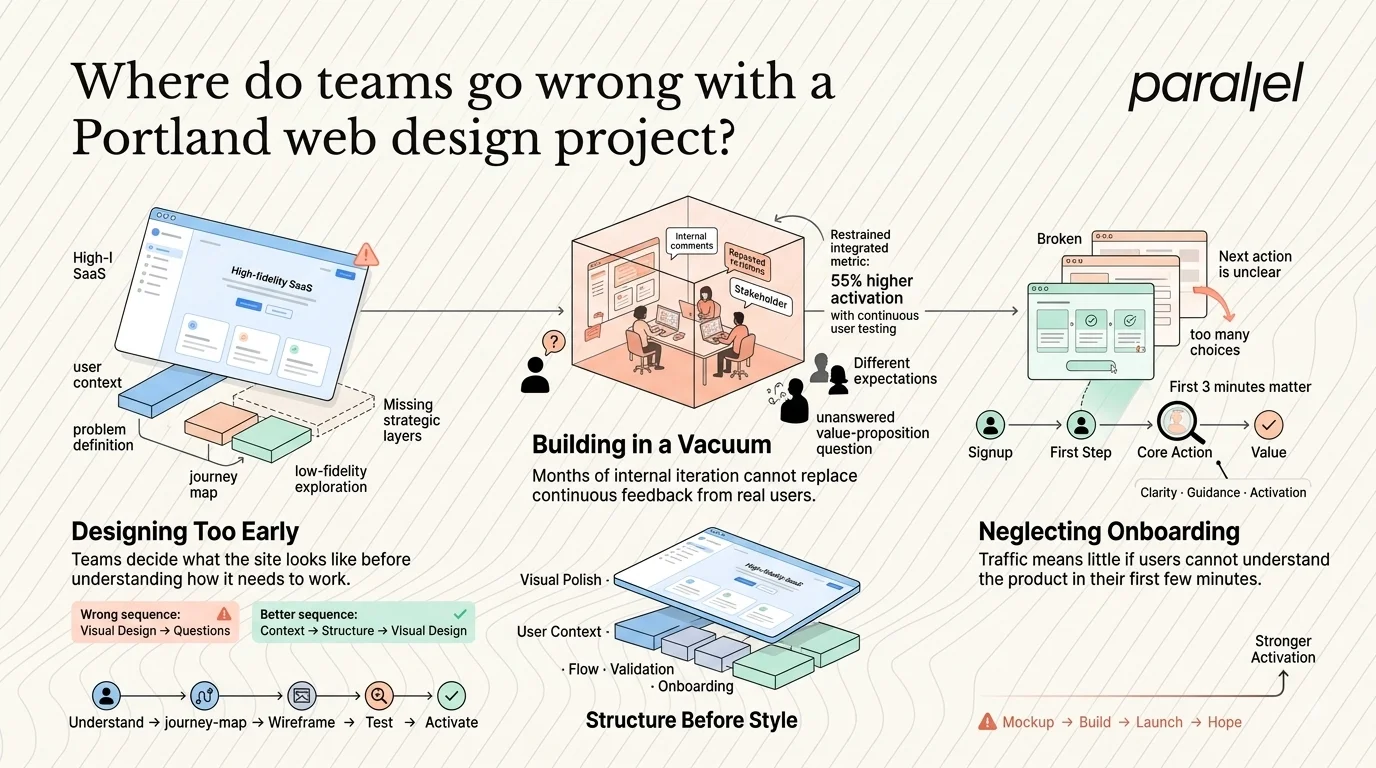
Another major failure point is designing completely in a vacuum. I have seen startups spend six months in stealth mode perfecting a design, only to launch and realize the users do not understand the core value proposition. According to a 2025 study by IDEO, products developed with continuous user testing have a 55% higher activation rate post-launch.
Teams also fail by completely ignoring the onboarding experience. Getting a user to your site is only the first step of the battle. If the first three minutes of your product experience are confusing, you will lose them forever. We frequently run SaaS onboarding teardowns to identify exactly where users drop off. The issues are almost always structural rather than visual.
The hidden cost of skipping product discovery
Many founders view product discovery as an unnecessary delay. They believe they already know what their market wants and push their teams to start writing code immediately. This is the most expensive mistake a startup can make.
When you skip discovery, you are essentially gambling with your engineering budget. You end up building features based on internal assumptions rather than validated market needs. A recent 2025 report by McKinsey highlights that fixing a UX error after development is up to 100 times more expensive than fixing it during the initial prototyping phase.
This hidden cost also extends to your team morale. Engineers become highly frustrated when they are forced to constantly rewrite code because the initial requirements were fundamentally flawed. A strong product strategy eliminates this friction by ensuring every feature is validated before development begins.
We see this pattern constantly in early-stage SaaS agencies. They launch a beautifully coded product that solves a problem nobody actually has. Discovery is not a delay. It is a vital risk mitigation strategy that protects your runway.
How should you structure your product strategy?
You need to establish a very clear framework before you start moving pixels on a screen. Start by defining the exact business problem you are trying to solve. Are you struggling with top-of-funnel conversion, or is your core issue long-term retention?
Once the core problem is clearly defined, you must map the user journey. Write down every single step a user must take to reach their "aha" moment within your product. Identify the friction points in that specific journey. Your goal at this stage is to entirely remove steps, not decorate them. Simplicity is the hardest thing to design.
Finally, validate your ideas with real people as quickly as possible. Build a low-fidelity prototype and put it in front of five target users. Watch where they click and listen to where they get confused. This process is central to our discovery framework. It ensures that your product decisions are grounded in reality rather than internal team opinions.
How to prepare your team before hiring an agency
Before you even start reaching out to agencies, your internal team needs to achieve alignment. Agencies are incredibly effective multipliers, but they cannot fix a broken internal business model. You need to know your exact destination before you hire a guide.
First, clearly define your target audience and your total addressable market. If you tell an agency that your product is "for everyone," you are setting the project up for failure. A tight, clearly defined audience allows for highly specific, effective design decisions. Take the time to determine your addressable market accurately.
Second, gather your existing data. Do not approach an agency with just a list of subjective complaints about your current software. Bring your analytics, your user churn rates, and your customer support tickets. This raw data provides the exact foundation a good agency needs to diagnose the real problems.
Third, establish clear internal decision-makers. Projects stall when feedback is collected by a committee of ten different stakeholders. Designate one primary product owner who has the final say on all design approvals. This drastically speeds up the iteration cycle and prevents the design from becoming watered down.
Conclusion
A great Portland web design project does not start with a mood board. It starts with a clear, objective understanding of human behavior and business constraints. The best digital products in the world are not just visually pleasing. They are intuitively obvious to the user.
When you choose a partner, look for teams that care as much about your long-term retention metrics as they do about your typography. Find a team that will actively push back on bad ideas and help you simplify your product thinking. Clarity will always outperform cleverness in the long run.
Frequently asked questions
1) What is the average timeline for a Portland web design project?
Most foundational design projects take between 8 to 12 weeks to complete. This allows adequate time for proper user research, strategic alignment, iterative prototyping, and final high-fidelity design. Rushing this specific process usually leads to structural UX flaws.
2) How much should I expect to invest in a strategic partner?
For a mature agency focusing on deep product strategy and UX, projects typically start around $30,000 to $50,000. Large enterprise agencies will often require six-figure minimums. You are paying for strategic clarity and risk reduction, not just development hours.
3) What is the difference between a web design agency and a product design partner?
A web design agency typically focuses on marketing sites, brand storytelling, and top-of-funnel conversion. A product design partner focuses on the actual software experience, working heavily on SaaS dashboards, user onboarding, and core retention metrics.
4) Do I need a local Portland web design agency to get good results?
No. While local agencies naturally understand regional culture, modern digital product building is entirely global. Specific expertise in SaaS and product strategy is far more important than geographical proximity to your office.
5) How do I know if my product needs a complete redesign?
If your underlying technical architecture is sound but conversions are low, you should start with a comprehensive UX audit. If your product has massive technical debt or is pivoting to a completely new target market, you likely need a full redesign.
6) Should we design for desktop or mobile first?
This decision depends entirely on your specific user analytics. If you are building an enterprise B2B SaaS platform, your users are likely on desktop during work hours. If you are building a D2C e-commerce brand, you absolutely must design for mobile first.
7) How do we ensure the design system scales as we grow?
You must build a foundational library of reusable UI components very early in the process. A strong partner will deliver a comprehensive design system in Figma that your engineering team can efficiently scale over many years.
8) Why should a startup choose ParallelHQ for Portland web design over a traditional agency?
Traditional agencies focus heavily on deliverables and visual flair. We focus entirely on business outcomes and decision-making clarity. We act as an extension of your product team to build software grounded in real user behavior.

check out these related blogs