I get asked this question more than almost any other: should we hire R/GA or a focused startup design partner? Having built ParallelHQ specifically to serve early-stage AI and SaaS founders, I have a clear perspective, but I'm going to give you R/GA's strongest case too, because that's how useful comparisons work. Here is what the R/GA vs ParallelHQ decision actually comes down to, without the agency spin.
TL;DR
- R/GA excels at enterprise-scale brand and platform work with multi-million-dollar budgets; ParallelHQ is purpose-built for startups that need senior design thinking at startup speed.
- R/GA engagements rarely start under $250K and most run $500K–$5M, a structural mismatch for most early-stage teams.
- Both agencies do serious design and user experience work; the right choice depends entirely on your stage, budget, and need for velocity.
What Is R/GA and Is It Still Relevant in 2026?
Founded in 1977, R/GA has been a pioneer at the intersection of technology, design and marketing, with work spanning web, mobile, social communications, retail and e-commerce, product innovation, brand development, and business consulting. That heritage is real and impressive. The more pressing question is what R/GA looks like right now. The honest answer is: it's in active transition.
R/GA laid off around 15% of its staff in April 2023 and was then sold to a private equity firm in March 2025. Specifically, the agency announced its return to independence as a privately owned company after 23 years as part of IPG, facilitated by a new partnership with private equity firm Truelink Capital. R/GA's next chapter is backed by a $50M Innovation Fund, enabling the company to invest in new skillsets and talent, and acquire new capabilities, emerging tools, and platforms. The post-independence numbers are encouraging for R/GA.
Revenue from the second half of 2025 expanded by over 30% compared to the first half, and six of the agency's top 10 clients collectively grew 40% YoY from 2024 to 2025. Ad Age named R/GA its 2026 Agency to Watch, citing the agency's move to reclaim its reputation as an innovator collaborating with brands to define new categories of marketing. So yes, R/GA remains relevant, but "relevant" in the enterprise tier of brand strategy and digital transformation.
R/GA partners with clients across Brand Design, Product & Experience Design, Campaign & Content Design, and CRM & Relationship Design, making it a comprehensive solution for businesses seeking integrated creative services. Its current major global clients include Google, Samsung, Moncler, TurboTax, Nike, and Eli Lilly.
The relevant question for founders is really this: is an agency rebuilding under private equity, optimizing for enterprise accounts and marketing-at-scale, a natural fit for a 15-person SaaS startup needing a validated product design and a coherent design system? Rarely.
What Makes ParallelHQ Different from R/GA as a Design Agency
The structural difference is focus. R/GA is a full-service creative innovation consultancy serving global brands across multiple disciplines. ParallelHQ is a product design partner built specifically for startups, AI, SaaS, fintech, healthtech, operating out of the US market.
Where R/GA builds campaigns and brand ecosystems for Nike and Samsung, ParallelHQ builds the product experience that determines whether a startup's Series A demo converts investors, whether a SaaS onboarding flow retains users past day 14, or whether a B2B dashboard earns trust from enterprise buyers in the first session.
Here's what that difference looks like in practice:
ParallelHQ's work sits firmly in the product layer, UI/UX design, interaction design, wireframing and prototyping, UX research, and design systems, all of it optimized for founders who need outcomes in weeks, not quarters.
The deeper differentiation is mindset. R/GA is built around creative awards and brand-narrative. ParallelHQ is built around product decisions: what should we build, for whom, and how do we validate it before we build too much of it.
R/GA vs ParallelHQ: Pricing and Value for Money
This is where the comparison becomes concrete fastest. R/GA engagements rarely start under $250K, and most run $500K–$5M. These figures reflect enterprise scope: multi-disciplinary teams, global coordination, integrated campaigns running across brand, product, and CRM simultaneously. That model is correctly priced for what it delivers, at that scale.
For a pre-Series B startup, that pricing structure is categorically prohibitive. Most early-stage founders need $30K–$120K of focused design work: a validated information architecture, a high-fidelity Figma prototype, a design sprint to test a core hypothesis, or a UX audit that identifies where onboarding is killing retention. ParallelHQ is scoped and priced for exactly that range.
R/GA's price floor alone eliminates it as a realistic option for most startups, before you've even evaluated design quality or process fit. Beyond the numbers, value for money also depends on overhead. Large agency engagements typically layer account managers, strategists, and creative directors between the client and the practitioners doing the work. You pay for coordination infrastructure. At ParallelHQ, founders and PMs work directly with senior designers, the people making the actual product decisions are in the room, every session.
R/GA's model makes sense for a VP of Brand at a Fortune 500 who needs a partner with global delivery infrastructure and deep campaign capabilities. It does not make sense for a founder who needs their MVP design validated and production-ready in six weeks. The value-for-money winner for startups is not a close call.
Honest Review of R/GA: Pros and Cons in 2026
Giving R/GA its fairest hearing, here is what the evidence supports.
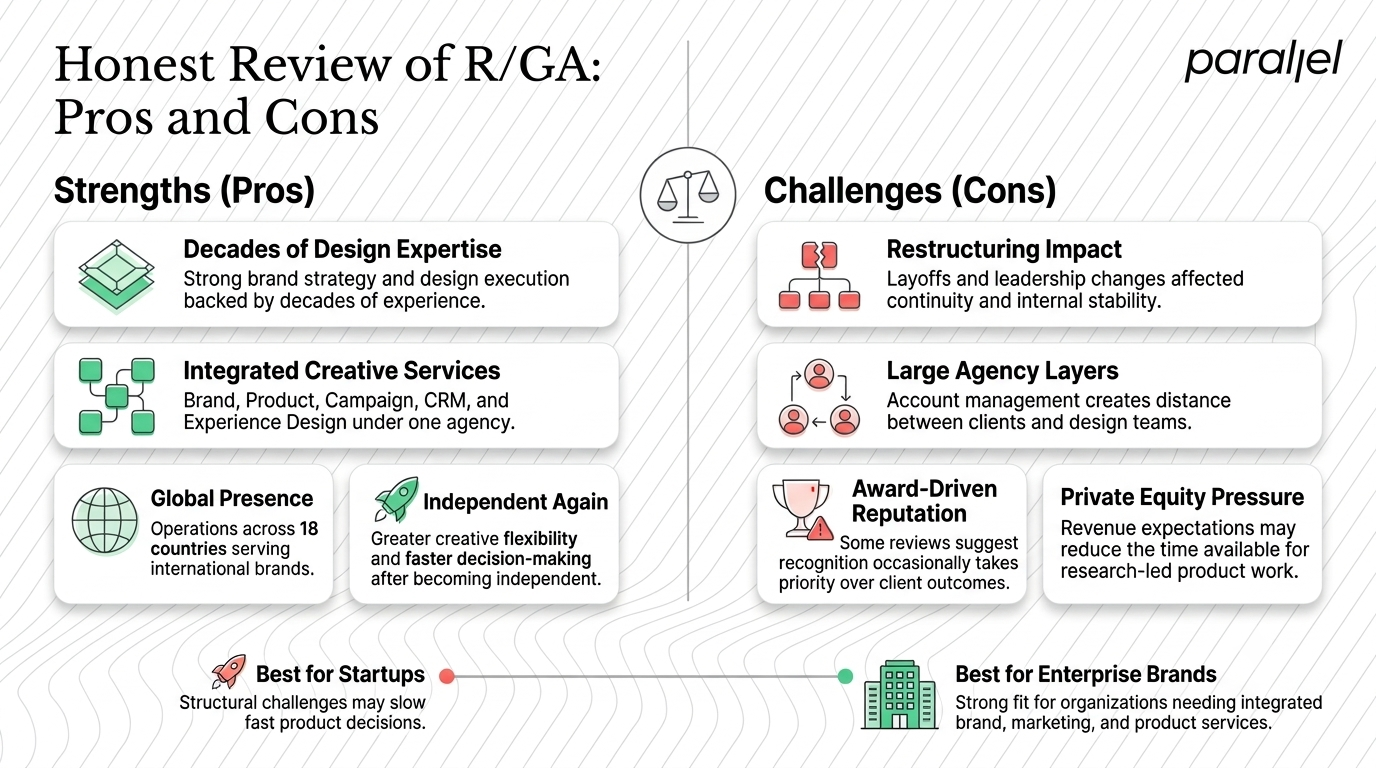
Where R/GA is genuinely strong:
- Decades of design thinking applied to brand strategy at scale, with a client roster that validates craft and executional quality.
- Comprehensive integrated creative services spanning Brand Design, Product & Experience Design, Campaign & Content Design, and CRM & Relationship Design.
- A global network spanning 18 countries, with representation across the United States, Europe, South America, and Asia-Pacific.
- Fresh independence, giving the agency more creative autonomy and speed than it had under IPG's holding-company structure.
Where R/GA struggles, especially for startups:
- Years of restructuring left real marks on culture and continuity. R/GA continued to course-correct following layoffs, executive departures, and headwinds in the tech sector, winning 22 accounts totaling $44.6 million in revenue, down from 2022's $59 million.
- The account-management model typical of large agencies creates distance between client and practitioner, a genuine liability when product decisions need to move fast.
- Some internal reviews note the agency cares more about winning awards than investing the time needed to solve client problems, a pattern that appears across large creative shops.
- The private equity ownership introduces pressure toward revenue growth that can conflict with the patient, research-led design process that produces excellent products.
R/GA is an agency rebuilding with real momentum. For the right client, large brand, sufficient budget, need for integrated campaign and product work, it belongs on the shortlist. For startups, these cons outweigh the pros structurally.
ParallelHQ vs R/GA for Startup Branding and Product Design: Which Should You Choose?
The question matters more than the competition. Before comparing agencies, get clear on what you're actually buying.
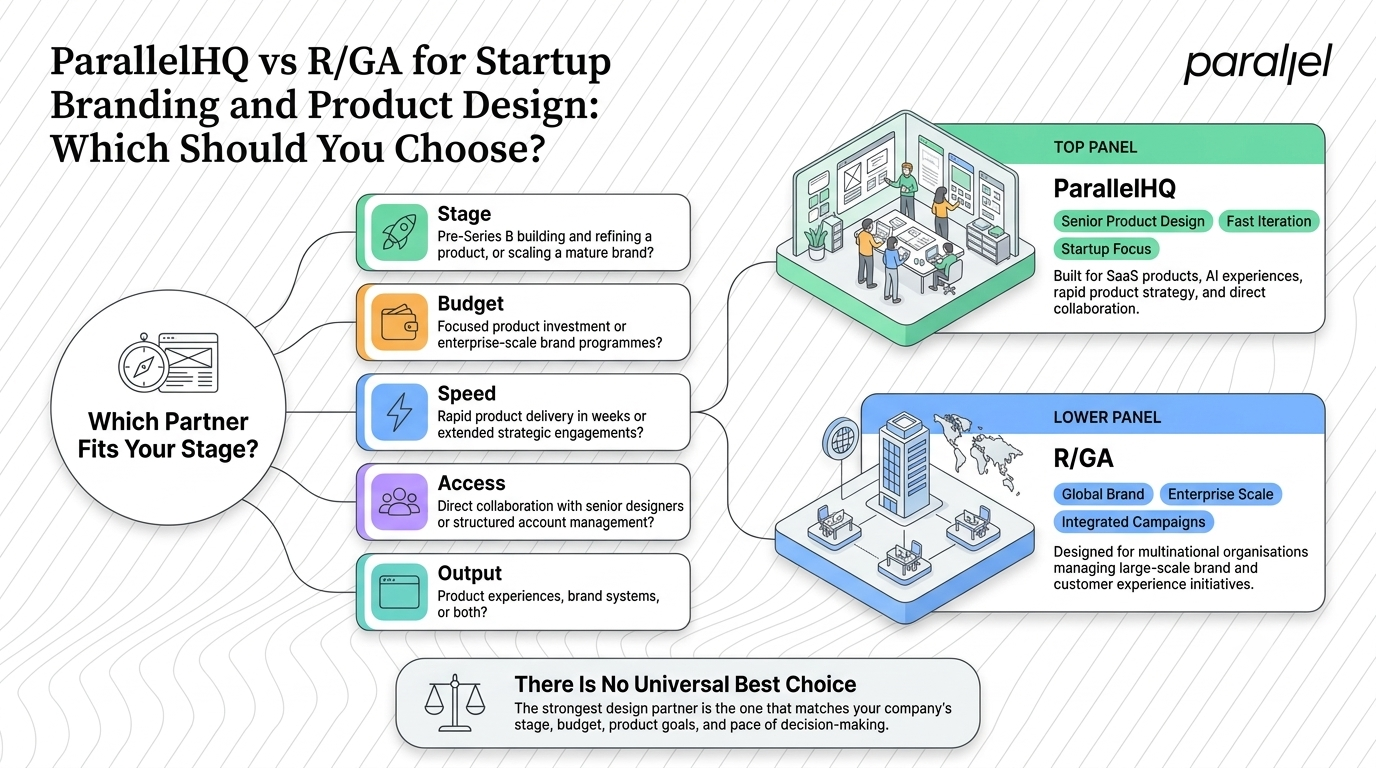
If you're making this decision, ask yourself:
- Stage: Are you pre-Series B with a product actively in the market, or post-Series B building brand infrastructure at scale?
- Budget: Is your design budget under $200K for this engagement, or is it part of a $500K+ integrated marketing investment?
- Speed: Do you need validated, buildable designs in 4–8 weeks, or can you manage a 3–6 month agency onboarding process?
- Access: Do you want to work directly with senior designers, or are you comfortable working through account managers?
- Output: Are you buying a product that users navigate, or a campaign and brand system that consumers experience across channels?
If your answers lean toward early-stage, lean budget, startup velocity, and direct access, ParallelHQ is the right fit. Our product strategy consulting, SaaS design services, and AI UX design capabilities are all built around this profile. If your answers lean toward post-Series C, large budget, integrated brand-and-campaign needs across global markets, R/GA, now with renewed independence and a $50M innovation fund, is a serious option worth evaluating. There is no universally correct answer in the R/GA vs ParallelHQ comparison. There is only the right answer for your specific stage and needs.
What Do Clients Say About R/GA Versus ParallelHQ?
Client sentiment for R/GA is mixed and instructive. The agency's work for global brands earns consistent creative recognition, the Ad Age Agency to Watch designation reflects genuine industry respect for creative quality. At the same time, some reviews note the agency does not prioritize what the client wants or is paying for, creating a stressful environment where employees are never able to meet client demands and management's demands simultaneously.
This is a pattern common in large agencies where internal award-chasing competes with client service as an organizing principle. As tech clients continued to spend less on advertising, digital agencies such as R/GA dragged on IPG's bottom line, and a series of leadership changes, reorgs, and ongoing layoffs compounded the challenge. That context matters for prospective clients: leadership continuity and organizational stability are part of what you're buying when you hire an agency for a multi-quarter engagement.
At ParallelHQ, client relationships are built on different dynamics. Founders and PMs work directly with me and senior designers throughout the engagement. There are no account managers between the design decision and the client decision. The feedback loop is tight: a research insight discovered on Tuesday can be reflected in a prototype by Friday. That's not a boast, it's a structural feature of how a focused startup design partner operates versus a global agency.
For early-stage founders, the clients who find the most value with ParallelHQ are those who have already tried freelancers (and found the coordination overhead too high) and aren't ready for R/GA-scale investment. They need senior-level design thinking paired with startup-grade execution speed. That is precisely the gap ParallelHQ was built to fill. If you're evaluating alternatives to larger agency models, our R/GA alternative page walks through this comparison in further depth.
Is ParallelHQ a Good Alternative to R/GA for Digital Design?
Yes, with the appropriate scope conditions. ParallelHQ is not trying to be a smaller R/GA. The comparison in the R/GA vs ParallelHQ decision is less about quality and more about fit.
ParallelHQ's core service stack covers the full product design lifecycle for startups:
- UX research and usability testing: Grounded in user behavior, not assumptions.
- Design sprints and opportunity mapping: Fast, structured frameworks for aligning product direction.
- Figma design services and design systems: Production-ready outputs that engineering teams can build from immediately.
- Vertical expertise: Dedicated fintech, healthtech, and AI software design practices, not generic product design applied to every category.
- SaaS onboarding teardowns and AI readiness design scorecards: Diagnostic tools built specifically for the problems AI and SaaS founders face.
What ParallelHQ does not do: large-scale integrated marketing campaigns, global rollout coordination across 18 countries, CRM design systems at Fortune 500 scale, or Super Bowl creative. R/GA does those things well. They are simply not what startup founders need.
The question "is ParallelHQ a good alternative to R/GA for digital design?" resolves to: for startup-scale product design, user experience design, and design systems work, ParallelHQ delivers equivalent design thinking at a fraction of R/GA's engagement floor, with significantly more direct access to senior practitioners.
Conclusion
- R/GA is a credible, relaunching creative agency with strong enterprise brand capabilities and a renewed innovation mandate post-IPG, but its $250K+ engagement floor and large-agency model make it the wrong fit for most early-stage startups.
- ParallelHQ is built for exactly the stage, speed, and budget profile that R/GA cannot serve: seed-to-Series B AI and SaaS founders who need senior product design thinking, tight feedback loops, and production-ready Figma outputs.
- The R/GA vs ParallelHQ comparison is not about which agency is "better", it's about which model matches your current stage.
- If you are a startup founder evaluating design partners right now, start with a conversation at ParallelHQ.
Frequently Asked Questions
1) What is R/GA's minimum budget for a design engagement?
R/GA engagements rarely start under $250K and most run $500K–$5M. This makes them structurally inaccessible for most pre-Series B startups. ParallelHQ is scoped and priced for the $30K–$150K range that early-stage product design typically requires.
2) Did R/GA recently change ownership?
Yes. R/GA returned to independence as a privately owned company after 23 years as part of IPG, in a deal facilitated by private equity firm Truelink Capital. The next chapter is backed by a $50M Innovation Fund. The transition was finalized in March 2025.
3) Is R/GA a good fit for SaaS startups?
Rarely at early stages. R/GA's client roster centers on global brands like Nike, Samsung, and Google, and its engagement structure is built for enterprise scale. A SaaS startup needing product UX, onboarding design, and a design system will find ParallelHQ's focused model, startup-grade speed, and direct senior access a significantly better match.
4) How does ParallelHQ handle design systems for startups?
ParallelHQ builds design systems in Figma, structured for startup engineering teams. The deliverable is not a documentation exercise, it's a production-ready component library with clear usage rules that reduces developer handoff friction and keeps visual design consistent as the product scales.
5) Can ParallelHQ run a design sprint like a larger agency would?
Yes. Design sprints at ParallelHQ follow a structured, time-boxed framework specifically tuned for startup product problems, validating a core hypothesis, mapping opportunity areas, and producing a testable prototype. Founders and PMs work directly with senior designers throughout, not through account layers.
6) How do I know if R/GA or ParallelHQ is the right choice for my brand identity project?
The deciding factors are budget, stage, and scope. If you're a global brand investing $500K+ in integrated brand, campaign, and product design across multiple markets, R/GA's capabilities are worth evaluating. If you're an AI or SaaS startup that needs a sharp, validated brand system and product design foundation built quickly at startup scale, ParallelHQ is the purpose-built choice. Explore the full comparison on our R/GA alternative page.

check out these related blogs


















.avif)












































































.webp)


