Founders often come to me exhausted after bad agency experiences. They spent six months and a significant budget, only to get polished presentation files that failed upon launch. When you look for the best product design agencies in Boston, you usually find lists of firms optimizing for industry awards instead of user activation. We built ParallelHQ to fix this exact problem. Product design is not about making screens look visually complex. It is about simplifying difficult business decisions and grounding them in real user behavior. Here is how I view the agency landscape and what you should evaluate before signing a contract.
Quick Answer
The right partner depends on whether you need visual polish or deep product strategy. Below is a comparison of the top 10 options based on their core focus, typical engagement size, and ideal client profile.
Why is it so hard to find the best product design agencies in Boston?
Many founders struggle with this decision because the design industry fundamentally misaligns with startup realities. Most traditional agencies operate like factory assembly lines. You hand them business requirements, and they hand you back visual screens. This isolated model completely breaks down for fast-moving early-stage companies.
If you search for the best product design agencies in Boston, you will notice a recurring theme across their case studies. The portfolios focus heavily on branding elements, typography choices, and complex animations. They rarely discuss the engineering constraints, database architecture, or the messy reality of getting a user to actually complete an onboarding flow.
We see teams overcomplicate their products simply because an external agency wanted to build something visually unique. This approach usually backfires. According to a 2026 Nielsen Norman Group report, over-engineered interfaces increase cognitive load and drop critical task completion rates by up to 24%.
You do not need a team to paint a pretty interface over a flawed product strategy. You need a partner who will ruthlessly challenge your assumptions. We focus heavily on product strategy consulting because structural clarity must come before pixels. A mature design partner acts as a stress test for your business logic.
Where do founders go wrong when evaluating the best product design agencies in Boston?
I review a lot of failed design projects from other firms. The root cause is almost never a lack of visual talent. The failure almost always stems from how the founder evaluated the agency during the initial sales process.
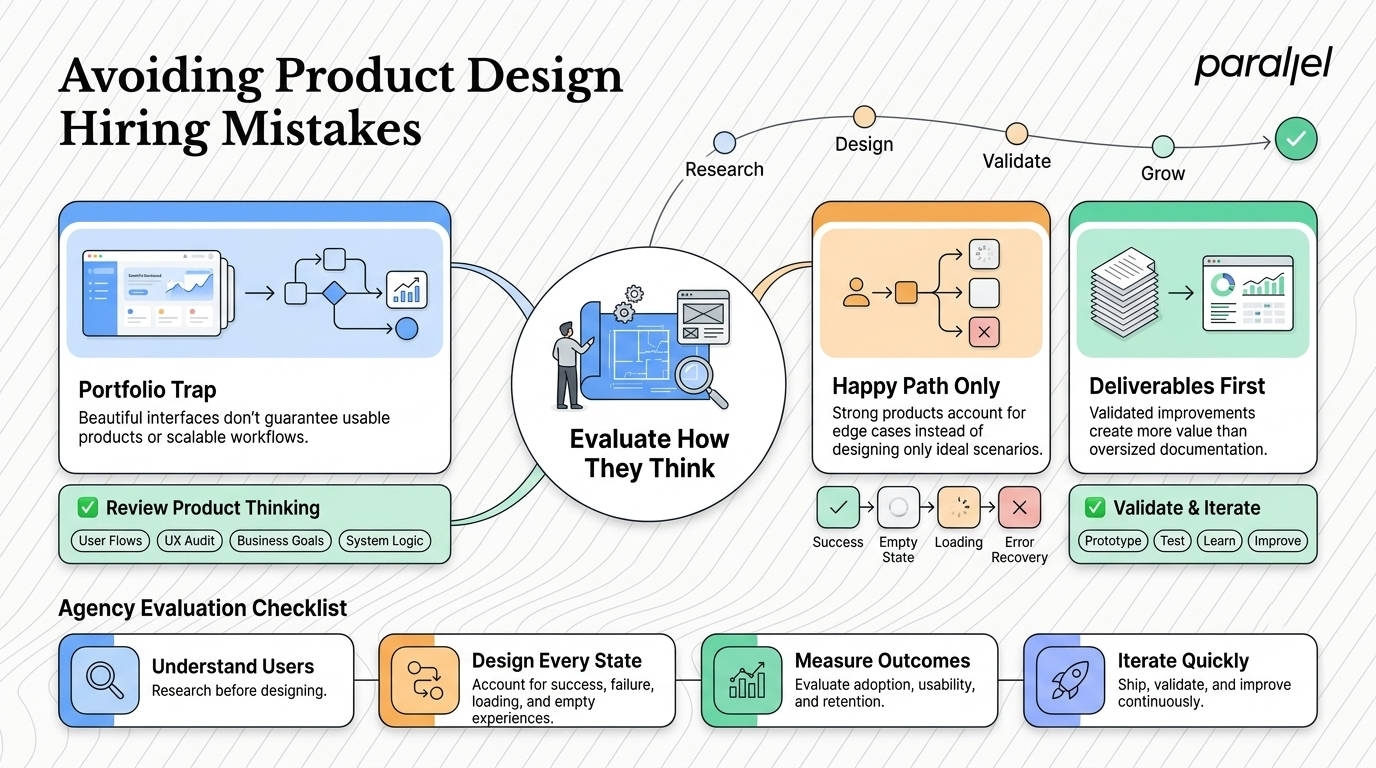
When vetting the best product design agencies in Boston, product teams often fall into three specific traps.
The Visual Portfolio Trap
Founders look at stunning case studies and assume that visual quality equals product viability. A beautiful dashboard means nothing if the underlying data model cannot support the filters the designer created. We frequently conduct UX audits on gorgeous platforms that users completely abandon because the core workflows are broken. You must evaluate how an agency thinks, not just how they draw.
The Happy Path Obsession
Inexperienced designers only design the ideal user journey. They design the screen where the user has uploaded perfect profile pictures and completed all data fields. They ignore the edge cases. They leave engineers to figure out zero states, error states, and loading states on the fly. This creates massive technical debt.
Buying Deliverables Over Outcomes
Agencies sell certainty in the form of massive deliverables. They promise a 100-page research report or a comprehensive design system before the core product loop is even validated. Forrester's 2025 B2B SaaS Activation Report clearly shows that shipping smaller, validated features increases adoption speeds by 40% compared to monolithic release cycles. You should buy validated learnings, not PDF reports.
What do you think about choosing from the best product design agencies in Boston?
You must shift your mindset from buying production bandwidth to buying decision-making frameworks. The ultimate goal of hiring an external product team is to reach clarity faster than you could internally.
Look for design partners that prioritize shared understanding across your entire team. When we run design sprints for our clients, the most valuable outcome is rarely the final high-fidelity prototype. The true value is forcing the CEO, the lead engineer, and the head of product into a room to agree on what they are not going to build.
Your partner should act as a ruthless filter for your product backlog. If an agency agrees with every single feature idea you suggest, they are failing you. They need to deeply understand your business model. If you run a high-volume SaaS product, the design must drive self-serve activation. If you run a deep tech enterprise tool, the design must support complex permissions and data density.
A 2026 McKinsey Design Index update highlights that companies integrating design deeply into their strategic planning see a 32% higher revenue growth rate. You only capture that growth if your agency understands the underlying business strategy.
What practical steps help you vet the product design agencies in Boston?
Do not base your entire decision on a polished sales deck. You need a structured approach to validate how an agency operates under actual pressure.
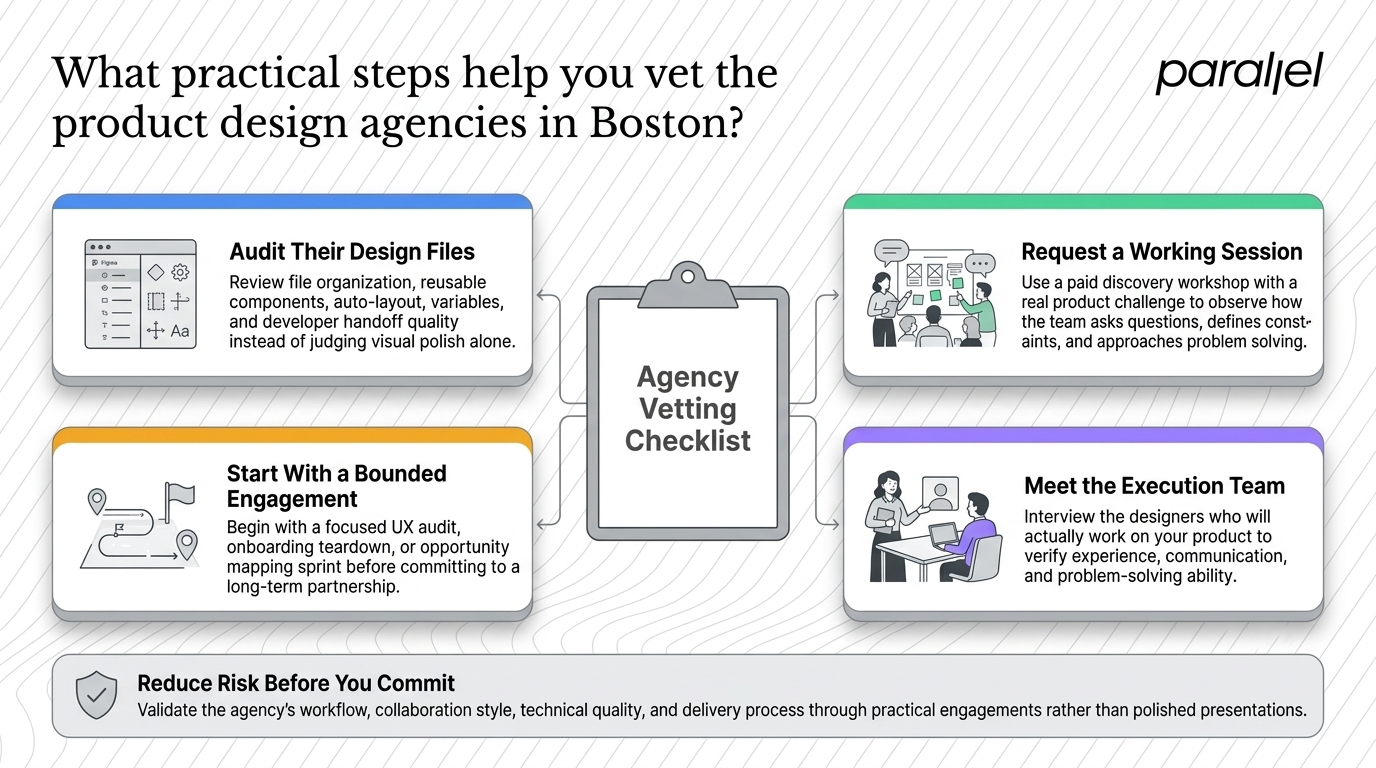
Follow this practical approach when speaking with the best product design agencies in Boston.
1) Audit Their Design Files
Ask the agency to show you exactly how they hand files over to engineering. If they just say they share a link, walk away. You want to open their software and look for auto-layout, local variables, and clean component properties. A messy file means a messy codebase.
2) Request a Working Session
Instead of a standard pitch, ask to do a paid, two-hour discovery session. Bring a real product problem. See how they facilitate the room. Do they ask sharp questions? Do they immediately try to solve the problem, or do they clarify the constraints first? This reveals their true maturity.
3) Start With a Bounded Engagement
Never sign a six-month retainer right away. Start with a SaaS onboarding teardown or a two-week opportunity mapping sprint. Treat it as a paid trial to mitigate your risk. If their thinking aligns with your pace, you can confidently scale the engagement.
4) Meet the Execution Team
Agencies often bait and switch clients. The brilliant senior partners pitch the work, but junior boot-camp graduates execute it. Demand to interview the exact product designer who will be embedded in your startup.
Who are the 10 best product design agencies in Boston to consider?
Boston has a rich history of technical engineering and design talent. Choosing the right partner means finding the exact match for your current growth stage, funding level, and technical complexity.
Here is my detailed breakdown of the top 10 options you will encounter when searching for a design partner in the area.
1) ParallelHQ
We built ParallelHQ to serve early-stage startups and scale-ups that need more than just surface-level UI. We focus heavily on UI/UX design grounded in actual user behavior. While our team operates globally, we work closely with US-based founders to offer a highly strategic approach to product building. We do not just hand over screens. We help you untangle complex workflows, map out your core discovery framework, and ensure your engineering team has exactly what they need to ship software fast. We focus on clarity over cleverness.
2) IDEO (Boston)
IDEO is legendary in the traditional design thinking space. They are the right choice if you are a massive global enterprise looking to invent entirely new physical and digital ecosystems. They excel at deep ethnographic research and conceptual innovation. However, for a fast-moving SaaS startup, their process can feel incredibly slow and research-heavy. If you need agile execution focused purely on digital product metrics, you might want to evaluate an IDEO alternative.
3) Upstatement
Upstatement excels in editorial design, digital branding, and content-rich publishing platforms. They do phenomenal work for media companies, universities, and large nonprofits. They have a strong engineering practice built around modern frameworks like React and Next.js. If your product relies heavily on storytelling, typography, and content management, they are a fantastic choice. They are slightly less focused on dense B2B SaaS applications or complex data visualization dashboards.
4) Thoughtbot
Thoughtbot is fundamentally an engineering-led agency with a strong, pragmatic design practice. They are strict practitioners of agile methodology, test-driven development, and Ruby on Rails. If you are a non-technical founder who needs a Minimum Viable Product built from scratch perfectly, they are a great option. Their design work is highly functional but leans heavily toward developer efficiency rather than experimental user experiences.
5) Rocket Insights
Rocket Insights acts as a full-service product agency. They bring product managers, designers, and engineers together to build custom applications. They work very well with mid-market companies that need to accelerate their product roadmap but lack internal hiring bandwidth. They focus on rapid delivery across mobile and web platforms. They are strong executors when the product vision is already well-defined by the client.
6) DockYard
DockYard specializes in custom web engineering, particularly with Elixir, Phoenix, and Progressive Web Apps. Their design team works very closely with their engineers to modernize legacy enterprise systems. If you have a highly complex, data-heavy web application that needs a complete architectural rewrite alongside a UX refresh, DockYard has the rare technical depth required to pull it off without breaking the system.
7) Mad*Pow
Mad*Pow focuses intensely on behavior change design. They dominate the healthcare, wellness, and financial services sectors in the local market. If you are building a product that requires users to change their daily habits, their psychological approach to user research is unmatched. They are highly specialized for regulated industries and understand how to design within strict compliance frameworks.
8) Rightpoint
Rightpoint is a massive global agency with a strong local presence. They focus on enterprise customer experience and large-scale digital transformation. They are built to navigate the internal politics of Fortune 500 corporations. They excel at integrating complex enterprise content management systems. Startup founders will likely find their overhead and project management layers too heavy for early-stage iteration.
9) ExtensionEngine
ExtensionEngine is highly specialized in building custom learning experiences. They design and build platforms for universities, corporate training programs, and EdTech startups. If your product involves curriculum delivery, student engagement tracking, or complex learning management systems, they have incredibly specific domain expertise. They understand the pedagogy behind software design.
10) Cantina
Cantina focuses on strategic technical consulting and corporate innovation. They help large organizations figure out what digital products they should build next. They are excellent at aligning diverse corporate stakeholders, performing technical due diligence, and mapping out long-term digital strategies. They are better suited for large-scale enterprise strategy than lean startup execution.
Conclusion
Great product design is ultimately invisible. It removes friction, clarifies user choices, and gets the customer to their desired outcome as quickly as possible. Hiring an agency should not feel like hiring a completely separate entity. It should feel like bolting on a senior product unit to your existing team. Prioritize clear thinking over flashy portfolios. Ask the hard questions about engineering feasibility upfront. Demand a partner who is willing to push back on your ideas when the user data proves otherwise.
Frequently Asked Questions
1) What is a product design agency?
A product design agency partners with companies to research, define, and design functional digital software. Unlike a traditional creative agency that focuses on marketing and brand awareness, a product agency focuses on software utility. They optimize for metrics like user retention, feature adoption, and task completion rates. They bridge the gap between business strategy and engineering execution.
2) How do we prepare before hiring a design partner?
You must define your business objectives clearly before making contact. Do not hand an agency a strict list of features to build. Instead, hand them a list of business metrics you need to move. Prepare your current user analytics, customer support tickets, and any previous user research. The more context you provide, the faster a mature agency can diagnose the actual problem.
3) How does a specialized UX studio differ from a full-service dev shop?
A specialized UX studio focuses entirely on user research, product strategy, and interface design. A full-service shop handles both design and engineering under one roof. Specialized studios often provide higher quality strategic thinking because design is their only core competency. Dev shops often view design merely as a mandatory prerequisite to unlock their engineering billable hours.
4) Is my startup ready to hire an external design team?
If you have reached product-market fit but are struggling with scaling your user experience, you are ready. If your engineers are constantly guessing at UI states or your churn rate is spiking due to usability issues, an external team can provide the systemic fix you need. If you are pre-revenue without funding, you should likely bootstrap your design internally first.
5) How does ParallelHQ approach product strategy differently?
We believe clarity is the ultimate business metric. We refuse to design in a vacuum. Our process starts with tearing down your assumptions and aligning your stakeholders. We use structured discovery frameworks to map real user opportunities before we open any design software. We build robust design systems that your engineering team can actually ship without friction.
6) How do agencies price their design services in 2026?
Pricing models vary widely across the industry. Some agencies charge strict hourly rates, while others use fixed-bid projects based on highly defined scopes. According to Product School's 2026 guidelines, the most effective modern model is the retained sprint model. This allows teams to pay a flat monthly rate for a dedicated allocation of senior design talent, allowing for flexible pivoting as product needs change.
7) How long does a typical product design engagement take?
A targeted UX audit or a strategic design sprint can take as little as two to three weeks. A comprehensive product redesign of a complex SaaS platform typically takes three to six months. We strongly advise founders to break large redesigns into smaller, actionable phases to ensure continuous delivery and testing with real users.
8) What deliverables should we expect from a product strategy engagement?
You should expect actionable assets, not just slide presentations. This includes documented user journey maps, validated low-fidelity wireframes, an interactive high-fidelity prototype, and a comprehensive component library. Most importantly, you should expect clear documentation detailing component states, logic rules, and responsive behaviors designed specifically for your engineering team.

check out these related blogs























































.webp)