I have spent the last decade working closely with founders, product managers, and design leaders at early-stage startups. Across hundreds of conversations, there is one decision that consistently trips them up: how to hire a product designer.
Get it right, and your product feels simple, useful, and grounded in real user behavior. Get it wrong, and you will burn months of runway on overcomplicated user experiences that fail to activate new signups.
The truth is that most teams do not need more visual output. They need better product thinking. Making the right choice between a freelancer, an agency, or a full-time hire dictates the trajectory of your entire product roadmap. Here is my experience-backed guide on navigating this critical choice without relying on guesswork.
Quick answer: who fits your current stage?
Wondering who fits your current stage? Here is the short answer.
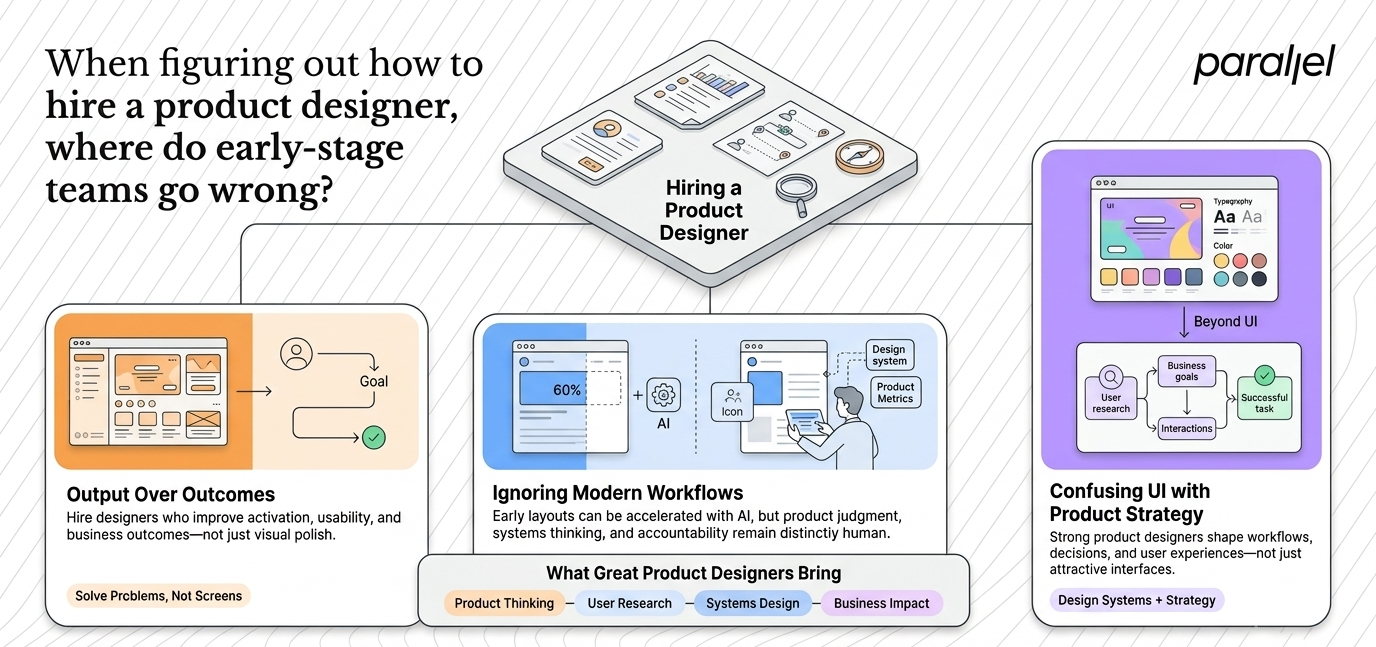
When figuring out how to hire a product designer, where do early-stage teams go wrong?
Before you even ask how to hire a product designer, you need to define the actual problem you are trying to solve. Most startups fail entirely at this initial step. They draft a generic job description, ask for a visually stunning portfolio, and hope the person they recruit will magically fix their flawed product strategy.
This lack of clarity leads to several critical mistakes that derail product development.
Mistake 1: Hiring for output over outcomes
We routinely see teams overcomplicate their software because they recruited someone who prioritizes beautiful screens over clear user journeys. A great designer will challenge your assumptions instead of just coloring in your wireframes. If a startup builds a robust dashboard with fifty features but users drop off at step two, the design has failed. Hiring someone to produce raw visual output rather than solving the core activation problem is a massive waste of resources.
Mistake 2: Ignoring the shift in modern workflows
The design industry has changed rapidly. According to the Figma State of the Designer 2026 report, artificial intelligence tools are now highly effective at getting early ideation and layout work to 60 percent complete. The real value of a product professional today lies in the remaining 40 percent. This final stretch involves taste, judgment, and accountability. If you hire someone purely for their ability to generate screens quickly, you are hiring for a commodity that AI can largely replicate. You need a partner who can think in systems and align interface decisions with your revenue goals.
Mistake 3: Confusing UI design with product strategy
Many founders mistake aesthetic capability for product sense. User interface design is about how a product looks. Product design is about how a product works and why it exists. If you bring on someone who only understands typography and color theory, your UX design will suffer. The interface might look gorgeous on a monitor, but it will fail when real users try to complete a complex task under pressure.
What exactly should you look for in a design portfolio?
When reviewing candidates or potential agency partners, you must look strictly past the polished visuals. A beautiful interface on Dribbble tells you absolutely nothing about how a piece of software performs in the real world. You want to see the messy middle of their process.
Here is a practical checklist for evaluating a portfolio.
- Problem definition: Does the case study clearly state the business problem and the user constraint before showing any visuals?
- Research methodology: Did they actually speak to users? Look for evidence of user research and how those insights directly altered the design direction.
- Iteration and messiness: Real product work is never a straight line. Look for examples where they tested a concept, realized it failed, and pivoted.
- Cross-functional collaboration: Do they mention how they worked with engineering to understand technical constraints? Design does not happen in a vacuum.
- Business outcomes: We always look for professionals who can articulate the business impact of their decisions. Look for hard metrics like percentage improvements in conversion rates or reductions in support tickets.
Watch out for massive red flags. If a portfolio relies heavily on unjustified trendy visuals (like excessive glassmorphism) without explaining the usability benefit, move on. If they show a perfectly linear process with zero roadblocks, they are likely sanitizing their work or they have never shipped a complex product.
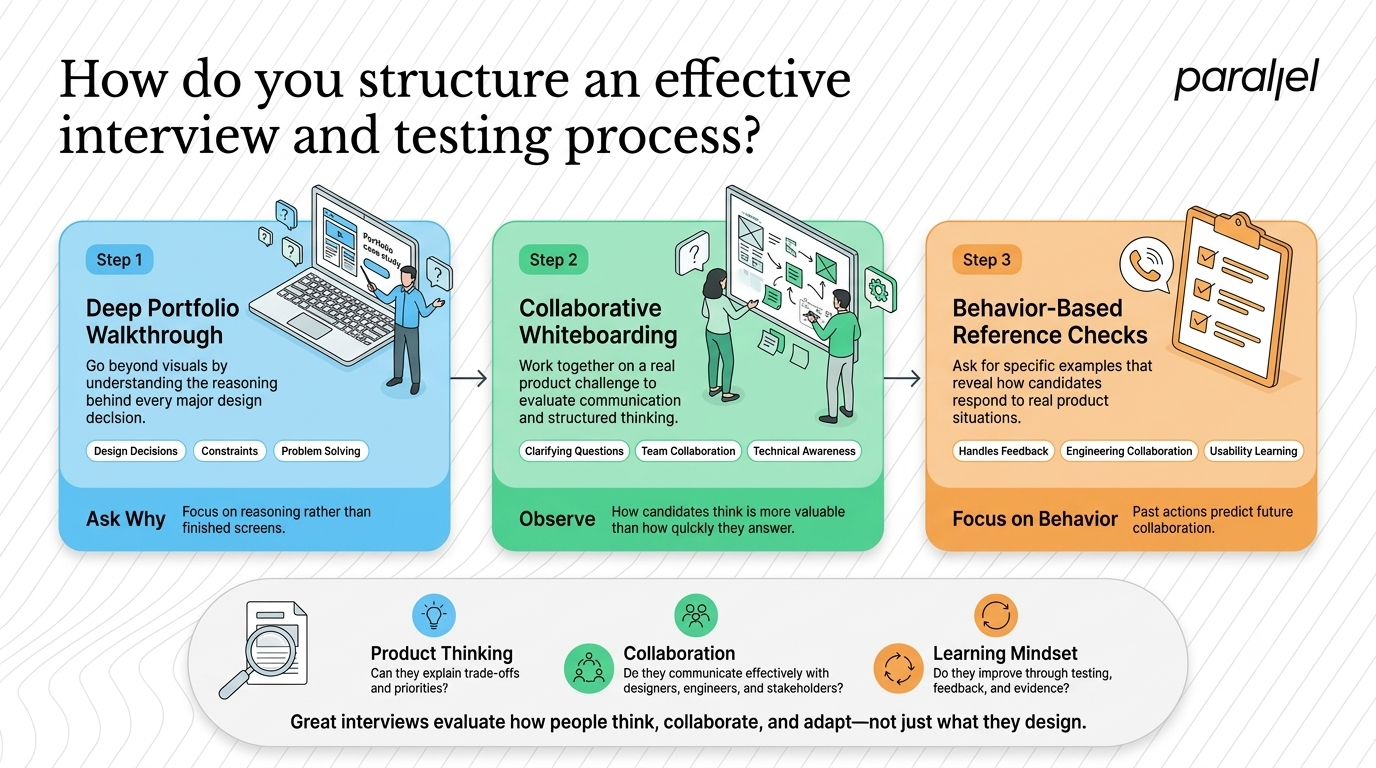
How do you structure an effective interview and testing process?
Once you know what to look for, you need a rigorous way to evaluate talent. Traditional interviews rarely uncover true product sense. I recommend a structured approach that mimics real collaboration and pressure.
Step 1: The deep portfolio walkthrough
Ask the candidate to present one project in extreme detail. Interrupt them with questions about their constraints. Ask why they chose a specific navigation pattern over a simpler alternative. You are looking for clear and logical reasoning. Strong professionals hold strong opinions loosely and will explain their rationale without becoming defensive.
Step 2: The collaborative whiteboarding session
Do not ask them to design a generic app on the spot. Instead, bring a real problem your team is currently facing. Spend thirty minutes working through it together. This exercise reveals everything you need to know about their communication style. Do they ask clarifying questions before jumping to solutions? Do they consider the engineering limitations? Are they comfortable pushing back on your initial ideas?
This collaborative dynamic is exactly what you will experience during a rigorous design sprint. You want someone who thrives in that environment.
Step 3: Reference checks that actually matter
Do not ask former managers if the candidate was a good designer. Ask specific behavioral questions. Ask how the candidate handled it when an engineer told them a feature was impossible to build. Ask what happened the last time their design failed a usability test. The answers to these questions will tell you how they will perform in your startup.
Agency, freelancer, or in-house: how to hire a product designer based on your business stage?
If you want to know how to hire a product designer without burning runway, you have to match the engagement model to your immediate needs. There is no single correct answer for every company, but there is definitely a wrong answer for your specific context.
Let us break down the reality of each option.
The freelance designer model
Freelancers are excellent for isolated tasks or highly narrow scopes. If you need a landing page update, a quick visual refresh, or minor component tweaks, a freelancer offers flexibility and lower upfront costs. You have a direct line to the person executing the work.
However, a freelancer represents a single point of failure. One person can only master so many skills. If your software requires deep strategic planning, complex interaction states, and accessibility compliance, a solo freelancer will likely stretch themselves too thin. Furthermore, the Upwork Future Workforce Index 2025 highlights that 43 percent of skilled independent workers eventually move into agency models to handle client demand properly. Relying on one solo operator for a critical launch carries significant capacity risk. If they get sick or take on a larger client, your timeline halts completely.
The agency or founder-led studio model
Agencies bring a wider range of skills and built-in accountability. You are not just securing visual output. You are getting strategic oversight, project management, and specialized expertise across the entire development lifecycle. According to 2026 data from MTHD Marketing, 67 percent of businesses report better overall results when partnering with an agency rather than relying on solo contractors.
However, not all agencies are created equal. Large, traditional agencies often come with heavy account management bloat and slow processes. This is why many startups look for a MetaLab alternative or an IDEO alternative that can move at startup speed.
At ParallelHQ, we operate as a founder-led studio. This means we offer the strategic depth and reliability of a larger organization, but with the direct involvement you would expect from a senior partner. We focus heavily on product strategy consulting alongside execution. This model is ideal for startups that need to move fast, require high-quality thinking, and cannot afford the months it takes to recruit internally.
The in-house team model
Building an internal team makes sense when you have a clear roadmap stretching out for years and the internal bandwidth to manage creative talent. An internal employee will develop deep, nuanced domain knowledge about your specific industry and user base that an external partner cannot match overnight.
The downside is speed and immense overhead. Finding, interviewing, negotiating, and onboarding a senior professional takes months. You also take on the heavy burden of their career development, benefits, equity, and management. If you are an early-stage founder trying to find product-market fit, managing a creative team often distracts from core business building. The true cost of an employee is often 30 to 40 percent higher than their base salary when you factor in taxes, software licenses, and recruiting fees.
What is the financial impact of knowing how to hire a product designer correctly?
Understanding how to hire a product designer is fundamentally a business strategy, not just an HR checkbox. The financial implications of poor user experience are staggering, especially for early-stage companies operating with strictly limited capital.
The return on investment for excellent usability is incredibly well documented. According to Forrester Research in 2026, every single dollar invested in UX yields an average return of 100 dollars. That equates to a 9,900 percent ROI. When you prioritize clarity, you naturally reduce customer support costs, lower your customer acquisition cost, and increase long-term retention.
Furthermore, companies that treat this discipline as a core strategic function financially outperform their peers. Recent data from the McKinsey Design Index shows that top-quartile companies achieve 32 percentage points higher revenue growth over a five-year period compared to industry averages.
Conversely, the cost of bad decisions is usually hidden in your engineering budget. Roughly 50 percent of development time is wasted on entirely avoidable rework. When your team fails to think through edge cases or validate concepts with real users, engineers end up building the wrong features. A strong partner prevents this massive waste by mapping out clear user journeys and testing prototypes before a single line of expensive code is written. We see this constantly when we conduct a UX audit for struggling SaaS platforms.
How do you integrate a new design partner into your product team?
Whether you choose a freelancer, a studio, or an employee, the onboarding process dictates the success of the relationship. You cannot simply hand over a brief and expect perfection two weeks later. You must integrate them deeply into your operational rhythm.
First, give them unfiltered access to your data. They need to see your analytics dashboards, read customer support tickets, and watch session recordings. We always start our engagements by absorbing as much quantitative and qualitative data as possible.
Second, establish clear communication channels immediately. Set up dedicated Slack spaces and integrate them into your Jira or Linear boards. Building maintaining design system documentation is impossible if your external partner is siloed away from your engineering leads. Treat a good agency partner exactly like you would treat an internal product lead. Give them context, give them trust, and hold them accountable to business metrics.
Conclusion
Ultimately, learning how to hire a product designer comes down to understanding your own constraints and goals.
If you need a quick tactical fix on a tight budget, a freelancer might suffice. If you have the luxury of time and a dedicated management structure, building an internal team is a strong long-term play. But if you need sharp product thinking, rapid execution, and a partner who will actively challenge your assumptions, a founder-led agency is almost always the smartest choice.
Do not settle for generic interfaces. Find a partner who cares as much about your SaaS metrics as they do about typography. The success of your software depends on it.
FAQ
1) What is the very first step in how to hire a product designer?
The first step is clearly defining the business problem you need them to solve. Are you struggling with user onboarding, facing low conversion rates, or building a complex platform from scratch? Documenting your specific challenges will dictate the exact seniority and skillset you need to look for.
2) What is the core difference between UI and product design?
A UI professional focuses primarily on the visual presentation, color theory, and interactive elements of an interface. A product professional takes a much broader approach. They conduct research, define the strategy, map complex user flows, and ensure the final output aligns perfectly with overarching business objectives.
3) Should I use a test project during the interview process?
Yes, but keep it brief and relevant to your actual product. We recommend a paid, time-boxed exercise taking no more than a few hours. Alternatively, a live whiteboarding session focused on a real problem your startup faces is highly effective. You should actively avoid asking candidates for days of unpaid speculative work.
4) How much does it realistically cost to bring on design help in 2026?
Costs vary wildly by the model you choose. A mid-level freelancer might charge between 50 and 150 dollars per hour. Full-time senior employees command base salaries ranging from 120,000 to over 200,000 dollars annually. Specialized studios typically quote by project scope or monthly retainers, often ranging from 10,000 to 50,000 dollars depending on complexity and timeline.
5) Freelancer vs Agency: Which is better for an early-stage startup?
It entirely depends on your internal bandwidth. If you have a strong product manager who can direct a freelancer's daily tasks and provide strategic oversight, a freelancer works well. If you lack internal product leadership and need a team that can manage the process end-to-end while providing strategic direction, a studio is the safer and faster option.
6) Is an in-house hire right for me right now?
If you have achieved strong product-market fit, have a steady pipeline of continuous interface needs, and possess the internal structure to manage a creative professional, then yes. If you are still iterating rapidly to find market fit or lack design leadership, the flexibility and speed of an external partner is usually the better choice.
7) How long does the hiring process typically take?
Finding, interviewing, and negotiating with a full-time senior professional can easily take three to six months in a competitive market. In contrast, you can typically onboard a vetted freelancer or a specialized design studio within two to four weeks.
8) How does ParallelHQ help teams with their product experience?
At ParallelHQ, we partner with founders and product leaders to simplify complex software experiences. We do not just deliver beautiful screens. We conduct rigorous user testing, facilitate strategy workshops, and build grounded, highly usable products. We operate as a strategic extension of your team, bringing clarity to your roadmap and helping you execute faster.

check out these related blogs