If you've received an R/GA proposal and want to pressure-test it against the wider market, or you've already decided R/GA isn't the right fit, this guide is a direct answer. I'm Robin Dhanwani, founder at ParallelHQ, and I've spent years watching founders and product leaders navigate the agency landscape. What follows is an honest, structured look at the best R/GA Alternatives Compared in 2026, covering enterprise incumbents, boutique product studios, and startup-ready partners alike. I'll tell you what each does well, where they fall short, and who they're actually built for.
TL;DR
- R/GA Alternatives Compared range from enterprise consultancies (AKQA, Huge) to sharp product studios (Work & Co, ustwo) to startup-native partners (ParallelHQ).
- Enterprise alternatives carry enterprise overheads. If you're a SaaS or AI startup, most of the big-name list is overkill.
- The smartest move: match the agency's actual client gravity to your stage.
- Boutique and mid-tier agencies often deliver faster cycles and more senior hands-on attention.
What R/GA Actually Is (and Why People Look for Alternatives)
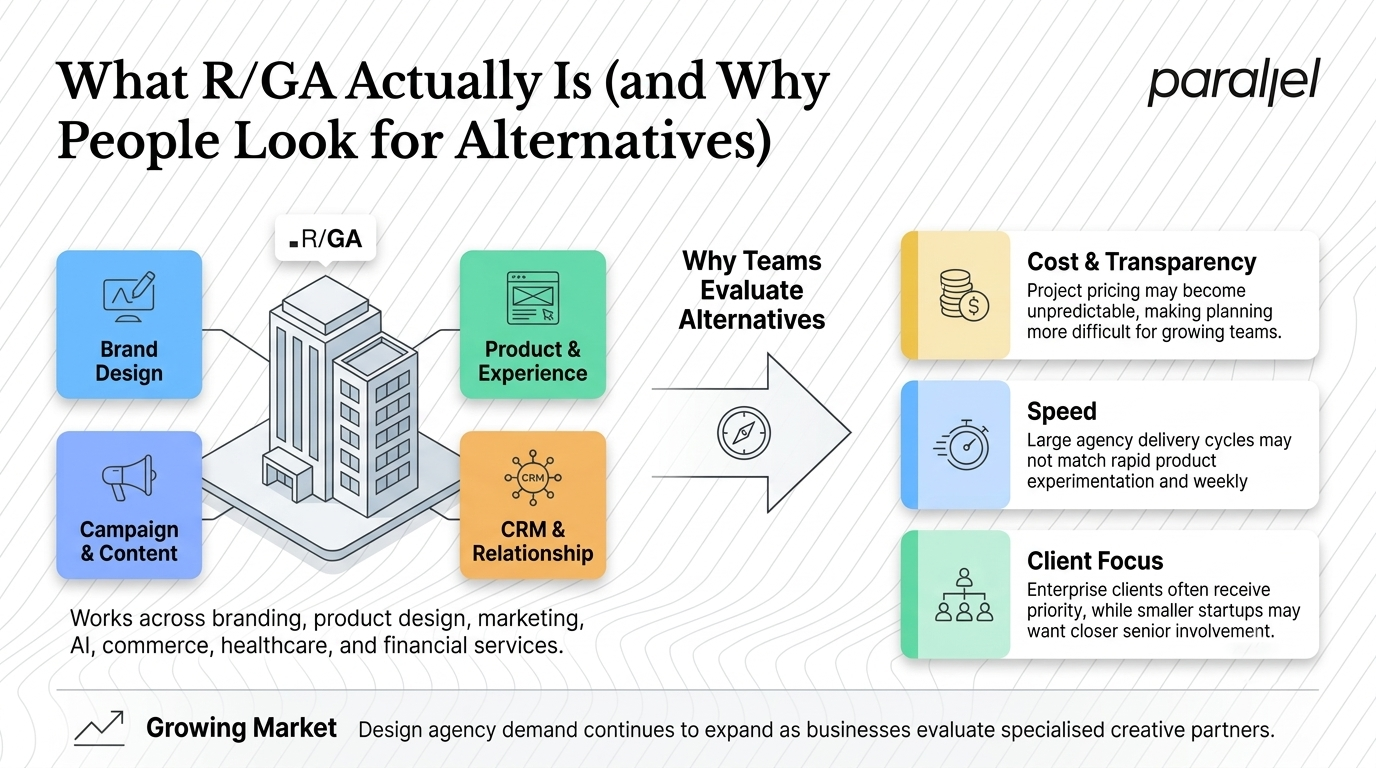
Before evaluating the alternatives, it's worth being precise about what R/GA is. R/GA is an independent creative innovation company for the intelligence age. R/GA partners with clients across Brand Design, Product & Experience Design, Campaign & Content Design, and CRM & Relationship Design, with deep expertise in AI, Commerce, Health, and Financial Services.
What makes R/GA distinctive is its historical position at the intersection of technology and creativity. The agency operates at the intersection of brand strategy, digital product design, marketing communications, and business transformation, serving Fortune 500 clients across industries including consumer goods, technology, automotive, retail, and financial services. That Fortune 500 orientation is precisely why many product and design leaders look elsewhere.
R/GA became an independent agency in 2025 when it spun out of Interpublic Group of Companies with private equity funding, which has prompted many businesses to explore alternative creative partners. The ownership change introduced real uncertainty about continuity, leadership stability, and pricing predictability.
Three friction points come up repeatedly when evaluating R/GA against the alternatives:
- Cost and transparency: Project-based pricing at traditional agencies can be unpredictable and often escalates beyond initial estimates, and for a CMO managing quarterly budgets, the lack of cost transparency creates planning challenges.
- Speed: Traditional agency timelines don't always align with the velocity modern businesses require. A UX director running rapid A/B testing cycles needs creative assets delivered in days, not weeks.
- Client gravity: R/GA is built around Nike, Google, and Samsung. If you're a Series A SaaS startup, you will not get partner-level attention.
The global design agency market reflects how many teams are actively rethinking this. The Design Agencies Market size was valued at $3.2 billion in 2025 and is estimated to reach $4.9 billion by 2034, exhibiting a CAGR of 5.5% from 2026 to 2034. Competition is real, and the alternatives are genuinely good.
R/GA vs Huge vs IDEO: Which Agency Is Better for Product Design?
These three names appear together constantly in agency comparisons. They're all large, all respected, and all genuinely different in practice.
R/GA sits at the creative-technology intersection, strongest on brand experience and connected marketing platforms. R/GA is widely credited with pioneering the concept of the 'networked brand' and its service offerings span brand strategy, experience design, product and service innovation, technology development, and connected marketing campaigns.
Huge has evolved considerably. Its global footprint was expanded through strategic growth and acquisitions, including the 2024 acquisition by AEA Investors and the subsequent 2025 merger with Hero Digital, which integrated additional regional capabilities. As of April 2025, Huge employs approximately 1,000 professionals worldwide, and the 2025 merger with Hero Digital further enhanced commerce, performance marketing, and martech capabilities including Adobe and Salesforce partnerships. Huge is strongest for omnichannel commerce and retail platforms. If your product is a SaaS tool with no e-commerce layer, Huge's deepest capabilities won't apply.
IDEO occupies a different category entirely. IDEO is a global UI/UX design agency that leverages discovery, play, and experimentation to help organizations get and stay ahead, with a multidisciplinary community of designers, entrepreneurs, engineers, teachers, and researchers focused on human-centered design. IDEO's strength is upstream strategic and organisational design. They'll help you frame the problem beautifully. But if you need Figma prototyping completed and shipped in a sprint, that's not their rhythm.
For pure digital product design at the enterprise tier, R/GA and Huge are closer competitors. For design-thinking methodology and organisational transformation, IDEO stands apart from both.
Top Creative Technology Agencies Similar to R/GA in 2026
If what you valued about R/GA was specifically the creative-technology fusion, these agencies compete directly on that ground.
AKQA is the clearest like-for-like alternative. AKQA is a design and innovation company that employs over 3,000 professionals across 20 countries, named Digital Agency Global Network of the Year in Campaign's 2023 Global Agency of the Year Awards, and also awarded the Cannes Lions Grand Prix for Digital Craft in 2023. The company has earned top honours including the Cannes Lions International Festival of Creativity Grand Prix for Innovation in 2025. AKQA's client list overlaps with R/GA's. AKQA sits at the center of service, experience and product design; clients include Louis Vuitton, Nike, Google, Pfizer, H&M, Volvo and Amazon. The gap: you're still looking at an enterprise-scale agency with enterprise-scale timelines.
Frog Design operates with a similar systems-level ambition. Frog is a global design and strategy firm that transforms businesses at scale by creating systems of brand, product and service that deliver a distinctly better experience. Frog concentrates on service design, UX strategy, and digital innovation, working with customers such as Sony, Disney, and Microsoft, and in 2025 is placing a strong focus on emerging technologies like AI, IoT, and sustainability-driven products. Frog's sweet spot is physical-digital systems design: hardware-software, IoT, and multi-touchpoint ecosystems. Strong for deep product strategy consulting; less suited to pure SaaS UI/UX execution.
Work & Co is architecturally different despite serving a similar tier. Work & Co is known for its collaborative process with clients and being hands-on, sharing working prototypes throughout rather than unveiling finished work, with projects typically having small, senior teams including company partners and founders who are hands-on active members on each project. Work & Co, part of Accenture Song, is a global design and technology company with over 425 people across the United States, Europe, and Latin America. The small-team model means more senior attention per project. The Accenture Song integration means you now get consulting depth alongside it. Pricing is enterprise, but the process discipline is excellent.
Best Agencies for Large Brand Digital Transformation Projects
For enterprise digital transformation, the R/GA Alternatives Compared shortlist looks like this:
Accenture Song / Droga5 deserves a mention because it's where brand strategy and consulting have fully merged. Their integration with Accenture Song provides access to technology consulting and business transformation capabilities that traditional creative agencies cannot match. If your transformation agenda needs to sit inside a broader ERP or cloud migration, this umbrella has the coverage.
Huge remains credible for retail and financial services transformation. Huge, based in Brooklyn, has earned a strong reputation as a digital-first agency that helps brands adjust to the fast-changing online world, with services ranging from UX and UI design to branding, strategy, and digital marketing.
ustwo is a compelling alternative for brands that want transformation to feel human rather than consultancy-delivered. ustwo is a strong option for teams that want UX work to feel human, well-crafted, and grounded in real user needs, with a track record of creating products that are both useful and memorable, and work that tends to carry more warmth and product personality than many larger consultancies.
For large-scale connected experience design with R/GA's level of craft, AKQA and Work & Co remain the most direct substitutes.
Is R/GA Worth the Cost Compared to Boutique Design Studios?
This is the real question for most founders and product leaders evaluating these options. Here's my honest take. R/GA's pricing is commensurate with its overhead: a global network, brand name, and enterprise account management apparatus. R/GA's global network spans 18 countries, with 2,000 employees representing over 20 nationalities with offices across the United States, Europe, South America, and Asia-Pacific. That infrastructure is valuable if you're Nike and need coordinated campaign rollouts across continents. It adds cost without adding value if you're a 30-person SaaS company that needs a polished product design and a solid design system.
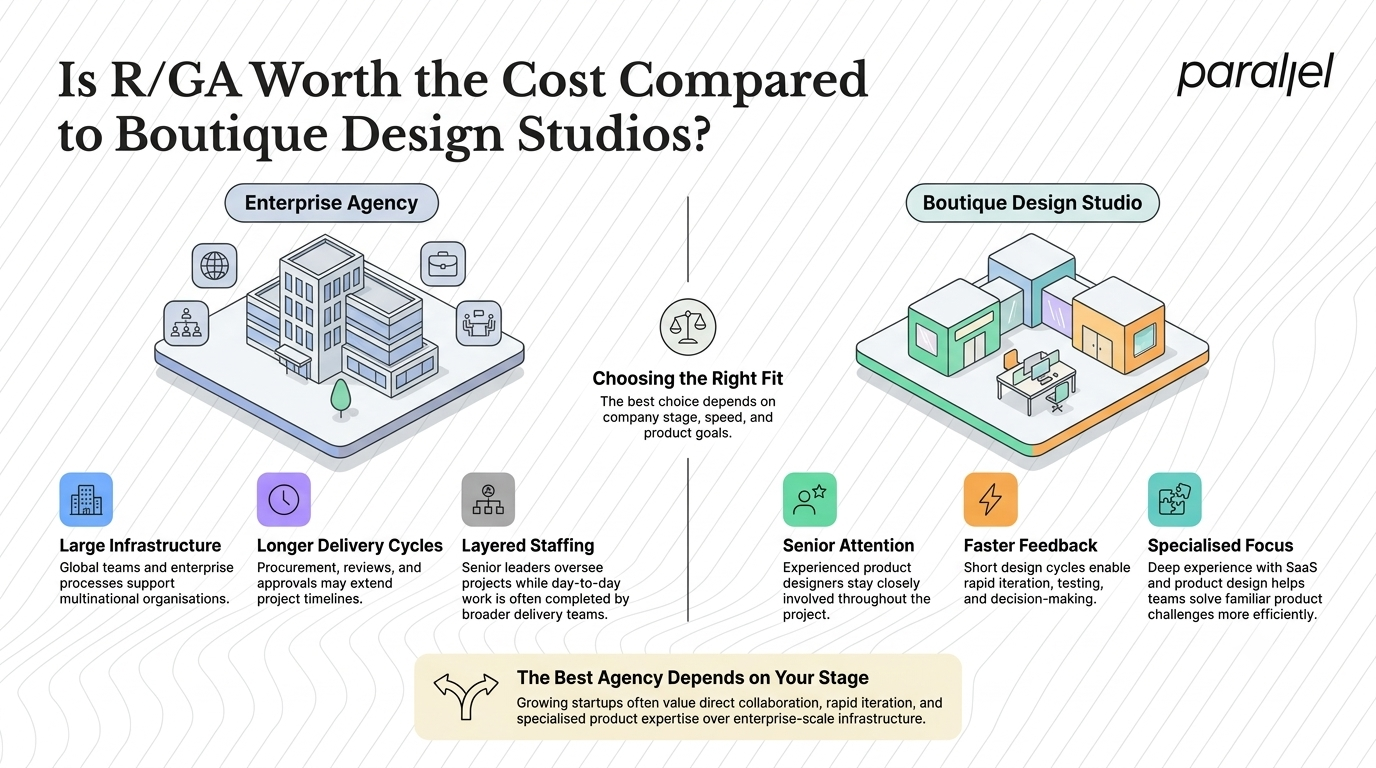
Boutique studios offer a different value equation:
- Senior attention: At large agencies, your project is typically staffed by mid-level talent with senior oversight at review stages. At a boutique, senior designers are hands-on throughout.
- Speed: Boutiques operate in shorter feedback loops. A design sprint at a focused studio can produce validated prototypes in five days. At enterprise agencies, procurement alone can take longer.
- Alignment: A studio that specialises in early-stage AI or SaaS products has pattern recognition you can't buy from a generalist.
The cost-quality curve doesn't scale linearly in design. A boutique studio billing $150/hr with a fully senior team often delivers better product outcomes than a large agency billing the same rate but staffing mid-level designers. The question isn't whether R/GA is good. It is. The question is whether R/GA is right for your stage, your timeline, and your decision-making cadence. If you're a Series A or B SaaS startup, the right agency is usually the one where your founder or CPO gets the direct mobile number of the person doing the work.
What Agencies Can Replace R/GA for Connected Experiences Work?
"Connected experiences" is R/GA's strongest territory: products, services, and marketing that behave as a coherent system across digital and physical touchpoints. The Nike+ ecosystem is the canonical example. Few agencies can genuinely replace R/GA here, but several come close for different reasons.
AKQA is the strongest replacement. Their model covers the same creative-technology space and their awards record confirms the quality of execution at scale. AKQA was awarded the Cannes Lions Grand Prix for Digital Craft in 2023 and won 22 Cannes Lions, including Grand Prix for Design and Glass in 2024, and in 2023 and 2024 was recognised with seven Fast Company Innovation by Design Awards.
Frog covers the physical-digital systems layer better than almost anyone. For IoT, healthcare devices, or automotive UX, Frog is a stronger fit than R/GA.
Work & Co is the tightest execution shop if your connected experience lives primarily in software. Teams are dedicated to one project at a time and work cross-functionally across design, product, engineering, and QA, with active involvement of all stakeholders starting at kickoff.
For startups building AI-native connected products, none of these three are built for your stage. Their minimum project thresholds, procurement cycles, and team structures assume an enterprise buyer. That gap is exactly why ParallelHQ's AI/UX design services and product design practice exist.
Cheaper Alternatives to R/GA for Startup Branding and Product Design
If you're at the pre-Series B stage, the question of cost is legitimate, not a compromise. You need design work that punches above your current valuation.
Lollypop Design Studio is India's highest-profile UI/UX option. Founded by Anil Reddy with a mission to put India on the global design map, the agency has grown to impact over two billion lives with a team of 200+ designers and developers whose approach combines AI-powered design thinking, deep user research, and a commitment to transforming complex business challenges into intuitive digital experiences. Pricing starts at $25–$49/hr with a $10,000 project minimum. The trade-off is that at that scale, you're not getting dedicated senior attention. The gap for startups is that size creates process. Some clients noted that Lollypop could improve in strategic planning and resource allocation, and for a startup that needs to move fast and change direction in week three, a 180-person studio can add friction where you need fluidity.
Clay takes a strategy-first position. Clay approaches SaaS design through the lens of strategy and identity, believing great digital products grow faster when brand and UX are unified, and merging user research with design system thinking to help SaaS companies build cohesive, scalable interfaces.
ParallelHQ is built specifically for the gap that all of the above agencies leave open. Where R/GA serves Nike, and Lollypop serves scale, ParallelHQ works exclusively with early-stage AI and SaaS startups. Our UI/UX design services, product strategy consulting, UX audit, and design systems work are all structured around the realities of fast-moving startups: lean teams, fast pivots, and founders who need to see progress in weeks, not quarters.
The complete picture of the R/GA Alternatives Compared at this tier:
ParallelHQ as the Startup-Native Alternative to R/GA
I'd be doing founders a disservice if I didn't make this case clearly. The agencies above are good. Most of them are genuinely excellent within their domain. But almost all of them share one structural reality: they're organised around enterprise procurement cycles, enterprise retainer sizes, and enterprise decision-making speeds. A 12-week strategy phase and a 20-person kickoff call are features for a Fortune 500 brand. For a startup in a funding window, they're liabilities.
ParallelHQ is structured around the opposite set of constraints. Here's what that means in practice:
- Discovery Framework: We use a structured discovery process to align on product goals, user needs, and design direction before any pixels are placed.
- Design Sprints: For startups that need validated concepts in a week, our sprint process compresses months of iteration into focused, testable output.
- MVP Development: We take products from concept to shippable MVP with design and development working in sync.
- User Research and Usability Testing: Real user validation embedded into the process, not an afterthought at the end of a long phase gate.
- AI Software Design Services: Specifically for AI-native products where the UX challenge is about trust, explainability, and interaction model, not just visual design.
The honest comparison: R/GA will produce a more awarded, more brand-elevated output for a Nike-scale brief. For a 15-person AI startup trying to convert a product-market-fit signal into a fundable, shippable product, ParallelHQ's founder-level attention and startup-native process are a better match. R/GA is built for the world's biggest brands. ParallelHQ is built for the companies trying to become one.
Conclusion
Here's what this comparison actually tells you:
- For enterprise connected experiences: AKQA is the closest R/GA substitute with a comparable creative-technology mandate and stronger recent awards.
- For product design execution: Work & Co's small-team, senior-led model delivers better process discipline than most larger agencies.
- For design thinking and organisational transformation: IDEO remains distinctive, though it operates more upstream than most product teams need.
- For AI and SaaS startups: Most names on the R/GA Alternatives Compared list are the wrong size, wrong speed, and wrong price point. ParallelHQ is designed for exactly this gap.
The best agency isn't the most famous one. It's the one where your stage, budget, and working rhythm align with how the agency actually operates.
Frequently Asked Questions
1) What is R/GA and what services does it offer?
R/GA partners with clients across Brand Design, Product & Experience Design, Campaign & Content Design, and CRM & Relationship Design, with deep expertise in AI, Commerce, Health, and Financial Services. It is an enterprise-tier creative technology agency with a global network, best suited to large brand transformation programs.
2) Who are R/GA's main competitors in 2026?
R/GA's primary competitors in the creative technology space are AKQA, Huge, Work & Co, Frog Design, and IDEO. Each covers different parts of the design spectrum: Huge contends with notable firms such as Razorfish, Critical Mass, VaynerMedia, iCrossing, and R/GA in the digital transformation lane, while AKQA and Work & Co compete more directly on digital product design quality.
3) Is R/GA a good fit for startups?
Rarely. R/GA's model is built around Fortune 500 procurement, long engagement cycles, and brand-level budgets. Most startups will find boutique product design agencies a better operational fit, with faster cycles, more senior hands-on attention, and minimum project thresholds that don't require a CFO sign-off.
4) How does AKQA compare to R/GA for product design?
Both agencies operate at the intersection of creativity and technology and serve overlapping enterprise clients. AKQA has earned top honours including the Cannes Lions Grand Prix for Innovation in 2025 , giving it strong recent momentum. AKQA tends to skew slightly more toward experience and service design; R/GA has historically been stronger on brand systems and connected marketing ecosystems.
5) What's the best alternative to R/GA for a SaaS startup on a limited budget?
For early-stage SaaS, the strongest options are boutique product design studios that specialise in startup contexts. ParallelHQ is built specifically for this: structured discovery, sprint-based design, and SaaS design services shaped around the speed and constraints of a funded startup rather than an enterprise procurement cycle.
6) What should I look for when comparing design agencies against R/GA?
Four things matter most: (1) whether the agency's typical client stage matches yours, (2) the seniority level of designers actually doing the work, (3) how transparent and predictable the pricing is, and (4) process speed. An agency's reputation is a signal, not a guarantee. Align on working rhythm before you align on brand name.

check out these related blogs