I talk to early-stage founders and product leaders every single week. Most of them come to us thinking their product needs a visual refresh. In reality, they have a clarity problem. Their interfaces are overcomplicated because their product thinking is muddy. When you look for the best UI UX design agencies in Boston, you usually find portfolios full of pretty screens but empty of real strategic depth. Real design solves business problems. It removes friction. It drives activation. Here is how to find a partner who actually understands that.
Quick Answer and TL;DR
You do not need an agency to make your app look nice. You need a partner to simplify complex product decisions and improve real user metrics. Here is a quick breakdown of the best UI UX design agencies in Boston.
What should you look for in the best UI UX design agencies in Boston?
The design industry has a superficiality problem. We see teams overcomplicate onboarding all the time because they hire designers who prioritize aesthetics over user behavior.
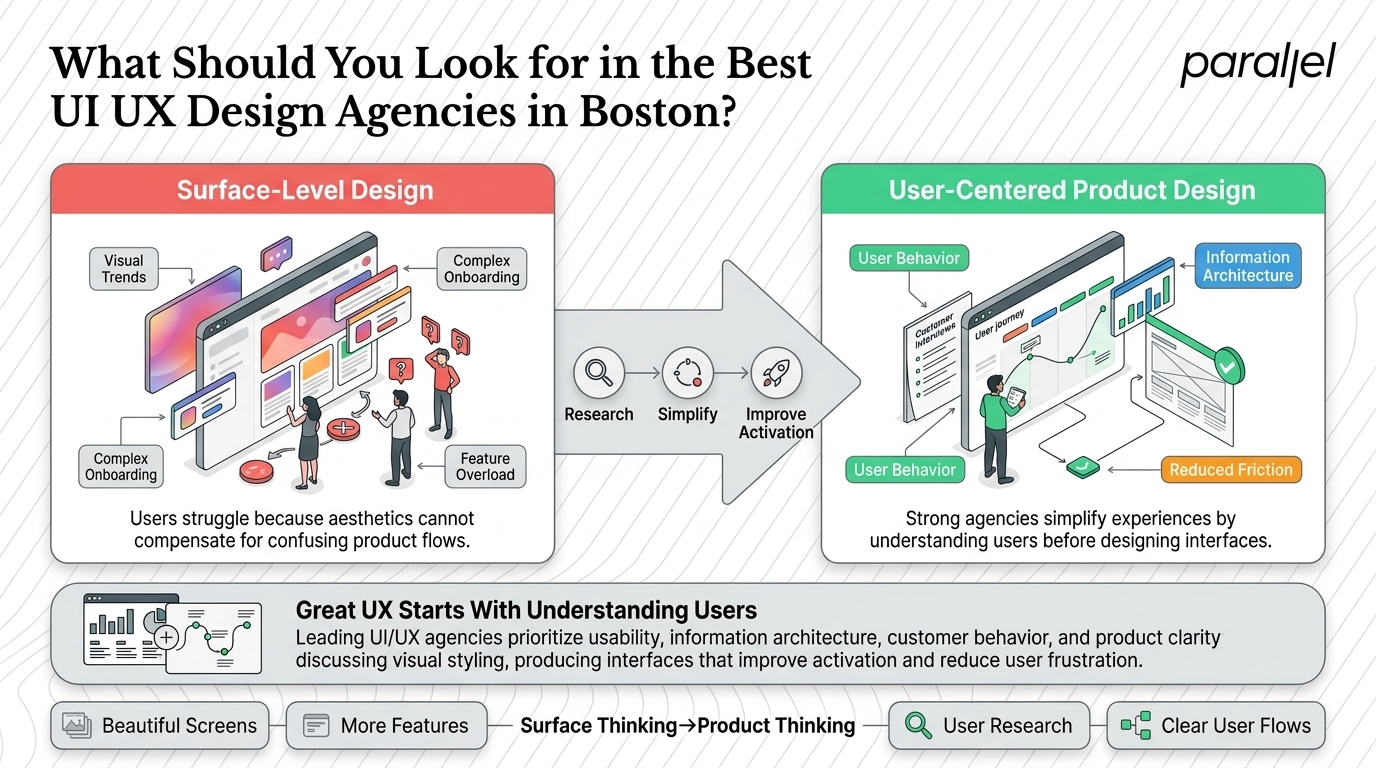
A sleek interface cannot save a fundamentally confusing product flow. When you are evaluating a design partner, you must look past the visual polish. You need to understand how they approach problem-solving. A mature design partner will spend more time mapping out user friction than they will picking typography. They should challenge your assumptions about what the user actually wants.
According to a 2026 report by the Nielsen Norman Group, products that prioritize foundational usability and clear information architecture see a 400% higher activation rate than those that rely solely on visual trends. This matters because user patience is at an all-time low. If your product is not immediately clear, users will churn.
Where do startups go wrong when hiring UI UX design agencies?
In my experience, this is where most product decisions go wrong. Founders treat design as the final coat of paint rather than the foundation of the product strategy.
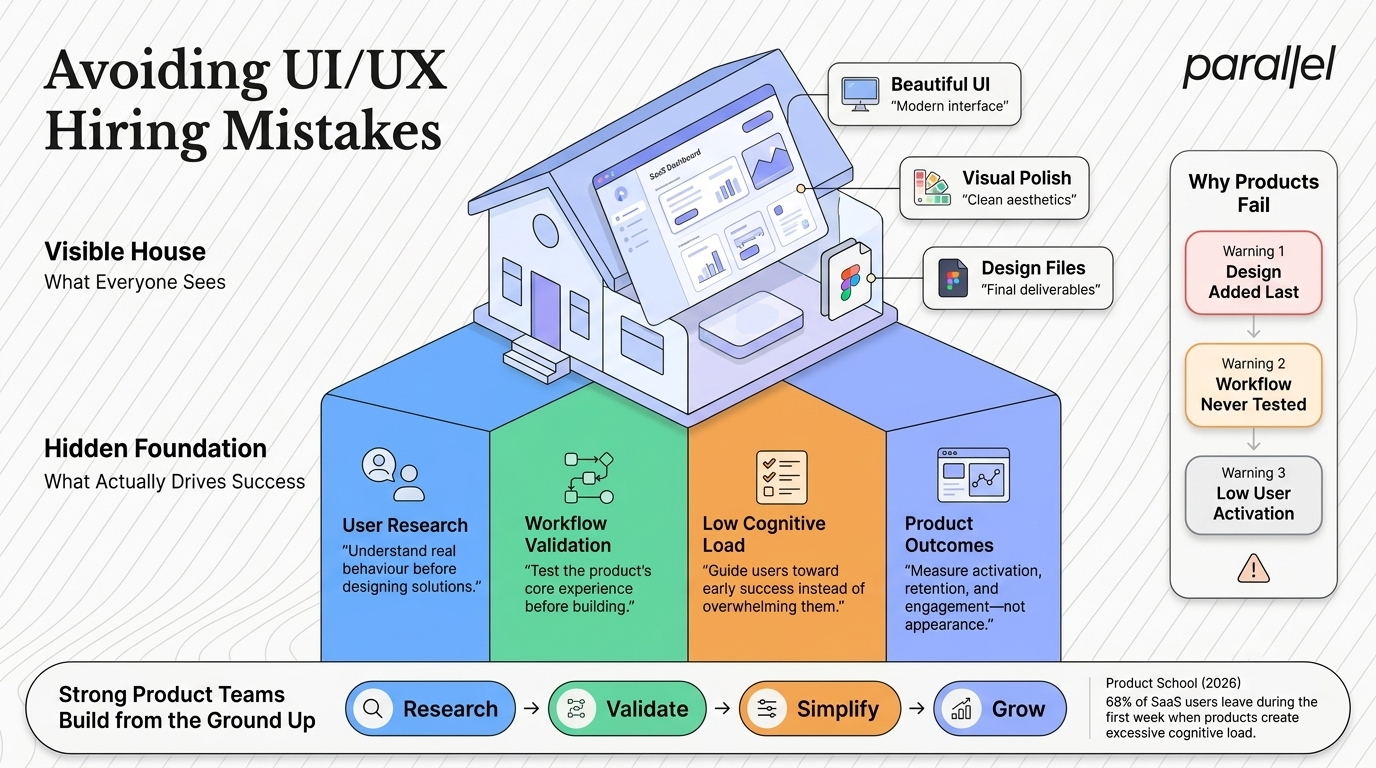
They hire an agency to "make it pop." The agency delivers a beautiful file. The engineering team builds it. But user engagement remains completely flat. This happens because the core workflow was never tested against real user behavior. The agency did not ask the hard questions about why a feature existed in the first place.
Recent 2026 data from Product School's State of Product Report highlights that 68% of users abandon SaaS platforms during the first week due to overwhelming cognitive load. We have seen this exact pattern at ParallelHQ. Weak onboarding and low activation are almost always the result of a product trying to do too much at once.
How to choose from the best UI UX design agencies in Boston for your product?
You need to shift your evaluation criteria. Stop looking at just the final deliverables and start looking at the friction in their process.
A great partner will require you to slow down before you speed up. They will want to conduct a UX audit to understand where users are currently dropping off. They will ask to see your behavioral analytics. They will demand to speak with your actual users. If an agency is willing to start designing high-fidelity screens on day one without understanding your core business metrics, you should walk away.
Here is a practical approach to vetting your next design partner. Ask them to walk you through a project that failed. Listen to how they talk about failure. Did the product fail because it looked bad, or did it fail because they solved the wrong user problem? The best teams learn from strategy failures, not just execution errors.
Comparing the 10 best UI UX design agencies in Boston (2026)
Finding the right fit requires understanding the unique strengths of each firm. Here is how the top players in the market break down based on real industry experience.
1) ParallelHQ
We built ParallelHQ because we saw too many product teams struggling with design decisions that should have been much simpler. We are a product design and strategy partner focused entirely on clarity.
Our approach is grounded in real user behavior, not passing design trends. We work closely with founders and product leaders at early-stage startups to fix overcomplicated product experiences. Whether we are running a targeted design sprint to validate a new feature or doing a complete SaaS onboarding teardown, our goal is always to improve your bottom line. We do not just hand over Figma files. We help you think better and make better product decisions.
While we operate globally, we actively support scaling companies through our product design services in Boston. If you have a weak activation rate or a muddy user journey, we are the team that will help you simplify it.
2) thoughtbot
If your core problem is bridging the gap between design and complex engineering, thoughtbot is a very strong contender. They have a long history in the Boston tech ecosystem and are deeply respected for their technical acumen.
They do not just design products. They build them. Their design philosophy is tightly coupled with agile development methodologies. This makes them an excellent choice for technical founders who need a team that speaks their language from day one.
However, if your primary need is deep strategic repositioning or high-end brand experience design, you might find their approach a bit too pragmatic and developer-centric. They excel when the product needs to be built fast and scale reliably.
3) Upstatement
Upstatement operates at the intersection of digital product design and brand storytelling. They are arguably the strongest team in the region if you are building a media platform, an editorial site, or a brand-heavy digital experience.
They understand how content drives user engagement. Their portfolio is full of high-impact work for major universities, publication houses, and large-scale media organizations. They think deeply about content architecture and typography.
If you are building a highly transactional B2B SaaS tool with complex data visualization, their content-first approach might not be the perfect fit. But for digital products where the brand narrative is the primary driver of value, they are exceptional.
4) Rocket Insights
Rocket Insights, now part of the Dept network, is a powerhouse for fast-growing scale-ups. They have a reputation for dropping seamlessly into existing product teams and accelerating output.
They are highly adaptable. They can handle mobile applications, voice interfaces, and complex web platforms with equal proficiency. Because they are part of a massive global network, they have immense resources to scale up a project very quickly if your timeline demands it.
The tradeoff with large network agencies is sometimes a lack of senior-level continuity on smaller accounts. If you are an early-stage founder who needs highly customized, partner-level strategic guidance every step of the way, you need to ensure you are getting their top tier of talent.
5) MadPow (Tech Mahindra)
MadPow built its reputation on behavioral science. They do not just look at how a user interacts with a screen. They look at the psychological drivers behind that interaction.
This makes them incredibly effective in highly regulated, complex industries like healthcare and financial services. If you are building a product that requires users to change their long-term behavior like a fitness tracking platform or a financial planning tool, their research methodology is top tier.
They are now part of Tech Mahindra, which gives them massive enterprise scale. This is great for large corporations. But for a nimble startup looking to move fast and break things, their rigorous, enterprise-grade research process might feel a bit heavy.
6) Blink UX
Blink UX focuses relentlessly on evidence-driven design. They are a research-first organization. If you have a product that is failing and you have absolutely no idea why, Blink is the team you call to find the root cause.
They conduct exhaustive qualitative and quantitative user research. They build out massive usability labs and generate insights that are backed by hard data. McKinsey’s 2025 Design Index shows that integrating this level of design research early on doubles industry benchmark growth. Blink executes this perfectly.
The downside is that deep research takes time and a significant budget. If you already have strong product intuition and just need a team to execute a clear vision rapidly, a heavy research phase might slow your time to market.
7) Rightpoint
Rightpoint is a massive digital consultancy. They focus heavily on employee experience and customer experience at the enterprise level.
If you are a Fortune 500 company looking to overhaul your internal intranet or unify your global customer portals, Rightpoint has the infrastructure to handle it. They are experts in digital transformation and organizational change management.
They are rarely the right fit for an early-stage SaaS startup. Their processes, pricing, and project management structures are built for massive corporations. They deliver great work, but their operating model requires a client with enterprise-level resources.
8) Third and Grove
Third and Grove is highly specialized. They are the experts in the room when it comes to complex e-commerce architecture.
If you are pushing the boundaries of Shopify Plus or building a completely custom headless commerce experience, they have the specific domain expertise you need. They understand the nuances of cart abandonment, checkout friction, and product merchandising better than generalist agencies.
Because they are so specialized in commerce, I would not recommend them for a pure-play B2B SaaS product or a healthcare application. But if your revenue is tied directly to a shopping cart, they are a fantastic choice.
9) Echo&Co
Echo&Co stands out for its commitment to social impact and public sector work. They design products for non-profits, government agencies, and organizations focused on climate change and social justice.
Their work is deeply rooted in accessibility and inclusive design principles. They understand how to build digital products that must serve incredibly diverse, often vulnerable populations. Their empathy-driven process is remarkable.
If you are building a hyper-commercial, high-growth consumer app, their agency culture and pacing might not align with aggressive venture capital timelines. But for mission-driven organizations, they are a perfect cultural fit.
10) Momentum Design Lab
Momentum Design Lab specializes almost exclusively in complex enterprise software and B2B SaaS platforms. They do not get distracted by consumer trends or flashy marketing sites.
They understand dashboards. They understand deep data visualization. They know how to design for users who spend eight hours a day inside a single application. If your product requires extensive user training just to understand the basic navigation, Momentum has the experience to simplify that architecture.
They are a very pragmatic, results-oriented firm. They might not win awards for the most avant-garde visual design, but they build highly functional tools that enterprise users actually tolerate using.
Conclusion
Hiring a design partner is a massive commitment of time and capital. You cannot afford to get it wrong. The market is saturated with talented visual artists, but there is a severe shortage of rigorous product thinkers.
Data from Forrester Research in 2025 highlights that every dollar invested in foundational UX brings a return of 100 dollars. But that return only happens if you are solving the right problems. Do not hire a team to make your product look better. Hire a team to make your product work better.
Look for partners who push back on your ideas. Look for teams that demand access to your users. Demand clarity over cleverness. If you build a product that is simple, clear, and grounded in real human behavior, the aesthetic polish will naturally follow.
Frequently Asked Questions
1) What do the best UI UX design agencies in Boston actually do?
The top firms do not just draw screens. They conduct deep user research, map out complex user journeys, and identify exact points of friction in your product. They align your business goals with user needs to create an interface that drives actual revenue and retention. They focus on structural clarity before they ever touch visual styling.
2) Are the best UI UX design agencies in Boston right for my early-stage startup?
It depends entirely on your current bottlenecks. If you are struggling to find product-market fit, spending heavily on a massive agency is usually a mistake. However, if you have validated your core concept but are seeing massive drop-offs during onboarding, hiring a strategic UI UX design partner is the fastest way to unblock your growth.
3) How much do top design firms typically charge?
Pricing varies wildly based on scope and agency size. A high-end boutique firm might charge anywhere from $50,000 to $150,000 for a comprehensive product redesign. Larger enterprise consultancies will often start engagements at $250,000 or more. The focus should always be on the ROI of the engagement, not just the upfront cost.
4) How long does a typical product design engagement last?
A focused design sprint to solve a specific feature problem can take just a few weeks. A complete platform overhaul or from-scratch MVP design usually requires three to six months. If an agency promises to redesign your entire complex B2B platform in four weeks, they are likely skipping vital user research.
5) What is the difference between UI and UX design?
UX (User Experience) is the structural foundation. It focuses on the logic, the workflow, and how easy the product is to use. UI (User Interface) is the visual execution of that structure. It focuses on typography, spacing, and brand alignment. You cannot have a good UI without solid UX backing it up.
6) How do I know if I need a UX audit or a full redesign?
Always start with an audit. A professional UX audit will evaluate your current product against established usability heuristics. It provides a clear diagnosis of the problem. Often, teams discover they do not need a full redesign. They just need to fix three or four critical friction points in their activation flow.
7) What metrics should a design agency be measured against?
Do not measure agencies on subjective visual preferences. Measure them on business outcomes. You should track metrics like user activation rates, time-to-value, task completion rates, and reduction in customer support tickets. Good design directly impacts these numbers.
8) How does ParallelHQ compare to the best UI UX design agencies in Boston?
We position ourselves differently. We are not a traditional agency built to churn out billable hours. We are a strategic product partner. We focus heavily on early-stage startups and complex SaaS products. Our entire methodology is built around uncomplicating product decisions and getting you to clarity faster than traditional firms. We guide, we simplify, and we ground every decision in real user data.

check out these related blogs



























.webp)