I've evaluated dozens of agencies since founding ParallelHQ, and the question I get most often from early-stage founders isn't "who are the best agencies?", it's "who's the right fit for us?" Ramotion is genuinely strong. But with a $50,000+ project minimum and hourly rates of $150–$199/hr , it simply isn't the right conversation for most pre-Series B teams. This guide gives you the honest Ramotion alternatives compared, by stage, budget, and what you're actually trying to build.
TL;DR
- Ramotion's project minimums start at $50,000 with hourly rates between $150 and $199, which rules out most early-stage teams.
- The best alternatives span three tiers: premium brand-and-product studios, SaaS-focused subscription agencies, and startup-native product design partners.
- Fit depends on your stage, not just your budget, a seed-stage AI product needs a different partner than a Series B rebrand.
- ParallelHQ is built specifically for early-stage AI and SaaS startups in the USA where speed of execution matches the pace of a startup roadmap.
What Makes Ramotion Worth Comparing Against?
Before running through Ramotion alternatives compared, it's worth being precise about what Ramotion actually is, because most comparisons get this wrong. Ramotion is a San Francisco-based product design agency that built its reputation on high-profile work for Apple, Netflix, and Mozilla, particularly in mobile app icon design and iOS interface systems. That heritage shapes everything about how they operate.

Their positioning unites brand and product, crafting brand strategy, identity, and user experiences for startups and Fortune 500 companies across digital touchpoints, which is why the studio is especially relevant for SaaS and tech companies, where your website, product UI, onboarding, and marketing assets all need to feel connected. Ramotion designs interfaces for B2B SaaS products, fintech portals, HIPAA-compliant healthcare applications, logistics platforms, corporate security systems, and high-traffic consumer mobile apps. Their Discovery Phase alone starts at $35,000 USD as a fixed-price engagement.
The honest critique: Ramotion's strengths are visual identity and UX design with smooth developer handoff, but they have limited UX research and strategy capabilities. For a funded startup that needs brand-level consistency alongside product interface design, that tradeoff is acceptable. For an early-stage team that needs strategy and research baked into the process, it matters.
Hourly rates across the US market in 2026 run from $100 to $149 per hour at the mid-market specialist level, and $150 to $200 per hour for senior boutique studios and larger enterprise-focused agencies, Ramotion sits firmly in that upper band. That price floor is the single biggest reason founders end up searching for alternatives.
The decision is rarely about quality. It's about whether Ramotion's engagement model matches your current stage.
Top Ramotion Alternatives Compared: The Full List
Here's the shortlist of ten agencies representing the strongest Ramotion alternatives compared across tier, model, and startup fit:
Which Design Agencies Are Better Than Ramotion for Startups?
"Better than Ramotion" is the wrong framing. The right question is: better for your specific stage and problem. Here's how the top three stack up against Ramotion on the dimensions that actually matter for startups.
Clay is Ramotion's closest like-for-like competitor. Clay is a global UI/UX design and branding firm headquartered in San Francisco that creates digital products, websites, design systems, and brand identities across industries, with deep experience in B2B, SaaS, AI, and fintech. Clay offers high-quality design services with project costs ranging from $10,000 to $150,000, depending on scope , though their minimum project size sits at $50,000+, matching Ramotion's floor. The key differentiator: Clay's UI/UX design services are best understood as brand-anchored product design, where the experience and identity are developed as a unified system.
Eleken solves a different problem. Eleken uses a simple subscription-style model: clients pay a fixed monthly fee and get a dedicated SaaS-experienced designer working on their product full-time. The fixed monthly rate is $5,999 for a full-time designer or $3,799 for part-time support. That predictability is useful for Series A teams building iteratively, but Eleken's scope is narrower than Ramotion, they mostly work on traditional B2B SaaS, dashboards, data platforms, CRMs, and workflow tools, with case studies that rarely cover AI-native products.
UX Studio is the research-first alternative. Where Ramotion leads with craft, UX Studio leads with diagnosis, they're strong for complex B2B SaaS products where understanding user behavior needs to precede visual execution. If your redesign problem is fundamentally a usability problem, not a brand problem, UX Studio is worth the conversation before Ramotion.
For founders building AI and SaaS products who need all three, strategy, research, and execution at startup speed, ParallelHQ's UI/UX design services are built around exactly that model.
Affordable Alternatives to Ramotion for Seed and Series A Startups
UX agency project costs range from $5,000 (single sprint) to $150,000+ (full product redesign) in 2026. That range matters because Ramotion only operates in the upper band. If you're pre-Series A, here's where the real alternatives live:
Bricx Labs is the leanest option for MVP-stage work. Bricx Labs is a boutique UI/UX design agency focused on SaaS and MVP-stage digital products, with services including UX audit, design system implementation, MVP design, and full UI/UX services. Their $5,000 minimum makes them accessible to seed-stage teams that need to move fast.
Eleken's part-time tier at $3,799/month gives you a dedicated SaaS designer without the overhead of a project-based agency. Unlike hourly or fixed-price agencies, the price doesn't change based on iterations or scope adjustments, which removes the budget anxiety that comes with every revision cycle.
Arounda serves early-stage SaaS and fintech teams with a mid-range pricing model. Their model is flexible enough for pre-product-market-fit teams that need fast design iteration, and their work skews toward B2B dashboard-heavy products.
For SaaS product design specifically, the question isn't just who's cheapest, it's who can move at your velocity without losing design quality. The most common mistake founders make is comparing hourly rates across agencies without understanding what those hours actually produce, a $75/hour agency billing 400 hours costs more than a $150/hour agency that ships in 80.
Affordable doesn't mean cheap. It means the engagement model matches your burn rate and your release cycle. A UX audit is often a better first step than a full engagement, it tells you exactly where the design problems are before you spend $50,000 solving the wrong ones.
Ramotion vs. Other Top UI/UX Design Agencies: What the Comparisons Miss
Most Ramotion alternatives compared articles stop at pricing. The more important comparison is what process the agency runs before they open Figma. The best firms work across research, user journeys, information architecture, wireframing, prototyping, interaction design, UI systems, validation, and handoff.
Ramotion's documented weakness is on the research end: they're known for visual identity and UX design, but have limited UX research and strategy capabilities.
Here's a sharper breakdown of where the major agencies differentiate on process:
Research and discovery usually run 2 to 4 weeks. Design sprints take 6 to 12 weeks. Full product redesigns with engineering integration extend to 3 to 5 months. Any agency quoting a full product redesign in 2 weeks is cutting the work that protects you from expensive rework post-launch.
For wireframing and prototyping specifically, the difference between Ramotion and startup-focused alternatives is that Ramotion's prototyping is often in service of a brand narrative, while agencies like ParallelHQ and UX Studio prototype to validate behavior and catch friction points before engineering picks it up.
Best UI/UX Agencies Similar to Ramotion for Mobile App Design
Ramotion designs platform-specific apps with intuitive flows, polished interfaces, and user retention as a core output. Their mobile work is genuinely strong. For founders looking for comparable mobile execution, these are the agencies worth considering:
Halo Lab is positioned as one of the stronger options for web-focused startups needing fast mobile UI execution. Their strengths are web and mobile UI design, branding, and front-end development, and their dedicated teams speed up design processes to get you launch-ready within weeks.
Tubik produces visual-first work for SaaS and consumer apps. Their portfolio skews toward polished, animation-rich interfaces, closer to Ramotion's aesthetic than most alternatives.
Designity brings a scalable model to mobile app design. Designity is a virtual, on-demand creative and marketing agency delivering flexible, scalable Creative-as-a-Service solutions, with each plan giving you access to an expert team led by a designated Creative Director.
For mobile app design in the AI and SaaS vertical specifically, the agencies that understand how to design for AI-native interactions, uncertainty states, trust architecture, progressive disclosure of AI outputs, are a fundamentally different category than those that produce beautiful but behaviorally shallow interfaces.
AI startups are booming in 2026, and designing for AI is a different beast than regular SaaS, agency experience with AI-native products matters. ParallelHQ's dedicated AI UX design practice exists specifically because these products require a different design method, not just a different aesthetic.
Is Ramotion Worth It, or Should You Use a Different Agency?
The honest answer: Ramotion is worth it for a specific profile, and not worth it for everyone else.
If you're a funded startup or tech company trying to build a serious brand system, marketing site, product UI, and design language, Ramotion's pricing becomes easier to understand, you're not just paying for a few screens, you're paying for brand thinking, product thinking, design consistency, and a team that has worked with recognizable tech companies.
If you're an early founder with a $2,000 design budget, Ramotion is not the right fit. If you only need a simple landing page to test an idea, this may be more agency than you need.
The profile where Ramotion makes sense:
- Post-Series B with a full product to rebrand and unify
- Clear brief, stable product strategy, budget to commit $75,000–$150,000+
- Primary goal is brand-level consistency between product and marketing
- Internal PM can manage the agency relationship over a multi-month engagement
The profile where you should look at the Ramotion alternatives compared in this guide:
- Seed or Series A, still validating core flows
- Need research and strategy before visual execution
- Budget is under $50,000 for the full engagement
- Building an AI-native product with non-standard UX patterns
- Want a dedicated design partner integrated into your sprint cycle
Choosing a UI UX agency is about method, stage, and vertical fit, prioritize proven criteria: research rigor, senior team continuity, engineering integration, and category expertise.
For product strategy consulting and opportunity mapping before committing to a full design engagement, working with a startup-native partner who can help you sequence the work correctly is usually worth more than going straight to a premium execution studio.
How to Choose from the Ramotion Alternatives Compared Here
Once you've decided Ramotion isn't the right fit right now, here's how to make the final call:
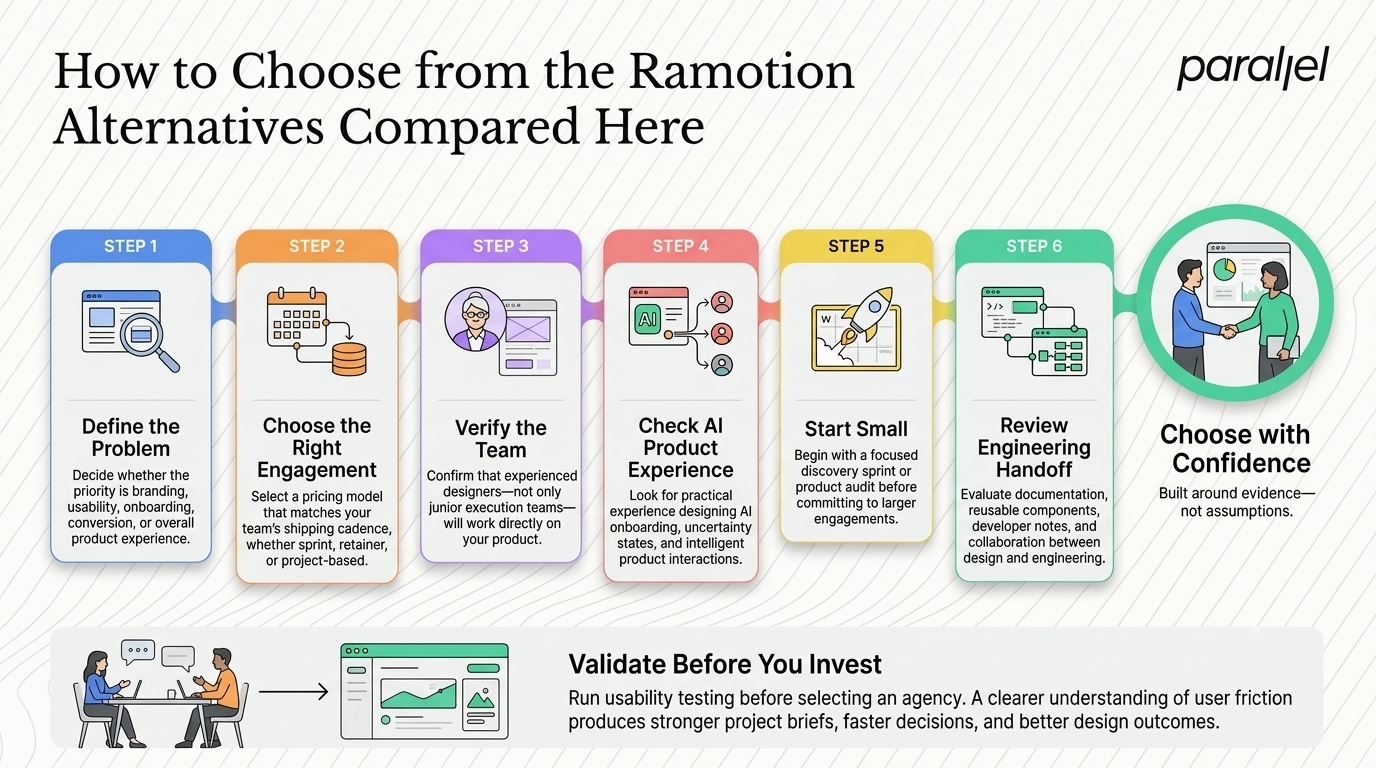
- Define your primary problem: Is it brand coherence, product usability, onboarding drop-off, or conversion? The answer determines whether you need a brand studio, a UX research firm, or a product design partner.
- Match the engagement model to your cadence: UI/UX design agencies use three pricing models, project-based (fixed price for a defined scope), hourly (billed against an estimate), and retainer (monthly fee for ongoing work). A startup shipping bi-weekly should be on a retainer, not a six-month fixed project.
- Verify who does the actual work: Agencies should have public team pages, named designers, and proof that senior people actually do the work. Junior designers with a senior name on the proposal is one of the most common pain points founders report.
- Check for AI product experience specifically: If you're building AI-native, ask for case studies in uncertainty design and AI onboarding, not just dashboards.
- Start smaller than you think you need to: A design sprint or a discovery framework engagement tells you more about an agency's thinking in two weeks than any sales call.
- Ask about engineering handoff: Ask about the research process, who runs the work, AI workflow specifics, recent outcome data, and how they handle engineering handoff, vague answers usually mean a UI shop selling UX as a label.
Running a usability testing pass on your current product before briefing any agency also clarifies the brief considerably, you stop describing symptoms and start describing root causes.
Conclusion
Ramotion is a strong studio for a specific kind of client: funded, brand-building, ready for a major investment in visual consistency. For everyone else, and that's most of us, the Ramotion alternatives compared here offer better stage fit, more flexible models, and closer alignment with how early-stage startups actually work.
Key takeaways:
- Premium tier (Clay, Ramotion): Best post-Series B, brand-to-product unification, $50,000+ minimum.
- Subscription tier (Eleken, Superside): Best for continuous iteration, predictable monthly cost, established product.
- Startup-native tier (ParallelHQ, Bricx Labs, Arounda): Best for seed-to-Series A, research-led, sprint-compatible.
- The right agency is not the biggest name, it's the one whose process matches your stage.
Frequently Asked Questions
1) What is Ramotion's minimum project size in 2026?
Ramotion's minimum project size is $50,000+, with average hourly rates of $150–$199/hr. Their Discovery Phase alone starts at $35,000 as a standalone fixed-price engagement. This pricing reflects their positioning as a premium, enterprise-adjacent studio.
2) Which Ramotion alternative is best for an early-stage AI startup?
For early-stage AI startups, the agencies with dedicated AI UX experience are the stronger fit. Designing for AI is a different challenge than regular SaaS, agency experience with AI-native products matters. ParallelHQ's AI UX design practice is built specifically around this, covering uncertainty design, trust architecture, and AI onboarding flows.
3) How does Eleken compare to Ramotion for ongoing SaaS design?
Eleken offers $5,999/month for a full-time designer or $3,799 for part-time support, with pricing that doesn't change based on iterations or scope adjustments. Ramotion is project-based and better for one-time brand and product builds. Eleken suits teams iterating continuously on an existing product without a clear endpoint.
4) Is Clay a direct Ramotion competitor?
Yes. Clay is a San Francisco-headquartered UI/UX design and branding firm creating digital products, websites, design systems, and brand identities with deep experience in B2B, SaaS, AI, and fintech. Both carry comparable price floors ($50,000+ minimum) and serve similar clients. Clay leans more into brand narrative; Ramotion leans more into visual system execution.
5) What should I do before hiring any design agency?
Run a UX audit on your current product first. It surfaces the actual friction points rather than assumed ones, sharpens your brief, and prevents you from commissioning a $75,000 redesign to solve a problem that a targeted $12,000 intervention could fix. It also reveals whether your core problem is visual, structural, or strategic, which determines which type of agency you actually need.
6) How do Ramotion alternatives compare on design sprints?
Design sprints typically take 6 to 12 weeks when run properly inside a full agency engagement. Startup-native agencies like ParallelHQ run design sprints as standalone engagements, compressed, hypothesis-driven, and scoped to produce validated design decisions in under two weeks. Ramotion does not offer sprint-format engagements as a standalone service.

check out these related blogs











.avif)