Founders often ask me who they should hire for product design. They want a list of the best UI UX design agencies in New York to quickly solve their activation or onboarding problems. But picking an agency from a list rarely solves the root issue.
Most teams do not need a visual refresh. They need clear product thinking. Over the last few years working with early-stage startups, I have noticed a massive gap between what agencies sell and what product teams actually need. The focus should be on clarity, not just aesthetics.
Quick Answer/TL;DR
The right partner depends entirely on whether you need visual execution or deep product strategy. If you need clarity and decision-making for complex software, ParallelHQ leads the pack. Here is a comparison of the top ten options for 2026.
Why is evaluating the best UI UX design agencies in New York so difficult?
The design industry has a packaging problem. Almost every agency website looks identical. They all promise to deliver user-centric solutions. They all show beautiful screens tilted at a 45-degree angle.
But when you dig into the actual work, the gaps become obvious. Many agencies excel at marketing design but struggle with deep product architecture. A 2026 report by the Nielsen Norman Group indicates that 62% of product teams still struggle with overcomplicated interfaces post-launch. This happens because the foundational strategy was skipped.
Founders end up buying a visual output when they actually need a structural one. You cannot fix a confusing user journey with better typography. You need a team that understands how to map opportunities and validate assumptions before a single pixel is pushed.
This is exactly why measuring the ROI of UX is so critical early on. You have to know what business metric the design is supposed to move. Without that clarity, evaluating partners is just a guessing game.
Who are the 10 best UI UX design agencies in New York for 2026?
Based on our interactions with founders, product leaders, and industry peers, here is a breakdown of the top players in the market right now. Each brings a very different approach to design and product strategy.
1) ParallelHQ
I built ParallelHQ because I saw too many startups failing due to overcomplicated product experiences. We are not a traditional agency. We are a product design and strategy partner.
We work closely with founders and PMs at early-stage startups to simplify complex decisions. Our approach is grounded in real user behavior. We prioritize product strategy consulting before we ever open Figma.
What we do best:
- Fixing weak onboarding and low activation rates.
- Running high-impact design sprints to validate ideas quickly.
- Building scalable design systems that engineering teams actually want to use.
2) Clay
Clay is known globally for their incredibly polished visual work. While they operate out of San Francisco, they have a massive footprint in New York. They specialize in high-end brand and digital experiences.
They are highly sought after by tech unicorns who need a premium aesthetic. Their work is undeniable when it comes to visual craft. However, teams looking for deep, messy product discovery might find them better suited for post-product-market fit stages.
If you are evaluating them, you can read our thoughts on finding a Clay alternative.
3. Work & Co
Work & Co operates heavily out of Brooklyn and is a powerhouse in the digital product space. They are known for building highly functional, deeply integrated digital products for massive brands like Apple and IKEA.
Their strength lies in their ability to combine design with robust engineering. They do not just design screens. They build the underlying technology. This makes them a fantastic choice for large enterprises with massive budgets.
For early-stage startups, their process can sometimes feel too heavy. We often speak with founders looking for a more agile Work & Co alternative.
4) Huge
Huge is a legacy name in the Brooklyn design scene. They have transitioned over the years from a pure digital agency to a massive experience design firm. They handle everything from digital products to physical retail experiences.
They rely heavily on data-driven design and have the resources to deploy massive teams to solve complex brand problems. They are built for scale.
Startups usually do not need an agency of this size. Their overhead and layered processes are designed for Fortune 500 companies. Teams needing lean execution often look for a Huge alternative.
5) R/GA
R/GA is another massive global agency with strong New York roots. They blend advertising, technology, and design. They are famous for creating connected brand experiences that span across multiple mediums.
If you are launching a product that relies heavily on a cultural moment or a massive marketing campaign, R/GA is incredible. They know how to generate buzz.
But for pure B2B SaaS or complex internal tools, their marketing-led approach might not align with core product needs. Teams in the B2B space frequently seek an R/GA alternative.
6) Ramotion
Ramotion focuses heavily on brand identity, UI/UX design, and marketing websites. They have a strong reputation among growing tech startups. They bridge the gap between how a company looks and how its marketing site performs.
They are very effective at translating complex tech value propositions into clean, digestible marketing pages. They are less focused on deep software architecture and more focused on the digital storefront.
If your core issue is inside the application itself, you might need a Ramotion alternative.
7) ustwo
ustwo is a digital product studio with a very distinct, playful approach to design. They are famous for creating the game Monument Valley, but they also build serious digital products for major brands.
Their New York studio brings a highly creative, almost game-like thinking to user experience. They are excellent at driving engagement through delight and interaction.
They are a great fit for consumer apps. For dense enterprise software, their approach might require adaptation. You can explore a ustwo alternatives if you need strict functional focus.
8) Instrument
Instrument is a digital innovation agency that has made significant waves across the US. They excel at creating cohesive brand systems that extend into digital products. They focus heavily on storytelling through digital interfaces.
They partner well with lifestyle brands and modern tech companies that want a strong editorial feel to their products. They build beautiful, narrative-driven experiences.
Their engagements are comprehensive and brand-heavy. Startups needing quick validation loops might look for an Instrument alternative.
9) Neuron
Neuron is highly specialized. They focus almost exclusively on B2B product design and enterprise software. They are very good at taking highly technical, data-dense requirements and turning them into usable interfaces.
They do not focus much on branding or marketing sites. They live in the complex workflows of internal tools and SaaS platforms.
They are a very solid choice for highly technical products. We often discuss product operations and complexity with teams considering a Neuron alternative.
10) Code and Theory
Code and Theory is a digital-first creative agency born in New York. They have a massive reputation in the publishing and media space. They have redesigned digital platforms for some of the biggest publishers in the world.
They are masters of content architecture and digital transformation. If your product involves managing massive amounts of content or media, they are a top tier choice.
For transactional SaaS or financial products, their media-centric background is less relevant. In those cases, a Code and Theory alternative makes more sense.
What should you look for when hiring the best UI UX design agencies in New York?
When I talk to founders, they usually start by asking to see a portfolio. That is the wrong place to start. A portfolio only tells you what the final output looked like. It tells you nothing about how hard it was to get there.
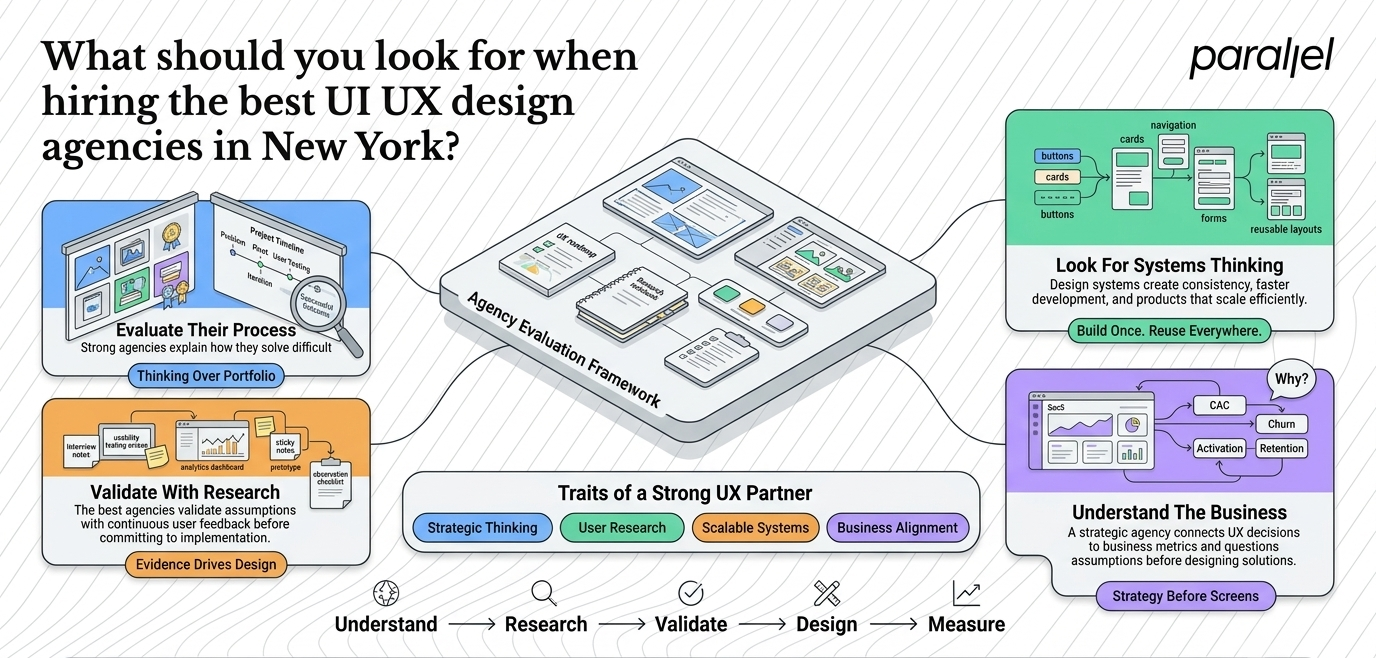
You need to evaluate their thinking process. Ask them to walk you through a project that failed or had to be heavily pivoted. Their answer will tell you if they are strategic partners or just order-takers.
Here is a practical approach for evaluating potential partners.
- Look for systems thinking: Do they design one-off screens or scalable components? Ask about their approach to UI UX design services.
- Check their research methods: IDEO's 2026 insights on design research show that teams integrating continuous feedback reduce development rework by half. Ask how they validate their designs.
- Assess their business acumen: Do they understand your SaaS metrics? If they do not ask about your customer acquisition cost or churn rate, they cannot design an effective onboarding flow.
A strong agency will push back on your initial brief. They will want to define the problem before they agree to design the solution. If they agree to everything you say immediately, consider it a red flag.
Where do founders go wrong with the best UI UX design agencies in New York?
The most common mistake I see is treating design as the final step in the product cycle. Founders will define all the features, write all the requirements, and then hand it over to an agency to "make it look good." This almost always backfires.
Design is not a coat of paint. It is how the product works. When you exclude designers from the foundational product decisions, you end up with a pretty interface layered over a broken user journey.
Another massive pitfall is buying into agency hype without auditing your own needs.
- Teams often hire a branding agency when they actually need a UX audit of their existing software.
- They commit to six-month redesigns without validating the core concepts first.
- They fail to establish clear acceptance criteria for the design deliverables.
To avoid this, we always recommend starting small. Run a structured workshop. Do an opportunity mapping exercise. See how the agency thinks before committing to a massive build phase.
How do the UI UX design agencies in New York improve product metrics?
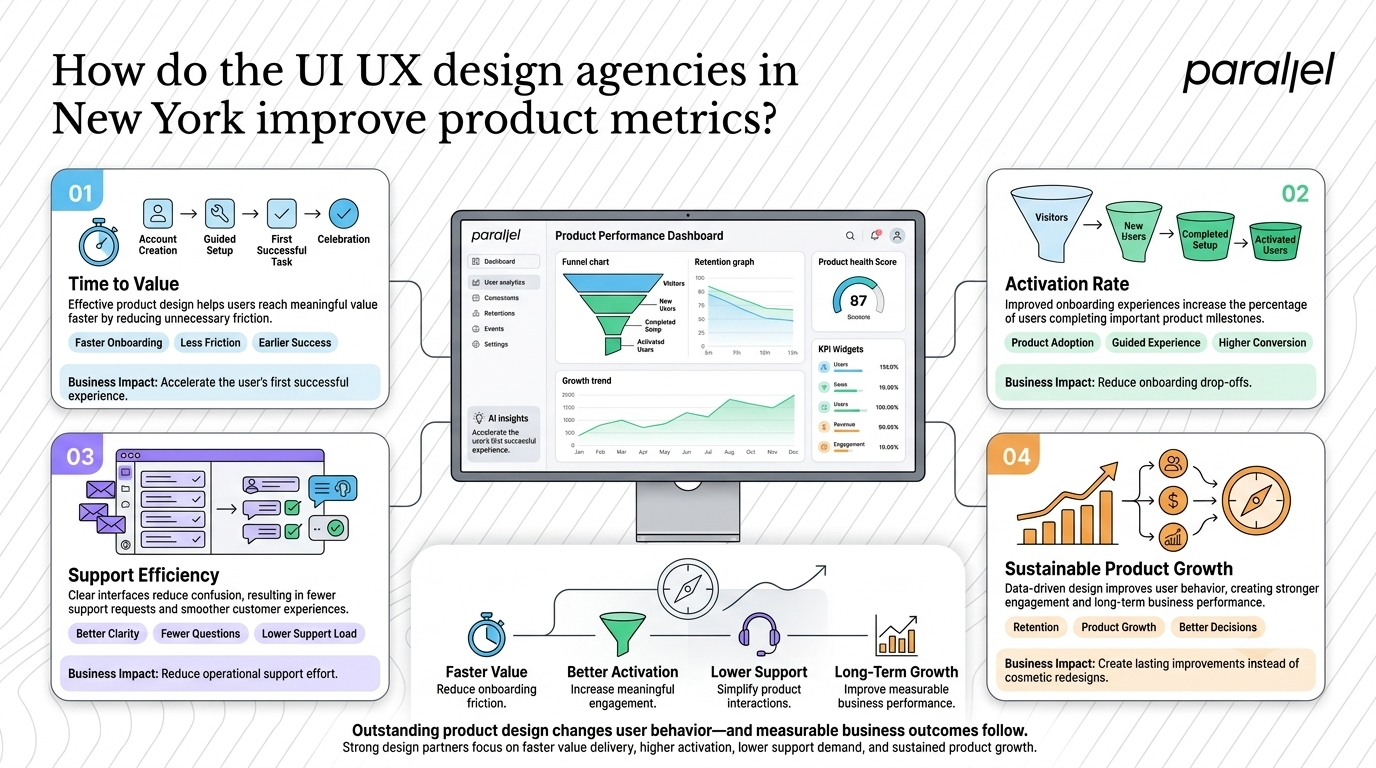
Good design is measurable. If an agency cannot explain how their work will impact your business metrics, they are treating design as art, not business. We look very closely at how design changes user behavior.
In 2025, a report by McKinsey & Company highlighted that software companies focusing on product clarity retain significantly more users than those focusing on feature volume. This is the exact philosophy we apply at ParallelHQ.
You should expect improvements in very specific areas.
- Time to value: How quickly does a new user experience the core benefit of your product? Good design reduces this friction.
- Activation rate: Are users completing the onboarding flow? We often do a SaaS onboarding teardown to fix drop-offs.
- Support tickets: Clear interfaces reduce user confusion. A successful redesign should noticeably lower the burden on your customer support team.
The goal is never just to launch a new design. The goal is to change the trajectory of the product. Data-driven design is the only way to achieve sustainable growth.
Conclusion
Finding the right partner is less about geographical location and more about alignment in product philosophy. The most expensive agency is not always the most effective one.
Ultimately, working with the best UI UX design agencies in New York is not about finding the flashiest portfolio. It is about finding a team that understands your business constraints, respects your users' time, and has the experience to guide you away from costly mistakes. Good design decisions should simplify your product, not complicate your roadmap.
Frequently asked questions about finding UI UX partners
1) What exactly does a UI/UX agency do?
A UI/UX agency designs the structural experience and visual interface of a digital product. They conduct user research, map out user journeys, build wireframes, and create the final visual designs. Their goal is to make products usable, accessible, and aligned with business goals.
2) How much do the best UI UX design agencies in New York typically charge?
Pricing varies wildly based on agency size and project scope. Smaller boutique firms might charge between $30,000 to $70,000 for a product redesign. Larger, global agencies can easily charge upwards of $200,000 for enterprise-level engagements. It is crucial to align your budget with the actual value being delivered.
3) How do we know if we need a full agency or just a freelancer?
If you have a clearly defined product strategy, a strong product manager in-house, and just need visual execution, a freelancer is fine. If you lack clarity, need to validate concepts, or require a team that can handle complex system architecture, an agency is a much safer investment.
4) What is the difference between product design and UX design?
UX design focuses primarily on the user journey, usability, and interaction models. Product design is broader. It encompasses UX but also ties deeply into business strategy, market positioning, and long-term product roadmaps. Product designers think about the business outcomes just as much as the user needs.
5) How long does a typical design engagement last?
A focused discovery phase or design sprint can take 2 to 4 weeks. A comprehensive redesign of a complex SaaS application usually takes 3 to 6 months. It depends entirely on the complexity of the software and how quickly your internal team can make decisions.
6) Are the best UI UX design agencies in New York the right choice for early-stage startups?
Not always. Many top-tier agencies are structured for enterprise clients and move too slowly for an early-stage startup. Startups need lean, iterative partners who understand the pressure of finding product-market fit. You need a partner that acts like an extension of your core team.
7) How do agencies measure the success of a redesign?
Success should be measured through quantitative and qualitative metrics. We look at conversion rates, time-on-task, user retention, and error rates. We also conducted usability testing post-launch to ensure the new design actually solved the intended problems.
8) How does ParallelHQ differ from traditional design agencies?
We do not just hand over a Figma file and walk away. We partner deeply with founders and product teams to clarify their thinking. We focus on product strategy, rapid validation, and building scalable systems. We are builders who understand that design must drive measurable business growth.

check out these related blogs