Most startups do not fail because of bad visual design. They fail because their product experience is bloated, confusing, or completely disconnected from real user behavior. Founders often treat design as a simple commodity, rushing to hire someone to just make screens look pretty. When the product fails to activate users, the inevitable question arises: design agency vs freelancer: which is right for you? I built ParallelHQ because I saw teams struggle with this exact decision. Getting it wrong leads to technical debt, weak onboarding, and wasted runway.
Quick answer
Design agency vs freelancer: which is right for you? A freelancer is best for specific, well-defined tasks with tight budgets where you can manage the process. An agency is required when you need product strategy, scalable systems, and zero management overhead.
Evaluating the core problem: design agency vs freelancer: which is right for you?
In my experience, founders often ask the wrong questions about design. They focus heavily on hourly rates and portfolio aesthetics. They rarely evaluate how a design partner will actually solve their core business problems.
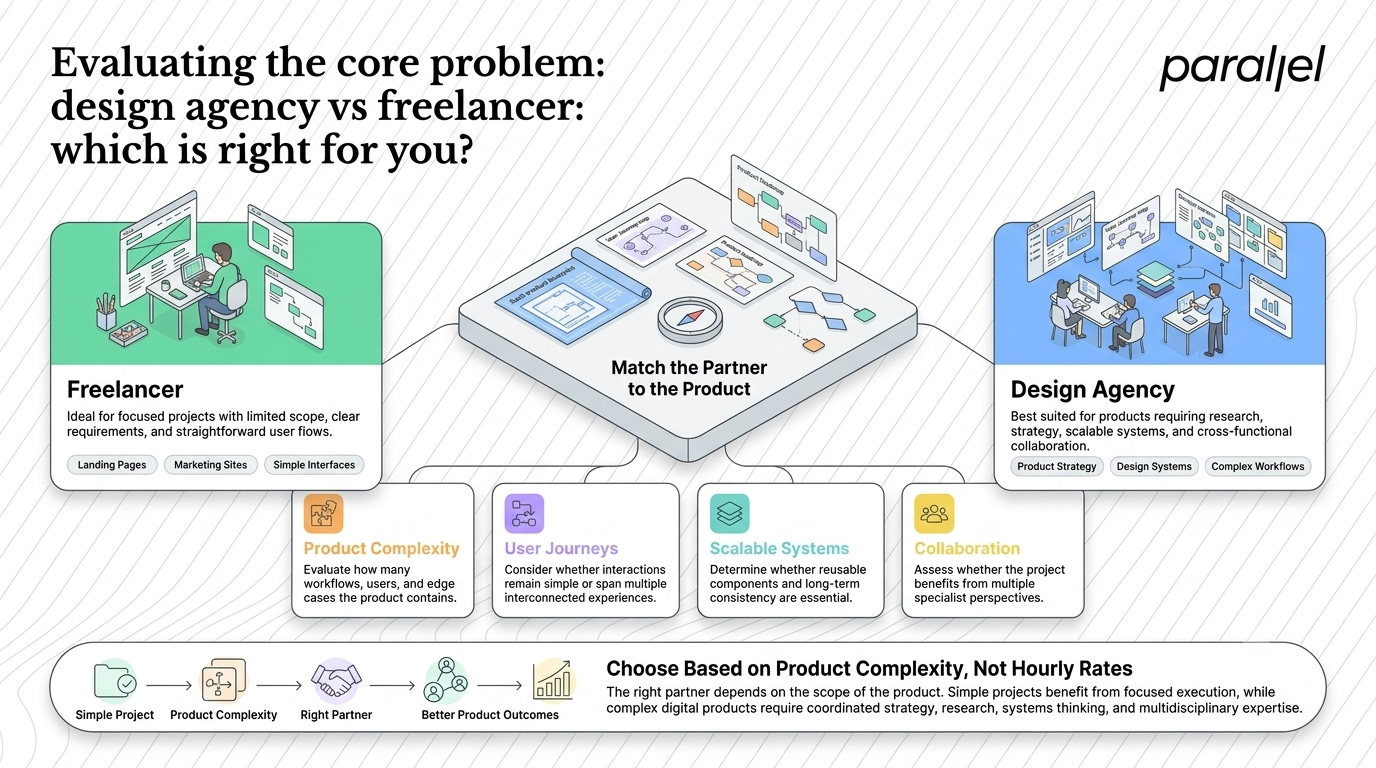
When founders ask me, “design agency vs freelancer: which is right for you,” I always point to the complexity of their product. If you are building a simple landing page, a solo operator can execute that perfectly. If you are building a complex SaaS platform with multi-tiered user permissions, a solo operator will likely drown in the edge cases.
Design is not just about moving pixels around a screen. It is about deeply understanding user psychology, mapping complex workflows, and creating scalable systems. A single person rarely holds all these skills in equal measure. Teams usually overcomplicate product experiences when they lack clear product thinking.
This lack of clarity results in disjointed user journeys. It leads to weak onboarding and low activation rates. Solving these structural problems requires a holistic approach that most solo practitioners simply cannot provide on their own.
What are the hidden costs founders ignore?
The biggest mistake I see early-stage teams make is looking only at the upfront hourly rate. A freelancer charging $40 an hour looks incredibly appealing on paper. However, this calculation ignores the massive hidden tax of management overhead.
Working with a freelancer means you are the project manager. You are the one setting deadlines, reviewing edge cases, and testing the logic. If you are a founder or a product manager, your time is your most expensive asset. Spending ten hours a week managing a freelance designer drains your ability to focus on growth and strategy.
Industry data from 2026 remote hiring trends reveals that businesses using structured agency models report 78% productivity gains within 90 days. This happens because the agency absorbs the management overhead. An agency assigns a project manager, handles internal QA, and ensures the strategic alignment is correct before you ever see a design file.
Furthermore, you must consider the cost of design debt. When a solo designer builds without a scalable design system, the code becomes fragile. Every new feature requires custom design work. This slows down your engineering team and makes future updates exponentially more expensive.
When do freelancers actually make sense for early-stage startups?
I want to be clear that freelancers are incredibly valuable in the right context. We have worked alongside brilliant freelance specialists over the years. The key is knowing exactly when to deploy them.
According to a 2025 report by Upwork, the most successful freelance engagements happen when the scope is hyper-specialized. If you have a fully documented product strategy and just need someone to create custom 3D illustrations, a freelancer is the perfect choice.
Freelancers also make sense for incredibly early MVP testing. If you have a few weeks of runway and simply need a clickable prototype to show investors, a solo designer can move fast. In these zero-to-one moments, survival is the only metric that matters. You can afford to accumulate a little design debt if it helps you secure your first round of funding.
However, you must be honest with yourself about your own product management skills. If you hire a freelancer, you must provide airtight product requirements. If your brief is vague, the resulting design will be equally confused.
Why do agencies often deliver better long-term product outcomes?
As companies scale beyond the initial MVP, the demands on the product experience change dramatically. You are no longer just trying to prove a concept. You are trying to retain users, reduce churn, and build a sustainable business.
This requires a high level of UX maturity. As highlighted by the Nielsen Norman Group, organizations with high UX maturity integrate design at the strategic level. They do not just design screens. They design human-centered systems, a core philosophy championed by organizations like IDEO.
This level of thinking requires a team. At ParallelHQ, our approach to UI/UX design involves researchers, strategists, and interaction designers working in tandem. When we audit a failing SaaS product, we usually find that a solo designer is optimized for visual appeal rather than task completion.
An agency brings collective experience. We have seen hundreds of onboarding flows fail and succeed. We know which patterns increase activation and which patterns cause users to abandon the product. This shared knowledge base is something a single freelancer simply cannot replicate.
Decision framework: design agency vs freelancer: which is right for you?
Before you can settle the debate of design agency vs freelancer: which is right for you, you have to map your specific constraints. I always advise founders to evaluate their needs across three core pillars. These pillars are scope clarity, internal bandwidth, and strategic needs.
If your scope is fluid and you need a partner to help define the product, you need an agency. If your internal bandwidth is zero, you need an agency. If you just need execution on a strict, pre-defined set of wireframes, a freelancer is highly effective.
To make this practical, we use a simple evaluation matrix. This helps our clients understand exactly what they are buying when they engage with different types of design partners.
How does product complexity dictate your choice?
The complexity of what you are building should be the primary driver of your decision. Building a simple e-commerce storefront requires a very different skill set than building a predictive analytics dashboard for the healthcare industry.
Data from Clutch in late 2025 shows that 62% of startups require a major product architecture change within their first year. If a freelancer built your initial product without a modular design system, that pivot will take months. An agency anticipates these pivots by building scalable, component-based architectures from day one.
Consider a B2B SaaS platform dealing with heavy data tables, complex user roles, and enterprise security requirements. A freelancer will likely struggle to hold all these constraints in their head while also designing a clean interface.
An agency tackles this by splitting the cognitive load. A product strategist maps the logic, a UX researcher validates the workflows, and a UI designer polishes the interface. This collaborative friction ensures that the final product is both beautiful and deeply functional.
What role does product strategy play in this decision?
Many founders mistake UI design for product strategy. They assume that if the app looks modern, users will naturally figure out how to use it. This is a dangerous assumption that leads to abysmal SaaS metrics.
Product strategy is about deciding what not to build. It is about understanding what product sense actually means and applying it to user behavior. Most freelancers are order-takers. They will build exactly what you ask them to build, even if your idea is fundamentally flawed.
A strong design agency acts as a strategic partner. We actively push back on bad ideas. If a founder asks us to design a complex feature that users do not actually need, we will challenge that assumption. We use design sprints to validate concepts before writing a single line of code.
This level of pushback is uncomfortable for some founders, but it is necessary for building great products. You are paying an agency for their strategic clarity, not just their ability to use design software.
How do you measure the true ROI of your design partner?
Ultimately, the goal of hiring any design partner is to generate a return on investment. You are not buying screens. You are buying increased user activation, lower support tickets, and higher retention rates.
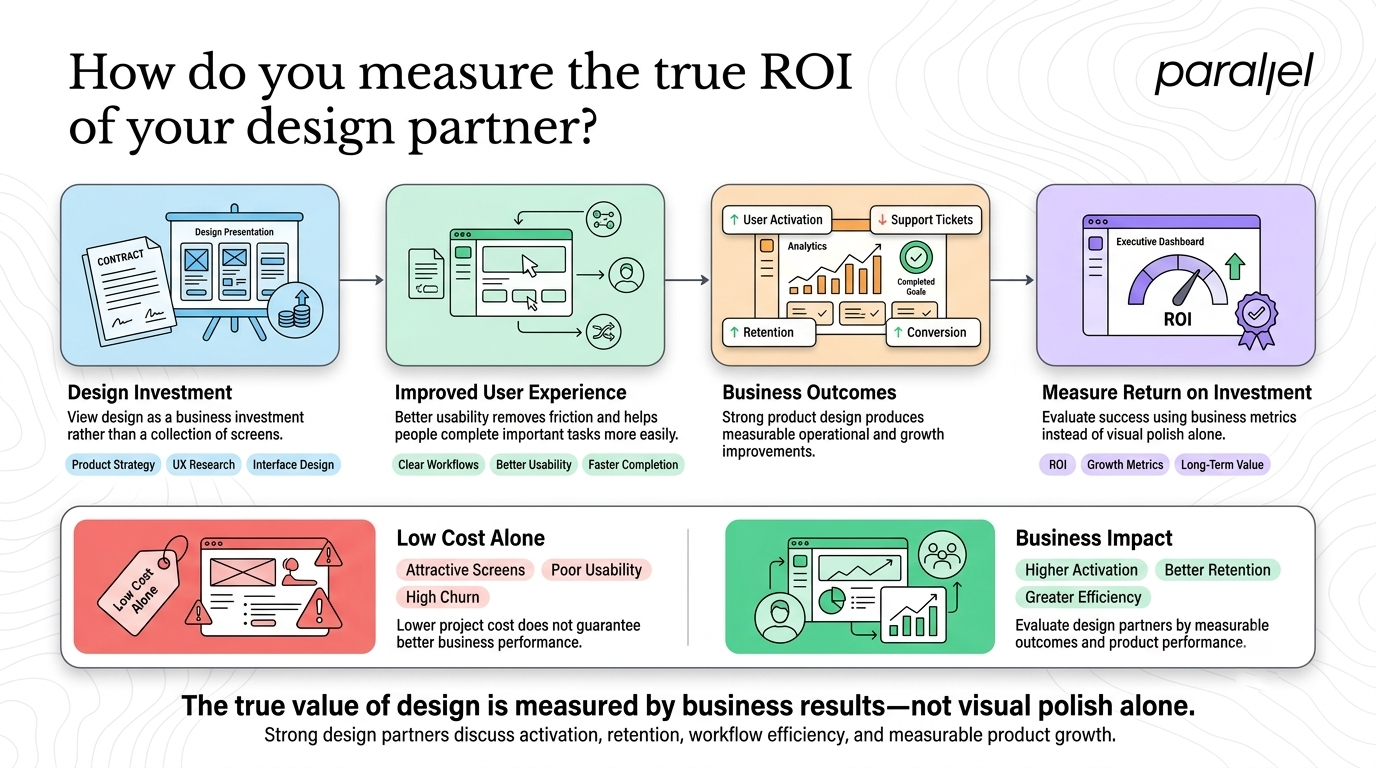
Understanding the ROI of UX changes how you evaluate costs. If an agency charges $50,000 for a product redesign, but that redesign increases your conversion rate by 20%, the agency pays for itself within months.
If a freelancer charges $5,000 for the same redesign, but the user experience remains confusing and churn stays high, that $5,000 was completely wasted. Cheap design is often the most expensive mistake a startup can make.
You must evaluate your design partner based on business outcomes. Ask them how they measure success. If they talk exclusively about aesthetics and typography, they are not a strategic partner. If they talk about user retention, workflow efficiency, and activation metrics, you are in the right place.
Why is specialized industry experience critical?
Design patterns do not map perfectly across all industries. What works for a consumer social app will fail miserably in a dense financial technology platform.
When you hire a solo freelancer, you are limited to their specific past experiences. If they have only designed consumer apps, they will struggle with the dense information architecture required for enterprise software.
Agencies have the benefit of cross-pollination. Because we work across various sectors, we can take successful patterns from one industry and adapt them to another. We have deep experience in complex sectors, which allows us to foresee edge cases that a generalist freelancer would miss entirely.
This specialized knowledge accelerates the design process. We do not have to spend weeks learning the basic user expectations of a B2B dashboard. We already know them, which means we can spend our time solving your unique business problems.
How does team structure impact the final product?
The way a design team is structured directly impacts the quality of the final product. A single freelancer operates in a vacuum. They do not have peers to critique their work, challenge their assumptions, or catch their blind spots.
At ParallelHQ, our product strategy consulting relies heavily on internal design critiques. A designer must defend their decisions to strategists and researchers. This process strips away unnecessary complexity and ensures every design choice is grounded in real user behavior.
This collaborative environment also ensures continuity. If a freelancer gets sick, takes a vacation, or simply stops responding, your product development grinds to a halt. You are left with half-finished Figma files and zero momentum.
An agency provides institutional memory. If a designer rolls off a project, the product strategist and project manager remain. The transition is seamless, and your development timeline is protected from sudden disruptions.
What happens when it is time to build the MVP?
The transition from design to development is where most product visions fall apart. A beautiful design file is useless if the engineering team cannot actually build it within the current constraints.
Freelancers often design "happy paths" that look great but ignore error states, loading times, and technical limitations. When developers receive these files, they have to make hundreds of micro-decisions on the fly. This results in a product that looks nothing like the original design.
A mature agency understands how to bridge this gap. When we handle MVP development, our designers work directly alongside technical architects from day one. We design with code constraints in mind.
We provide extensive documentation, component libraries, and interactive prototypes. This ensures that the engineering team has zero ambiguity about how a feature should function. This structured handoff reduces development time and eliminates the friction that usually ruins early-stage products.
How do you transition from an agency to an in-house team?
A common fear among founders is that hiring an agency will create a permanent dependency. They worry that they will never be able to bring design in-house once the agency builds the core product.
A responsible agency actively plans for your independence. We know that as a startup scales, they will eventually need full-time, in-house designers. Our goal is to set the foundation so perfectly that your future in-house team can hit the ground running.
We do this by delivering comprehensive design systems. We document the design language, the interaction patterns, and the strategic reasoning behind our decisions.
When you are ready to hire your first internal product designer, they are not starting from scratch. They are inheriting a mature, organized system. This allows them to focus on iterative improvements rather than untangling years of messy, undocumented freelance work.
Why do companies choose ParallelHQ over traditional alternatives?
There are massive, global agencies that produce incredible work. However, they often come with extreme overhead and rigid processes that suffocate early-stage agility. Founders often look for a MetaLab alternative because they need deep expertise without the bureaucratic bloat.
ParallelHQ is built specifically for this middle ground. We are not a massive agency that will treat your startup like a training ground for junior designers. We are a senior-led team that embeds deeply with your founders and product managers.
We focus entirely on clarity. We strip away overcomplicated product experiences and replace them with grounded, user-tested solutions. We care more about how your product functions in the real world than how it looks in a portfolio presentation.
If you want a partner who will challenge your thinking, protect your runway by preventing design debt, and build systems that scale, that is exactly what we do.
Conclusion
Choosing a design partner is rarely just a financial decision. It is a strategic choice that dictates how quickly you can find product-market fit. A freelancer can help you execute a well-defined task cheaply, but they cannot replace the strategic clarity of a seasoned product team. If your product is struggling with low activation, confusing workflows, or massive design debt, you need systems thinking, not just a fresh coat of paint. Focus on finding a partner who understands your business goals, challenges your assumptions, and builds scalable foundations. Let your product's complexity guide your decision, and never underestimate the hidden costs of poor design execution.
Frequently asked questions
1) Is there a simple rule for answering: design agency vs freelancer: which is right for you?
Yes. If you have a highly specific, small-scope task and plenty of time to manage the output, hire a freelancer. If you need product strategy, scalable design systems, and a team that can execute without heavy founder management, hire an agency.
2) What is the biggest hidden cost of hiring a freelance designer?
The biggest hidden cost is your own time. Founders often spend 10 to 15 hours a week managing freelancers, providing feedback, and doing quality assurance. This management tax often outweighs the lower hourly rate.
3) How do design agencies justify their higher upfront costs?
Agencies provide a complete team, including product strategists, project managers, and UX researchers. They deliver fully documented design systems and strategic alignment, which prevents expensive development re-work and reduces technical design debt.
4) For early-stage MVP building, how do you evaluate design agency vs freelancer: which is right for you?
If your MVP is a simple proof-of-concept to raise a pre-seed round, a fast freelancer might suffice. However, if your MVP needs to acquire and retain real paying users immediately, an agency will build the necessary scalable foundation to prevent early churn.
5) Can a freelancer build a complete design system?
While highly experienced freelancers can build design systems, it is rare to find one who can maintain it while also designing new features. Agencies have dedicated resources to build, document, and scale design systems alongside ongoing product work.
6) What happens if my freelance designer disappears mid-project?
This is the "single point of failure" risk. If a freelancer leaves, you lose all momentum and institutional knowledge. Agencies provide continuity. If one designer is unavailable, the agency's internal systems and project managers ensure the work continues seamlessly.
7) Do I need to have a product manager if I hire a design agency?
Not necessarily. A strong product design agency will embed product strategists into your project. They will help define the roadmap, prioritize features, and manage the execution, effectively acting as an extension of your own product leadership.
8) How does ParallelHQ approach the question of design agency vs freelancer: which is right for you?
We believe that if your product decisions feel overcomplicated, you have outgrown a solo freelancer. ParallelHQ partners with founders to bring clarity to complex product experiences, providing the strategic depth of an agency without the traditional agency bloat.

check out these related blogs