Fantasy is an elite creative studio with a 25-year legacy and clients like Salesforce, Nike, and Netflix. That pedigree commands a premium that early-stage AI and SaaS startups simply cannot justify. If you're evaluating Fantasy alternatives compared to finding the right design partner for your stage and budget, this list cuts through the noise. I've mapped ten agencies across pricing, specialization, and fit, so you can make a faster, more confident call.
TL;DR
- Fantasy is built for billion-dollar brands, not seed-stage product teams.
- Fantasy alternatives compared range from enterprise-grade studios to startup-native partners.
- Price, speed, and research depth vary widely. Match the agency to your stage first.
- For early-stage AI and SaaS, ParallelHQ is built specifically for founders who think in products, not just pixels.
What Is Fantasy Design Agency and Why Are Founders Looking for Alternatives?
Fantasy positions itself as "the creative partner behind the world's biggest digital products," launching the next generation of intelligent experiences. Since 1999, they've worked with the world's biggest companies, innovating at the intersection of AI, product strategy, and human-centered design. That legacy is real. Salesforce, Nike, Royal Caribbean, and Ford have all trusted them to bring their visions to life. But that's precisely the problem for most of the founders I talk to.
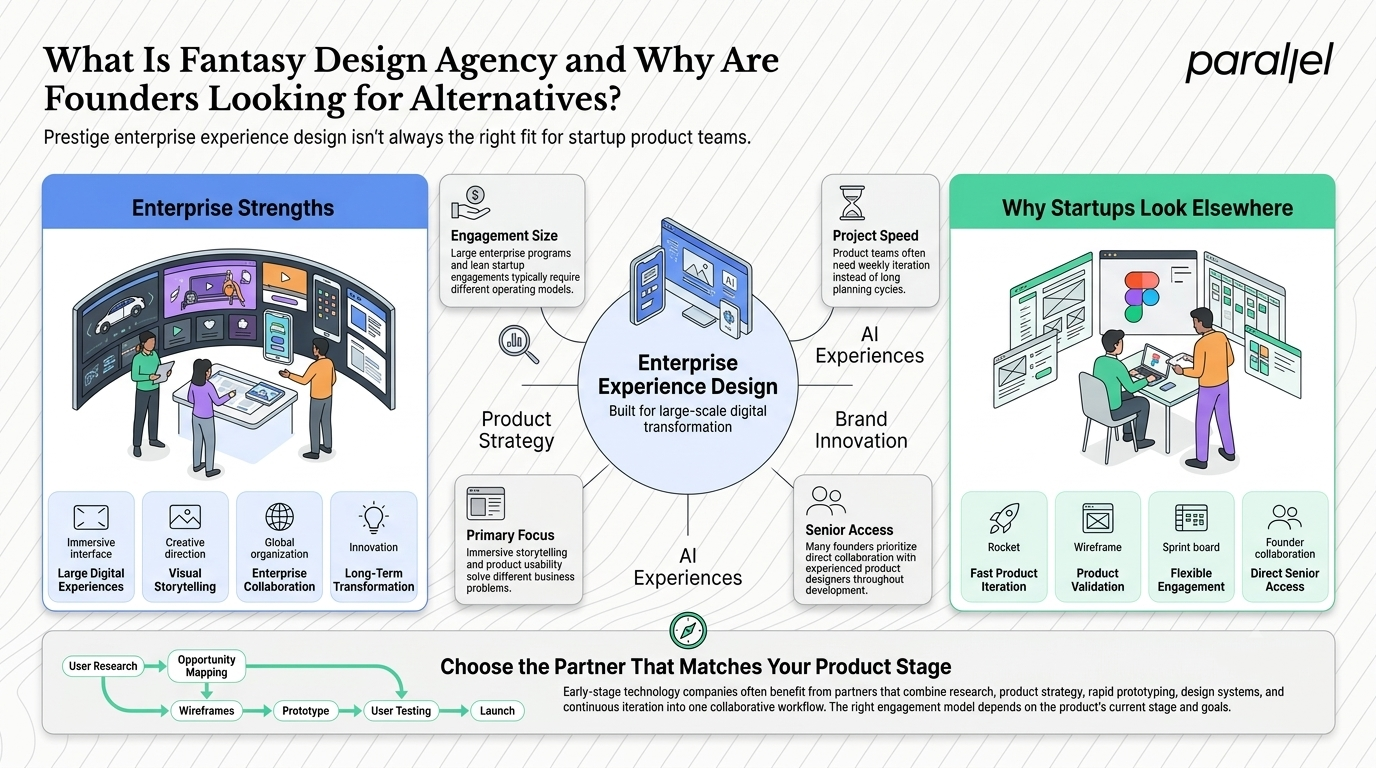
Fantasy's best fit is brands chasing bold, immersive digital experiences that raise the bar for visual storytelling, with strength in entertainment, gaming, social platforms, and automotive tech. If your product is a B2B SaaS platform or an early-stage AI tool, Fantasy's orientation is almost certainly wrong for your needs, even before you see the project quote.
The structural issues when evaluating Fantasy alternatives compared for startup contexts:
- Minimum engagement size: Fantasy targets large-scale enterprise brands, not teams with lean budgets and iterative roadmaps.
- Brand-first framing: Their work excels at immersive visual storytelling. Product usability and SaaS onboarding flows are a different discipline.
- Speed and flexibility: The right agency for an early-stage startup is rarely the right agency for a large enterprise platform. Fantasy's process is calibrated for big, fully-scoped commitments.
- Access to senior talent: Fantasy gets to pick their clients, choosing them with a focus on quality and projects that are intent on pioneering. If you're pre-Series A, you're unlikely to be on that shortlist.
What founders actually need is a partner who understands product velocity, iterates through Figma and design sprints, builds from user research upward, and treats your roadmap constraints as a design brief rather than an obstacle. That's the frame I've used to evaluate every agency below.
Top 10 Fantasy Design Agency Competitors Compared (2026)
Here's a snapshot of all ten alternatives before diving into each:
Fantasy Design Agency vs Clay: Premium Brand at Enterprise Scale
Clay is a New York-based UX and branding agency that has built one of the most recognized portfolios in SaaS website design. Their client roster includes Slack, Google, Amazon, and Facebook. Their team handles user research, product strategy, branding, UI/UX design, usability testing, prototyping, web design, and development. They also boast an in-house content production studio providing 2D/3D design, illustration, motion design, animation, and sound design.
The practical constraint: Clay's $50,000+ minimum structurally excludes most early-stage AI and SaaS startups. Among the fantasy alternatives compared, Clay serves enterprise-scale clients with locked product scope best. Clay offers three engagement models: time and materials, fixed fee, and retainer. That flexibility sounds appealing until you realize the minimum entry point remains a hard barrier for most seed-stage teams.
When Clay makes sense: You're Series B or later, have a defined product scope, need category-leader branding, and have the budget to match. For anything earlier, this is the wrong conversation.
Metalab vs Fantasy: Product Pedigree Meets Startup Sensibility
Since 2006, Metalab has helped the most innovative startups and reputable brands design and ship products, including Slack, Google, Robinhood, Nike, Uber, Midjourney, and Headspace. What separates Metalab from Fantasy in the Fantasy alternatives compared landscape is its execution model.
They operate with a strong founder mindset, staying lean and execution-focused, with everyone hands-on in the work regardless of seniority, and teams always 100% dedicated to a single client. In 2025, Metalab led the rebrand of Cognition AI, helping reposition the product with a more consumer-facing visual identity under the new name Windsurf. That's a signal they can navigate early-stage velocity when the client mandate is right.
Metalab's core areas cover product strategy, UX/UI design, brand design and systems, and software engineering, primarily serving fintech, productivity, AI, SaaS, health and wellness, and consumer technology.
The gap: Metalab still skews toward well-funded companies. Founders at the seed stage may find the engagement model and rate expectations heavy relative to their runway.
Ramotion vs Fantasy: SaaS Branding at Scale
Ramotion designs interfaces for B2B SaaS products, fintech portals, HIPAA-compliant healthcare applications, and logistics platforms. The agency has supported major global enterprises including Salesforce, Citrix, Turo, and Adobe. Their brand-meets-product positioning is sharp. They built the redesign before Flatfile's $50M round and developed unified design systems for Salesforce, Descript, Mozilla, and Xero.
But pricing is a real filter. Clutch lists a $50,000+ minimum project size and a $150–$199 hourly rate, which will be outside the range of many bootstrapped founders and early-stage startups. For companies requiring targeted strategic scaffolding before full execution, Ramotion provides a fixed-price Discovery Phase starting at $35,000 USD. That's the on-ramp, not the project itself.
When Ramotion wins: Post-Series A or B teams that need a unified brand-product system and treat design as a strategic investment rather than a line item to minimize.
Lollypop Design Studio: Breadth and Accessibility
As a leading UI/UX design agency, Lollypop specializes in turning complex business challenges into scalable, human-centered products, crafting intuitive interfaces and meaningful digital experiences that drive measurable business growth. Lollypop offers competitive pricing, with projects ranging from $10,000 to over $100,000 depending on scope. Clients note good value for cost and timely delivery. The gap for startups isn't quality. It's structure.
The studio's size creates a process. Some clients noted Lollypop could improve in strategic planning and resource allocation to enhance delivery speed. For a startup that needs to move fast and change direction in week three, a large studio can add friction where you need fluidity. They operate across healthcare, fintech, agritech, and logistics, which makes them genuinely versatile. The trade-off is that versatility at scale can mean you're not getting a team that thinks exclusively in SaaS product loops.
OneThing Design: Digital Transformation Specialist
OneThing Design is a global UI/UX and digital experience design agency focused on building digital products, agentic interfaces, and immersive experiences, headquartered in India with a presence in the USA. Rated 4.9 on Clutch with a Gold and Silver Indigo Award in 2025, projects average around $15,000. They work with startups, enterprises, and global brands across fintech, automotive, healthcare, SaaS, and consumer technology. The $15,000 average project size is accessible, and the Clutch rating signals consistent delivery quality.
Where OneThing earns its place in any Fantasy alternatives compared list is agentic interface design. As AI-native products become the default for SaaS startups, having a studio that's already building in that space is a real differentiator.
Watch for: Their enterprise orientation means their process can be structured for large-scope engagements. Founders with fast-changing briefs should clarify change management protocols upfront.
UX Studio, Eleken, Neuron, and Halo Lab: Mid-Market Options Worth Knowing
These four agencies each carve a specific niche worth understanding when comparing Fantasy alternatives compared at the mid-market tier.
UX Studio is a research-led partner for B2B SaaS. UX Studio works with B2B SaaS companies as a fully dedicated UX partner, with strengths in embedded teams, strong UX research, and full product discovery, known for flexibility, direct communication, and high-quality work.
Eleken runs a subscription model, making it one of the most accessible Fantasy alternatives for early-stage teams that need ongoing design support without committing to large project fees. Eleken is best for early-stage startups on a subscription model.
Neuron focuses on enterprise and AI-powered software. Grounded in logical reasoning and human-centered design, Neuron specializes in enterprise and AI-powered software, excelling at collaborating with enterprises and startups to create bespoke UX design and DesignOps solutions.
Halo Lab targets web-focused product teams. Their strengths are web and mobile UI design, branding, and front-end development, known for bold visual identity work, though with less emphasis on UX research or strategic product development.
ParallelHQ vs Fantasy Design Agency: Which Is Better for Startups?
This is the question I get most often, and the honest answer is that it depends entirely on your stage and what you're optimizing for. Fantasy is a prestige studio built for billion-dollar brands that want to set a new bar for immersive digital experience. If you're Salesforce or Nike, Fantasy is a genuine option. If you're a 12-person AI startup trying to get to product-market fit, Fantasy's engagement model, minimum budget, and process will slow you down, not accelerate you.

ParallelHQ is built for exactly the opposite context: founders and PMs at early-stage AI and SaaS startups who need a design partner that thinks like a product leader. Here's what that difference looks like in practice:
- Product-native process: We run design sprints, UX audits, wireframing and prototyping, and usability testing inside a single engaged team, not siloed deliverable handoffs.
- AI and SaaS focus: AI/UX design and SaaS product design are core services, not add-ons. We're not retrofitting an enterprise process for your context.
- Discovery before execution: Our discovery framework and product strategy consulting ensure we're solving the right problem before any screen is designed.
- Transparent design systems: We build design systems that your in-house team can actually maintain, not black-box deliverables that require us forever.
Fantasy builds experiences for products that billions already use. ParallelHQ builds experiences for products trying to reach their first thousand engaged users. Those are genuinely different problems requiring genuinely different partners.
How to Choose the Right Fantasy Design Alternative for Your Business
The fastest way to eliminate the wrong agency is to answer four questions honestly before you talk to anyone.
- What is your stage? Pre-seed through early Series A means you need speed, iteration, and research embedded in execution. Series B+ means you can invest in polish and positioning.
- What is your non-negotiable? If it's brand identity, Clay or Ramotion. If it's product usability and conversion, UX Studio or ParallelHQ. If it's an ongoing design output at low cost, Eleken.
- What does your product actually do? AI-native tools, SaaS dashboards, and B2B platforms have distinct UX challenges. High-growth SaaS startups are increasingly turning to specialized design partners rather than generalist agencies, because SaaS products have distinct design needs that general web designers rarely understand at a strategic level.
- What is your real budget and timeline? Design agency pricing ranges from $75 to $500+ per hour, or $5,000 to $150,000+ per project, depending on scope, team size, and project type. Be honest about which range you're in before the first call.
The best Fantasy alternatives compared aren't necessarily cheaper. They're better aligned. An agency that charges $20,000 but doesn't understand your product category will cost you more in rework than a specialized partner at $40,000 who ships right the first time.
Conclusion
- Fantasy is excellent for enterprise brands with eight-figure design budgets and a defined, immersive creative mandate.
- For AI and SaaS startups, the Fantasy alternatives compared here all offer better stage-fit, faster iteration cycles, and more transparent pricing.
- The right choice depends on your product stage, research needs, and whether you need brand prestige or product usability.
- ParallelHQ is the purpose-built partner for founders who need a senior design team that thinks in product outcomes, not just deliverables.
Frequently Asked Questions
1) What makes Fantasy design agencies expensive for startups?
Fantasy positions itself as a premium, enterprise-first creative studio. They get to pick their clients, choosing with a focus on quality and pioneering projects. That selectivity, combined with a senior team and New York/San Francisco overheads, puts their minimum engagement well outside early-stage startup budgets.
2) Which Fantasy alternative is best for early-stage SaaS startups?
ParallelHQ is purpose-built for early-stage AI and SaaS founders. We combine product strategy, UX research, and Figma-native execution without the enterprise overhead. For subscription-based design support, Eleken is also worth evaluating.
3) Is Clay a realistic alternative to Fantasy for funded startups?
Only at a specific budget tier. Clay is a full-service branding and UX agency optimized for enterprise and growth-stage companies with a $50,000+ project minimum. For Series B teams with defined scope and brand ambitions, yes. For Seed or Series A, no.
4) What should I look for in a design agency for an AI product?
Look for agencies that have shipped AI-native interfaces, not just adapted traditional UX patterns. Key services to confirm: AI UX design, interaction design for non-deterministic outputs, and user research with target personas. Generalist agencies retrofitting AI work rarely get the interaction patterns right.
5) How much does a typical startup product design engagement cost in 2026?
UI/UX design agency costs in 2026 typically range from $10,000 for a small MVP to $300,000+ for complex enterprise platforms, with price depending on scope, complexity, industry, and the level of risk your product carries. Most startup-focused agencies sit in the $15,000 to $75,000 range for a full product design sprint.
6) Can ParallelHQ replace a full in-house design team?
For most early-stage startups, yes. ParallelHQ operates as an embedded product design partner, covering UX research, product design, design systems, and MVP development under one engaged team. This means you get senior coverage across every design function without the hiring overhead or ramp time of building in-house.

check out these related blogs





































































.avif)