Founders constantly burn capital building products nobody wants. When founders ask me about the design sprint vs MVP debate, they usually have it completely backward. They want to spend six months coding a product to validate an idea they could have tested in five days. I have watched this happen for years. At ParallelHQ, we believe clarity must precede code. You do not need a fully functional application to see if users actually care about your solution. You just need to ask the right questions and build the right prototype.
What is the fundamental difference in the design sprint vs MVP decision?
The design sprint vs MVP decision is simple. Run a design sprint to answer the question of whether you should build something at all. Run an MVP to figure out how to scale a validated concept.
Why does the design sprint vs MVP confusion lead to startup failure?
Every week, I talk to product leaders who overcomplicate their initial release. They define an MVP (Minimum Viable Product) as a slightly smaller version of their final vision. This leads to bloated scopes, exhausted engineering teams, and massive financial waste.
The concept of an MVP has been heavily distorted over the years. Originally, it was meant to be the absolute smallest experiment needed to learn about a customer. Today, founders treat it as version 1.0 of their production software.
The stakes for getting this wrong are incredibly high. According to recent 2026 data analyzed by CB Insights, 42% of startups fail because there is no market need. Founders are building things the market simply does not want. Running out of cash is the second leading cause of failure at 29%. Together, these two factors account for 71% of all startup deaths.
This is exactly where the design sprint vs MVP confusion starts. Founders use a coded MVP as a discovery tool. Building a coded application is the most expensive possible way to conduct user research. If you write code to figure out if customers like a feature, you are actively burning your runway.
There is a psychological trap at play here. Writing code feels like real progress. Engineers are busy, support tickets are moving across the board, and stakeholders see software taking shape. But this is a false sense of velocity. If you are running rapidly in the wrong direction, speed is actually your enemy.
What is the true cost of building an MVP without user validation?
I have seen teams spend $100,000 on an MVP that fails immediately upon launch. The primary reason is that they skipped early validation. They assumed their internal logic perfectly matched real user behavior.
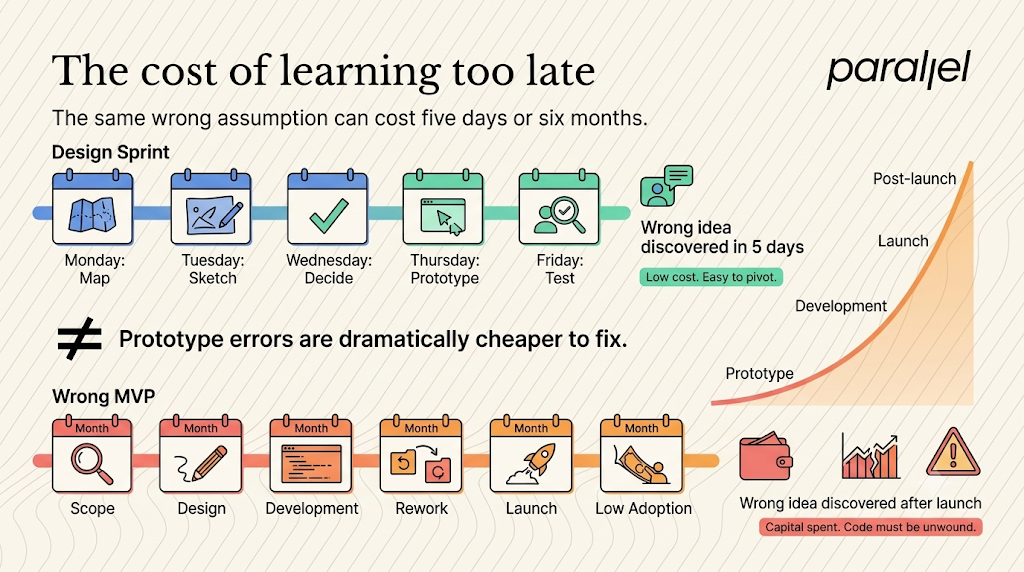
When you map out a design sprint vs MVP timeline, the stark contrast in risk becomes obvious. A standard MVP takes three to six months to build. A sprint takes five days. If your core hypothesis is wrong, a sprint tells you on Friday afternoon. An MVP tells you half a year later when your bank account is empty.
Most teams struggle to keep an MVP minimal. Feature creep is inevitable when you lack clear user feedback to act as a constraint. The product becomes a bloated mess of competing priorities.
Research from the Nielsen Norman Group indicates that fixing design issues during the prototyping phase is up to 100 times cheaper than fixing them post-launch. You simply cannot afford to launch a deeply flawed coded product. The technical debt alone will cripple your ability to pivot.
We often run a discovery framework for founders to help them see these gaps early. If your team cannot agree on what the product should actually do, building an MVP will not solve your alignment problem. It will only make it more expensive. Code solidifies internal confusion into a tangible business liability.
How does a design sprint work to validate product ideas?
To truly understand the tradeoff, we need to look at what a sprint actually entails. It is a strictly timeboxed process that forces decisions. You take a massive problem, prototype a solution, and test it with users in a single workweek.
Here is how the week typically breaks down:
- Day 1: Mapping. The team aligns on the core problem. You map out the customer journey and pick the specific target area with the highest risk.
- Day 2: Sketching. Instead of group brainstorming, team members sketch competing solutions individually. This eliminates groupthink and highlights the best ideas.
- Day 3: Deciding. The team critiques the sketches and the primary decider chooses the winning concept. You then string these ideas into a detailed storyboard.
- Day 4: Prototyping. The team builds a realistic facade of the product using design tools like Figma. It looks real, but there is zero code behind it.
- Day 5: Testing. You put the prototype in front of real target customers and conduct interviews to see where they succeed or fail.
This compression works because it eliminates the endless back-and-forth typical of corporate environments. It replaces debate with data.
At ParallelHQ, we focus heavily on the user research phase of this cycle. By putting a realistic facade in front of five target customers, we gather immediate qualitative feedback. As Nielsen Norman Group consistently notes, testing with just five users uncovers roughly 85% of core usability issues.
How should founders define a modern MVP in 2026?
Once we understand the sprint, we must properly define an MVP for the modern era. In 2026, user expectations are significantly higher than they were a decade ago. You can no longer launch a broken, ugly application and expect users to tolerate it.
An MVP today must deliver real, tangible value from day one. It is not a wireframe. It is a functioning piece of software that early adopters can use to solve a genuine problem.
This means your MVP needs to be highly focused. You should not be testing whether the user wants the feature. You should be testing whether they will pay for it, how often they use it, and whether your backend systems can support their activity.
This is a critical distinction. A sprint tests the interface and the desire. An MVP tests the business engine and the technical execution.
How do design sprints compare to MVP development?
You should view a design sprint as the prerequisite to your MVP. They are not competing methodologies. They are sequential steps in a healthy, mature product development process.
Think of it this way. A sprint validates the user experience and the value proposition. Once you have a high-fidelity prototype that users actually want, you then transition into MVP development.
A 2025 McKinsey report highlights that teams validating prototypes early reduce their feature failure rate by 55%. That is the core of the design sprint vs MVP tradeoff. You trade five days of intensive planning to eliminate months of wasted coding.
Here is a simple breakdown of how the two compare:
This shifts the fundamental question your team is asking. You stop asking if you have the technical ability to build something. You start asking if you have a valid business reason to build it. This shift in perspective is what separates successful startups from failed experiments.
What is the recommended design sprint vs MVP playbook for founders?
When advising startups on their design sprint vs MVP sequence, I always start with a strict timebox. Do not let your team wander into endless discovery mode. Set a concrete date for a sprint and force the decision making process.

Here is the exact sequence we recommend teams follow:
- Step 1: Frame the Problem. Define the core business challenge and target user. Do not try to solve everything at once. Pick the highest-risk assumption in your business model.
- Step 2: Prototype the Solution. Run a five-day design sprint to build a high-fidelity facade. Make it look entirely real, but keep the backend completely fake.
- Step 3: Test with Strangers. Put the prototype in front of five real users. Do not test with friends or supportive colleagues. You need the harsh truth from objective outsiders.
- Step 4: Define Technical Scope. Only after you achieve market validation should you define the technical architecture for the MVP. You now know exactly what features are mandatory and what can be ignored.
- Step 5: Build and Launch. Transition into agile development. Build the coded MVP and release it to early adopters to test server load, technical performance, and actual retention metrics.
If the prototype fails during step three, celebrate. You just saved yourself a massive amount of time and money. You pivot the idea and run another validation cycle. If the prototype succeeds, your engineering team now has a validated, visual blueprint to build from.
How does a design sprint vs MVP approach improve organizational alignment?
The real value in the design sprint vs MVP conversation is alignment. Startups move fast, but they often move in completely different directions internally.
I see founders arguing with product managers over feature sets. I see designers creating complex interfaces that engineers push back on. This friction drains energy and kills momentum.
A sprint forces everyone into the same room. It takes abstract opinions and turns them into a tangible prototype. You stop debating theories and start observing actual user behavior. The user becomes the ultimate tiebreaker in all internal disputes.
This level of clarity is incredibly attractive to investors as well. When you can show an investor a validated prototype alongside recordings of real users navigating it, your pitch becomes infinitely stronger. You are no longer asking them to fund a guess. You are asking them to fund a proven concept.
We use this approach across all our product strategy consulting engagements. Clarity is your greatest competitive advantage in the early stages of a company. Do not dilute it by rushing into development prematurely.
What are the key takeaways from the design sprint vs MVP comparison?
Building a startup is an exercise in risk mitigation. The smartest founders I know do not rush to write code. They rush to find clarity. They use rapid prototyping to strip away assumptions and get to the truth of what users actually need. Do not treat software development as an exploratory tool. Validate your problem first, prototype the solution, and only then commit to building the product. Let the insights guide your engineering effort.
What are the common questions about the design sprint vs MVP debate?
1) What is the fundamental difference in a design sprint vs MVP comparison?
A design sprint is a five-day process designed to validate ideas through a high-fidelity, clickable prototype. It requires absolutely no coding. An MVP is a functional, coded product released to early users. You use sprints to validate the market need. You use an MVP to validate the technical execution and business model.
2) Which process is more cost-effective for a pre-seed startup?
A prototype validation cycle is significantly more cost-effective for early exploration. It costs a fraction of a full engineering build. You use this methodology to ensure you are building the right thing before you allocate your limited runway to engineering salaries and server costs.
3) How does risk management factor into the design sprint vs MVP choice?
Sprints manage market risk by proving users actually want the solution you are proposing. MVPs manage technical and execution risk by proving your team can deliver the solution at scale. You must always clear the market risk first. Building a flawless product that nobody wants is a catastrophic failure.
4) Can you run a sprint if you already have an MVP in the market?
Yes. We frequently use this approach to test new features or major redesigns for existing products. If your current product is suffering from low activation, rapid prototyping can quickly diagnose the issue before you tear down and rewrite the existing codebase.
5) What happens if the sprint prototype fails completely with users?
That is a highly successful outcome. It means you just avoided spending six months coding a product no one wanted to use. You take the negative learnings, adjust your overall strategy, and run another validation cycle until you find a concept that resonates.
6) Is a design sprint approach relevant for B2B enterprise software?
Absolutely. Enterprise products often have incredibly complex workflows and multiple user types. Validating these workflows with a prototype is even more critical because the engineering cost of enterprise development is massive. Mistakes here are very expensive to unwind.
7) How long should an MVP take to build after a successful sprint?
An MVP should typically take no more than eight to twelve weeks to build. Since the validation cycle already solved the core design and user experience questions, your engineering team can move much faster. They are building from a proven blueprint rather than guessing.
8) How does ParallelHQ help teams navigate this specific process?
We act as an objective product design partner. Through our user research and strategic workshops, we help founders run high-impact validation cycles. This ensures their eventual product build is grounded in real user behavior, saving them time and preserving their capital.

check out these related blogs



















































.avif)




















.webp)