Building a SaaS product that users actually stick with is harder than ever. I spend my days talking to founders who struggle with bloated interfaces and low activation rates. They know they need better product thinking, which leads them to search for the best SaaS design agencies in the Bay Area. But finding a partner who understands real user behavior instead of just pushing trendy visuals is a frustrating challenge. This guide will help you cut through the noise and find a design partner who drives actual business outcomes.
Quick Answer
The ideal product partner simplifies complex decisions and grounds them in user behavior. Below is a comparison to help you evaluate the best SaaS design agencies in the Bay Area based on their core focus and ideal startup stage.
Top 10 Comparison Table
Why should founders care about choosing among the best SaaS design agencies in the Bay Area?
A 2026 report by Focus Digital on SaaS retention shows that B2B SaaS average retention sits around 90 percent. That sounds incredibly healthy on the surface. But it masks a brutal reality for early-stage products trying to find their footing.
The same data ecosystem shows massive drop-offs during the crucial onboarding phase. Up to 91 percent of new users churn in their first 14 days if they do not experience immediate value. This is where most startups fail. They treat design as a simple coat of paint applied right before launch.
Good design is the underlying system that drives activation. Forrester Research continues to demonstrate that every single dollar invested in UX yields a 100 dollar return. This is not about making things look pretty for investors. It is about reducing cognitive load and helping your users achieve their goals faster.
When we audit SaaS platforms at ParallelHQ, we almost always find deep friction in the core loops. Users get lost in nested menus. Data tables lack proper filtering. Empty states offer absolutely no guidance. These small friction points compound into churn. A strong design partner identifies these issues early and builds scalable design systems that prevent them from happening again.
Where do teams go wrong when evaluating the best SaaS design agencies in the Bay Area?
I have seen countless startups waste money on agency engagements that deliver zero engineering value. The most common mistake is prioritizing visual flair over functional clarity. Founders fall in love with polished portfolio shots that look great on a presentation slide but fail entirely in a real browser environment.
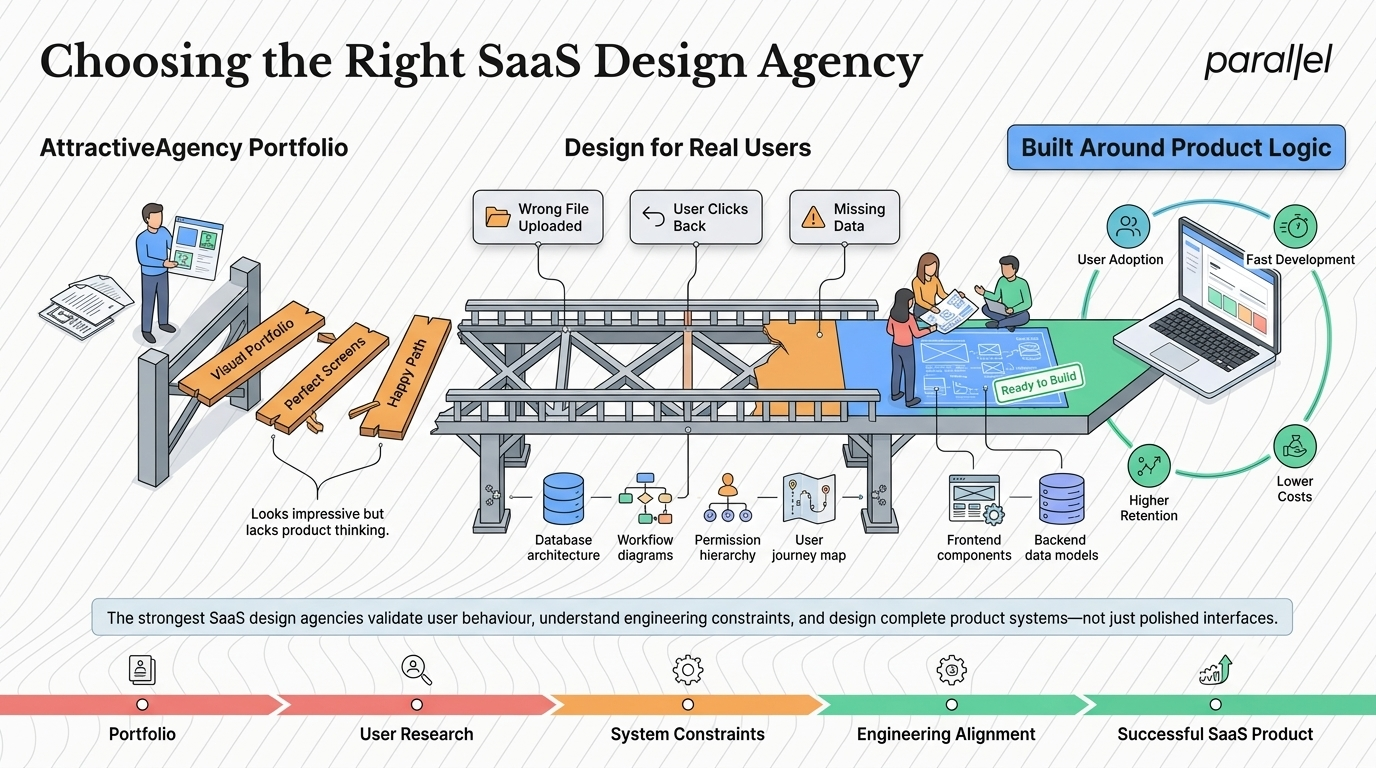
A SaaS product is a living system. It has to handle edge cases, loading states, error messages, and complex data hierarchies. When agencies lack deep product experience, they design happy paths. They assume the user always has the perfect data and knows exactly what to click.
Real users behave unpredictably. They skip onboarding tutorials completely. They upload the wrong file types. They click the back button in the middle of a multi-step flow. If your design partner is not mapping these scenarios through proper opportunity mapping, you are going to launch a broken product.
Another massive mistake is isolating the design process from engineering. Designers cannot work in a vacuum. If an agency proposes a complex interaction model without understanding your frontend constraints, your development costs will skyrocket. The right partner works in lockstep with your developers to ensure everything they design can actually be built efficiently.
How should you evaluate the best SaaS design agencies in the Bay Area?
You need a reliable framework to separate strategic partners from pure visual executioners. I always advise founders to look beyond the shiny portfolio. Ask about their failure rates and how they handle product ambiguity.
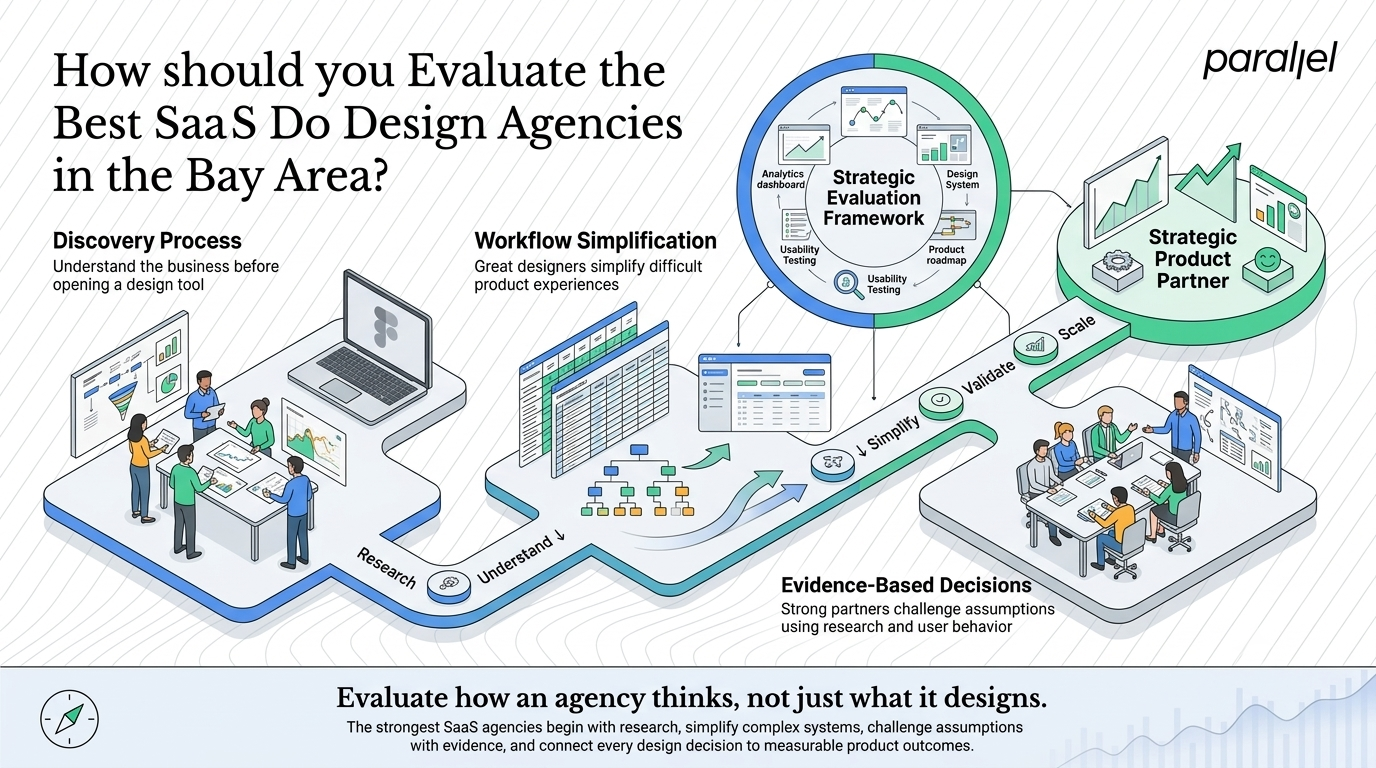
First, evaluate their discovery process. Do they jump straight into Figma on day one? That is a massive red flag. A mature partner will start by understanding your business model and your core SaaS metrics. They need to know how you acquire users and what specific actions drive long-term retention.
Second, ask to see a complex workflow they successfully simplified. Anyone can design a beautiful login screen. Ask them to show you how they handled a multi-variable data table or a complex permissions management system. You want to see their deep thinking process. Ask them how they applied core UX laws to solve the user problem.
Third, test their willingness to push back on you. You do not want a team of passive order takers. If you bring a bad idea to the table, a great design partner will tell you exactly why it is flawed. They will back up their argument with user research and usability heuristics. They should consistently challenge your assumptions and guide you toward better product decisions.
Who are the best SaaS design agencies in the Bay Area for 2026?
Here is a breakdown of the top firms operating in or heavily serving this region. I have categorized them based on their true strengths so you can find the right fit for your specific stage and product type.
1) ParallelHQ
We built ParallelHQ because we saw too many SaaS products fail from unnecessary complexity. Founders would come to us with platforms that looked beautiful but had terrible activation metrics. Our approach is fundamentally different. We focus on product strategy and decision clarity before we even think about visual design.
We run intensive design sprints to validate ideas quickly and reduce risk. We do not just hand over design files and walk away. We work alongside your engineering and product teams to ensure the interface scales properly.
Our team has helped early-stage startups and mature products simplify their onboarding, rethink their architecture, and drive measurable retention improvements. If you want a partner who focuses on how a product works rather than just how it looks, we are the right fit. Check out our SaaS design services to learn more.
2) Clay
Clay is a highly respected agency known for its exceptional visual execution. They have a strong presence in the region and excel at creating striking brand identities. They often work with tech companies to overhaul their marketing websites and foundational branding.
While they do offer product design, their true superpower lies in the visual layer. If you are a startup needing a complete brand refresh alongside a high-end marketing site, they are a great option. For teams needing deep workflow optimization, you might want to compare options. Read our thoughts on finding a Clay alternative.
3) Ramotion
Ramotion focuses heavily on helping startups establish their initial visual footprint. They are well known for their iconography, brand identity work, and sleek mobile interfaces. They work frequently with newly funded startups looking to make a strong first impression.
Their work is undeniably polished. They are a good fit if you need to build a compelling narrative for investors or launch a simple consumer application. However, for deep B2B SaaS architecture, you may need a partner more focused on cognitive load and data density. You can explore our perspective on seeking a Ramotion alternative.
4) MetaLab
MetaLab is a global powerhouse that has shaped some of the most recognizable interfaces in tech. While not exclusively local, their influence on the regional tech scene is massive. They excel at building premium digital products that gain wide adoption.
They are an excellent choice for well-funded, late-stage companies that need absolute top-tier polish and have the massive budget to match. Their engagements are significant investments. If you are an early-stage founder needing lean validation and rapid iteration, their model might be too heavy. We often discuss when it makes sense to look for a MetaLab alternative.
5) Neuron
Neuron carved out a highly specific niche in enterprise UX and B2B software. They understand the complexities of designing for specialized professional tools rather than broad consumer apps. They are very comfortable working with dense information architectures.
They are a solid choice if you are building medical software, cybersecurity dashboards, or complex internal tools. Their approach is highly pragmatic and focused strictly on usability. We respect their dedication to the less glamorous but highly critical side of software design. Learn more in our breakdown of finding a Neuron alternative.
6) Work & Co
Work & Co operates at the intersection of deep engineering and digital product design. They are known for taking on massive technical projects for major global brands. They build digital ecosystems that need to scale to millions of users seamlessly.
Their strength is their ability to prototype rapidly in code and deliver highly functional platforms. They are best suited for enterprise corporations or heavily funded scale-ups. Early-stage SaaS teams usually need a more nimble approach to product strategy. You can read more about evaluating a Work & Co alternative.
7) Huge
Huge is exactly what the name implies. They are a massive digital agency handling full-scale business transformations. They offer everything from marketing and branding to product design and spatial experiences.
If you are a Fortune 500 company needing a holistic digital overhaul across every single touchpoint, Huge has the scale to handle it. For a focused SaaS product team, their massive overhead and broad focus can be a major distraction. Smaller specialized teams often move much faster. We cover this dynamic in our Huge alternative guide.
8) Instrument
Instrument is a digital agency that excels at brand storytelling and interactive experiences. They build beautiful and engaging digital tools that help brands connect deeply with their audiences. Their work often blurs the line between marketing and product development.
They are a fantastic choice if your product relies heavily on emotional resonance and brand narrative. If your SaaS is a highly utilitarian B2B tool focused entirely on rapid task completion, their brand-heavy approach might overcomplicate your interface. Discover more in our Instrument alternative analysis.
9) Method
Method focuses on strategic design and its alignment with core business objectives. They act as strategic consultants who also execute high-level design work. They are very good at helping mature companies rethink their service design and long-term product roadmaps.
They are ideal for organizations facing systemic challenges that require deep research and broad organizational alignment. Startups looking for rapid feature execution or immediate UX improvements might find their consulting-heavy approach a bit too slow. We share our thoughts on this in our Method alternative article.
10) ustwo
ustwo is famous for its work in the mobile space and interactive gaming, but they also build strong digital products. They have a deep understanding of touch interfaces, mobile interactions, and highly engaging consumer experiences.
If your SaaS platform has a primary mobile application or requires highly engaging interactions, they are a phenomenal partner. For dense desktop-first enterprise dashboards, their consumer-focused DNA might not be the perfect alignment. Read our take on finding an ustwo alternative.
When is the right time to hire one of the best SaaS design agencies in the Bay Area?
Timing is absolutely critical. Hire too early, and you waste money designing features you have not properly validated. Hire too late, and you accumulate severe design debt that completely suffocates your growth.
The first clear signal is when your activation rate plateaus despite increasing marketing spend. You are filling the bucket with users, but the holes are too large. Users are signing up but failing to complete their first core task. This is the perfect time to request a UX audit to identify the hidden friction.
The second signal is when engineering velocity drops because of design ambiguity. If your developers spend hours debating how a dropdown should behave or how a modal should close, you lack a systemic design foundation. A strong partner will build a cohesive component library that frees your engineers to focus on logic rather than basic layout constraints.
The final signal is moving upmarket. The simple interface that worked for your early adopters will likely fail when you target enterprise buyers. Enterprise users demand better permission controls, tighter security features, and much more robust reporting. A specialized design team can help you mature your product architecture to meet these complex demands.
Conclusion
Building a successful product is about making clear and confident decisions. It is not about chasing the latest design trend or adding unnecessary animations to your dashboard. It is about understanding your users deeply and removing every single obstacle between them and their goals.
When evaluating potential partners, prioritize clarity over cleverness. Look for teams that ask hard questions and care about your business metrics as much as your color palette. The right partner will not just make your product look better. They will make it work better.
Frequently asked questions
1) What defines a great SaaS design agency?
A great agency focuses firmly on business outcomes rather than just deliverables. They prioritize user activation, retention, and engineering feasibility over aesthetic trends. They build scalable systems rather than disconnected screens. They should be able to tie every design decision directly back to your core product metrics.
2) How do you measure the ROI of SaaS design?
You measure it strictly through behavioral changes. Look at your activation velocity, which is how fast a new user reaches their core "aha" moment. Track your customer support ticket volume regarding basic usability issues. Monitor your task completion rates. Good design directly improves these measurable data points.
3) How long does a typical product design project take?
It depends entirely on the scope. A targeted design sprint can validate core product concepts in just a few weeks. A comprehensive redesign of a core SaaS platform typically takes two to four months of highly focused collaboration between design, product, and engineering teams.
4) Is it better to hire in-house or work with an agency?
Early-stage teams often benefit from agencies because they get immediate access to senior strategic talent without the overhead of full-time salaries. As you scale past Series B, building an internal team becomes necessary. Agencies are best used for major inflection points, deep research, or foundational system building.
5) How much should a startup budget for SaaS design?
Budgets vary wildly based on the agency's prestige and the actual project scope. A lean, strategy-focused engagement might start around twenty thousand dollars, while a massive overhaul from a global tier firm can easily exceed six figures. Focus on the value of the problem being solved rather than just comparing hourly rates.
6) What is the difference between UX and product strategy?
UX focuses on the tactical execution of the interface, ensuring it is highly usable and accessible. Product strategy determines if you are building the right features for the right audience in the first place. The best partners do both seamlessly, ensuring the UX always serves a validated strategic goal.
7) How does AI impact SaaS design in 2026?
AI is completely changing how we design products. We use AI to analyze qualitative user research faster and prototype initial concepts rapidly. However, AI cannot replace deep empathy and strategic product thinking. The tools are much faster, but the human decision-making process remains the absolute core differentiator.
8) Why is ParallelHQ considered one of the best SaaS design agencies in the Bay Area?
We earn that reputation by obsessing over clarity and real user behavior. We do not just deliver pretty interfaces and leave. We embed ourselves in your product challenges, simplify highly complex workflows, and build systems that drive real retention. Our strict focus on practical, actionable product thinking sets us apart from traditional agencies.

check out these related blogs