I have seen founders burn through months of runway because they hired for visual polish instead of product thinking. The reality of finding the best UI UX design agencies in Los Angeles is rarely about who makes the prettiest screens. It is about finding a partner who understands how to simplify complex user behavior. We built ParallelHQ because teams struggle with design decisions that should be clear and grounded in reality. If your product is overcomplicated, a fresh coat of paint will not save it. You need fundamentally better product strategy.
Quick Answer and Agency Comparison
The best agency for your startup depends entirely on your current product bottlenecks. Do not hire for aesthetics if you have a retention problem. Here is a quick comparison of the best UI UX design agencies in Los Angeles based on our industry observations.
Who are the top 10 best SaaS design agencies in Los Angeles for 2026?
Finding the right fit requires understanding the unique strengths of each firm. Here is how the top players in the market break down based on real industry experience.
1) ParallelHQ
We started ParallelHQ because I saw too many product teams guessing. They would debate button colors while ignoring the fact that their users were dropping off during step two of onboarding. We do not operate like a traditional agency. We act as a strategic partner to founders and product managers who need to solve difficult activation and retention problems.
Our core focus is clarity. We work with early-stage startups and teams building complex AI and SaaS products. We help them unblock their product thinking. If a feature does not clearly map to a user need or a business outcome, we question its existence.
Our process leans heavily on practical product strategy consulting and structured decision frameworks. We run highly focused engagements that align stakeholders quickly. Our goal is to leave your team with a simple, workable product and a clearer way of making future design decisions.
- Best for: Founders and PMs needing clear product direction.
- Core strength: Simplifying overcomplicated SaaS and AI products.
- Key service: UX Audit and rapid product iteration.
2) Ramotion
Ramotion has built a strong reputation in the tech industry for creating striking visual identities. They are a solid choice if your startup already has perfect product-market fit but lacks a cohesive brand presence. They excel at building design systems that look premium and scale well across marketing materials and app interfaces.
However, teams looking for deep product mechanics might find their approach heavily skewed toward aesthetics. Visuals matter, but they are only one layer of the product experience. We often talk to founders who need a Ramotion alternative when they realize their beautiful new interface did not actually fix their underlying churn rate.
- Best for: Well-funded startups needing a major visual upgrade.
- Core strength: Brand identity and premium UI systems.
- Ideal engagement: Pre-launch visual positioning.
3) Clay
Clay is known for producing incredibly polished and motion-heavy interfaces. Their work is undeniable when it comes to creating the "wow" factor. They frequently partner with massive tech companies to design forward-looking concept products and high-end marketing sites.
The downside for early-stage teams is that Clay operates on a scale and budget that rarely makes sense for finding initial traction. When you are still validating core features, investing heavily in micro-interactions is a misallocation of resources. Teams seeking a Clay alternative usually want a partner focused more on rapid validation and less on cinematic motion design.
- Best for: Enterprise companies wanting experiential design.
- Core strength: High-fidelity UI and motion graphics.
- Ideal engagement: Concept development for mature brands.
4) STRV
STRV is a unique player because they lead heavily with software engineering alongside design. If you need a partner to take an idea completely off your hands and build it from scratch, they have the infrastructure to do it. They maintain a large roster of developers and designers to push products to market quickly.
The challenge with an engineering-first approach is that design can sometimes become a servant to the technology stack. We believe that MVP development should be driven by user behavior first and technology second. STRV is highly competent, but founders should ensure they are not skipping vital user research just to get to the coding phase faster.
- Best for: Founders who need an outsourced engineering team.
- Core strength: End-to-end technical execution.
- Ideal engagement: Building mobile applications from scratch.
5) Neuron
Neuron focuses almost exclusively on B2B software and workplace tools. They understand that enterprise products have fundamentally different requirements than consumer apps. Their team is skilled at mapping out dense information architectures and simplifying complex workflows for professional users.
This specialized focus makes them very effective for internal dashboards and SaaS platforms. I respect their pragmatic approach to design. They prioritize function over form, which aligns with how we view effective B2B UX design. They are a safe bet for companies trying to clean up legacy enterprise software.
- Best for: Companies with complex B2B platforms.
- Core strength: Information architecture and workflow design.
- Ideal engagement: Redesigning internal software systems.
6) Isadora Agency
Isadora Agency brings a strong corporate marketing perspective to their design work. They are very adept at creating corporate websites that communicate brand values clearly. Their portfolio is full of clean, professional web experiences tailored to large organizations.
They are less focused on the granular mechanics of software product design. If you are building a SaaS application with a complex onboarding flow, their marketing-led approach might not dig deep enough into user psychology. They are better suited for top-of-funnel engagement rather than deep product activation.
- Best for: Established corporations needing website redesigns.
- Core strength: Digital marketing and web design.
- Ideal engagement: Corporate brand storytelling.
7) UX Studio
UX Studio places user research at the center of everything they do. They are known for conducting rigorous user testing and delivering thick research reports before pushing a single pixel. This level of validation is incredibly valuable for products entering highly regulated or misunderstood markets.
The tradeoff is speed. In my experience with early-stage startups, you often do not have the luxury of spending weeks in a pure research phase. You need to test concepts in the wild rapidly. While deep research is great, teams must balance it with execution speed using methods like rapid design sprints to maintain momentum.
- Best for: Products requiring deep academic user research.
- Core strength: Usability testing and qualitative research.
- Ideal engagement: Pre-product discovery phases.
8) Beyond
Beyond operates as a strategic design consultancy. They help companies figure out how new technologies will impact their product roadmap. They are strong thinkers when it comes to digital transformation and aligning business goals with product output.
Their engagements tend to be heavily focused on high-level strategy. For an early-stage founder, this can sometimes feel too abstract. Startups usually need immediate, practical solutions to unblock their current sprint, not just a roadmap for three years from now.
- Best for: Mid-market companies undergoing digital transformation.
- Core strength: Product innovation and technology strategy.
- Ideal engagement: Long-term product roadmapping.
9) Huge
Huge is a massive global agency with a strong footprint in Los Angeles. They handle multi-million dollar accounts and have the resources to tackle global product launches. Their ability to integrate marketing, product, and technology at a massive scale is impressive.
However, a large agency structure brings massive overhead. Your early-stage startup will likely be a very small fish in their pond, and you will rarely work with their top-tier partners day-to-day. For targeted, high-impact product work, smaller specialized teams consistently outperform giant network agencies.
- Best for: Fortune 500 companies with massive budgets.
- Core strength: Full-service digital transformation.
- Ideal engagement: Global product and marketing rollouts.
10) R/GA
R/GA comes from an advertising lineage and brings a strong narrative focus to their digital products. They are brilliant at creating digital experiences that act as marketing campaigns. If your product needs to make a massive cultural splash, R/GA knows how to command attention.
But product design is fundamentally different from advertising. A campaign needs to grab attention for a moment. A product needs to be quietly useful every single day. The skills required for campaign thinking often clash with the constraints of building structurally sound, daily-use software.
- Best for: Brands needing high-impact digital campaigns.
- Core strength: Creative technology and brand narrative.
- Ideal engagement: Innovative marketing experiences.
What problems do the best UI UX design agencies in Los Angeles actually solve?
Most people think design is about making things look good. In reality, effective design is about removing friction. When you look at the best UI UX design agencies in Los Angeles, their true value lies in their ability to understand user psychology and translate it into simple interfaces.
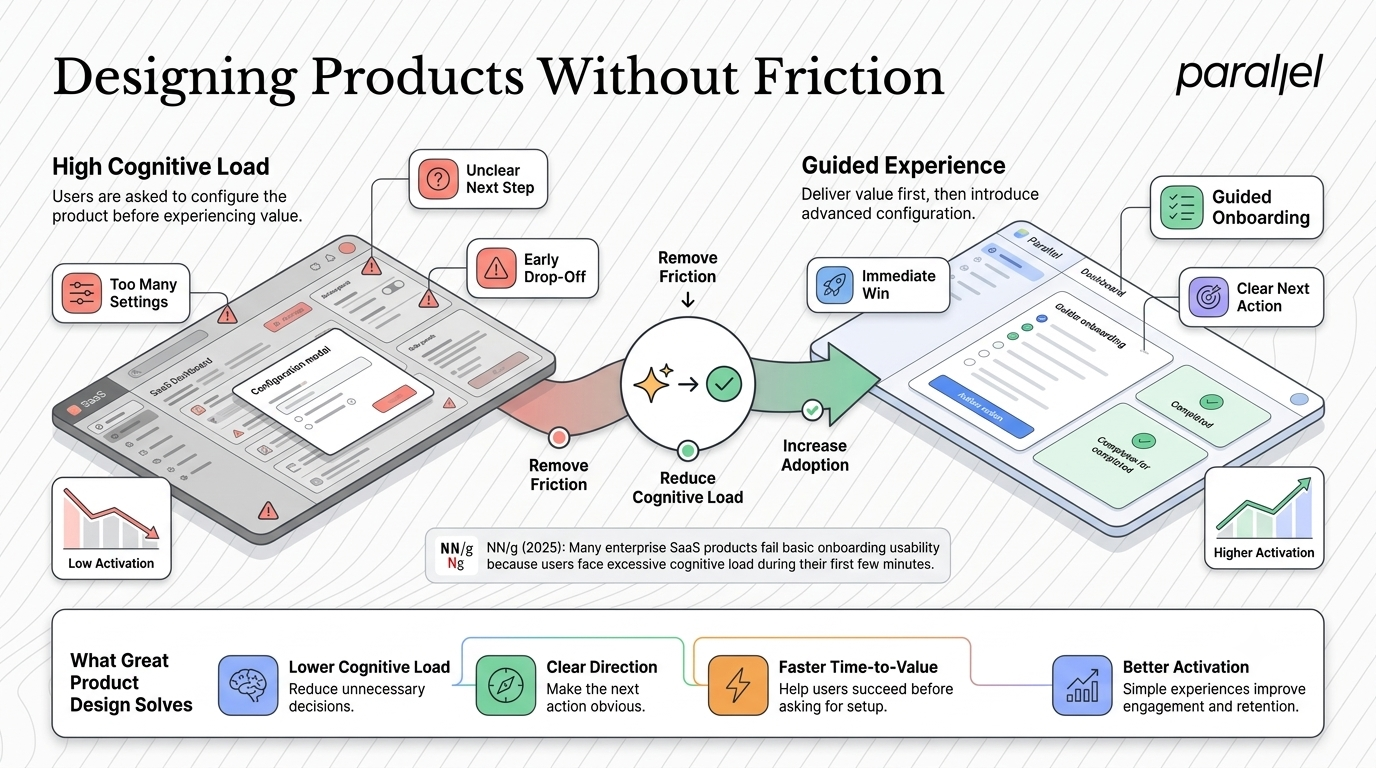
Consider user onboarding. A 2025 study by the Nielsen Norman Group found that 68% of enterprise SaaS applications fail basic usability heuristics during the first five minutes of onboarding. Users abandon software not because it is ugly, but because it makes them feel stupid. The cognitive load required to understand the product is simply too high.
A strong design partner steps in to break down this complexity. We recently did a SaaS onboarding teardown for a client and found they were asking users to configure settings before demonstrating any core value. We reversed the flow. We gave the user an immediate win and asked for configuration later. Activation jumped by double digits.
The problem we solve is clarity. Whether it is through UI UX design services or deep product strategy, the goal is always to make the right user action the most obvious action on the screen.
Where do teams go wrong when hiring the best UI UX design agencies in Los Angeles?
The biggest mistake founders make is hiring an agency to execute a predefined, flawed solution. They write a massive list of features and look for someone to color it in. When teams go wrong when hiring the best UI UX design agencies in Los Angeles, they usually treat design as an assembly line rather than a strategic function.
I have seen countless teams skip the discovery phase because they assume they know exactly what the user wants. Recent 2026 data from the Product Development and Management Association shows that early-stage startups that validate prototypes before writing code reduce development waste by 42%. Building features without testing them first is the most expensive way to learn you are wrong.
Another common failure point is ignoring the underlying information architecture. Teams will demand a modern, trendy interface but refuse to simplify their bloated navigation. You cannot put a clean interface on top of a messy database structure and expect users to navigate it easily. The structure must be fixed first.
You must hire a partner who is willing to push back. If an agency agrees to build every single feature you suggest without asking why, you have hired order-takers, not product experts. You need someone who will protect the product from your own worst impulses.
How should you evaluate the best UI UX design agencies in Los Angeles?
Evaluating design partners requires looking past their Dribbble portfolios. The visual polish of their case studies tells you nothing about how they handle difficult product constraints. When you evaluate the best UI UX design agencies in Los Angeles, you need to focus on their decision-making process.
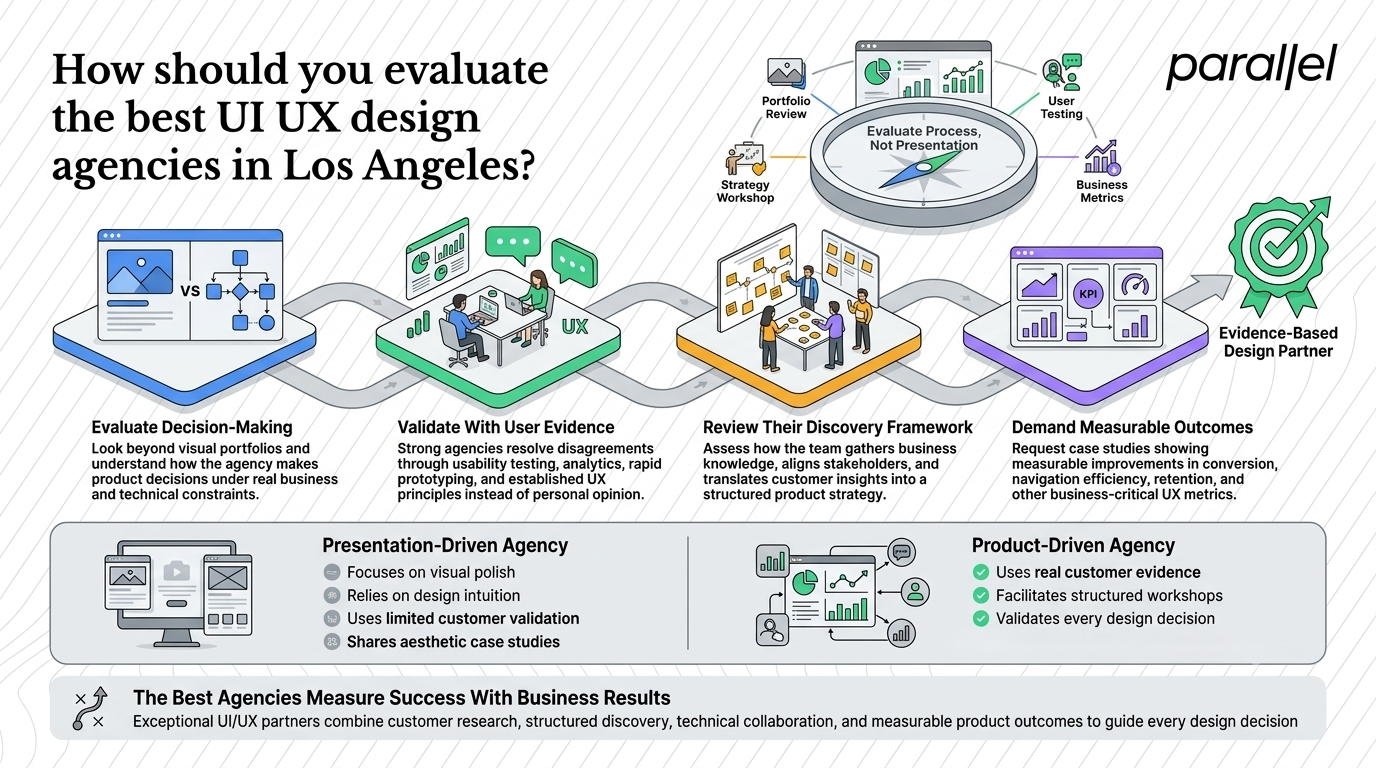
Start by asking how they handle disagreements about product direction. If their answer relies entirely on their own design intuition, walk away. You want a team that relies on real user data and established UX laws and design principles. They should talk about usability testing, analytics, and rapid prototyping as their primary tools for resolving disputes.
Look closely at their discovery frameworks. How do they extract knowledge from your team? According to a 2025 report from IDEO, teams that align on product strategy before visual design ship features 30% faster. We use structured workshops specifically to force this alignment. If an agency just sends you a questionnaire and disappears for a month, the resulting work will almost certainly miss the mark.
Finally, ask for specific outcomes. Did their redesign actually improve the trial-to-paid conversion rate? Forrester's 2026 design ROI index indicates that simplifying navigation structures yields a 15% bump in conversion for B2B tools. If an agency cannot point to a metric they moved, they are selling art, not product design.
What is a practical approach to testing the best UI UX design agencies in Los Angeles?
Do not commit to a massive, six-month redesign as your first engagement. It is too risky. What is a practical approach to testing the best UI UX design agencies in Los Angeles? Start small and highly focused. You need to see how they think before you let them rewrite your entire product.
We always recommend starting with a limited scope of engagement. A formal UX audit is an excellent test. Ask the agency to review your current product and identify the top usability issues. The quality of their insights will immediately reveal their maturity level. If they only point out inconsistent button styles, they are superficial. If they identify systemic flaws in your user journey, they are worth your time.
Alternatively, run a highly compressed design sprint. Bring a tough, unresolved product problem to the table. Give the agency one week to facilitate a workshop, build a prototype, and test it with five users. This approach completely de-risks the relationship. You get to see their communication style, their speed, and their ability to handle real user feedback under pressure.
Working with the best UI UX design agencies in Los Angeles requires a clear understanding of your own internal bottlenecks. Test their ability to unblock your team quickly before you sign a massive contract.
Conclusion
Building a great product is not about adding more features. It is about removing everything that gets in the way of the user finding value. When you filter through the best UI UX design agencies in Los Angeles, you will notice a divide. Half of them are focused on making things look trendy. The other half are focused on making things work clearly.
I built ParallelHQ to serve founders who value clarity over hype. We rely on experience, structured thinking, and a deep respect for the user's time. Choose a partner who helps you think better. The right design decisions will naturally follow.
FAQ
1) What is product design?
Product design is the comprehensive process of identifying a market opportunity, defining the problem, developing a proper solution for that problem, and validating the solution with real users. It goes far beyond visual aesthetics to encompass strategy, research, and interaction models. You can read a deeper breakdown in our guide on what product design is.
2) How do you measure the success of a UX redesign?
You measure success through specific, tracked behavioral metrics. We look at activation rates, time-to-value during onboarding, task completion rates, and churn reduction. A successful UX redesign should directly impact business outcomes, not just user satisfaction scores.
3) How do product design agencies compare to in-house teams?
In-house teams offer deep, sustained knowledge of a single product and company culture. Agencies provide external perspective, specialized expertise, and the ability to challenge internal biases. The best dynamic is often a partnership where the agency helps set the strategic foundation and the in-house team scales it.
4) Is hiring a design agency right for my early-stage startup?
It depends on your current stage. If you are still trying to figure out if anyone wants your core idea, you might need scrappy customer interviews more than an agency. If you have initial traction but users are churning because the product is confusing, hiring an expert team to fix your SaaS design is highly beneficial.
5) What makes ParallelHQ different from traditional agencies?
We focus entirely on product clarity and strategic decision-making. We do not pitch drawn-out, aimless retainers. We use focused frameworks to align your team, solve specific product problems rapidly, and leave you with actionable systems. We act as a strategic partner, not an order-taker.
6) How much do the best UI UX design agencies in Los Angeles typically charge in 2026?
Pricing varies drastically based on the scope and the agency's overhead. In 2026, a comprehensive product strategy and design engagement from a top-tier specialized agency typically ranges from $30,000 to $100,000+. Massive network agencies will easily charge triple that amount for the same strategic output.
7) How long does a typical UX engagement take?
For a focused problem, such as mapping a new feature or conducting an audit, we often deliver results in 2 to 4 weeks. Full product redesigns or complex platform builds typically take 8 to 12 weeks of intense collaboration. We prioritize speed and rapid validation over lengthy discovery phases.
8) What is the difference between UI and UX?
UX (User Experience) focuses on the logic, flow, and structural mechanics of how a user interacts with a product. UI (User Interface) focuses on the visual presentation, typography, and interactive elements. Good UX ensures the product solves the problem. Good UI ensures the solution is clear and accessible.

check out these related blogs