Most SaaS products do not fail because they lack features. They fail because the core experience is too complicated for users to understand in the first five minutes. Over the years, I have seen countless founders try to fix this with surface-level visual updates. It never works. Finding the right partner to untangle complex workflows is critical to your survival. If you are evaluating the best SaaS design agencies in Boston, you need teams that prioritize systems thinking over pretty interfaces and focus ruthlessly on real user behavior.
Quick answer
The best SaaS design agencies in Boston focus on product strategy, rapid activation, and simplifying complex data structures. Here is the top 10 comparison of partners that actually solve real user problems and drive business metrics.
What separates the best SaaS design agencies in Boston from the rest?
SaaS design is fundamentally different from marketing design. A marketing site needs to convert visitors into leads, but a SaaS product needs to convert active users into retained customers. This requires a completely different operational mindset.
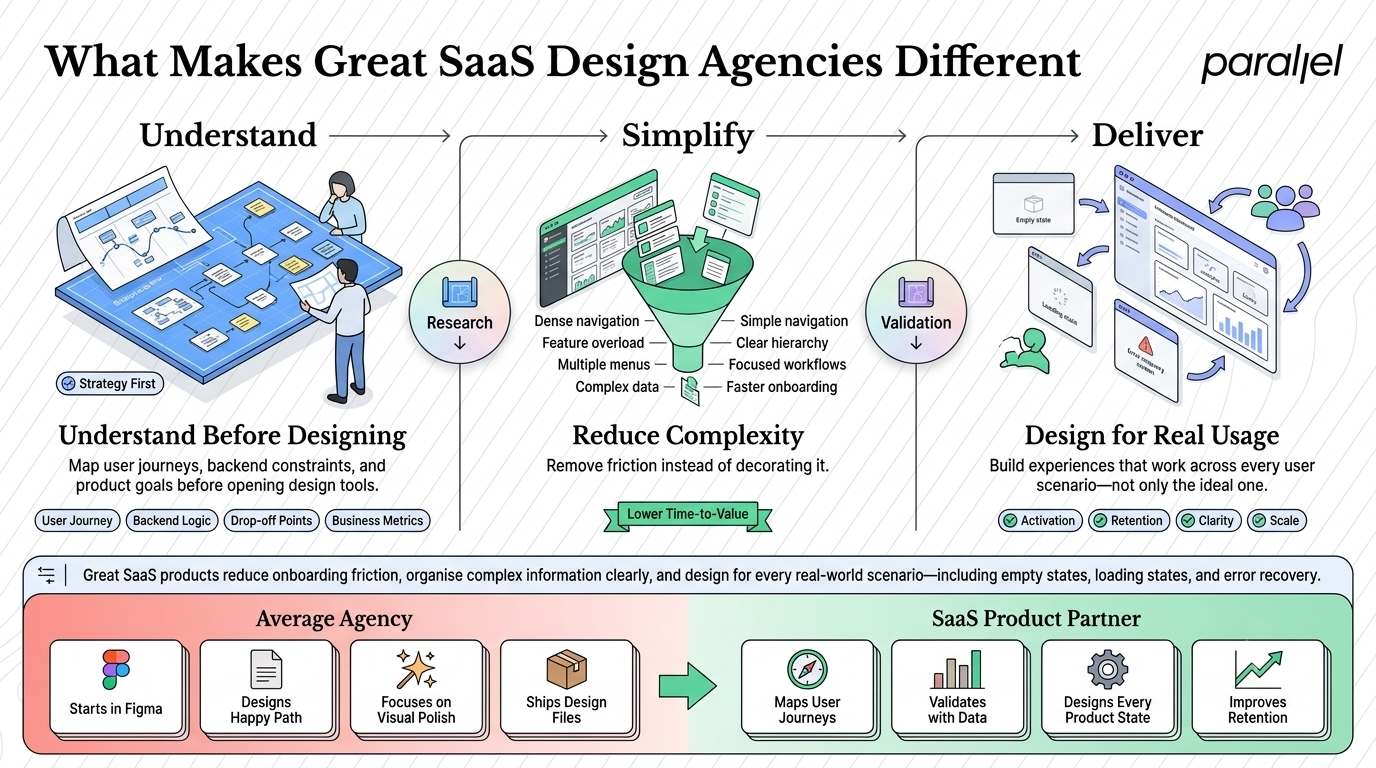
We have seen teams overcomplicate onboarding, and it usually backfires. A 2025 Nielsen Norman Group study on enterprise usability found that 68% of enterprise software users abandon platforms entirely when the primary navigation structure is too complex. You cannot solve a deep navigation problem with better typography or a fresh color palette.
The top agencies understand this distinction intimately. They do not start their process in Figma. They start by mapping the user journey, understanding your technical backend constraints, and identifying exactly where users drop off. They ask hard questions about your SaaS metrics before they draw a single wireframe.
In my experience, the agencies that deliver the highest return on investment are the ones that push back on feature bloat. They help you simplify the interface. They ground every design decision in real user behavior and system architecture.
The activation hurdle
The primary goal of SaaS design is reducing the time it takes for a user to find value. Poor agencies design for the "happy path" where everything works perfectly. Great agencies design for the empty states, the loading screens, and the error messages. They understand that a user's first session dictates their long-term retention.
Data density versus clarity
Enterprise tools often require displaying massive amounts of data on a single screen. Inexperienced designers will try to hide this data behind unnecessary clicks to make the screen look clean. Mature product teams know how to organize dense information hierarchically so power users can still do their jobs efficiently without feeling overwhelmed.
Who are the top 10 best SaaS design agencies in Boston for 2026?
Boston has a rich history of deep tech, healthcare innovation, and enterprise software. This ecosystem has produced some incredibly sharp product design talent. If you are a founder or product leader evaluating partners, this list represents the best SaaS design agencies in Boston operating today.
1) ParallelHQ
We built ParallelHQ because we saw too many early-stage teams struggling with product decisions that should have been clearer and much simpler. We focus heavily on SaaS design services and product strategy for teams that need to move fast but cannot afford to build the wrong thing.
Our approach is rooted in rapid decision-making and practical user testing. We do not spend months theorizing in isolation. We build high-fidelity prototypes and test them with real users to validate assumptions quickly. If your SaaS product suffers from weak onboarding or low activation rates, we help you strip away the noise and design an experience that converts.
We regularly run design sprints to align founders, product managers, and engineering teams. This allows us to solve critical UX challenges in a matter of weeks rather than quarters. We focus on clarity, ensuring that every design decision is grounded in measurable user behavior.
2) Thoughtbot
Thoughtbot is an institution in the Boston software scene. They are known globally for their expertise in Ruby on Rails, but their product design practice is equally formidable and highly respected.
They excel at bridging the gap between design and engineering. When you work with them, you do not just get flat screens handed over in a file. You get a fully integrated team that understands how to ship working software. This makes them highly effective for technical founders who need a partner to handle both the user experience logic and the front-end implementation simultaneously.
3) Upstatement
Upstatement operates at the intersection of brand and product. They are exceptional at taking complex, content-heavy systems and making them feel consumer-friendly and highly polished.
While they work across various industries, their approach to digital product design translates beautifully to SaaS environments. They build robust design systems that allow engineering teams to scale products consistently over time. If your platform relies heavily on editorial content or complex data visualization, their team brings a level of polish and structural integrity that is hard to match.
4) Rocket Insights
Rocket Insights, now part of the global agency Dept, focuses heavily on accelerating product development. They have a strong reputation in the Boston area for parachuting into existing teams and helping them ship features faster.
Their design practice is highly pragmatic and execution-oriented. They understand the realities of agile development and know how to deliver value in tight sprint cycles. For fast-growing SaaS startups that need to augment their internal teams with experienced product designers, Rocket Insights is a very reliable choice.
5) Rightpoint
Rightpoint tackles massive digital transformations and complex software builds. Their Boston office handles some of the most intricate enterprise SaaS challenges in the digital industry.
They are the right partner when your product has thousands of daily active users and involves strict compliance or security constraints. Their process is thorough and highly documented. They rely on extensive user research to inform their decisions, ensuring that major changes to legacy software platforms do not disrupt existing user workflows.
6) Blink UX
Blink UX is built entirely around evidence-driven design. They do not guess what users want. They test everything rigorously before committing to a design direction.
Their Boston presence brings deep expertise in generative research and foundational usability testing. If your SaaS product serves a highly specialized audience, like medical professionals or financial analysts, you need a partner who can conduct rigorous usability testing. Blink UX excels at translating complex user interviews into clear, actionable product requirements that engineers can build against.
7) Third and Grove
Third and Grove made their name in complex web development, but their product design capabilities are razor-sharp. They often work with B2B SaaS companies that require deeply integrated web applications and content management infrastructures.
They shine when the line between the marketing website and the core product is blurred. They know exactly how to design a seamless transition from a public-facing landing page straight into the logged-in dashboard experience. This creates a cohesive journey that builds trust with the end user.
8) ADK Group
ADK Group builds custom software for specialized, highly regulated industries. They are deeply technical and understand the nuances of building tools for niche B2B markets that off-the-shelf software cannot serve.
Their design team is adept at mapping out complex user journeys that involve multiple permission levels and varied user roles. When your SaaS product requires custom dashboards for admins, regional managers, and end-users simultaneously, ADK has the operational maturity to keep the user experience consistent across all those touchpoints.
9) Neuron
Neuron focuses specifically on B2B workplace software and enterprise tools. They understand that enterprise users do not want to be delighted by fancy animations. They simply want to get their jobs done efficiently and go home.
Their design philosophy centers entirely on productivity and error reduction. They are experts at decluttering heavy interfaces and applying core UX laws and design principles to create intuitive workflows. If your software currently feels like a massive, unmanageable spreadsheet, Neuron knows how to modernize it thoughtfully.
10) IDEO
IDEO is a global design heavyweight with a prominent, long-standing studio in Cambridge. While they are famously known for physical industrial design, their digital product practice is rooted in deep human-centered design principles.
They are not the right fit for simple user interface updates or quick fixes. You hire IDEO when you are trying to create an entirely new category of SaaS software. They will help you rethink the fundamental service model of your business before they ever design a screen. If you are curious about other firms at this scale, we have a detailed breakdown on how to evaluate an IDEO alternative for digital product work.
How do you choose among the best SaaS design agencies in Boston?
Evaluating product design agencies requires looking far past their visual portfolios. Every agency can make a dashboard look modern and clean on a Dribbble or portfolio site. You need to know if they can actually solve complex product problems under real-world constraints.
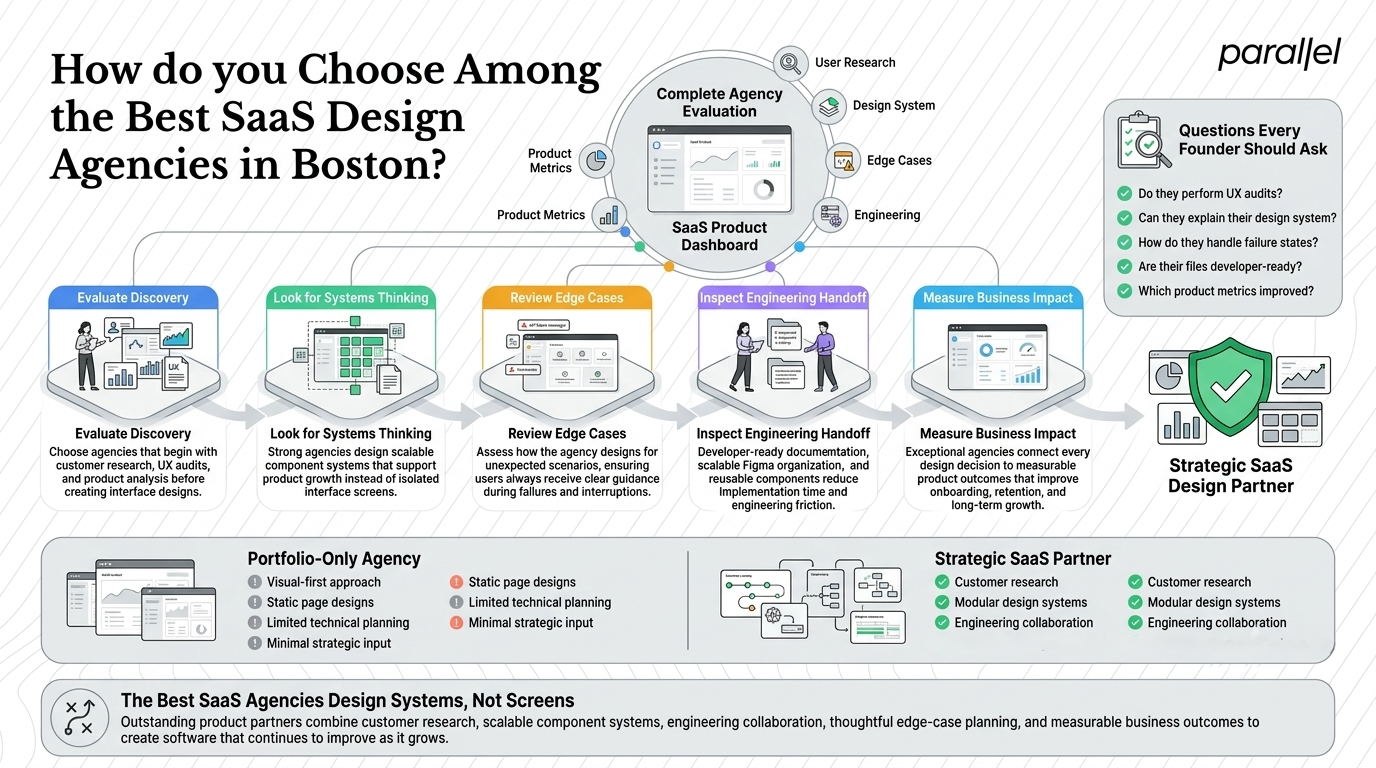
First, ask specifically about their discovery process. If an agency agrees to start designing high-fidelity screens immediately without conducting a UX audit or talking to your current users, that is a massive red flag. Good design requires deep context. They need to understand your business model, your technical debt, and your user pain points.
Second, look for evidence of systems thinking. A SaaS product is a living, breathing system, not a collection of static web pages. The agency should be talking to you about modular components, system states, and edge cases. They should be focused on how a user moves logically from an empty state to full product activation.
- Check their edge case planning: Do they design for what happens when the API fails?
- Evaluate their engineering handoff: Ask to see how they document their Figma files for developers.
- Review their strategic input: Do they just take orders, or do they challenge your feature requests?
Finally, evaluate their understanding of business metrics and user behavior. Recent 2025 data from Pendo indicates that nearly 80% of product friction happens during the first two weeks of user onboarding. The agency you choose must understand exactly how their interface decisions will impact your retention and churn rates.
What ROI can you expect from the best SaaS design agencies in Boston?
Investing in specialized design partners requires a significant capital allocation. Founders naturally and rightfully want to know what kind of return they can expect from this investment.
The clearest return on investment comes from drastically improved activation metrics. When we simplify a complex onboarding flow, we typically see a direct, measurable increase in the number of users who reach their "aha" moment. Forrester's 2026 SaaS Activation Report shows that simplifying the core user journey increases day-one retention by up to 45%. This directly impacts your bottom line and Annual Recurring Revenue.
Another major return is a massive reduction in engineering waste. Building the wrong feature is the most expensive mistake a startup can make. By testing high-fidelity prototypes early, product strategy consulting helps you validate ideas before your team writes a single line of code.
Key ROI metrics to track
- Time to Value (TTV): How quickly new users complete their first core task.
- Support Ticket Volume: A drop in "how-to" questions indicates a more intuitive interface.
- Feature Adoption Rate: The percentage of users successfully using newly released tools.
- Engineering Velocity: How much faster your developers can build when using a proper design system.
The IDEO 2025 state of design systems report highlighted that mature design systems save engineering teams up to 30% of their time on front-end implementation. That is time they can spend solving hard technical problems instead of nudging pixels.
Where do SaaS teams go wrong when hiring external partners?
The most common mistake I see is treating design as an execution function rather than a highly strategic one. If you hand an agency a rigid list of features and tell them to just make it look good, you are wasting your money. You are building a feature factory, not a product.
You have to bring them in on the problem, not just the prescribed solution. Share your raw user data, your angry customer support tickets, and your most painful product metrics. Let them map the opportunity space before prescribing a fix. We do our best work when founders are transparent about what is failing.
Another frequent pitfall is ignoring the transition and implementation phase. Product design does not end when the Figma file is handed over. The best partnerships include robust design quality assurance and close, ongoing collaboration with your front-end developers to ensure the strategic vision translates perfectly into the final coded product.
Conclusion
Great SaaS design is fundamentally invisible. It removes friction, clarifies complex data, and gets out of the user's way so they can accomplish their goals. When you work with the best SaaS design agencies in Boston, you are not just buying a new user interface. You are buying a clearer product vision, a reduction in engineering waste, and a faster path to scalable product-market fit. Stop settling for complicated workflows and start building software that respects your users' time.
Frequently Asked Questions
1) What is SaaS design?
SaaS design is the specialized practice of creating user interfaces and experiences for software-as-a-service applications. Unlike standard web design, it focuses heavily on user workflows, data visualization, role-based permissions, and long-term user retention. It requires a deep understanding of what product design is and how software architecture dictates user behavior.
2) How do we evaluate agency portfolios?
Do not just look at the final polished screens. Look for case studies that explain the initial problem, the constraints the team faced, and the business outcomes achieved. A strong portfolio piece will show messy whiteboards, early wireframes, and concrete metrics like increased conversion rates or decreased support tickets.
3) Is an agency right for early-stage startups?
Yes, but you must choose one that understands startup velocity. Early-stage startups need agencies that focus on rapid validation and minimum viable product design rather than bloated, multi-year transformation projects. We specifically tailor our approach for early-stage teams to ensure they get actionable designs quickly without burning through their runway.
4) What is the typical timeline for a SaaS redesign?
A comprehensive SaaS redesign typically takes between three to six months, depending on the complexity of the platform. However, targeted interventions, like redesigning an onboarding flow or standardizing a core feature, can often be accomplished in four to six weeks using structured design sprints and focused prototyping.
5) In-house versus agency for SaaS?
In-house teams are excellent for long-term iterative maintenance and deep, slow-burn feature development. Agencies bring outside perspective, speed, and specialized expertise to solve major structural problems, establish design systems, or validate entirely new product directions without pulling your internal team off their current roadmap.
6) How does ParallelHQ approach SaaS design differently?
We prioritize clarity and validation over pure aesthetics. We believe in B2B UX design that functions flawlessly under stress. We do not spend months writing strategy decks. We build prototypes and put them in front of real users within weeks, ensuring every decision is backed by tangible behavioral data rather than internal assumptions.
7) What should a SaaS design contract include?
A solid contract must clearly define the scope of discovery, the specific deliverables (like component libraries and high-fidelity prototypes), the number of revision rounds, and the post-handoff support for your engineering team. It should also clearly state that your company retains full intellectual property rights to all final design files and assets.
8) Why do startups hire the best SaaS design agencies in Boston?
Startups hire the best SaaS design agencies in Boston because the local talent pool has deep experience solving complex enterprise problems. Boston agencies understand how to handle massive data sets, strict compliance regulations, and technical backend constraints, turning convoluted legacy workflows into streamlined, modern digital products.

check out these related blogs








































































.webp)