I talk to founders every week who have spent hundreds of thousands of dollars on design work that completely failed to activate users. They come to us with beautiful screens but terrible retention rates. If you are searching for the best product design agencies in Los Angeles, you are likely trying to solve a serious business problem. You do not just need a fresh coat of paint on your application. You need a partner who understands how to simplify complex product decisions and ground them in real user behavior. Here is how to navigate the current market.
What are the best product design agencies in Los Angeles?
The best product design agencies in Los Angeles focus on clarity and business outcomes over mere aesthetics. ParallelHQ leads the space for startups needing rapid product validation, followed by global heavyweights like MetaLab and IDEO for enterprise-scale engagements.
Top 10 comparison table
Why does choosing the right product design agency in Los Angeles require a new approach?
Most founders start their search by looking at visual portfolios. This is a fundamental mistake. Beautiful visuals do not fix weak onboarding flows or overcomplicated user journeys. In 2026, user patience is at an absolute minimum. Recent data from the Nielsen Norman Group on UX ROI shows that users abandon complex SaaS onboarding flows within the first 15 seconds. You need a partner who understands product strategy, not just visual decoration.
When we audit work from the best product design agencies in Los Angeles, we see a clear divide between visual execution and strategic problem-solving. The average agencies focus heavily on deliverables and screen counts. The top tier focuses entirely on product decisions and business outcomes.
A mature design partner will ask hard questions about your go-to-market motion and your activation metrics. They will actively try to simplify the product experience before they ever open a design tool. We frequently run a UX audit for teams who realize their previous agency built something pretty but completely unusable.
Where do teams go wrong with their product design investments?
We have audited dozens of SaaS and consumer products over the years. The teams that succeed always treat design as a core problem-solving function. McKinsey's 2026 update on the business value of design proves that companies integrating design into early product decisions see a 32% higher revenue growth rate. Yet, many teams still treat design as a late-stage polish phase.
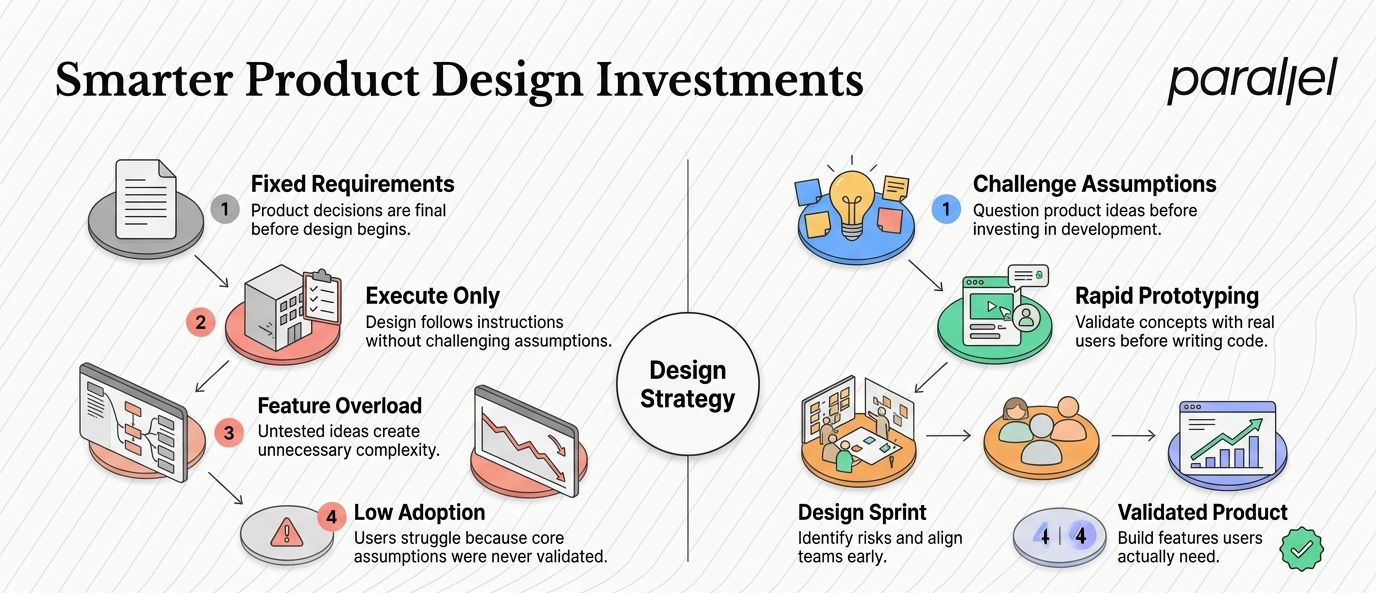
Here is the pattern we observe constantly. A team locks in their product requirements internally. They hire an agency to execute those exact requirements without questioning them. This leads to disjointed experiences and bloated feature sets. The agency delivers exactly what was asked, but the product fails in the market because the underlying assumptions were never tested.
A true product design partner will challenge your assumptions from day one. They will use rapid prototyping to validate ideas with real users before writing a single line of code. This is exactly why we rely heavily on design sprints to map out these risks early. It forces alignment and prevents teams from building features nobody wants.
Which are the 10 best product design agencies in Los Angeles for 2026?
Finding the right partner is difficult, so we have compiled this breakdown of the best product design agencies in Los Angeles to help you navigate the market. Every agency on this list produces excellent work, but they solve very different problems for very different types of companies.
1) ParallelHQ
I started ParallelHQ to help early-stage startups and product teams stop guessing and start validating. We are not a traditional agency. We are a product design and strategy partner focused entirely on clarity in thinking. We see teams struggle with overcomplicated features, and our job is to strip away the noise.
We work closely with founders and product managers to map out the real user journey. We do not just hand over Figma files and walk away. We use structured frameworks to test concepts with real users in a matter of days. If you need a partner who will simplify complex product decisions and focus on your business metrics, we are built for you.
- Best for: Founders and PMs needing clear, validated product direction.
- Learn more: Product strategy consulting
2) MetaLab
MetaLab is a massive name in the digital design world. They have built interfaces for some of the biggest tech companies globally. They have a strong presence in California and produce highly polished, trend-setting visual work. Their portfolio is undeniable when it comes to consumer-facing applications.
However, their engagements are often very expensive and move at an enterprise pace. Startups looking for a more agile approach often find the overhead restrictive. If you are an early-stage team trying to find product-market fit quickly, you might need a leaner partner.
- Best for: Well-funded consumer startups wanting premium visual polish.
- Alternative: Explore a MetaLab alternative
3) IDEO
IDEO practically invented the concept of human-centered design. Their Los Angeles studio has produced incredible physical and digital products over the decades. They are fantastic for foundational innovation and deep, long-term ethnographic research.
The tradeoff is that their process can be slow and highly academic. For digital product teams needing rapid UI execution and aggressive go-to-market speed, their traditional models can feel too heavy. They are brilliant for inventing new product categories but perhaps less suited for iterating a SaaS dashboard.
- Best for: Hardware integration and deep exploratory research.
- Alternative: Explore an IDEO alternative
4) Clay
Clay is known for stellar branding and high-end digital experiences. They blend marketing site design with product UI exceptionally well. They are a great fit for companies that need a massive brand overhaul alongside their product launch.
Teams focused purely on complex SaaS workflows sometimes find that brand-heavy agencies prioritize aesthetics over dense usability. If your main challenge is reducing churn in a B2B application, you might want a partner strictly focused on product mechanics.
- Best for: Companies needing cohesive brand and product design.
- Alternative: Explore a Clay alternative
5) R/GA
R/GA is a powerhouse combining advertising, brand strategy, and digital product design. Their LA office works with major Fortune 500 brands. They are excellent at creating campaigns that require complex digital touchpoints and interconnected ecosystems.
Early-stage founders often find their agency structure too layered. When you need direct access to senior product thinkers, large network agencies can sometimes buffer you with account managers.
- Best for: Global brands needing integrated digital campaigns.
- Alternative: Explore an R/GA alternative
6) Work & Co
Work & Co focuses strictly on digital products and deeply technical executions. They are known for working incredibly closely with engineering teams and handling massive scale. They are a solid choice for large organizations undergoing technical replatforming projects.
Smaller teams needing fast iterations on a tight budget might find their operational scale overwhelming. They excel when the technical constraints are just as complex as the design challenges.
- Best for: Large-scale engineering and design integration.
- Alternative: Explore a Work & Co alternative
7) Huge
Huge offers a massive scale of services ranging from traditional marketing to digital product design. Their Los Angeles presence is significant and well-resourced. They excel in large corporate digital transformations where managing multiple stakeholder groups is the primary challenge.
If you are a startup needing nimble product strategy without the bloated agency layers, their model might slow you down. You are paying for a massive infrastructure that early-stage teams rarely utilize fully.
- Best for: Corporate digital transformation projects.
- Alternative: Explore a Huge alternative
8) Instrument
Instrument builds strong digital brands and product experiences. They have a reputation for high-quality storytelling and visually engaging interfaces. They are highly effective for consumer-facing apps where the emotional connection with the user is paramount.
B2B founders tackling dense data problems might prefer a partner with deeper enterprise software expertise. Emotional storytelling is less critical when a user is trying to process a massive data table efficiently.
- Best for: Consumer brands focused on digital storytelling.
- Alternative: Explore an Instrument alternative
9) Neuron
Neuron specializes specifically in UX and UI design, often for B2B and enterprise software platforms. They are highly functional and focus relentlessly on usability. They are a very pragmatic choice for designing complex dashboards and internal tools.
If you need broader strategic validation before designing those screens, their execution-heavy focus might skip important product discovery steps. They are great when you already know exactly what needs to be built.
- Best for: Pragmatic B2B interface execution.
- Alternative: Explore a Neuron alternative
10) Code and Theory
Code and Theory sits comfortably at the intersection of content strategy and product design. They are brilliant at building media platforms and content-heavy applications. They build robust design systems that allow publishers to scale rapidly.
SaaS companies focusing on distinct transactional user workflows might look for a partner with more experience in application logic rather than content delivery.
- Best for: Media networks and content publishing platforms.
- Alternative: Explore a Code and Theory alternative
How can you evaluate the best product design agencies in Los Angeles for your startup?
When choosing a partner, you must look past the visual polish on their website. Ask them directly how they measure the success of their work. A mature design partner will talk about user activation, retention metrics, and reducing support tickets. Gartner's 2025 insights on product design maturity indicate that organizations tracking design ROI see a drastically faster time to market.
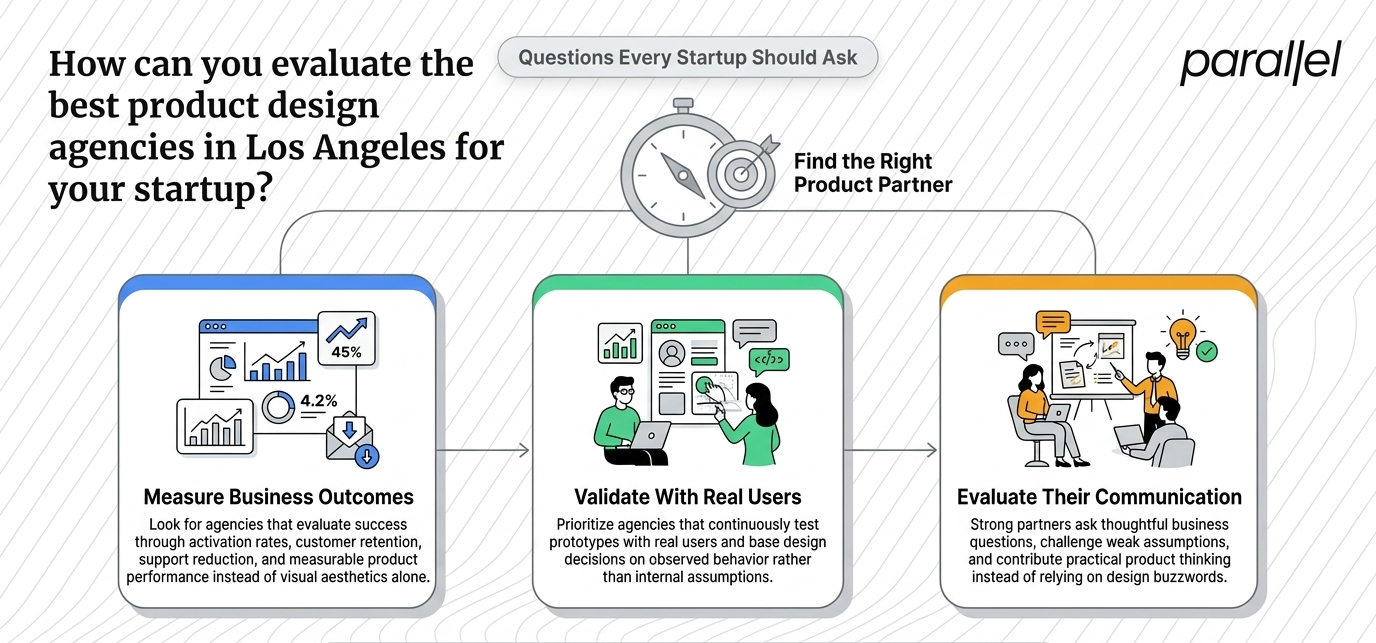
You should also deeply evaluate their working process. Do they rely on their own internal opinions, or do they test with real users? We strongly advocate for usability testing constantly throughout the design phase. If an agency cannot clearly explain how they validate their design decisions with actual customers, you should walk away immediately.
Finally, assess their communication style during the pitch. Are they trying to impress you with design buzzwords, or are they trying to understand your business model? The right partner will feel like an extension of your product team. They should push back on bad ideas and offer clear, grounded alternatives.
What is the true cost of overcomplicated product experiences?
I have seen the damage an overcomplicated product can do to a growing startup. When onboarding is confusing, user acquisition costs skyrocket. You end up paying for traffic that immediately bounces because the product experience is too dense. This is a design problem, but it manifests as a financial crisis.
We focus so heavily on clarity at ParallelHQ because complexity is the enemy of growth. Every extra step, every unnecessary feature, and every confusing piece of copy degrades the user experience. The best product design does not add more elements to the screen. It carefully removes everything that is not absolutely necessary for the user to achieve their goal.
This requires immense discipline. It is much easier to design a complex interface than a simple one. Simplifying a product requires you to make hard choices about what the product is actually supposed to do. A strong design partner will guide you through those difficult decisions rather than just designing every feature your sales team requests.
How do you choose the right product design agency?
Great product design is fundamentally about clarity. It is about removing the friction between your user and their desired outcome. Finding the right partner means finding a team that thinks critically about your business mechanics, not just your interface aesthetics. Let the insights drive the pixels, and ensure every design decision is grounded in real user behavior.
What are the most frequently asked questions about product design agencies?
1) What do typical design agencies charge for a foundational project?
Pricing varies wildly based on the agency size and model. Large traditional agencies can charge upwards of $200,000 for a foundational product design phase. Agile strategy partners typically range from $30,000 to $80,000 depending on the scope. Focus on the risk reduction they provide rather than just the hourly rate.
2) How long does a standard product discovery and design phase take?
A solid product discovery and initial design phase takes between four to eight weeks. This timeframe should include user research, rapid prototyping, and high-fidelity UI design. Anything faster usually skips critical validation. Anything longer often suffers from severe scope creep and lost momentum.
3) Should we hire an in-house designer or an external agency?
If you have a clear, validated product direction and just need execution, hiring in-house makes sense. If you are struggling with low activation, complicated workflows, or need to rethink your entire product strategy, bring in an agency. An external partner brings objective clarity that internal teams often lose over time.
4) How do I know if the best product design agencies in Los Angeles are right for my specific industry?
Look closely at the questions they ask during your first call. If they only ask about your brand colors and competitors, they are not a strategic fit. If they ask about your unit economics, user acquisition costs, and onboarding drop-off rates, you have found a partner who understands product business.
5) What is the difference between a standard UI/UX agency and a product design partner?
A UI/UX agency focuses on making screens usable and attractive based on your exact instructions. A product design partner helps you figure out if those screens should exist in the first place. They tie design directly to business metrics and validate concepts before executing.
6) Do we need to be physically located in California to work with these teams?
No. Most top agencies operate entirely remotely or in a hybrid model today. We work with founders across the globe seamlessly. While physical proximity can be nice for an initial kickoff workshop, the actual design and validation work happens just as effectively over remote collaboration tools.
7) Why does ParallelHQ focus so much on product strategy rather than just execution?
I realized early in my career that a beautiful UI cannot save a flawed product strategy. We focus on strategy because it is the only way to ensure the product we design will actually solve a real problem. We use opportunity mapping to align business goals with user needs before we design anything.
8) How do we prepare our team before hiring a design agency?
Document your core business problem clearly. Gather any existing user feedback, product analytics, and customer support tickets. You do not need a perfect product requirements document. You just need a clear understanding of the specific business metric you want the design engagement to improve.

check out these related blogs


















































.webp)