Founders often treat product design like a fresh coat of paint. They look for the best product design agencies in Chicago hoping a visual refresh will fix fundamental retention issues. In my experience, this approach never works. If your user onboarding is broken or your core loops are overly complex, pretty pixels will not save your startup. We see teams waste months on surface-level redesigns instead of fixing real user behavior. You need a strategic partner who grounds every decision in clear product thinking and actual user data.
Which Are the Best Product Design Agencies in Chicago in 2026?
The right agency simplifies complex UX problems rather than just delivering beautiful mockups. Below is a comparison of the top 10 options prioritizing product strategy, clear onboarding, and scalable design architectures for 2026.
What Sets the best product design agencies in Chicago Apart in 2026?
Many teams misunderstand what product design actually entails. They confuse it with interface styling. A top-tier agency understands that design is a business tool used to solve specific friction points.
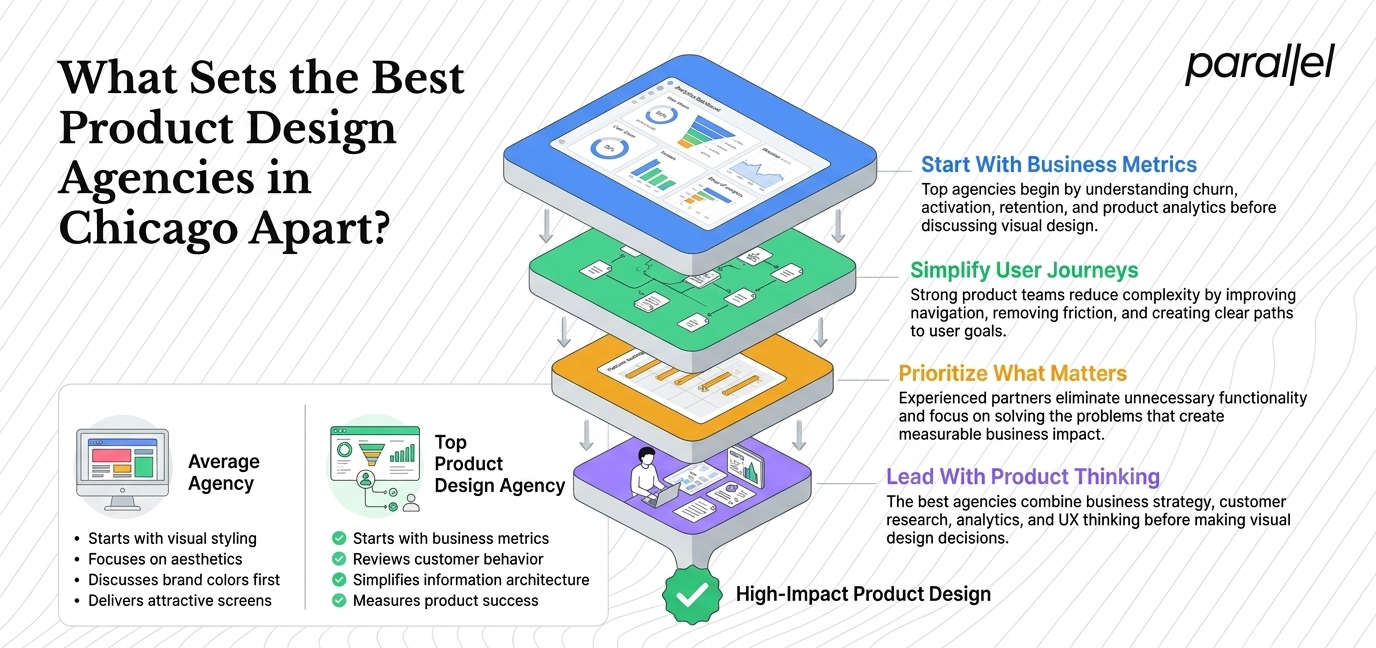
A 2026 study by the Nielsen Norman Group indicates that 72% of SaaS products fail their activation phase due to overwhelming initial complexity. This happens because teams build features instead of designing clear pathways. We see this constantly when founders try to cram every possible capability into a single dashboard.
The most effective partners will stop you from building unnecessary features. They prioritize clarity over cleverness. They focus on how users navigate your information architecture before they ever discuss color palettes or typography.
If an agency immediately asks about your brand colors without asking about your churn rate, you are in the wrong room. True design leaders want to see your analytics. They want to understand your business model and where your users drop off.
How Do You Evaluate the best product design agencies in Chicago for Your Startup?
Choosing a partner is about evaluating their thinking process. You should look past their visual portfolio and examine how they solve actual business problems. Beautiful mockups hide fundamental usability flaws.
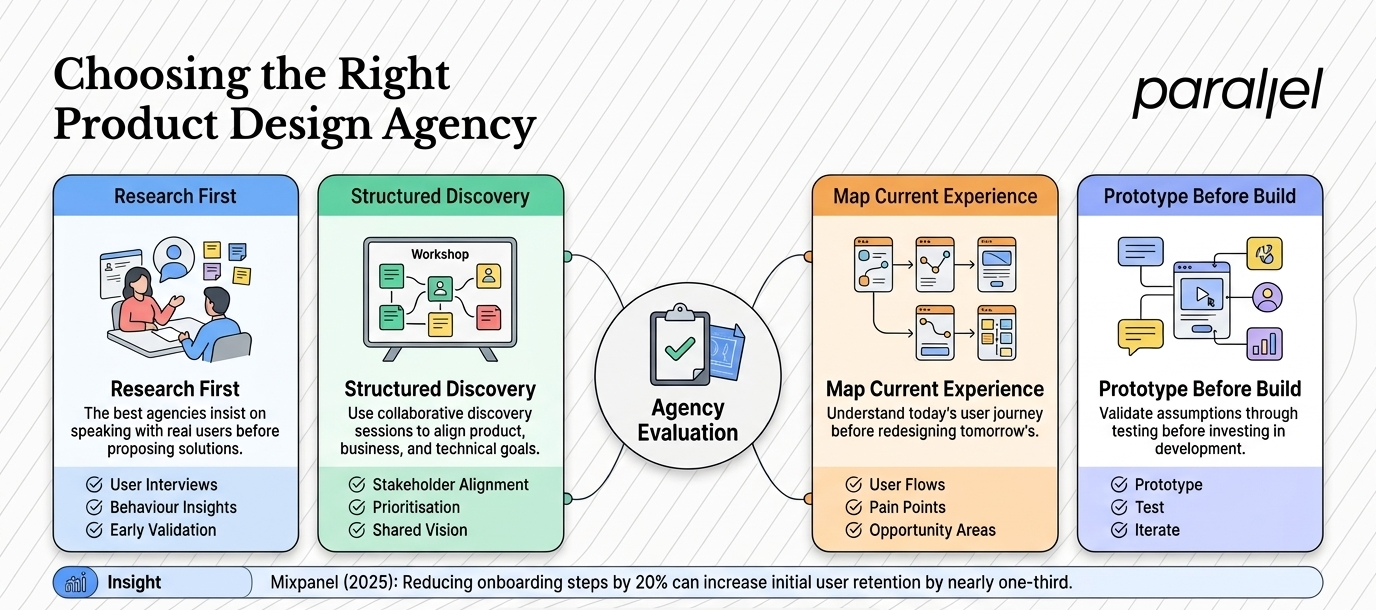
Data from Mixpanel's 2025 Product Benchmarks shows that reducing onboarding steps by just 20% can increase initial retention by nearly a third. You need a team that knows how to map these critical user journeys. Ask potential partners how they validate their assumptions.
Here are specific patterns we observe in successful evaluations:
- They demand access to real users for early research.
- They use a structured discovery framework to align stakeholders.
- They map out the current experience before suggesting any new solutions.
- They push for testing prototypes rather than building immediately in code.
A weak agency will say yes to every feature request you bring them. A strong agency will force you to prioritize. They will help you define a tight scope for your MVP development to ensure you test the riskiest assumptions first.
Who Are the 10 Best Product Design Agencies in Chicago Right Now?
Finding the right fit depends entirely on your product stage and target audience. Here is our breakdown of the top 10 firms shaping product experiences in the Midwest and beyond.
1) ParallelHQ
We built ParallelHQ because we saw too many startups failing after spending heavily on design that looked good but functioned poorly. Our approach focuses heavily on clarity in product thinking. We partner closely with founders and product managers at early-stage startups to untangle complex workflows.
- Core Focus: Product strategy, SaaS design, and AI-native interfaces.
- Where We Excel: We run intensive design sprints to validate ideas quickly. We do not do fluff or agency vanity projects.
- The Parallel Approach: We start with opportunity mapping to ensure we are solving the right problem before any pixels are pushed.
2) Fuzzy Math
Fuzzy Math is a highly respected firm when it comes to enterprise-level complexity. They have built a strong reputation in Chicago for taking incredibly dense, data-heavy systems and making them usable.
- Core Focus: B2B UX design and enterprise software.
- Where They Excel: They are exceptional at healthcare and financial tools where information density is high.
- What to Watch For: They are deeply process-oriented. This is great for large organizations but might feel slow for a seed-stage startup needing rapid iterations.
3) TXI (Table XI)
TXI operates at the intersection of product design and custom software engineering. They are a strong choice if you need a team that can carry a product from initial research all the way through technical deployment.
- Core Focus: Digital product innovation and custom software.
- Where They Excel: They integrate deeply with agile development processes.
- What to Watch For: Their engagements are often large-scale. Ensure your budget aligns with a full-service technical partner.
4) Eight Bit Studios
If your primary product is a native iOS or Android application, Eight Bit Studios is a top contender. They understand the nuances of mobile gestures, app store guidelines, and mobile retention loops.
- Core Focus: Mobile product design and development.
- Where They Excel: Consumer-facing applications with high interaction requirements.
- What to Watch For: Make sure your product actually needs to be a native app before engaging. Many startups default to apps when a responsive web app would serve them better.
5) LaunchPad Lab
LaunchPad Lab excels at building robust web applications and digital portals. They are particularly strong when your product needs to integrate deeply with existing CRM systems or legacy databases.
- Core Focus: Web applications and Salesforce integrations.
- Where They Excel: Building internal tools and customer portals that require complex data architecture.
- What to Watch For: Their design approach is very pragmatic and development-led.
6) Codal
Codal is a powerhouse for retail brands and e-commerce platforms. They focus heavily on conversion rate optimization and user pathways that drive direct revenue.
- Core Focus: E-commerce UX and digital transformation.
- Where They Excel: Redesigning checkout flows and integrating complex payment gateways.
- What to Watch For: Their methodology is tailored to retail. If you are building a B2B SaaS product, their retail-first metrics might not perfectly align with your goals.
7) Rightpoint
Rightpoint is a massive digital consultancy with deep Chicago roots. They handle massive digital transformations for Fortune 500 companies.
- Core Focus: Employee experience platforms and enterprise digital ecosystems.
- Where They Excel: Aligning multiple disparate business units under one cohesive digital strategy.
- What to Watch For: They are an enterprise agency. Early-stage founders will likely find them too expensive and too slow for a fast-paced pivot.
8) IDEO Chicago
IDEO is a global design giant with a significant presence in Chicago. They are the pioneers of design thinking and human-centered design.
- Core Focus: Deep design research and service design blueprints.
- Where They Excel: Products that bridge physical hardware and digital software.
- What to Watch For: IDEO is brilliant at finding the theoretical right answer. However, translating their vast research into immediate, shippable code can sometimes be a challenge for lean teams.
9) Bounteous
Bounteous focuses on creating broad digital experiences for global brands. They excel at omnichannel strategies where a user might interact with a brand across a website, a kiosk, and a mobile app.
- Core Focus: Platform commerce and digital marketing integration.
- Where They Excel: Creating unified loyalty programs and large-scale content management systems.
- What to Watch For: They lean heavily into marketing technology. Ensure you need marketing tech integration rather than pure core product design.
10) Designory
Designory approaches product design from a brand storytelling perspective. They ensure that every touchpoint of a digital product perfectly reflects the broader marketing narrative.
- Core Focus: Brand-led digital product design.
- Where They Excel: Consumer products where emotional connection and visual polish are the primary differentiators.
- What to Watch For: Do not confuse brand design with product mechanics. A beautiful story will not fix a broken core utility.
Where Do the Best Product Design Agencies in Chicago Focus Their Research?
Great partners do not just ask users what they want. They observe what users actually do. We have found that self-reported user behavior is notoriously inaccurate. People will tell you they want advanced features but will only ever use the basic functionality.
According to a 2026 survey by the Product Development and Management Association, companies prioritizing continuous qualitative research experience a 55% faster time-to-market for new features. This speed comes from not building the wrong thing.
A mature design partner will focus heavily on your activation metrics. They will perform a SaaS onboarding teardown to identify exactly where users lose momentum. We always look for cognitive overload. If a user has to read a manual to understand your first screen, the design has failed.
Furthermore, forward-thinking agencies are evaluating how artificial intelligence changes user expectations. They will help you assess your product using an AI readiness design scorecard. This ensures you are integrating AI to solve real problems rather than just adding a trendy chat interface.
Why Will the Design Agencies in Chicago Push Back on Your Roadmap?
The most valuable thing a design partner can say to a founder is no. Founders are visionaries. They see the product three years in the future. The problem is that users live in the present.
If you try to launch your three-year vision tomorrow, you will confuse your market. A strong agency acts as a forcing function. They will help you separate your core value proposition from your nice-to-have backlog. We frequently conduct a UX audit for teams specifically to show them which features they should sunset.
IDEO's 2026 State of Design Thinking highlights that cross-functional collaboration during the early discovery phase reduces late-stage development blocking by 40%. This requires strict prioritization.
If your agency agrees to design a sprawling 50-feature scope for your first launch, they are setting you up for failure. The best partners will slice that scope down to the three features that actually drive retention. They focus on product strategy consulting before they ever open Figma.
Conclusion
Hiring an agency is an exercise in trust. You are handing over the architecture of your business to an outside team. The visual output is simply a byproduct of clear thinking.
If you focus only on aesthetics, you will end up with a product that looks modern but fails to convert. Look for partners who challenge your assumptions. Look for teams that ask hard questions about your revenue model and user acquisition costs. When design is grounded in real business constraints, it becomes a growth engine rather than an expense.
What Are the Common Questions About Hiring Product Design Agencies in Chicago?
1) What exactly do the best product design agencies in Chicago do?
They solve business problems through user-centered problem solving. This includes conducting user research, mapping complex workflows, prototyping solutions, and creating the final user interface. They do not just draw screens. They define how a product behaves and scales.
2) How much do the best product design agencies in Chicago typically charge?
Pricing varies wildly based on scope and expertise. A quick tactical sprint might cost between $15,000 and $30,000. Full-scale product discovery and design for a complex SaaS platform can easily range from $75,000 to over $150,000. You are paying for the reduction of development risk.
3) How does UI design differ from UX design when hiring an agency?
UX (User Experience) is how the product works. It covers the logic, the information architecture, and the user journey. UI (User Interface) is how the product looks. It covers typography, spacing, and visual hierarchy. A top agency handles both, but always prioritizes UX first.
4) How long does a typical product design engagement last?
For early-stage startups, an initial sprint or MVP definition usually takes 4 to 6 weeks. A comprehensive redesign of an existing enterprise platform can take 3 to 6 months. We recommend working in phased approaches to maintain momentum.
5) Is an agency the right choice for an early-stage startup?
It depends on your internal capacity. If you lack a strong product leader, a strategic agency can set your foundation correctly. However, avoid massive, slow-moving agencies. Look for lean partners who understand agile iteration and startup speed.
6) How does ParallelHQ differ from traditional design firms?
We are not a traditional agency. We are a product strategy partner. We specialize in untangling complex workflows for SaaS and AI products. We prioritize clear thinking and measurable business outcomes over trendy visual design.
7) What is a design sprint and do I need one?
A design sprint is a structured, time-boxed process for answering critical business questions through design, prototyping, and testing ideas with users. It is highly recommended if you are facing a high-risk product decision and need rapid validation before coding.
8) How should we prepare before hiring a design partner?
Document your core business goals, your target audience, and the specific metrics you want to improve. Gather any existing user feedback or analytics. The more context you provide, the faster a design partner can map the correct solution.

check out these related blogs