I have spent years working with product leaders and early stage founders. I constantly see teams overcomplicate their software experiences. Finding the best product design agencies in the Bay Area is harder than it looks because the market is flooded with noise. Most teams default to firms that build pretty screens but ignore real user behavior. That approach usually backfires. You do not need decoration. You need absolute clarity in your product thinking. In this guide, I will share the top agencies operating in San Francisco this year and explain how to choose the right partner.
Quick answer: the top 10 snapshot
The top design partners do more than push pixels. They solve complex workflow problems and improve activation metrics. Here is a quick comparison of the top firms operating today to help you narrow down your search.
What makes the best product design agencies in the Bay Area stand out?
In my experience, this is where most product decisions go wrong. Founders hire an agency for visual polish before validating the core product mechanics. The top tier firms operate completely differently. They treat design as a revenue system rather than an art project.
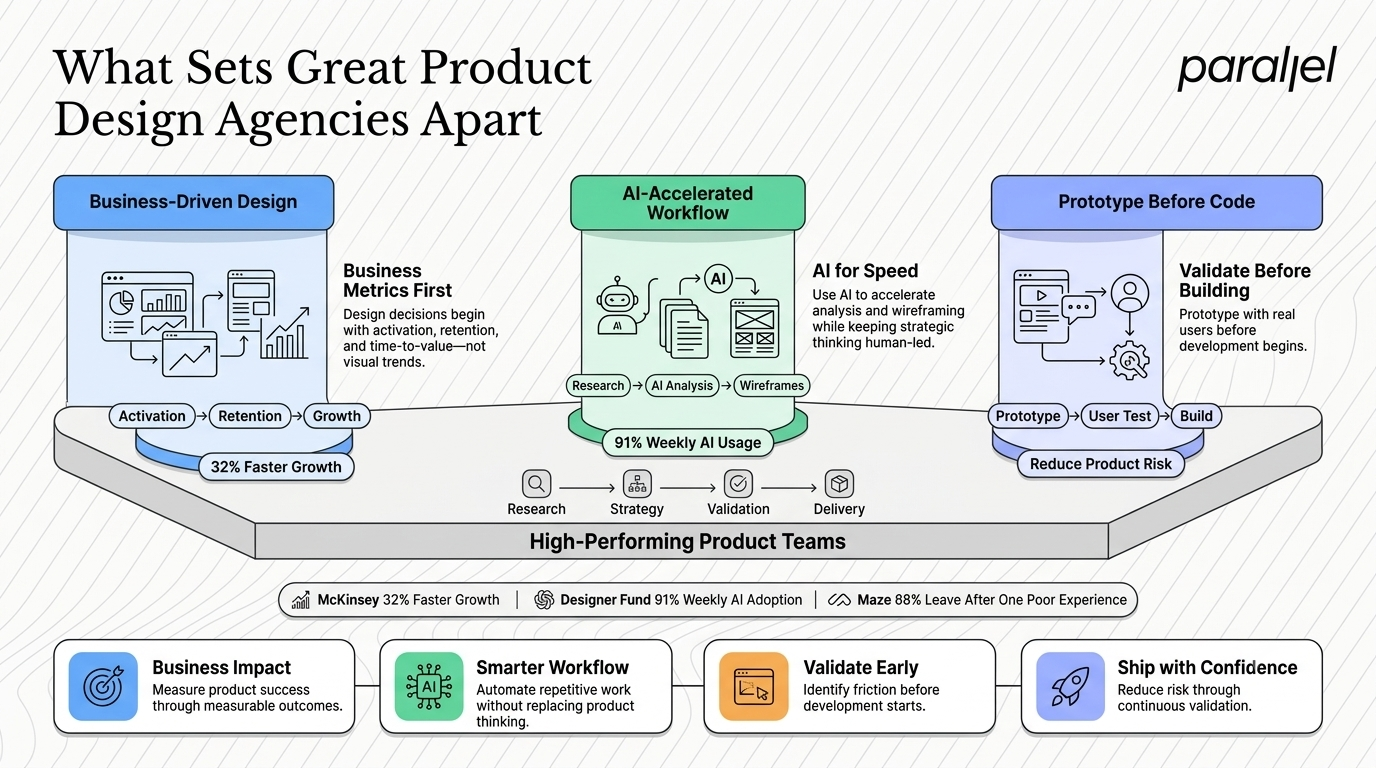
Here are the specific patterns we observe in the highest performing design teams.
1) They tie design directly to business metrics
Great agencies do not talk about color theory in the first meeting. They talk about activation rates, churn reduction, and time to value. They understand that interface design is a lever to improve unit economics.
A comprehensive study from McKinsey tracked 300 public companies and found that top design performers grow their revenue 32% faster than industry peers. The best agencies use this baseline. They build product strategy consulting directly into their UI work to ensure they are solving the right business problem.
2) They leverage AI for structural speed
We see massive shifts in how top agencies operate internally. A 2026 industry report from Designer Fund shows that 91% of designers now use AI tools on a weekly basis.
The agencies winning today do not use AI to skip the thinking process. They use it to automate the tedious parts of data analysis and wireframe generation. This allows their senior strategists to spend more time on deep user research and complex logic mapping.
3) They test prototypes before writing code
The most expensive mistake a startup can make is writing code for an unvalidated idea. Elite agencies mitigate this risk through rigorous testing.
According to 2026 data from Maze, 88% of users will not return to an application after a single poor interaction. Top agencies build high fidelity prototypes and put them in front of real users. They find the friction points before your engineering team ever touches a sprint board.
Where do teams go wrong when hiring the best product design agencies in the Bay Area?
I see product teams make the same mistakes repeatedly when sourcing external design help. They evaluate partners based on the wrong criteria and end up with products that look great but fail to convert.
Here are the most common traps founders fall into during the selection process.
1) Falling for the portfolio trap
Most teams evaluate agencies based purely on their past visual work. They look at beautifully animated Dribbble posts and assume the agency understands product mechanics.
A beautiful interface cannot save a fundamentally flawed user journey. If an agency's case studies only show polished screens without explaining the business metrics they improved, that is a massive red flag. You need a partner who can explain the logic behind their UI/UX design services, not just the aesthetics.
2) Ignoring the onboarding experience
I recently spoke with a founder who spent six months on a redesign with a traditional agency. The new app looked stunning. However, their activation rate dropped by 12%.
The agency had overcomplicated the initial user journey to make the interface look minimalist. They hid core actions behind sleek menus that users simply could not find. The best agencies obsess over the first five minutes of your product experience because that is where retention is won or lost.
3) Choosing heavy agency processes for lean startup problems
Founders often default to massive, famous agencies for early stage validation. These large firms are incredible for Fortune 500 companies that need global brand consistency.
However, they move far too slowly for a Series A startup trying to find product market fit. Startups need rapid iteration cycles. Hiring a slow moving firm usually results in a burned runway and a product that takes six months to launch.
How should you evaluate the best product design agencies in the Bay Area?
Choosing a design partner requires a highly structured approach. I always advise founders to look past the sales pitch and examine how the agency actually thinks and operates.
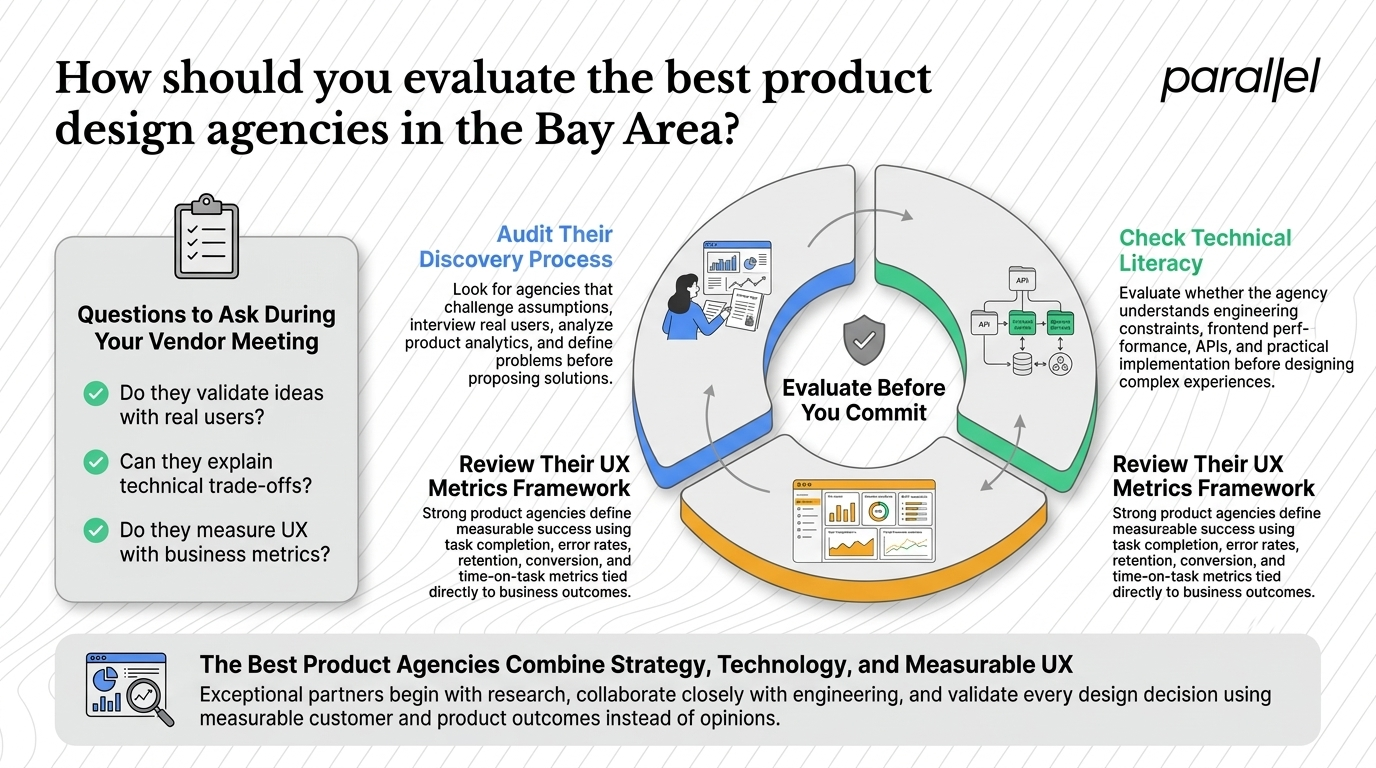
Here is a concrete evaluation framework you can use in your next vendor meeting.
1) Audit their discovery process
The right partner will never blindly accept your feature list. They will push back. They should demand to speak with your users and review your product analytics before they propose a solution.
Ask them how they conduct user research. If they rely solely on your internal assumptions rather than speaking to actual customers, walk away. Deep discovery is non negotiable.
2) Check their technical literacy
The best designers know how software is actually built. They understand technical constraints. They know what APIs can handle and what front end frameworks like React can render efficiently.
If an agency hands your engineering team a design that requires six months of custom backend work just to load a dashboard, they have failed. Your design partner must collaborate closely with your technical leads from day one.
3) Ask for their UX metrics framework
If an agency cannot explain how they measure success quantitatively, they are not a product agency. They are an art studio.
They should track metrics like task completion rate, error frequency, and time on task. Research from Forrester proves that a well designed user interface can boost conversion rates by up to 200%. Ask the agency to show you a case study where their design directly improved a core SaaS metric like retention or churn.
Who are the top 10 best product design agencies in the Bay Area right now?
Here is my breakdown of the top firms operating in the Silicon Valley and San Francisco region this year. I have categorized them based on where they excel so you can align them with your current growth stage.
1) ParallelHQ
We built ParallelHQ because we saw teams struggle with product decisions that should have been simple, clear, and grounded in real user behavior.
We are a product design and strategy partner tailored for founders and PMs at early stage startups. We focus entirely on clarity in thinking. Our approach strips away the fluff. We use structured frameworks like design sprints to validate your riskiest assumptions in a matter of days.
We do not just hand over a Figma file and disappear. We act as an extension of your product team to fix weak onboarding, simplify complex workflows, and drive actual user activation. If you need a partner focused on outcomes rather than just output, we are built for you.
2) IDEO
IDEO is a legendary name in the design world. They essentially brought design thinking to the mainstream business world. Their San Francisco office handles incredibly complex innovation challenges.
They are an excellent choice for massive corporate transformations or projects that blend physical hardware with digital environments. However, their engagements are slow and highly expensive. Lean software startups looking for rapid iteration often explore an IDEO alternative to move faster.
3) Clay
Clay has built a fantastic reputation in San Francisco for merging premium brand identity with modern digital product design. They create visually stunning, highly engaging experiences for well funded tech companies.
If your core product relies heavily on visual storytelling and brand perception, they are a very strong option. However, for B2B dashboards or platforms deeply reliant on complex data logic, a specialized Clay alternative might be more appropriate.
4) Neuron
Neuron focuses strictly on enterprise software and complex B2B SaaS workflows. Their San Francisco team takes a deeply research-led approach to UX design.
They excel at translating vague feature requests into structured, executable workflows for engineering teams. They are very strong at simplifying role based permissions. Founders seeking a different operational style for their complex software often look into a Neuron alternative.
5) Frog Design
Frog Design tackles global product ecosystems and high level innovation consulting. Their Bay Area studio brings together deep strategy and technology expertise to service massive global brands.
They are fantastic at driving cultural and commercial impact at a massive scale. Much like IDEO, their organizational scale can be too heavy for early stage startups. Agile teams usually prefer a Frog design alternative for faster software execution.
6) Ramotion
Ramotion specializes in combining brand identity with robust interface systems. They are highly skilled at creating cohesive visual languages that translate perfectly into digital applications.
If your startup goal is to completely rebrand while simultaneously launching a new web platform, they are a great fit. For projects purely focused on deep application architecture without the branding layer, you might consider a Ramotion alternative.
7) Work & Co
Work & Co focuses strictly on digital products and platforms that require deep technical integration. They do not just design interfaces. They often help build the underlying technology architectures for Fortune 500 companies.
Their technical depth is highly impressive. But their massive scale means startups might find their processes a bit heavy handed. Founders needing rapid, lean validation cycles often seek a Work & Co alternative.
8) Fuselab Creative
Fuselab is a highly specialized agency focusing on data heavy software. They are a top choice for healthcare, government, and AI applications where regulatory depth and data density matter immensely.
They operate exceptionally well when the core problem involves complex data visualization. They are far less focused on consumer lifestyle aesthetics and entirely focused on strict, functional utility.
9) Punchcut
Punchcut focuses on multidevice and future facing digital products. Since 2002, their San Francisco team has designed interfaces for everything from mobile devices to advanced automotive dashboards.
They operate heavily at the strategy and research end of the market. This suits large organizations exploring entirely new product categories rather than lean teams iterating on a standard web application.
10) Impekable
Impekable combines product strategy, UI design, and software engineering into a single unified engagement. Based in the Bay Area, they focus on removing the friction that often occurs during design and development handoffs.
They work well for companies that need an end to end build team. They handle everything from initial user research to the final shipped code on the backend.
What are the key steps to onboard the best product design agencies in the Bay Area?
Once you select a design partner, the onboarding phase dictates the trajectory of the entire project. Do not rush this step. I have seen great partnerships fail because the initial alignment was poorly managed.
Here is the exact process we recommend to ensure a successful engagement.
1) Establish the baseline metrics
Before anyone opens a design tool, agree on what success looks like quantitatively. Are you trying to reduce customer churn, improve trial conversions, or increase daily active usage? Document your current baseline numbers immediately. You cannot measure the ROI of the engagement if you do not know where you started.
2) Request a comprehensive platform review
A good partner needs to understand where your existing friction points live before they propose any solutions. Demand a deep UX audit of your current platform during week one. This process diagnoses the core issues and prevents the team from fixing things that are not broken.
3) Give them total access
Treat the agency like an extension of your own internal product organization. Share your raw analytics dashboards, unedited user feedback logs, and brutal technical constraints. Transparency speeds up the discovery phase and prevents the agency from designing solutions your engineers cannot actually build.
Conclusion
Finding a design partner is really about finding a team that thinks as critically about your business model as you do. The right agency will actively challenge your assumptions and force you to simplify your product logic.
We have seen teams waste months building complex features that users ultimately ignore. Do not let that happen to your startup. Focus on absolute clarity, validate your ideas with real users early, and choose a partner that values measurable outcomes over visual aesthetics. The design decisions you make today will define your product trajectory and user retention for years to come.
Frequently asked questions
1) What exactly do the best product design agencies in the Bay Area do?
The top agencies go far beyond creating attractive screens. They analyze user behavior, map complex system logic, and design interfaces that drive specific business outcomes. They focus heavily on user research, rapid prototyping, and ensuring the final designs are technically feasible for your engineering team to build.
2) How much does it cost to hire a top tier design partner?
Pricing varies wildly based on scope and agency scale. For a comprehensive product redesign or MVP build from a top Bay Area firm, you should expect to invest anywhere from $50,000 to over $250,000. Leaner, specialized strategy firms can often deliver targeted high impact engagements for less, while global agencies command a massive premium.
3) How long does a typical product design engagement take?
An early stage MVP design or targeted feature overhaul typically takes 4 to 12 weeks. Massive enterprise platform redesigns can take six months or longer. We highly recommend breaking large projects into smaller, testable sprints to validate ideas quickly rather than waiting months for a grand reveal.
4) Should I hire an agency or build an in-house design team?
This depends on your growth stage. Agencies provide immediate speed, diverse cross industry expertise, and senior level strategy that is very hard to recruit for early on. In house teams are better for long term, incremental maintenance. Many successful startups use an agency to build the foundation and then hire an in-house team to maintain it.
5) What is the difference between a UI/UX agency and a product strategy firm?
A traditional UI/UX agency often stops at the interface layer. They make the screens you ask for look good. A product strategy firm actively challenges the business logic behind the screens. They ask why a feature exists in the first place and focus on the underlying mechanics of user activation and retention.
6) How do I know if my startup is ready to hire an external design firm?
You are ready when you have validated that a real market problem exists, but the friction in your current application is actively blocking growth. If your sales team is closing deals but users are churning because the software is too hard to use, it is time to bring in external product design expertise.
7) How does a UX audit differ from a full redesign?
A UX audit is a diagnostic tool. It evaluates your existing platform against usability heuristics and analytics to pinpoint exactly where users are getting stuck. A redesign is the execution phase where those problems are actually fixed. You should never start a redesign without completing a thorough audit first.
8) How does ParallelHQ differ from traditional design agencies?
We operate as a strategic product design services partner rather than a traditional production agency. We do not just sell aesthetics. We focus entirely on clarity and decision making. We use rapid validation frameworks to ensure your team builds the right thing the first time, saving you months of wasted engineering effort.

check out these related blogs















































.avif)