I see founders make the same mistake every week. They bolt a large language model onto their product and expect users to figure it out. But AI does not solve bad product thinking. It usually amplifies it. If you are looking for the best AI design agencies in Denver, you need a partner who understands that AI is a user experience problem first. We have watched teams burn months of runway on features that users simply do not trust. Building successful AI products requires grounded decision-making and real user research. Let us look at who actually delivers clarity instead of hype.
Quick answer: 10 best AI design agencies in Denver
The best AI design agencies in Denver prioritize user trust and clear workflows over flashy technology. ParallelHQ leads this space by treating AI as a design problem focused on real user behavior and measurable product activation.
Best AI Design Agencies in Denver
1) ParallelHQ
We built ParallelHQ because we saw teams struggle with design decisions that should have been simple. When building AI products, teams often get distracted by the technology and forget the user. Our job is to bring clarity to product thinking. We work closely with founders and product managers at early-stage startups to design experiences grounded in real behavior.
Our approach focuses on simplifying complex AI interactions. We do not just design screens. We help you figure out what to build in the first place. Through our UX design services, we map out the exact points where AI can actually reduce user friction. We have helped teams turn intimidating open-ended chat interfaces into guided, step-by-step workflows that users actually complete.
- Observed pattern: Most AI tools suffer from the blank canvas problem. Users log in, see an empty prompt box, and leave because they do not know what to ask.
- How we fix it: We design proactive suggestions and structured inputs. We focus heavily on AI UX design to ensure the system guides the user naturally.
- The outcome: Teams working with us see significantly higher activation rates because the cognitive load on the user is vastly reduced.
2) Fruition
Fruition is a strong player in the Denver market for teams needing a blend of marketing and technology. They focus heavily on full-stack web development and integrating AI into broader marketing initiatives. Their team understands how to connect digital presence with backend operational tools.
They excel at taking established brands and modernizing their digital infrastructure. While they are not exclusively an AI product studio, they bring a lot of value to companies looking to implement AI-driven personalization on their websites. Their approach is highly analytical and driven by traffic and conversion metrics.
- Observed pattern: Mid-market companies often have siloed data that prevents them from personalizing the user journey.
- How they fix it: They unify content management systems with AI marketing tools to create dynamic website experiences.
- The outcome: Better lead generation and more cohesive digital branding for established companies.
3) Neon Rain Interactive
Neon Rain Interactive specializes in custom web application development. They are a great fit for organizations that have complex backend requirements and need a reliable engineering partner. Their design process is highly structured and focuses heavily on technical feasibility and scalable architecture.
When it comes to AI, Neon Rain is adept at integrating third-party APIs into custom dashboards. They are particularly effective for businesses that need internal tools or complex portals modernized with machine learning capabilities. Their team is deeply rooted in Denver and has a long track record of stable software delivery.
- Observed pattern: Enterprise portals become bloated over time, making it hard for users to find the data they need.
- How they fix it: They rebuild these systems from the ground up, often using AI search and sorting algorithms to surface relevant data.
- The outcome: Faster internal workflows and reduced operational friction for large teams.
4) Cuttlesoft
Cuttlesoft approaches design from a highly technical engineering perspective. They are primarily known for their expertise in Python and data engineering. This makes them a strong choice for technical founders who need an agency that deeply understands the underlying machine learning models before designing the interface.
Their team bridges the gap between complex data science and usable software. They do not just focus on the surface level visuals. They dive deep into how data flows through the application. If your product relies on complex data visualization or predictive analytics, their approach is very grounded.
- Observed pattern: Data-heavy applications overwhelm users with raw metrics instead of actionable insights.
- How they fix it: They design interfaces that translate raw data into plain language and clear visual summaries.
- The outcome: Technical products become accessible to non-technical business stakeholders.
5) NEWMEDIA
NEWMEDIA is a veteran in the Denver digital agency scene. They have built a reputation for handling massive, complex website redesigns and CMS implementations. Their strength lies in managing large-scale projects with multiple stakeholders and strict compliance requirements.
They have started incorporating AI into their workflow primarily through content generation and dynamic user experiences on large websites. Their UX research phase is typically extensive, involving deep stakeholder interviews and market analysis. They are best suited for large organizations needing an agency with significant project management infrastructure.
- Observed pattern: Large organizations struggle to maintain consistent content and user journeys across thousands of web pages.
- How they fix it: They implement smart content architecture and AI-driven recommendations to keep users engaged.
- The outcome: Higher time-on-site and better structured digital properties for massive brands.
6) Volare Systems
Volare Systems is laser-focused on agile software prototyping. They are an excellent partner for early-stage companies that need to get a working minimum viable product out the door quickly. Their design philosophy is entirely pragmatic, focusing on getting functional software into the hands of real users as fast as possible.
They are highly effective at building AI prototypes. Instead of spending months on high-fidelity designs, they build working software using lightweight frameworks and API integrations. This allows founders to test real AI behavior rather than just looking at static mockup screens.
- Observed pattern: Startups spend too much time designing perfect interfaces for AI features that the market does not actually want.
- How they fix it: They build rapid functional prototypes to validate the core AI utility before polishing the design.
- The outcome: Founders save money by testing core assumptions early and pivoting based on actual usage data.
7) Atypic
Atypic is a digital agency that leads with branding and creative strategy. They understand that software is an extension of the brand experience. For consumer-facing products, they excel at creating interfaces that feel warm, engaging, and visually distinct from the standard enterprise software look.
Their integration of AI often revolves around creating unique, interactive digital campaigns or highly polished consumer mobile apps. They are a great fit if your product needs to stand out visually in a crowded market and requires a strong emotional connection with the user.
- Observed pattern: Consumer AI applications often feel cold, robotic, and lacking in brand personality.
- How they fix it: They inject strong brand voice and micro-interactions into the UX to make the AI feel more approachable.
- The outcome: Higher user delight and stronger brand loyalty in consumer-facing digital products.
8) FlowState
FlowState specializes in digital solutions for the retail and e-commerce sectors. They understand the specific conversion funnels and user behaviors associated with online shopping. Their design decisions are deeply rooted in increasing cart size and reducing checkout abandonment.
They leverage AI primarily for product recommendations, dynamic pricing displays, and smart search functionalities. If you are building an AI product focused on the retail sector, their domain expertise is highly valuable. They know exactly how to design e-commerce interfaces that convert.
- Observed pattern: E-commerce shoppers bounce when search results are too literal and fail to understand context.
- How they fix it: They design semantic search experiences that understand user intent, powered by AI models.
- The outcome: Significant increases in conversion rates and average order values for online retailers.
9) Denver Website Designs
Denver Website Designs focuses on providing robust digital foundations for local and regional businesses. They offer a very streamlined, practical approach to web design and development. They are not trying to reinvent the wheel. They are trying to build tools that drive tangible business results.
They help smaller businesses adopt AI through practical integrations, such as intelligent scheduling tools or customer support chatbots. Their design style is clean, accessible, and optimized for local search visibility. They are a reliable partner for companies needing straightforward digital execution.
- Observed pattern: Small businesses are intimidated by AI and do not know how to apply it to daily operations.
- How they fix it: They implement targeted, simple AI tools within traditional website structures to solve specific problems.
- The outcome: Local businesses modernize their customer service without needing to manage complex software.
10) Techtonic
Techtonic offers a unique model in the Denver area, combining onshore software development with specialized training programs. They are a solid choice for companies scaling up their development efforts and needing reliable, structured engineering support alongside basic UX design.
Their design capabilities are functional and developer-driven. They are best utilized when you already have a strong product vision but need a dedicated team to execute the build and ensure the interface follows standard usability heuristics. They are highly efficient at executing established product roadmaps.
- Observed pattern: Scale-ups often have a backlog of technical debt that prevents them from implementing new AI features.
- How they fix it: They provide disciplined engineering teams to refactor code and build clean, functional interfaces for new tools.
- The outcome: Stable, scalable software delivery that allows product teams to move faster.
Why are the best AI design agencies in Denver focusing on trust?
In my experience, this is where most product decisions go wrong. Teams assume that if the AI gives a smart answer, the user will automatically adopt the tool. That is simply not true. A 2026 report by the Nielsen Norman Group shows that 68% of users abandon AI features when they cannot understand how the model reached its conclusion. Users do not inherently trust black-box technology.
When we do a UX audit for a struggling AI product, the issue is rarely the quality of the model. The issue is visibility. The interface fails to show its work. If a user asks a system to analyze a financial document and the system just spits out a number, the user will spend twenty minutes manually verifying it anyway. The product has failed to save them time because it failed to build trust.
The solution requires designing for transparency. We ensure that the interface clearly cites sources, explains its reasoning, and provides clear confidence levels. We use interaction design to build trust progressively. By allowing the user to hover over AI-generated text to see the original data source, we bridge the gap between machine output and human confidence.
How do the best AI design agencies in Denver fix product onboarding?
We have seen teams overcomplicate onboarding, and it usually backfires. The worst thing you can do to a new user is drop them into an empty dashboard with a glowing text box that says, "Ask me anything." This forces the user to invent a workflow from scratch. Recent 2025 data from McKinsey highlights that AI products prioritizing guided user onboarding see a 1.5x increase in 30-day retention.
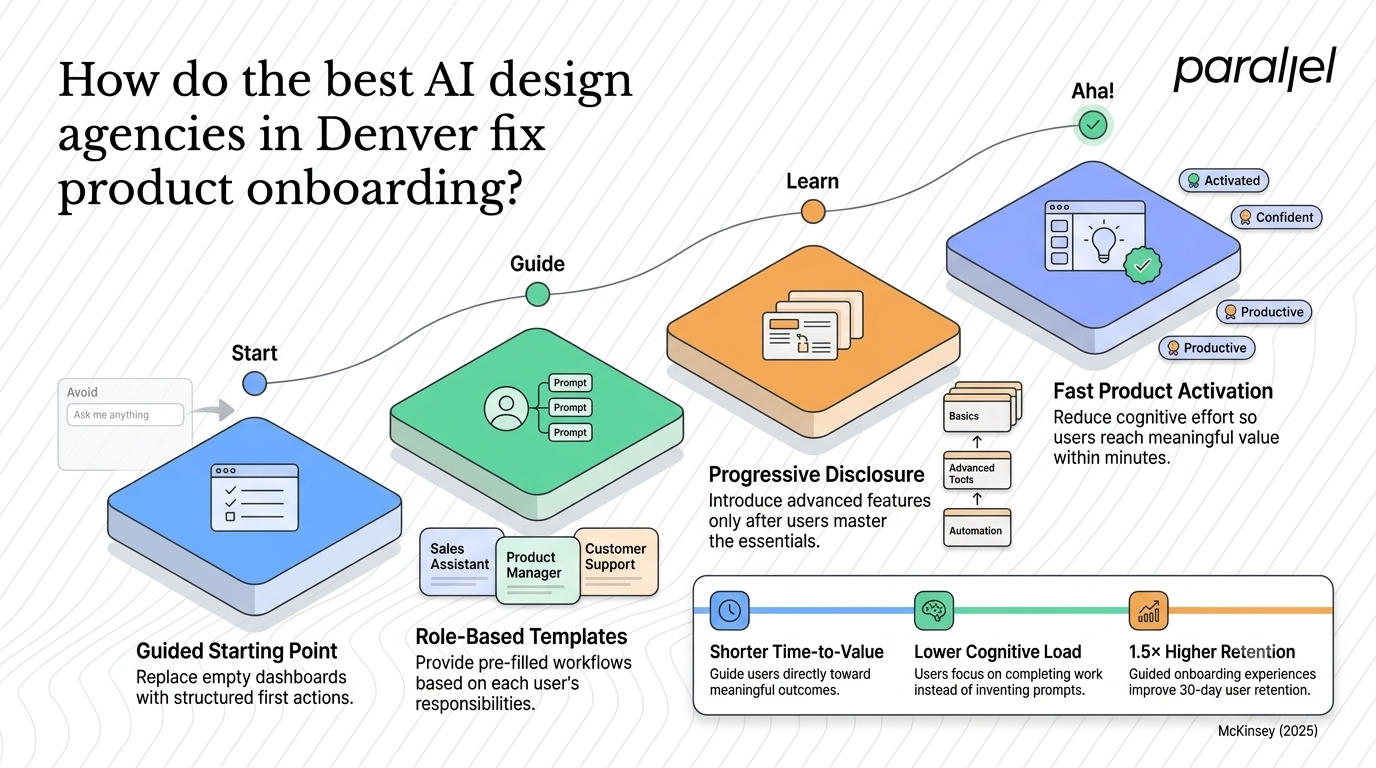
Good product thinking dictates that you must guide the user to their first "aha" moment within minutes. We spend a lot of time conducting SaaS onboarding teardowns because this critical window defines the entire customer lifecycle. The user should not have to learn prompt engineering to get value out of your software.
We approach this by designing structured starting points. Instead of an open chat box, we provide pre-filled prompt templates based on the user's role. We use progressive disclosure to introduce complex features only after the user has mastered the basics. This is a core pillar of our product design services. By removing the cognitive burden of figuring out what to do next, we drastically improve product activation.
What frameworks do the best AI design agencies in Denver actually use?
Agencies that rely entirely on traditional, months-long waterfall design processes are failing AI startups. The technology moves too fast for that. You cannot spend three months perfecting a mockup for an LLM feature, only to find out the model hallucinates wildly in production. According to Forrester's 2026 product strategy index, teams that validate AI opportunities before writing code reduce their time-to-market by up to 40%.
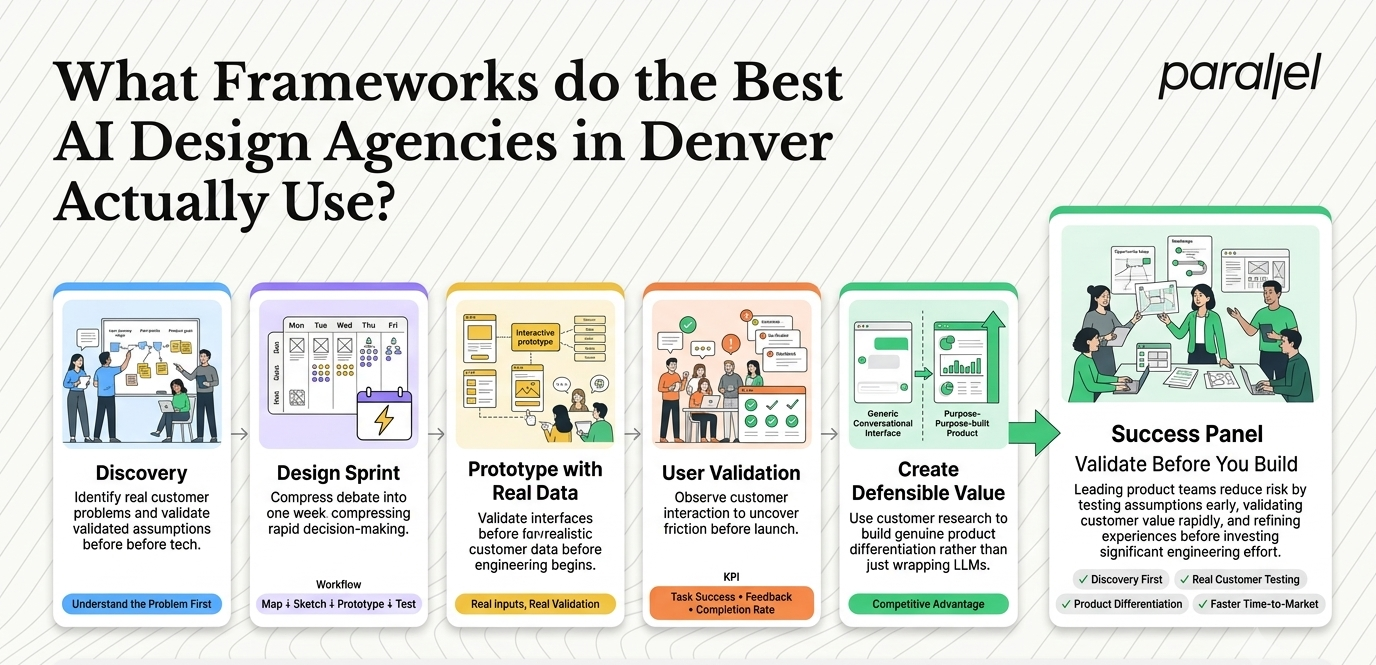
This is why we aggressively utilize the Design Sprint methodology. It forces clarity. In five days, we help teams unpack their assumptions, sketch solutions, and test a high-fidelity prototype with real users. We do not guess how users will react to an AI agent. We put a prototype in their hands on Friday and watch them try to use it.
This framework is incredibly effective for identifying what we call "AI wrappers." If your product is just a thin UI over ChatGPT, the design sprint will reveal that users do not see the unique value. We use opportunity mapping during these sprints to find areas where proprietary data and clever UX can create a defensible moat. Fast validation is the only way to build AI products safely.
Are the AI design agencies in Denver right for early-stage startups?
When researching the best AI design agencies in Denver, you will notice a divide. Many traditional agencies are built to service massive enterprises with endless budgets and infinite timelines. They sell heavily stylized presentations and dense strategy documents. For an early-stage founder, this is usually a massive waste of capital. Startups need speed, clear thinking, and executable design.
I constantly advise founders to avoid agency fluff. You do not need a fifty-page brand manifesto. You need an interface that converts. You need a partner who acts as an extension of your product team. We designed our product strategy consulting to be highly tactical. We embed with founders to challenge their assumptions and push for simpler solutions.
If your team lacks clarity on user behavior, bringing in an external partner is absolutely the right move. However, you must choose a team that has actually shipped software. Look for a portfolio of real product work, not just conceptual dribble shots. You need practitioners who understand the technical constraints of modern APIs and the realities of user attention spans.
Conclusion
Finding the best AI design agencies in Denver is not about who has the flashiest website or the most buzzwords in their pitch deck. It is about finding a team that thinks clearly about user behavior. AI is an incredibly powerful tool, but it is just a tool. It cannot fix a product that lacks a fundamental understanding of its customer's pain points.
We have spent years working with teams to strip away the unnecessary complexity from their interfaces. The most successful AI products we see are the ones that feel entirely ordinary to use. They do not demand attention. They simply solve the problem faster and more reliably than the old way. If you focus on that level of clarity, the design decisions become much easier.
Frequently asked questions
1) What makes the best AI design agencies in Denver different from traditional agencies?
Traditional agencies often focus primarily on visual aesthetics and brand positioning. The best agencies in this specific niche treat design as a strategic business function. They understand the technical constraints of large language models, the necessity of designing for trust, and how to mitigate AI hallucinations through interface guardrails. They focus on product mechanics, not just pixels.
2) How much should a startup budget for AI product design?
Budgets vary wildly based on scope. A rapid validation phase like a design sprint can range from $10,000 to $25,000. Full-scale product design engagements for a complex SaaS platform typically start around $50,000 and scale upward. It is crucial to define the scope strictly to an MVP (Minimum Viable Product) to avoid burning cash on unvalidated features.
3) How long does an AI design project typically take?
If you are running a tight, focused process, you can validate a core concept in one to two weeks. Designing a full, production-ready MVP usually takes between six to twelve weeks. The timeline depends heavily on how quickly your team can make decisions and whether you have existing user research to build upon. We always recommend starting with a short discovery phase to lock in the timeline.
4) Should we build our own AI model or use an existing API for our MVP?
In almost every case, early-stage startups should rely on existing APIs (like OpenAI, Anthropic, or specialized models) for their MVP. Building a proprietary model from scratch is incredibly expensive and slow. Your immediate goal is to validate the user experience and the business model. Focus your design efforts on how the user interacts with the data, not on training the underlying model.
5) How do you measure the success of an AI design engagement?
We do not measure success by how pretty the screens look. We measure it by product metrics. We look at activation rates (how many users complete the onboarding flow), task completion time (does the AI actually save them time), and retention (do they come back after the first week). A successful design directly moves these numbers in a positive direction.
6) Is our team ready to hire an external design partner?
You are ready if you have a clear understanding of the business problem you are trying to solve and the specific audience you are targeting. If you are still entirely unsure what your product is supposed to do, an agency will struggle to help you. You need a baseline hypothesis. Once you have that, a strong design partner can help you refine it, test it, and build it.
7) How does ParallelHQ approach AI product strategy?
We start by challenging the core assumption. We ask if AI is actually the best solution for the user's problem, or if a simple filter would do the job better. If AI is necessary, we use frameworks like opportunity mapping to define exactly where it adds value. We prioritize clarity, design for transparency, and test prototypes with real users before writing code.
8) What is the biggest mistake founders make with AI interfaces?
The single biggest mistake is the "blank canvas" approach. Founders often expose an open-ended chat interface and expect the user to know exactly what to type. This creates massive cognitive friction. Users do not want to learn how to prompt your system. The interface must provide structure, suggestions, and clear boundaries to guide the user toward a successful outcome.

check out these related blogs




























.avif)















































.webp)