I have seen early-stage startups burn months of runway building features that absolutely nobody wants. The root cause is almost always a lack of early validation. When founders approach me trying to fix their product direction, my advice is always the same: stop debating in meeting rooms and start testing with real people. If you are searching for what is a design sprint? process, agenda & outcomes are exactly what we will cover in this guide. It is a strict, five-day framework designed to answer critical business questions through rapid prototyping and user testing. Here is how we use it to build better products.
Quick answer
A design sprint is a structured five-day process used to solve complex problems, build prototypes, and validate ideas with real users. It minimizes risk, aligns cross-functional teams, and provides clear product direction before you write a single line of code.
Understanding what is a design sprint? process, agenda & outcomes
To fully grasp what is a design sprint? process, agenda & outcomes must be viewed not as a creative exercise, but as a risk mitigation strategy. Developed originally by Jake Knapp at Google Ventures, the sprint is a compilation of business strategy, innovation, behavior science, and design thinking.
We have run countless sprints at ParallelHQ, and the core value always remains the same. You are buying time. Instead of waiting months to launch a minimal viable product to see if an idea is good, you get clear data from a realistic prototype in just one week. You fast-forward into the future to see your finished product and the customer reactions to it.
This approach is critical for high-risk decisions. Whether you are validating a new market entry, fixing a broken onboarding flow, or pivoting your core offering, the sprint gives you evidence. According to Nielsen Norman Group, the foundation of good user experience is prioritizing evidence over opinions. The sprint forces your team to do exactly that.
Why do founders ask about design sprint?
Building the wrong thing is the most expensive mistake a startup can make. In 2026, capital is not as freely available as it once was. You cannot afford to spend six months in development only to launch to crickets.
When product leaders ask me about what is a design sprint? process, agenda & outcomes are usually secondary to their main concern. Their main concern is saving money and time. A 2026 product management report from Lyssna highlighted that discovering a fundamental flaw during a five-day sprint costs a mere fraction of what it costs after months of engineering.
Here is why this methodology is non-negotiable for serious product teams:
- Faster decision making: Sprints force a tight timeline. You cannot defer decisions to next quarter. You have to decide by Wednesday.
- Alignment across silos: You bring engineering, design, marketing, and the CEO into one room. Everyone hears the same user feedback on Friday.
- Early user validation: You test with real humans before you write production code.
- Bypassing endless debates: Teams often get stuck in endless debate cycles. The sprint replaces debate with a testable prototype.
I have seen teams completely change their product strategy based on a single Friday testing session. That is the power of early validation.
Where teams fail with design sprint?
I see many teams attempt to run sprints and fail miserably. They read a book, book a conference room, buy sticky notes, and end up with nothing but wasted time. When this happens, it is usually because they fundamentally misunderstood the core rules of the framework.
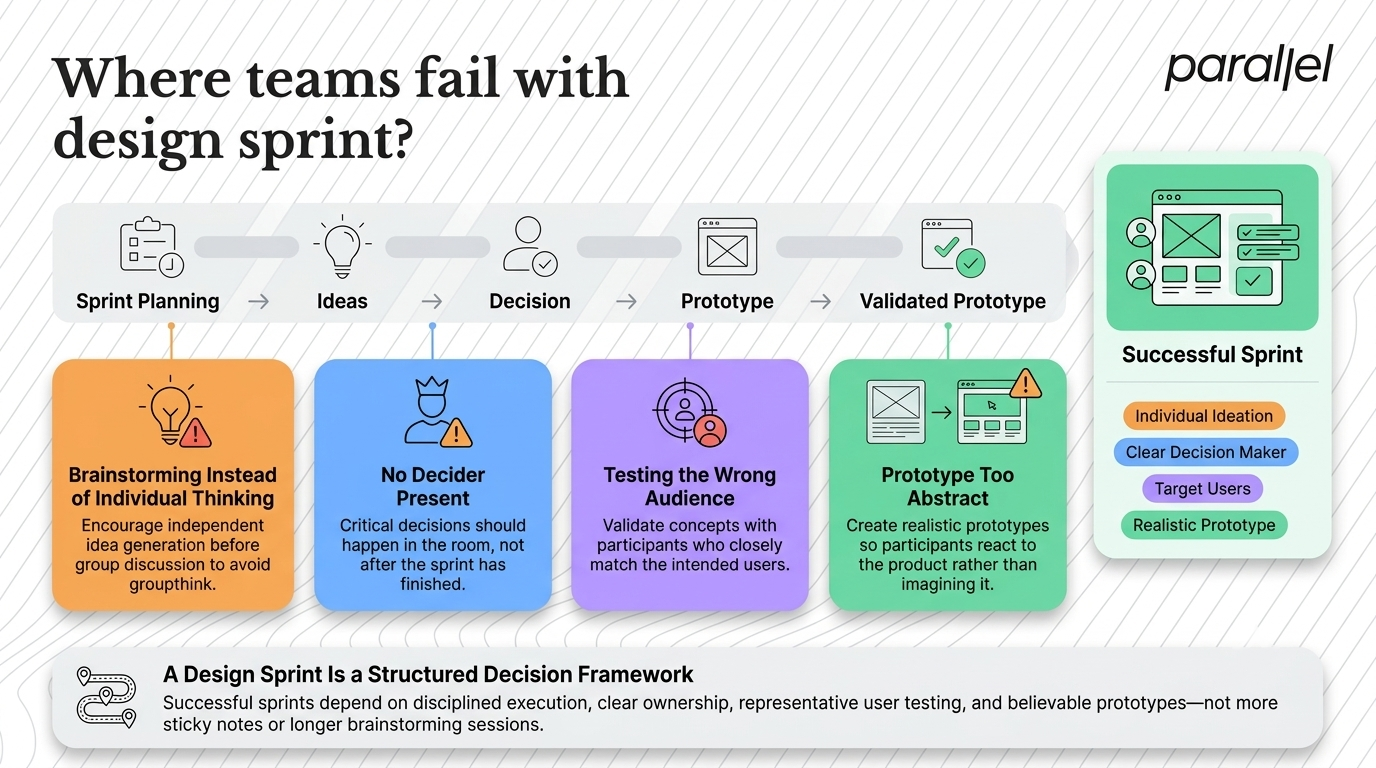
Here are the most common traps we see teams fall into.
1) Treating it like a brainstorming workshop
Brainstorming is largely ineffective. Loud voices dominate, and introverts with great ideas get drowned out. The sprint process relies on individual ideation. We work alone, together. You sketch your solutions individually, which prevents groupthink and surfaces truly diverse perspectives.
2) Proxy authority in the room
The sprint requires a Decider. This is usually the founder, CEO, or Head of Product. If the Decider is not in the room, the sprint is useless. I have seen teams make brilliant prototypes, only to have a stakeholder veto the entire concept on Monday morning because they lacked context. If the person who makes the final call cannot attend, do not run the sprint.
3) Testing with the wrong people
Your Friday test is only as good as your participants. If you are building a B2B SaaS product for financial auditors, you cannot test it with your friends or college students. You must recruit the exact target audience. It is hard work, but testing with 5 users who represent your actual market is the only way to get valid data.
4) Building a wireframe instead of a prototype
Users cannot react naturally to low-fidelity wireframes. If you show them a gray box and say to imagine it is a graph, they will start evaluating the design rather than reacting to the product. Your prototype needs a believable facade. It must look and feel like a real product to elicit genuine emotional reactions.
How to structure a design sprint?
The magic of the sprint lies in its strict, non-negotiable schedule. You cannot skip days, and you cannot blend activities. If you want to master what is a design sprint? process, agenda & outcomes, you must follow the five-day map exactly as intended.
Here is the breakdown of how we run design sprints with our startup partners.
Monday: Map the problem
Monday is about building a shared understanding. You start at the end by defining a long-term goal. Where do you want to be in one year? Then, you map out the challenge.
- Morning: Define the long-term goal and list out your biggest risks and assumptions.
- Afternoon: Ask the experts. Interview people across your company to gather context. Finally, pick a specific target on your map. You cannot solve everything. You must pick the most critical moment in the user journey.
Tuesday: Sketch solutions
Tuesday shifts from defining the problem to exploring solutions. We look at existing ideas to remix and improve, and then we sketch.
- Morning: Lightning demos. Review products from other industries that solve similar problems.
- Afternoon: The four-step sketch. This involves taking notes, drawing rough ideas, running a Crazy 8s exercise, and finally creating a detailed, anonymous solution sketch. No group brainstorming is allowed.
Wednesday: Decide and storyboard
By Wednesday morning, you have a stack of potential solutions. You cannot build all of them. You have to decide.
- Morning: The art critique. We review all sketches silently, vote on the best elements, and the Decider makes the final call on which direction to prototype.
- Afternoon: Storyboarding. You take the winning sketch and weave it into a step-by-step plan for your prototype. This storyboard is the exact blueprint your designers will follow on Thursday.
Thursday: Prototype a facade
Thursday is an intense day of execution. You have eight hours to build a realistic prototype.
- The mindset: You are not building a production-ready application. You are building a facade. Like a movie set, it only needs to look real from the front.
- The tools: We rely heavily on Figma for rapid, high-fidelity UI/UX design.
- The roles: Divide and conquer. You need Makers to build screens, a Stitcher to link them together, an Asset Collector to gather images, and an Interviewer to prepare for Friday.
Friday: Test and learn
Friday is the reason the sprint exists. You will interview five real users and watch them interact with your prototype.
- The setup: One interviewer is in the room with the user. The rest of the team watches a live stream in a separate room.
- The process: You ask the user to complete tasks and think out loud. You observe where they hesitate, where they succeed, and where they get completely lost.
- The synthesis: At the end of the day, you look for patterns. If four out of five users fail to understand your pricing page, you have a definitive answer.
Summary of the sprint week
Evaluating outcomes in the real world
Founders often assume that a successful sprint means the prototype works perfectly on Friday. This is incorrect. To properly evaluate the process, you have to realize that negative results are highly valuable.
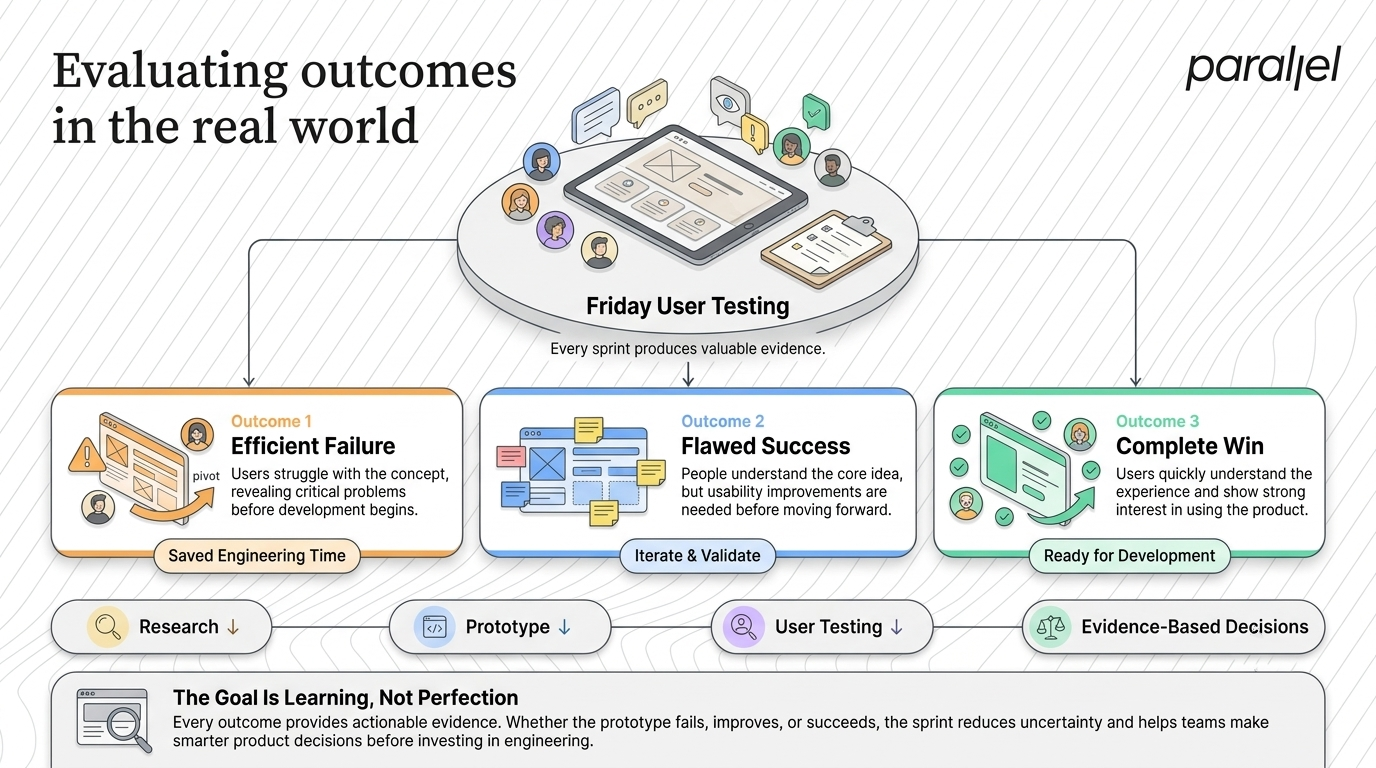
There are generally three outcomes at the end of a sprint week.
1) The efficient failure
Your prototype completely fails on Friday. Users hate it, they do not understand it, or it does not solve their problem. This feels terrible in the moment, but it is actually a massive victory. You just saved your company six months of engineering time and thousands of dollars in MVP development. You learned what not to do, and you can pivot immediately.
2) The flawed success
This is the most common outcome. Users understand the core concept and see value in it, but the execution is clumsy. They stumble on the navigation or get confused by the copy. This means you are on the right track. You simply need to take the insights from Friday, iterate on the design, and run a shorter validation test before handing it off to engineering.
3) The complete win
Users breeze through the prototype, understand the value proposition immediately, and ask when they can buy the product. This is rare, but when it happens, you have the ultimate green light. Your team can move into production with absolute confidence, armed with deep user research to back up their decisions.
We saw this exact dynamic play out when we worked on the Digilocker product experience. By mapping the complex journey of document access and testing rapid prototypes, we were able to cut through organizational assumptions and deliver a streamlined user journey grounded in actual citizen behavior.
How to prepare for a successful sprint
You cannot just walk into a room on Monday morning and expect magic to happen. A successful sprint requires meticulous preparation.
First, you need to define the challenge clearly. If your problem is too broad, the sprint will lack focus. If it is too narrow, a full five-day sprint might be overkill.
Second, you must do your homework. Bring existing research, SaaS metrics, and known constraints into the room. A sprint should not be spent rediscovering facts you already know. According to recent insights on innovation cycles from Forbes, teams that prepare adequate pre-sprint data can reduce their overall business-case creation time by up to 90 percent.
Finally, clear the calendars. A sprint requires deep work. You cannot have team members stepping out for sales calls or checking Slack every ten minutes. It is a full commitment from Monday to Friday. If you cannot commit the time, you are not ready for a sprint.
Conclusion
Building software is incredibly difficult, but deciding what to build should not be a guessing game. The design sprint provides a predictable, repeatable framework for extracting the best ideas from your team and crashing them against reality. It removes ego from the product design process and replaces it with evidence.
If your team is arguing in circles about a new feature, or if you are staring down a massive product pivot with zero user data, stop talking. Book a room, clear your schedules, and run a sprint. The clarity you gain on Friday afternoon will change the way you build products forever.
Frequently Asked Questions
1) How do you define a design sprint? process, agenda & outcomes considered?
A design sprint is a five-day process that uses design thinking to reduce the risk of bringing a new product or feature to market. The process involves mapping the problem, sketching solutions, deciding on a direction, building a prototype, and validating the idea through user feedback.
2) How do you facilitate a remote design sprint?
Remote sprints require excellent digital tools and stricter time management. We use infinite canvas tools like Miro for the map and sketches, and Figma for prototyping. The key is to keep video sessions short and allow for plenty of offline, deep-work time for sketching and reviewing.
3) Design sprint versus agile sprint: what is the difference?
An agile sprint is a set period (usually two weeks) where engineers build and ship functional code. A design sprint is a five-day exercise to figure out what that code should actually be. You run a design sprint to validate the concept before you feed it into your agile development sprints.
4) Is a design sprint right for my early-stage startup?
Yes, especially if you have limited runway. Early-stage startups cannot afford to build products nobody wants. Sprints are perfect for validating your initial value proposition, testing your first onboarding flow, or deciding between two major product directions before seeking funding.
5) How does ParallelHQ approach what is a design sprint? process, agenda & outcomes?
We approach it with a strict focus on business outcomes. We do not run sprints for the sake of creative theater. We act as objective facilitators, bringing our deep expertise in SaaS and AI product design to help your team cut through noise, prototype rapidly, and get honest answers from real users.
6) What happens if the prototype fails the user test?
You celebrate. A failed prototype on a Friday means you saved months of development time and capital. You take the specific learnings about why it failed, adjust your assumptions, and decide whether to pivot your strategy or run a modified, shorter sprint to test a new direction.
7) Who needs to be in the sprint room?
Keep the team small, ideally 5 to 7 people. You absolutely need the Decider (usually the founder or PM). You also need diverse perspectives: a designer, an engineer, a marketing expert, and someone who talks to customers daily (like sales or customer support).
8) Does design sprint apply to AI products?
Absolutely. In fact, it is critical. AI products often suffer from trust issues and complex user interfaces. Running a sprint allows you to test how users react to AI suggestions, how much control they need, and whether the AI capabilities actually solve a real problem before you invest heavily in engineering.

check out these related blogs
































.avif)