Finding the right startup web design agency is one of the highest stakes decisions early-stage founders make. I have seen this scenario play out countless times across my career. You build a great product. You hire a firm to design the website. They deliver something visually stunning. Yet, your bounce rate increases and your user activation drops. This happens because teams often prioritize trendy visuals over clear thinking and real user behavior. I built ParallelHQ because I knew design decisions needed to be simpler, clearer, and grounded in reality. This guide will show you how to think better about web design and choose the right partner in 2026.
Quick answer (TL;DR)
The best startup web design agency combines product strategy with deep usability research. They focus on clear messaging and high activation rates rather than just delivering cinematic visuals.
Here is a quick comparison of the top 10 firms for early-stage tech companies.
What makes a website truly work for early-stage startups?
I have spent years working with founders, product managers, and design leaders. I constantly see teams overcomplicate their digital presence. A website for a startup is not a static digital brochure. It is an active product vehicle. It must convert curiosity into measurable action.
The financial impact of getting this right is massive. According to 2026 UX ROI statistics compiled by Searchlab and Forrester, every single dollar invested in user experience returns roughly one hundred dollars in business value. Companies that prioritize mature design practices see significantly higher revenue growth. A widely cited 2025 McKinsey report showed design-led companies outpacing their industry peers by 32 percent in total revenue.
Despite this clear mandate for good design, the average e-commerce and SaaS conversion rate hovers around a mere 2.91 percent in 2025. Why is it so incredibly low? Visitors are overwhelmed by noise. Google research notes that 88.5 percent of users will leave a site and never return after a bad digital experience. If your site takes too long to load, uses confusing jargon, or hides the core value proposition, the user simply leaves. The ultimate goal of your digital presence is absolute clarity. You can read more about how we quantify this in our breakdown of the ROI of UX.
Why does hiring a startup web design agency usually fail?
In my experience, this is exactly where most product decisions go wrong. Startups hire an external team and give them a vague brief. The external team then designs for their own portfolio rather than the end user.
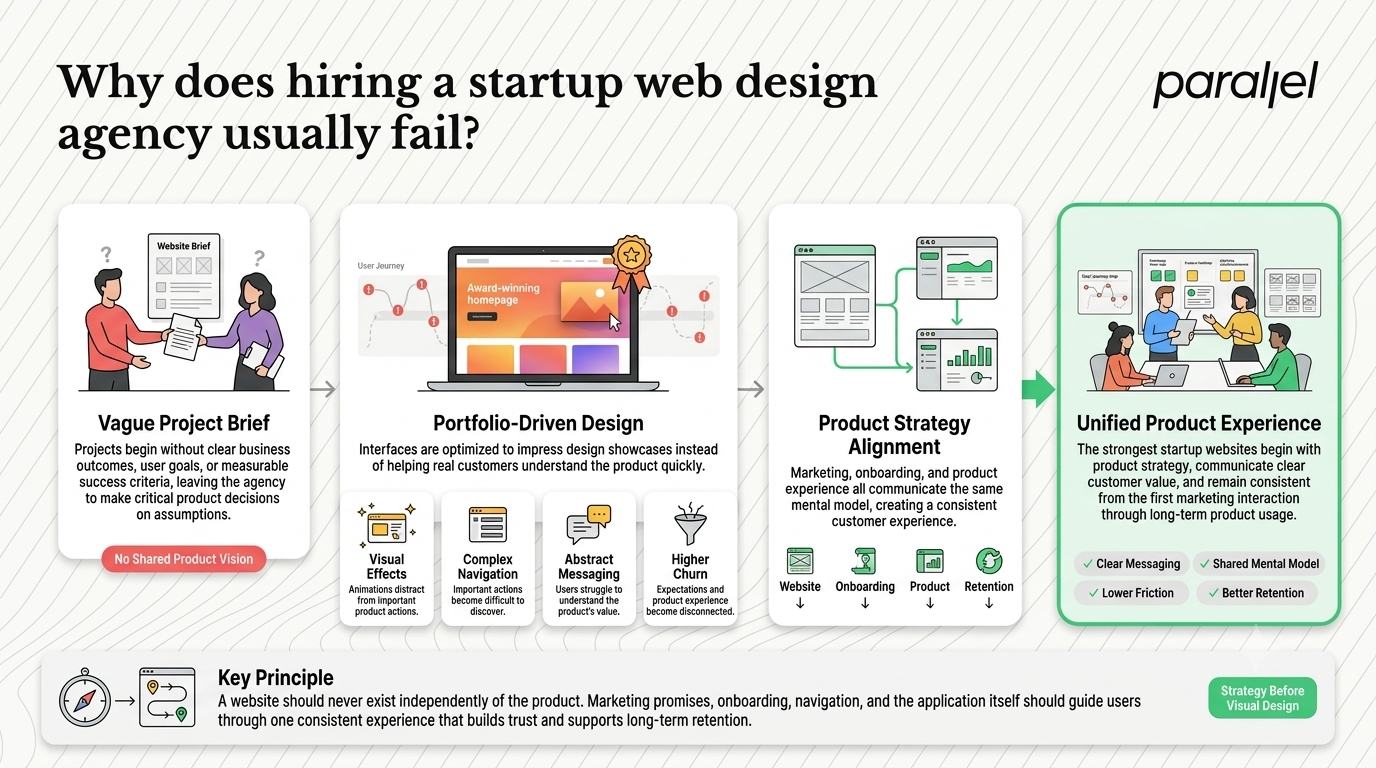
They add heavy scroll animations. They hide primary navigation behind complex, unintuitive menus. They use abstract marketing language instead of clear product descriptions. These choices might look fantastic on a global design award website. However, they perform terribly for real users trying to understand how a new software product actually works.
Teams fail when they divorce web design from product strategy. Your marketing site and your core application must share the exact same mental model. If the website promises a simple, frictionless experience but the actual product is highly complex, users will churn immediately. You need a partner who understands both ends of that funnel. This is why we heavily prioritize deep product strategy consulting before we ever begin pushing pixels.
How the AI shift is changing web design in 2026
Over the last year, artificial intelligence has fundamentally altered how digital products operate. We are moving rapidly past simple chatbots. The focus now is on Agentic Experience design. According to the 2026 AX Maturity Model framework, the best interfaces no longer wait for manual user input. They anticipate needs dynamically.
However, many startups make a critical error during this transition. They attempt to bolt AI features onto a fundamentally poor user interface. A messy website does not become effective just because you add an intelligent search bar. Foundational usability laws still apply. You cannot ignore Hick's Law, which dictates that too many choices will paralyze your users. You must fix your core information architecture before layering complex intelligence on top of it. If you are building an AI-native product, you have to approach the interface with intense discipline. We help teams navigate this specific challenge through our AI UX design services.
Who are the top 10 design partners for tech startups in 2026?
Let us break down the current landscape. I have reviewed and analyzed the top players in the digital design industry. Here is exactly how they stack up for early-stage teams.
1) ParallelHQ
At ParallelHQ, we have built our startup web design agency model differently. We do not believe in surface-level aesthetics that fail to convert. We focus entirely on clarity in product thinking. We work closely with early-stage teams to simplify highly complex product decisions. Our approach is deeply grounded in real user data, rapid validation, and measurable business outcomes.
- The background: We are a specialized product design and strategy partner. We act as a direct extension of your founding team.
- Core philosophy: Design decisions should be simple, clear, and grounded in observable user behavior.
- Where teams go wrong: Startups often waste months arguing over subjective design opinions. We eliminate this friction by running structured design sprints to test ideas with real users quickly.
- Ideal startup stage: Pre-seed to Series B founders who need actionable product thinking and high-converting UI/UX design services.
- Next steps: If your product is suffering from low activation, start with our rapid UX audit to identify the immediate roadblocks.
2) MetaLab
While MetaLab is not strictly a startup web design agency, their premium product work heavily influences how many founders think about design. They designed the early interfaces for massive utility tools like Slack and Coinbase. Their execution is undeniably top-tier in the industry.
- The background: A highly renowned global digital product agency known for crafting beautiful, intuitive software interfaces.
- Core philosophy: Highly polished, premium digital product design that feels instantly recognizable.
- Where teams go wrong: Founders often want MetaLab-level polish on day one. Before finding true product-market fit, you need rapid iteration. Pixel-perfect finality comes much later in the product lifecycle.
- Ideal startup stage: Series B to enterprise companies with massive budgets and firmly established core products.
- Alternative perspective: See how our rapid validation approach compares in our MetaLab alternative guide.
3) Clay
Clay is a San Francisco-based agency famous for stunning UI and meticulous micro-interactions. They heavily utilize 3D graphics, WebGL, and highly cinematic scroll effects.
- The background: A premier UI/UX agency that blends high-tech aesthetics with modern brand storytelling.
- Core philosophy: Cinematic digital storytelling designed to position brands at the absolute cutting edge of technology.
- Where teams go wrong: Heavy animation can completely destroy usability. If your audience needs to find technical SaaS documentation quickly, cinematic scrolling will simply frustrate them.
- Ideal startup stage: Series A and beyond, particularly AI and Web3 startups needing to establish immense technical trust.
- Alternative perspective: Read our thoughts on balancing aesthetics with utility in this Clay alternative breakdown.
4) Ramotion
Many early-stage startups struggle with deeply fragmented identities. Ramotion specializes in fixing this exact problem by seamlessly bridging brand identity and digital user interface design.
- The background: A boutique digital product agency focusing on brand identity, UI/UX design, and web development for growing tech companies.
- Core philosophy: Cohesive, scalable branding merged seamlessly with highly functional digital execution.
- Where teams go wrong: Startups often attempt full, expensive rebrands entirely too early. You should wait until your product direction is fully validated before investing in a massive identity shift.
- Ideal startup stage: Seed to Series B startups that need their public web presence to finally match a maturing core product.
- Alternative perspective: Explore how we handle holistic product growth in our Ramotion alternative analysis.
5) IDEO
IDEO is the organization that famously pioneered human-centered design. They are a legacy global innovation firm. Their deep research methodologies are heavily documented and highly respected worldwide.
- The background: A global design and innovation company that uses design thinking to solve complex systemic challenges.
- Core philosophy: Deep ethnographic research, intense empathy mapping, and broad macro-systems thinking.
- Where teams go wrong: IDEO is brilliant for solving massive, ambiguous global problems. They are generally too slow and far too expensive for a lean software startup simply needing a website redesign to boost conversions.
- Ideal startup stage: Well-funded enterprise organizations tackling complex integrations of physical products and digital services.
- Alternative perspective: Review our framework for moving faster in our IDEO alternative guide.
6) Work & Co
Work & Co focuses almost entirely on core digital products rather than standard marketing campaigns. They build the actual digital utilities that drive massive business revenue for their clients.
- The background: A premier technology and design partner known for building highly utilized everyday digital products.
- Core philosophy: Fast technical prototyping and continuous, rigorous testing of digital applications.
- Where teams go wrong: Their engagements are massive in scale. Early-stage teams rarely have the organizational structure, budget, or internal engineering bandwidth to properly support a Work & Co engagement.
- Ideal startup stage: Late-stage Series C startups and enterprise brands needing incredibly robust digital utilities.
- Alternative perspective: Read our Work & Co alternative comparison to see how leaner teams should operate.
7) Huge
Huge is a massive global agency known for large-scale digital transformation and enormous brand campaigns. They have offices worldwide and routinely handle massive corporate accounts.
- The background: An experienced design and digital marketing agency operating on a massive global scale.
- Core philosophy: Data-driven corporate marketing merged seamlessly with large-scale digital brand experiences.
- Where teams go wrong: Lean startups often get completely lost in the shuffle at massive global agencies. You may end up working directly with junior teams while paying premium, top-tier agency rates.
- Ideal startup stage: Fortune 500 companies executing highly complex global marketing initiatives.
- Alternative perspective: See how a specialized boutique approach benefits founders in our Huge alternative page.
8) Ustwo
Ustwo is famous in the industry for creating the critically acclaimed game Monument Valley. They bring a highly playful, deeply engaging, and visually distinct approach to digital product design.
- The background: A global digital product studio focused on creating meaningful, highly engaging digital experiences.
- Core philosophy: Joyful, highly interactive, and deeply user-centric digital environments.
- Where teams go wrong: Not every digital product needs to be playful. A healthcare compliance tool needs absolute clarity, speed, and trust, not gamification.
- Ideal startup stage: Consumer startups and digital health platforms that rely heavily on daily user habit formation.
- Alternative perspective: Check out our Ustwo alternative insights on when to prioritize utility over playfulness.
9) Instrument
Instrument excels at brand-led digital experiences. They are master storytellers who build deeply immersive, narrative-driven websites for massive brands.
- The background: A multidisciplinary creative agency that redefines brands and digital experiences.
- Core philosophy: Fusing high-level brand storytelling with premium digital product execution.
- Where teams go wrong: Storytelling is excellent, but users ultimately visit your software site to solve a specific problem. If a heavy narrative gets in the way of utility, your conversion rates will drop.
- Ideal startup stage: Consumer lifestyle brands and heavily funded tech companies needing immediate brand elevation.
- Alternative perspective: Explore our Instrument alternative guide for a more utility-focused approach.
10) Code and Theory
This firm brings an incredibly strong engineering and data-driven approach to their design work. They excel at managing and structuring highly complex content ecosystems.
- The background: A digital-first creative agency focusing heavily on the intersection of engineering and design.
- Core philosophy: Equal, rigorous emphasis on creative design and robust, scalable technical architecture.
- Where teams go wrong: Over-engineering your early technology stack can quickly trap you in technical debt. You should keep things as lightweight as possible until the user scale genuinely demands otherwise.
- Ideal startup stage: Media publishers and enterprise platforms with massive, complex content requirements.
- Alternative perspective: Read our Code and Theory alternative breakdown.
How do you evaluate your next startup web design agency?
When you speak to a prospective startup web design agency, you must look far beyond their visual portfolio. Beautiful case studies are merely a baseline requirement in this industry. You need to uncover how they actually think, operate, and solve real business problems.
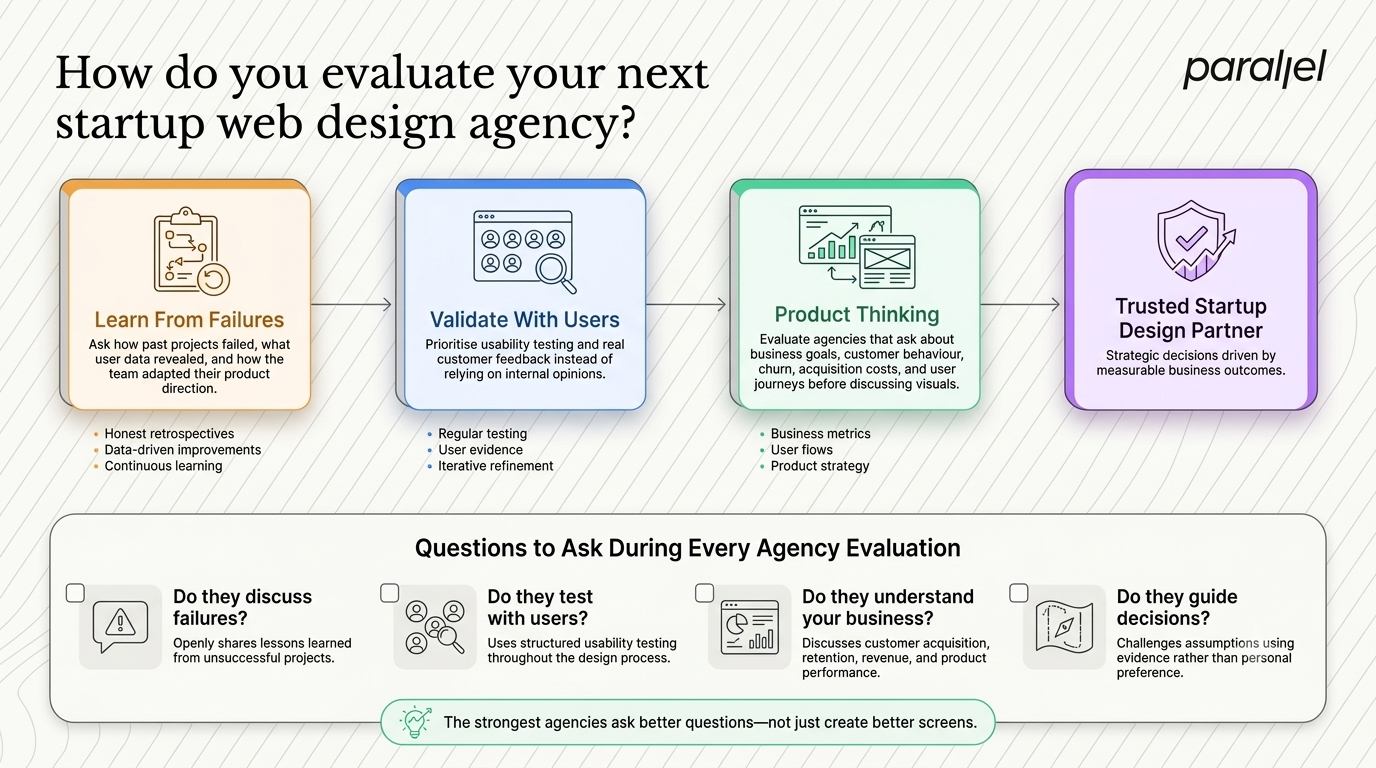
Look for these specific behavioral signals during your evaluation.
- Ask deeply about their failures. A mature design leader will openly discuss past projects that completely missed the mark. They will explain exactly what user data proved them wrong and how they pivoted the product direction. If a firm claims every single project was a flawless success, they are clearly not tracking real performance metrics.
- Interrogate their testing process. Do they rely on internal subjective opinions or external user validation? The Nielsen Norman Group has long established that testing with just five distinct users uncovers 85 percent of core usability issues. If your partner does not seamlessly integrate usability testing into their weekly workflow, you should walk away immediately.
- Evaluate their core product thinking. Does the firm actively ask about your business model? Do they want to know your current churn rate, your customer acquisition cost, and your primary user flows? If they only ask about color preferences, typography, and mood boards, they will not drive real product growth. Look for a partner who can provide genuine SaaS design services focused on metrics.
Conclusion
Building a valuable tech product is hard enough on its own. Communicating its exact value to the world should not be a massive roadblock. The absolute best design decisions always feel obvious in hindsight. They remove unnecessary friction. They guide the user completely naturally from point A to point B. They focus entirely on solving a specific, defined problem.
Ultimately, your startup web design agency should act as a seamless extension of your founding team. They should aggressively challenge your internal assumptions, test their own design hypotheses, and care just as much about your core conversion metrics as they do about aesthetic polish. Always choose a partner who values clarity over complexity.
Frequently asked questions
1) What does a startup web design agency actually do?
A dedicated firm goes far beyond simply coding a visual layout. They deeply analyze your target audience, define user journeys, structure your complex information architecture, and create interfaces specifically designed to maximize product activation. They actively bridge the critical gap between top-of-funnel marketing and your core software application.
2) How much should early-stage teams budget for web design?
Budgets vary wildly based on expected scope and regional location. A basic template customization might cost a few thousand dollars. However, a comprehensive strategy, deep research, and custom digital product design engagement can range from twenty thousand to well over one hundred thousand dollars. You must focus on the expected return on investment rather than just the initial sticker price.
3) How long does a website redesign typically take?
In my direct experience, a highly focused redesign takes between six and twelve weeks. If a project timeline stretches beyond three months for an early-stage company, the scope is likely far too bloated. Rapid execution allows you to launch faster and gather real behavioral data sooner.
4) What is the difference between a marketing firm and a product design partner?
Marketing firms focus heavily on top-of-funnel metrics like total traffic, ad clicks, and general brand awareness. Product design partners focus obsessively on core user behavior, time-to-activation rates, and long-term customer retention. We frequently help fast-growing teams align these two distinct functions through targeted product strategy consulting.
5) How do you clearly measure the ROI of web design?
You measure it strictly through observable behavioral changes. Look closely at bounce rates, time to activation, and core conversion percentages. You can also measure the direct reduction in customer support tickets. When an interface is genuinely intuitive, users require significantly less hand-holding. If you are struggling with low B2B conversions, reviewing our B2B CRO suggestions is a great starting point.
6) When is the exact right time to hire an external design team?
You should hire externally when your internal team is moving entirely too slowly or when you recognize a severe, unexplained gap in user retention. If your actual software product works incredibly well but your website consistently fails to explain it to new prospects, an external perspective is highly valuable.
7) What makes a modern website truly accessible?
Accessibility means intentionally designing for all users, including those with varying disabilities. This involves ensuring proper color contrast ratios, establishing screen reader compatibility, and allowing full keyboard navigation. With the strict 2025 European Accessibility Act now in effect, ignoring digital accessibility introduces massive legal and business risks. We highly recommend conducting a routine accessibility audit to ensure full compliance.
8) Is ParallelHQ the right partner for my specific startup?
We partner best with founders and product leaders who deeply value speed, behavioral data, and clear communication. If you simply want a flashy, cinematic website to win agency design awards, we are definitely not the right fit for you. If you want to simplify your complex product experience and drastically increase user activation, we should talk. We handle projects globally, whether you need website design services in San Francisco or specialized product design services in London.

check out these related blogs





































.webp)