The era of simply wrapping a traditional interface around a large language model is over. Over the past few years, I have watched countless early-stage teams struggle to move beyond the basic chat box. The reality is that non-deterministic user experiences require a completely different approach to product thinking. If you are a founder searching for the best AI design agencies in San Francisco, you need partners who understand probability, trust, and clarity. It is not just about visual polish. It is about grounding complex technology in real user behavior. Here is how we think about the current landscape and the teams doing it right.
Quick Answer
Here is a quick comparison of the top 10 best AI design agencies in San Francisco to help you make an informed decision for your next product cycle.
Why are the best AI design agencies in San Francisco rethinking product design?
AI changes the fundamental rules of product design. We are moving away from deterministic flows where a user clicks a button and gets a predictable result. We are entering an era of probabilistic flows where users ask open-ended questions and receive generated, variable responses. This shift breaks traditional UX patterns.
The data backing this up is sobering. According to MIT's 2025 Project NANDA report, a staggering 95% of organizations deploying generative AI saw zero measurable return on their investments. Furthermore, Gartner forecasts that 30% of generative AI projects will be abandoned completely after the proof-of-concept phase.
In my experience, this massive failure rate is rarely a technology problem. It is a design and product problem. Teams fail to design for user trust.
Recent 2026 research from the Nielsen Norman Group on AI UX highlights that adaptive interfaces and AI features only succeed when users trust the system's output. Trust calibration is now a primary UX metric. If an AI agent suggests a major change to a user's workflow or financial plan, the user absolutely needs to see the reasoning behind it.
We have seen teams overcomplicate the onboarding experience for new AI tools, assuming users want to learn advanced prompt engineering. They usually do not. Users want clear guardrails, visible confidence levels, and intuitive recovery paths when the AI inevitably gets something wrong. Designing for these moments of friction is what separates a mature product from a fragile prototype.
Who are the top 10 best AI design agencies in San Francisco right now?
Here is my breakdown of the top 10 players operating in the Bay Area today. Each brings a distinct philosophy to solving complex product challenges.
1) ParallelHQ
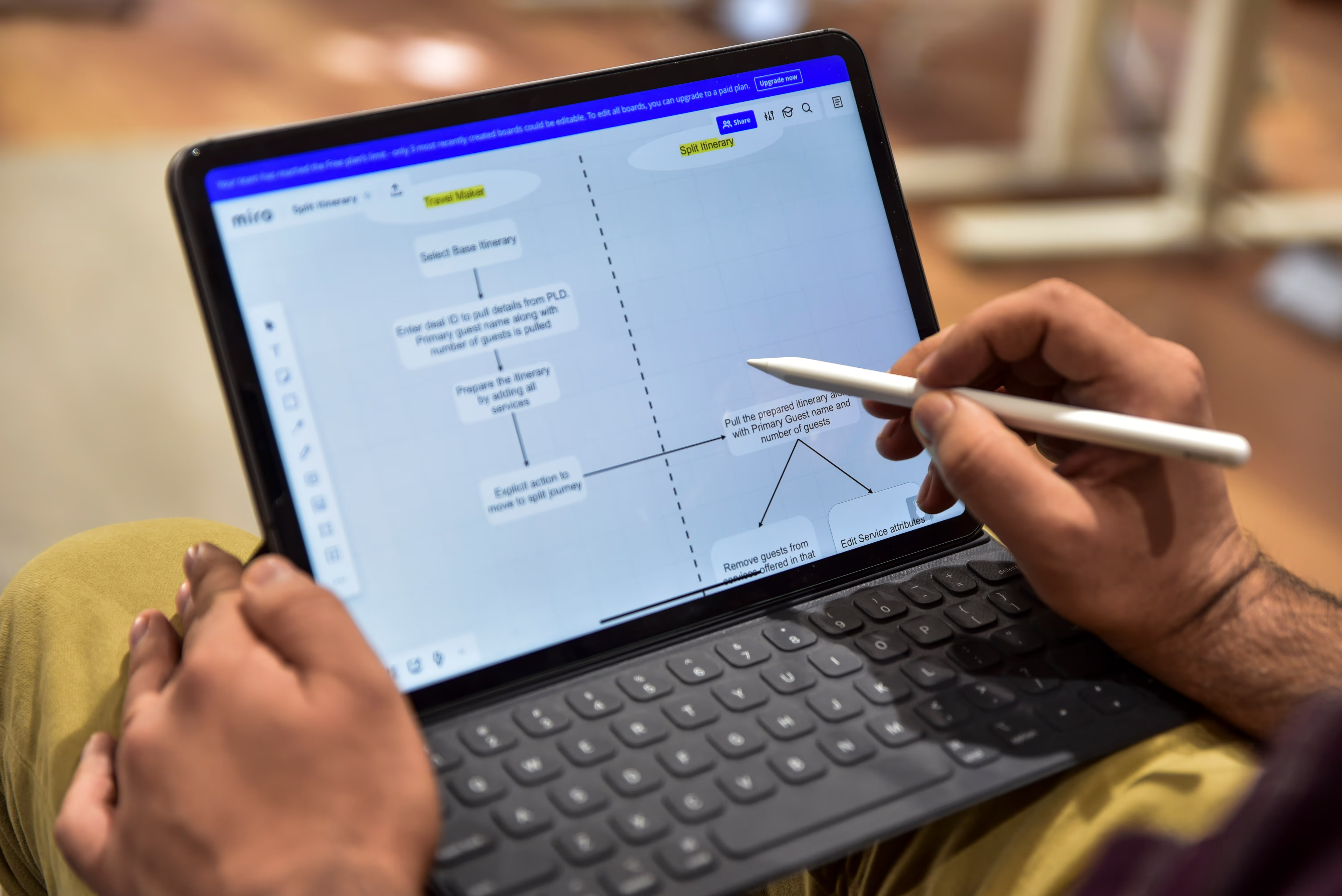
At ParallelHQ, we focus on absolute clarity in product thinking. I built this company because I saw too many startup teams struggling with design decisions that should have been much simpler and far more grounded in real user behavior. We do not do agency fluff. We work closely with founders and product managers to map out complex AI software design services and simplify them into clear, usable experiences.
Our approach revolves around understanding the core problem before painting any screens. We frequently utilize intensive design sprints to break down ambiguous AI concepts into testable prototypes within days. This focus on grounded product strategy and rapid validation is exactly why we rank among the best AI design agencies in San Francisco for early-stage teams and fast-moving scale-ups. We care about what works for your users, not what looks trendy on a portfolio site.
- Best for: Founders and PMs needing clear, actionable product thinking.
- Core services: UI/UX Design, Product Strategy Consulting, UX Audit, AI UX Design.
2) Clay
Clay has established a massive reputation in the Bay Area for pushing the absolute boundaries of visual and interaction design. They are the agency teams call when a product needs to feel like a premium, futuristic experience.
When it comes to AI, Clay excels at the micro-interactions. They design the subtle animations, the spatial transitions, and the visual feedback loops that make interacting with an LLM feel less like typing into a terminal and more like engaging with a polished digital assistant. If your startup is well-funded and requires a world-class, highly differentiated visual identity to stand out in a crowded AI market, they are a formidable choice.
- Best for: High-growth startups needing premium aesthetics and distinct interaction design.
- Alternative reading: Clay Alternative.
3) IDEO
IDEO remains a heavyweight institution in the design world. Their San Francisco office practically invented human-centered design as we know it today. While they typically handle massive, multi-year transformations for global enterprises, their methodology is highly relevant to AI.
IDEO leans heavily into deep ethnographic user research. This qualitative depth is invaluable when navigating the ambiguous ethical and practical use cases of AI in everyday life. They are less focused on shipping rapid SaaS updates and more focused on uncovering how human beings will fundamentally interact with intelligent systems over the next decade.
- Best for: Enterprises looking for fundamental innovation and deep service design.
- Alternative reading: IDEO Alternative.
4) Neuron
Neuron focuses their expertise heavily on B2B software and complex SaaS platforms. The consumer AI space gets a lot of attention, but the enterprise AI space is where the most complex UX problems live.
Neuron is highly technical. They understand the nuances of dashboard architecture, dense data visualization, and complicated enterprise permission structures. When you are injecting AI into a workflow used by data scientists or financial analysts, the design cannot just be sleek. It must be highly functional and strictly accurate. Neuron excels at building SaaS design services that handle massive data outputs without overwhelming the end user.
- Best for: B2B companies with highly technical user bases and complex workflows.
- Alternative reading: Neuron Alternative.
5) Frog Design
Frog brings decades of specific experience blending hardware and software into cohesive ecosystems. As AI moves beyond the browser and into physical devices, spatial computing, and ambient environments, Frog's systems thinking approach provides a massive advantage.
They look at the entire physical and digital environment of the user. If you are building an AI product that interfaces with IoT sensors, smart home devices, or industrial hardware, you need a partner who understands industrial design as deeply as they understand software interfaces. Frog has the scale and history to manage these complex deployments.
- Best for: Companies building connected AI devices and ambient computing ecosystems.
- Alternative reading: Frog Design Alternative.
6) R/GA
R/GA sits uniquely at the intersection of product design, technology, and high-level marketing. They do not just build digital products. They build products that serve as powerful growth engines for global brands.
In the AI space, R/GA is highly effective at consumer-facing applications where user acquisition and brand perception are critical. They understand how to weave generative AI tools into campaign-driven digital products that capture public attention. If your AI tool needs to double as a massive marketing asset, their integrated approach is very hard to beat.
- Best for: B2C AI products needing strong market positioning and brand integration.
- Alternative reading: R/GA Alternative.
7) Work & Co
Work & Co is famous for their rapid prototyping and engineering-led design process. They are fundamentally opposed to delivering static design files and walking away. They build, test, and ship functional products.
This is a critical advantage for AI products. You simply cannot test a dynamic LLM response accurately in a static Figma file. You have to build it in code and test it with real inputs to see where the experience breaks. Work & Co's ability to prototype with live data makes them an excellent partner for major brands needing to move an AI concept from a boardroom deck into the real world quickly.
- Best for: Brands needing to prototype in code and launch functional V1s quickly.
- Alternative reading: Work & Co Alternative.
8) Instrument
Instrument creates highly engaging digital experiences and storytelling platforms. They are digital storytellers at their core. This skill set is surprisingly vital when introducing entirely new tech paradigms to hesitant mainstream consumers.
People are often intimidated by AI. They worry about privacy, job displacement, and data security. Instrument excels at breaking down these complex, intimidating technologies into approachable, human-centric website design services. They build the educational layers and onboarding experiences that help skeptical users feel comfortable adopting new tools.
- Best for: Products requiring heavy user education, onboarding, and engagement.
- Alternative reading: Instrument Alternative.
9) Huge
Huge leverages vast amounts of data to craft massive omnichannel experiences. Their ability to analyze user behavior at scale makes them a strong partner for optimizing complex AI recommendation engines and personalization algorithms.
If you are a large retailer or media company, your AI strategy likely relies on serving the right content to the right user at the exact right moment. Huge has the analytical depth to measure these micro-interactions and continuously refine the user journey. They treat design as an ongoing optimization exercise driven by hard metrics.
- Best for: Large organizations needing to optimize complex, data-heavy user journeys.
- Alternative reading: Huge Alternative.
10) Method
Method takes a highly strategic approach to product evolution and legacy modernization. They look at the entire lifecycle of a business and help companies adapt their older, rigid systems into modern platforms.
Many established companies have decades of valuable proprietary data but terrible legacy interfaces. Method helps these organizations unlock their data by wrapping it in modern, AI-powered workflows. They are experts at navigating the internal politics and technical debt required to bring an older company into the modern AI era safely and effectively.
- Best for: Legacy companies transitioning to AI-first operational models.
- Alternative reading: Method Alternative.
Where do teams go wrong with AI user experiences?
In my experience, this is where most product decisions go completely off the rails. Teams treat artificial intelligence as a magic feature to be bolted onto an existing product, rather than a fundamental shift in how the user interacts with the system. We see the same three mistakes repeatedly.
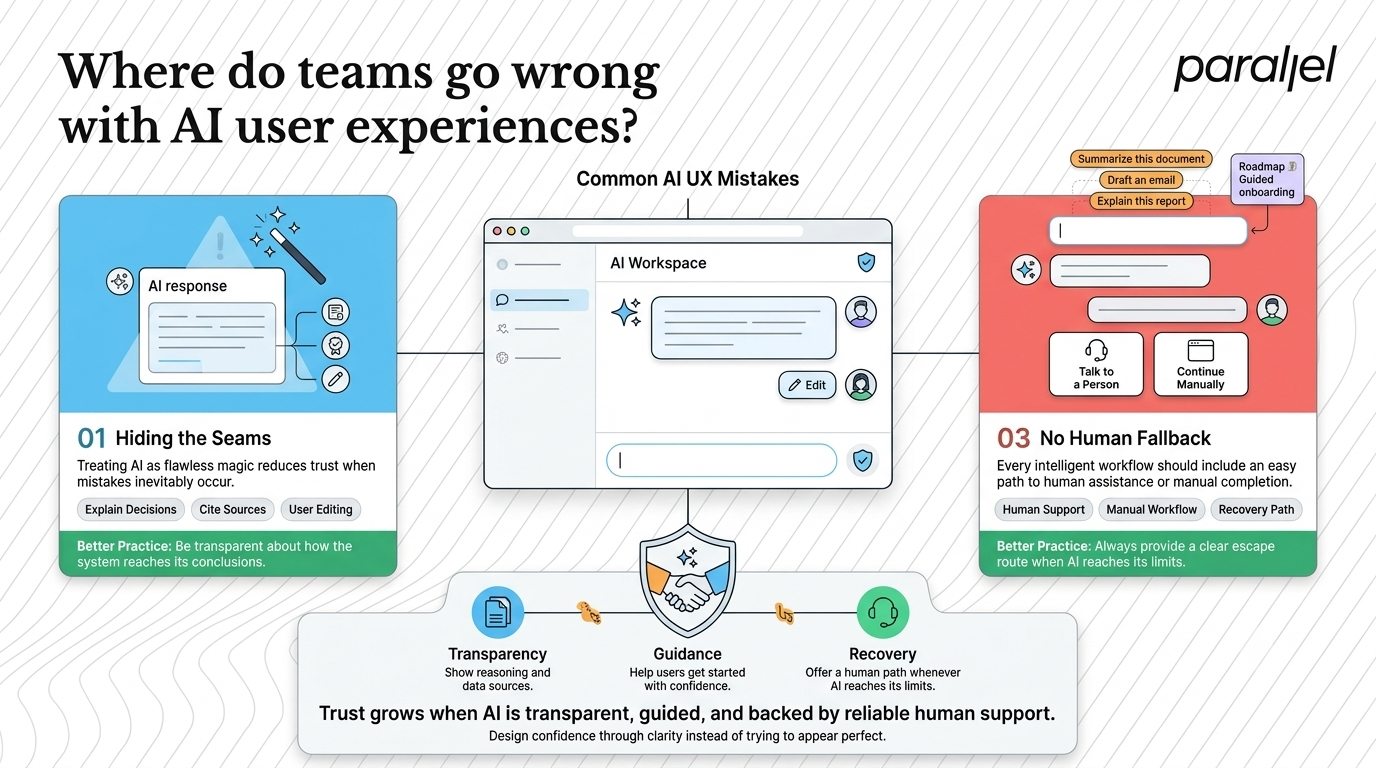
1) Hiding the seams of the system
Many designers try to make AI feel like flawless magic. They hide the processing time, obscure the data sources, and present the output as absolute truth. This is a massive mistake. When the AI inevitably hallucinates or makes a bad recommendation, the user feels betrayed. The best products expose their seams. They show their work, cite their sources clearly, and give users total control over editing the final output. Transparency builds trust much faster than fake perfection.
2) Ignoring the empty state paralysis
A blank chatbot UX design interface is incredibly intimidating for a new user. They stare at a blinking cursor and have no idea what they are allowed to ask or what the system is actually capable of doing. You have to guide them actively. Provide contextual starter prompts. Show examples of successful workflows. Establish clear boundaries regarding what the AI cannot do so the user does not waste time hitting dead ends.
3) Forgetting the human fallback path
No AI model is perfect, and edge cases happen constantly. When a user hits a wall and the AI gets stuck in a loop of unhelpful responses, there must be a clear escape hatch. There has to be an easy way to escalate the issue to a human support agent or switch over to a manual, traditional UI workflow. If you trap a frustrated user inside a broken conversational interface with no way out, they will simply abandon your product forever.
How should founders evaluate the best AI design agencies in San Francisco?
Choosing a design partner is rarely about finding the team with the flashiest portfolio. It is about finding alignment in product philosophy. You do not need a team that just knows how to use the latest generative design tools. You need a team that knows how to solve human problems using those tools.
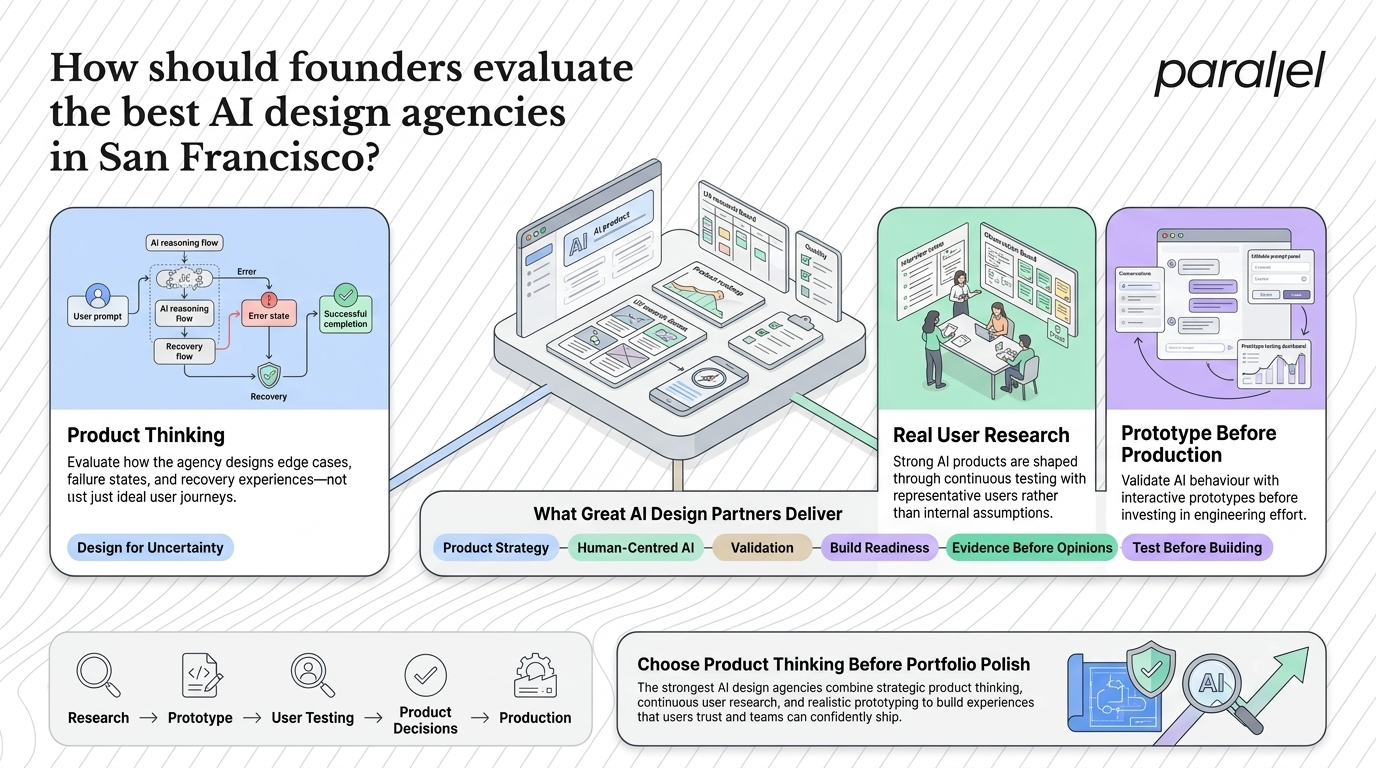
Here is how we advise founders to think about this decision.
1) Look for deep product thinking over visual trends.
Ask the agency how they handle edge cases and error states in non-deterministic systems. Anyone can design a happy path where the AI gives the perfect answer on the first try. You want to hire the team that geeks out over designing the recovery flow for when the AI fails completely.
2) Demand a commitment to real user research.
If an agency relies entirely on internal assumptions or team brainstorms for an AI product, walk away immediately. AI interactions are too new and too unpredictable. You absolutely need rigorous usability testing with real target users to understand the subtle dynamics of trust and cognitive load.
3) Check their specific approach to prototyping.
You cannot test an AI product effectively using static wireframes. The agency must have a framework for building functional prototypes or, at the very least, simulating dynamic responses in their testing environments. Ask them specifically how they plan to test prompt responses with users before writing production code.
Conclusion
Building successful AI products is rarely about having the most complex, proprietary data model. It is almost always about having the clearest, most trustworthy user experience. The underlying technology will continue to commoditize rapidly, but deep empathy for your user's specific daily workflow will remain your strongest competitive moat. Partnering with one of the best AI design agencies in San Francisco can be the difference between a product that feels like a temporary novelty and a product that becomes an indispensable tool.
Let the clarity of your thinking speak for itself. Do not build AI features just because they are technologically possible today. Build them because they solve a real, painful problem for your users in a way that is clear, grounded, and undeniably useful.
Frequently Asked Questions
1) Who are the best AI design agencies in San Francisco right now?
The top players in the market include ParallelHQ for clear product strategy and early-stage execution, Clay for high-end visual polish, and IDEO for deep ethnographic systems research. The right choice depends entirely on your specific product stage, your internal technical capabilities, and the core challenge you are trying to solve.
2) How do I know if my product actually needs AI-native design?
If your product generates open-ended text responses, personalizes content dynamically based on live behavior, or handles complex tasks with highly variable outcomes, you need AI-native design. Traditional linear UI patterns will break under these conditions because they cannot account for the unpredictable nature of the system's output.
3) What is the difference between a traditional design agency and an AI design partner?
A traditional agency often focuses on static screens, predictable user journeys, and linear feature sets. An AI design partner fundamentally understands how to design for probability, complex data feedback loops, and user trust in non-deterministic systems. They design for the conversation, not just the click.
4) How much should I expect to invest in AI product design consulting?
Costs vary widely based on the scope and the agency's scale. Boutique strategy firms and specialized teams might start focused sprint engagements around $20,000 to $50,000 to validate core concepts. Conversely, large global agencies often require project minimums well over $250,000 to engage in enterprise-level transformations.
5) How does ParallelHQ approach AI product design differently than others?
We focus heavily on absolute clarity and rapid decision-making. We do not just paint screens and hand over files. We use proven frameworks like design sprints to break down complex, ambiguous AI concepts into testable, grounded user experiences. We prioritize shipping usable MVP development concepts over endless discovery phases.
6) Why do so many AI products fail immediately after the pilot stage?
They fail because they lack clear business value and they fail to establish user trust. They often force users to learn entirely new mental models without providing enough immediate, tangible value or system transparency to justify the required effort. Bad design kills good models.
7) Is it better to hire an in-house designer or an agency for early-stage AI startups?
An agency partner is often the best choice for establishing the foundational product strategy, building the initial design systems, and defining the complex UX architecture. Once product-market fit is confidently proven, hiring an internal team to maintain, test, and iterate is usually the most efficient long-term path.
8) How long does a typical product strategy engagement take?
For early-stage startups and rapid innovation teams, we typically run highly focused discovery and strategy phases that last anywhere from 3 to 6 weeks. This provides just enough time to validate critical assumptions with real users and create a clear roadmap without slowing down your engineering momentum.

check out these related blogs