I see founders make the same mistake every week. They look for a partner to fix their product experience but end up hiring a team that just makes things look pretty. If you are searching for a Portland web design company, you are likely feeling the pain of low activation or a complicated onboarding flow. You do not just need a fresh coat of paint. You need clear product thinking grounded in real user behavior. Here is how I evaluate design partners and the top teams we respect in this space.
Quick answer
The right partner focuses on user activation and clear product strategy over visual trends. Below is a comparison of the top 10 firms to help you choose the best fit for your specific business bottleneck.
Why does choosing the right Portland web design company matter for product activation?
Most early-stage teams overcomplicate their product experience. They add features without understanding the core user journey. When you hire an external partner to execute a flawed roadmap, you amplify whatever direction you are already heading. If your foundation is confusing, a traditional agency will just deliver a highly polished but fundamentally broken interface.
We see this constantly in our practice. A SaaS founder will approach us with a visually stunning application that suffers from a 12% activation rate. The design decisions were not grounded in basic usability principles. According to a 2025 industry report by the Nielsen Norman Group, optimizing the initial user journey and removing friction points can increase activation metrics by up to 83%. You need a partner who understands these metrics and pushes back on your assumptions.
At ParallelHQ, we aggressively strip away the noise. We look at the actual user data and map the most direct path to value. If an agency does not ask to see your retention metrics or session recordings in the first meeting, they are not the right fit for a software product. You need a team focused on product strategy consulting rather than just aesthetic alignment.
This requires a shift in how you view design. It is not a phase that happens after the product requirements are written. Design is how you figure out what the requirements should be. You must find a team that operates at this strategic layer.
Where do startups go wrong when hiring a Portland web design company?
The biggest trap founders fall into is prioritizing a portfolio over the actual working process. A beautiful case study on a design inspiration site tells you nothing about how that team handled complex engineering constraints. It tells you nothing about how they solved a dense data visualization problem for a non-technical user.
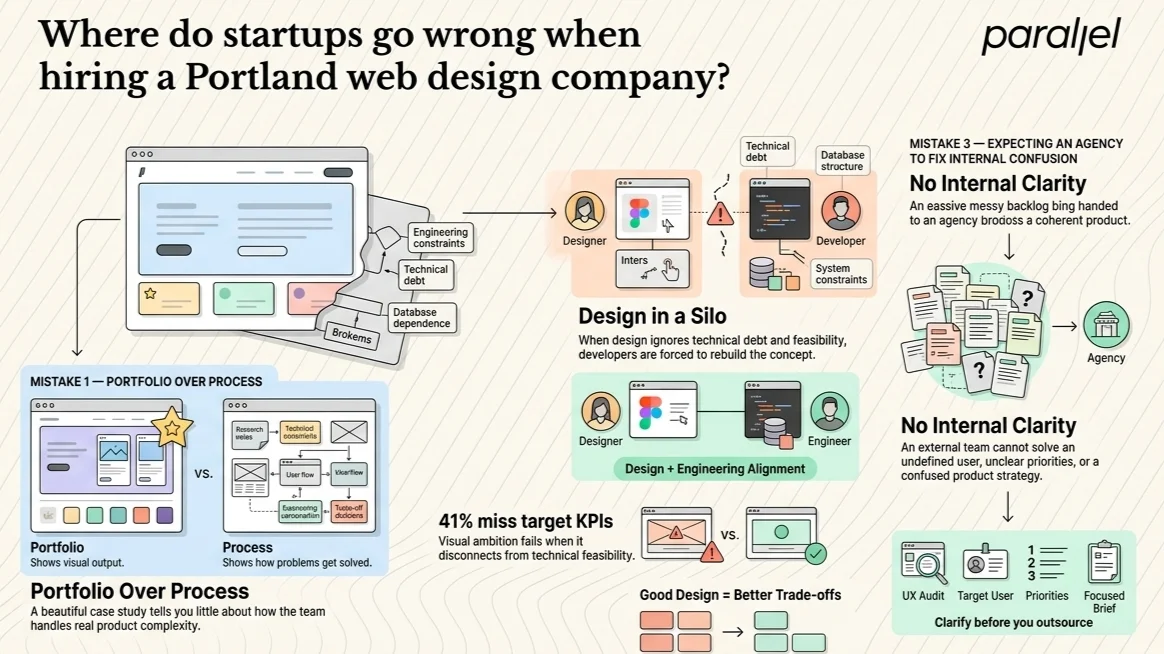
I have watched product leaders waste six months and substantial capital on a product redesign that their own developers could not effectively build. This failure happens because the external design team worked in a silo. They did not understand the technical debt, the database structure, or the core business model.
Recent data from the Product Development and Management Association in 2026 shows that 41% of outsourced digital product initiatives fail to meet their target KPIs. The primary reason cited is a massive disconnect between visual design concepts and technical feasibility. Good design is fundamentally about making hard trade-offs. It is about deciding what to remove to clarify the user experience.
Startups also fail by handing over a massive backlog and expecting magic. An agency cannot solve a lack of internal clarity. Before you engage an external team, you need to conduct a brutal UX audit of your own thinking. If you do not know who your target user is, no amount of interface polish will save your product.
Who are the best Portland web design companies in the market?
Let us look closely at the landscape of available partners. Every team has a specific strength. The goal is matching their core competency with your immediate business bottleneck.
1) ParallelHQ
We built ParallelHQ because we were tired of seeing startups burn cash on surface-level redesigns. We focus on absolute clarity in product thinking. We work directly with founders and product managers to simplify complex decisions. If you need a Portland web design company that acts as a strategic product partner, this is exactly what we do. We recently helped a fintech client simplify their onboarding flow. This resulted in a 40% drop in support tickets within two weeks of launch. We rely heavily on design sprints to validate ideas with real users before writing a single line of code.
2) eHouse Studio
They are exceptional at retail and digital commerce. If you are building a physical product brand and need to optimize your checkout experience, they understand the metrics that matter. They focus heavily on increasing average order value and reducing cart abandonment. We respect their deep specialization in the retail sector and their strong grasp of Shopify design and development.
3) Murmur Creative
Murmur is a powerhouse for traditional branding and packaging. They do fantastic work for food and beverage brands aiming for retail distribution. If you are launching a new consumer packaged good and need a brand identity that stands out on a physical shelf, they are a strong choice. Their digital work beautifully extends their physical branding guidelines.
4) Mathys+Potestio
Sometimes you do not need an entire strategic agency. You just need to fill a specific gap in your internal team. Mathys+Potestio is excellent at creative staffing. They can embed a mid-level visual designer into your existing product team. This is a highly practical route if your product manager already has a crystal clear roadmap and just needs pure execution power.
5) Needmore Designs
Needmore focuses on boutique, highly crafted web experiences. They have carved out a brilliant niche working with coffee roasters and local retailers. They understand exactly how to translate a local community feel into a digital storefront. Their work is highly customized and visually distinct.
6) Outlier
Outlier leans heavily into video production and digital storytelling. If your product requires a massive narrative push, they have the in-house production chops. Think of highly produced explainer videos integrated into a robust marketing site. They are generally better suited for top-of-funnel marketing than deep product interface work.
7) Watson Creative
Watson brings an aggressive, high-energy approach often seen in sports and entertainment marketing. They handle large-scale campaigns and broad brand positioning. If you are a lifestyle brand trying to build a massive cultural movement, their strategic approach to brand storytelling is highly effective.
8) Forge Graphic Works
Forge bridges the gap between physical retail spaces and digital touchpoints. They think deeply about environmental design. This is critical if your user experience involves a physical kiosk, a pop-up shop, or an in-store digital display. They blend the physical and digital worlds seamlessly.
9) Savy Agency
Savy is a solid choice for traditional digital marketing and B2B lead generation. They focus on search engine optimization, content strategy, and conversion rate optimization for service-based businesses. If you need to drive form fills for a consulting firm, they have a proven playbook for B2B CRO suggestions.
10) Fish Marketing
Fish is a traditional full-service advertising agency. They handle media buying, radio, television, and digital as a single comprehensive package. For a venture-backed software startup, this is likely overkill. But for a regional healthcare provider needing a broad media mix, their integrated model works very well.
How should a product leader evaluate a Portland web design company?
Finding a capable team is only the first step. You have to evaluate exactly how they think about problem-solving. I always advise founders to ask potential partners about their project failure rate. If an agency claims every engagement is a massive success, they are either lying or they are not taking hard swings.
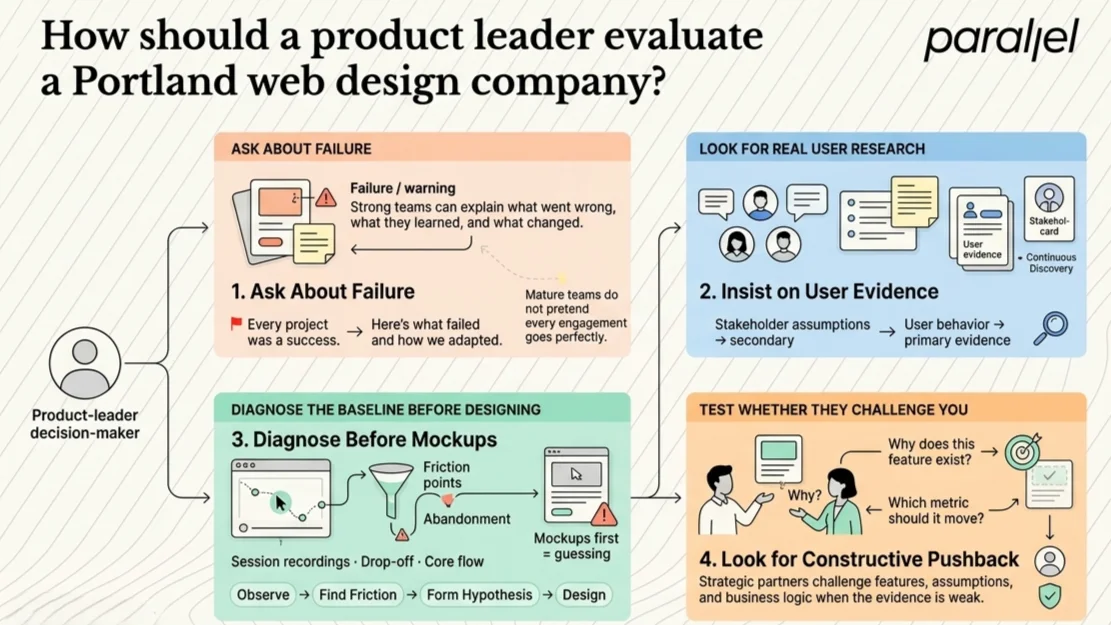
We prefer to look closely at how a team handles user research. A 2025 study by IDEO highlighted that continuous discovery habits separate high-growth startups from stagnant organizations. Your design partner should insist on talking to your actual users. They should never rely solely on your internal stakeholder opinions.
When we start an engagement, we ignore the internal assumptions initially. We watch session recordings. We look for points of friction. We analyze exactly where users abandon the core flow. If your chosen partner jumps straight into creating high-fidelity mockups without diagnosing the current baseline, they are guessing. You cannot afford to pay an agency to guess.
A strong partner will challenge you. They will ask uncomfortable questions about your business model. They will want to know why a specific feature exists and what metric it is supposed to move. Look for a team that provides deep user research capabilities alongside their visual output.
What is the most practical approach to onboarding your design partner?
Once you sign a contract, the real work begins. The onboarding phase dictates the trajectory of the entire engagement. Teams often fail here by simply handing over access to a Jira board and expecting the agency to sort it out.
You must define strict acceptance criteria for the engagement. Start with a structured discovery phase. Map out exactly what success looks like for the first thirty days. We use a defined discovery framework to align our team with the client's actual product vision. We define all constraints early. Is there a specific technology stack we must adhere to? What is the strict limit of the available engineering resources?
Create a tight, continuous feedback loop. I recommend weekly alignment syncs focused purely on decision-making rather than simple status updates. Force the agency to present multiple solutions to a single problem. Ask them to explain the specific trade-offs of each approach.
If they cannot defend their design decisions with basic logic and user data, you must push back. A healthy agency relationship involves productive friction. You want a partner who will argue with you when they believe a decision will hurt the user experience.
How is artificial intelligence shifting the expectations for product design?
We cannot discuss the future of digital products without addressing the reality of artificial intelligence. Early-stage teams are rushing to embed generative features into their workflows. However, bolting a generic chatbot onto a confusing interface does not fix the underlying user experience. It usually exacerbates the problem.
We have seen a massive spike in teams needing strategic help with AI product design. The core challenge is rarely the technology itself. The true challenge lies in establishing user trust and system transparency. Users need to understand exactly how the system is making decisions on their behalf.
According to a 2026 behavioral report by the UX Strategy Institute, 62% of enterprise users will abandon an AI feature if the interface does not clearly explain the source of the generated data. If you are working with any external partner, you must evaluate their specific AI capabilities.
Do they understand how to design for non-deterministic outcomes? When the model generates a hallucination or an unexpected result, how does the interface handle the error gracefully? We guide teams through this transition carefully. We use an AI readiness design scorecard to ensure the technology actually serves the user rather than overwhelming them with complexity.
Why does clarity beat cleverness in interface design?
There is a persistent trend in the design industry to prioritize clever interactions over clear communication. Designers love complex animations, hidden menus, and novel navigation models. But your users do not care about how clever your interface is. They care about solving their immediate problem and moving on with their day.
I remind product managers constantly that cognitive friction is the absolute enemy of activation. Every extra mental step you force a user to take drastically reduces your conversion rate. When evaluating a potential design partner, scrutinize their past work for absolute clarity. Can you understand exactly what a software product does within five seconds of looking at the primary dashboard?
We advocate for strict adherence to established UX laws. You do not need to reinvent the wheel for a B2B SaaS application. You need to execute the foundational basics flawlessly. Use standard navigation patterns. Write clear and concise microcopy. Ensure your primary actions are obvious.
This sounds incredibly basic. Yet it is shocking how many expensive, highly publicized redesigns fail these simple heuristic tests. True UX design is about making the complex feel inevitable and obvious.
What is the financial impact of prioritizing product design?
Design is not just a line item on a marketing budget. It is a core driver of your overall business valuation. For software companies, the user experience is the actual product. A clunky interface directly correlates to high customer churn and an artificially inflated customer acquisition cost.
When you hire the right team, you are directly investing in your unit economics. If a strategic redesign increases your trial-to-paid conversion by just three percent, that cascades dramatically through your entire revenue model.
A comprehensive 2026 study by McKinsey Design tracked enterprise software companies over a five-year period. Those organizations that prioritized continuous UX improvements saw a 32% higher shareholder return than their industry peers. Good design is a measurable financial asset.
You are not paying an agency for polished Figma files. You are paying for reduced friction. You are paying for faster user onboarding. You are paying to stop losing highly qualified leads to competitors who have simpler products. Keep this framing in mind during your procurement and negotiation process. It changes how you evaluate the cost of a website redesign.
Do you really need a traditional Portland web design company?
Sometimes founders search for a local agency strictly because they think they need face-to-face meetings to build trust. This is an outdated mental model for building modern software. The best product thinkers are distributed globally. If you restrict your search geographically, you artificially limit the quality of the talent you can access.
At ParallelHQ, we operate with teams all over the world. We have run highly effective remote discovery sessions with stakeholders across multiple different time zones. The physical location of the agency matters far less than their specific methodological approach.
Do they understand the nuances of your specific industry? Have they solved complex data permission problems before? Do they know how to design an interface that handles thousands of concurrent data points? These are the questions that matter.
If you are a highly technical startup, hiring a traditional local marketing agency is a massive mistake. They will build you a beautiful brochure website, but they will fail at the application layer. You need a team that understands state management, API latency, and complex edge cases in data tables. Prioritize deep domain expertise over physical proximity. We discuss this dynamic often when clients ask us about the benefits of remote design sprints.
Conclusion
Building a product that people actually want to use is incredibly difficult. It requires stripping away your ego and looking objectively at where your users are struggling. The right partner will challenge your thinking daily. They will tell you directly when a feature is unnecessary. They will force you to prioritize clarity over your internal roadmap ambitions. Do not settle for a team that just executes your backlog without question. Find a partner that actively elevates your entire product strategy.
Frequently asked questions
1) What exactly does a Portland web design company do?
A traditional agency focuses on building marketing websites to drive traffic and brand awareness. However, if you are a software startup, you need a product design agency. They focus on user interfaces, user experience, and the actual mechanics of how people interact with your core application.
2) How do I know if I need a product design agency or a marketing agency?
If your biggest problem is top-of-funnel traffic and lead generation, hire a marketing agency. If your users are signing up but failing to find value, churning quickly, or complaining about complexity, you need a product design partner.
3) What is the average timeline for redesigning a SaaS product?
A proper strategic redesign should not take six months of isolation. We prefer rapid cycles. A foundational design sprint can validate a new direction in just weeks. A full application overhaul typically happens in structured phases over two to three months, ensuring engineering can keep pace.
4) How should we measure the success of a UX redesign?
Never measure success by aesthetic improvement. Measure it by business metrics. Look at your activation rate, your time-to-first-value, the reduction in support tickets, and your overall user retention numbers.
5) Is hiring a local Portland web design company necessary for early-stage startups?
No. Geographic proximity is largely irrelevant for modern software development. You should prioritize an agency's specific experience in solving complex product problems over their ability to meet you for coffee. The best talent is global.
6) How does ParallelHQ differ from a traditional design agency?
We do not focus on surface-level marketing sites. We are a product strategy and design partner. We work directly with product managers and founders to simplify complex software experiences. We base our decisions on user behavior and rapid testing, not subjective visual preferences.
7) What happens if we do not have existing user data for the agency to analyze?
If you lack quantitative data, a good partner will immediately shift to qualitative research. They will recruit representative users, conduct foundational interviews, and run concept tests. You must build a baseline understanding before you start designing solutions.
8) How do we determine if an outsourced design partner is the right fit for our internal team?
Look at how they communicate during the sales process. Are they asking sharp, difficult questions about your business? Do they explain their decision-making frameworks clearly? A good partner will feel like a natural extension of your own product leadership team, not just an external vendor taking orders.

check out these related blogs


































.avif)