I have seen early-stage founders waste months building SaaS features no one uses. Overcomplicated product experiences kill activation rates and drain your runway. If you are looking for the best saas design agencies in San Francisco, you are likely dealing with a product that feels too heavy or an interface that confuses your users. You do not need surface-level aesthetics. You need clarity, sharp product thinking, and a design partner who understands real user behavior. Let us break down how to choose the right partner and which agencies actually deliver results.
Quick answer
Here is how the top players compare in 2026:
Top 10 best saas design agencies in San Francisco
The reality of SaaS design in 2026
The global SaaS market is projected to reach $465 billion by the end of 2026 according to Precedence Research. Your users have endless alternatives. If your product takes more than five minutes to understand, they will leave and never come back.
We see this pattern constantly. Startups ship a dense dashboard with twenty different features, hoping to impress users with sheer capability. Instead, this density creates friction. The goal of your product is not to display features. The goal is to help a user accomplish a specific task as quickly as possible.
One of the biggest shifts happening right now is the move toward AI-native interfaces. Gartner predicts that more than 80% of companies will have deployed AI-enabled apps by 2026. This does not mean simply slapping a chatbot into your application. It means designing core experiences where the interface anticipates user needs. When software becomes this smart, the user interface must become radically simple.
Where product teams go wrong
Most founders treat design as a coat of paint applied at the very end of the software development cycle. They hire design firms that deliver beautiful files but fail to understand the underlying technical constraints or the psychology of the user.
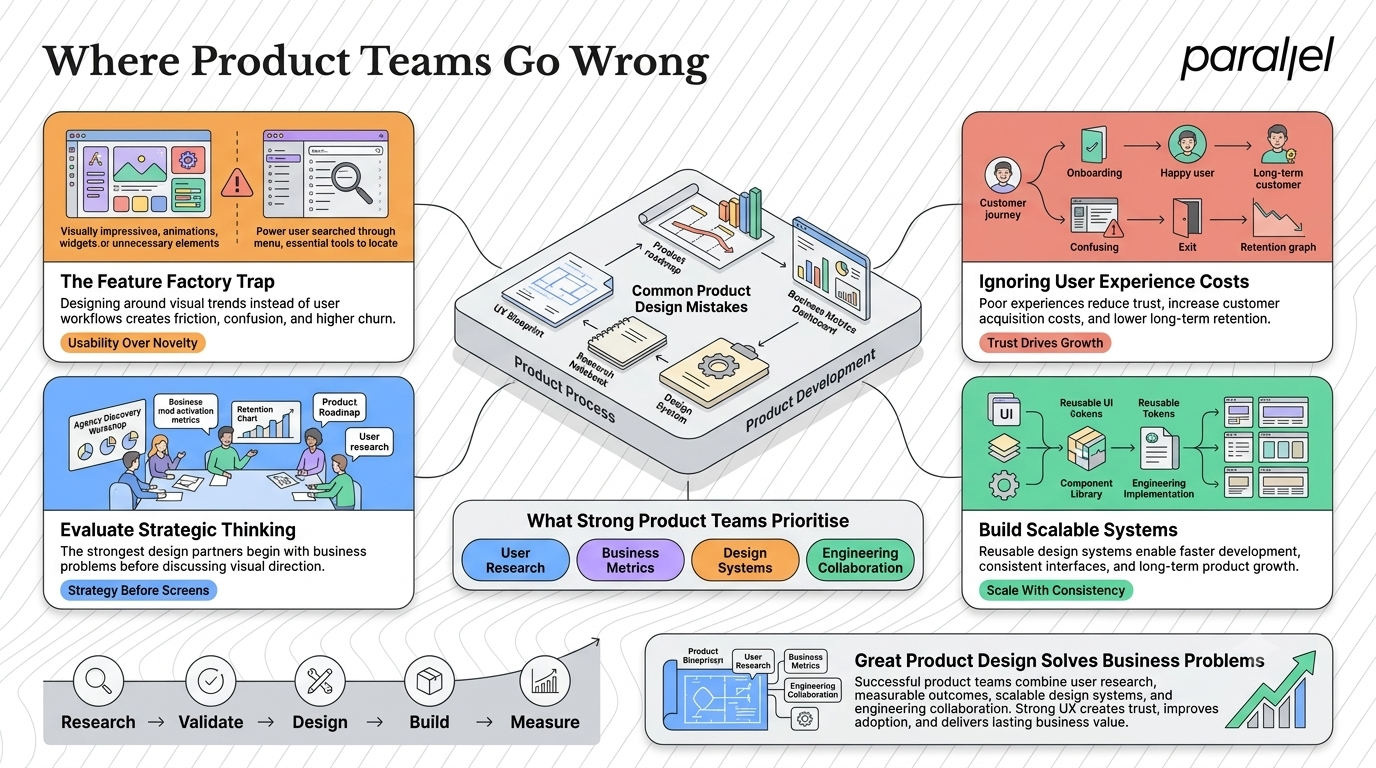
1) The feature factory trap
I recently audited a B2B platform that had redesigned its entire interface based purely on visual trends. They ignored their core power users in the process. Their churn rate spiked immediately because existing users could no longer find the essential tools they relied on daily. Good SaaS design is not about looking modern. It is about making complex workflows feel effortless. You need a design process rooted in generative research and usability testing, not just aesthetic opinions.
2) Ignoring the cost of poor experiences
Founders often underestimate how quickly bad design destroys trust. Recent industry data shows that 88% of users will not return to a site after a poor digital experience. Furthermore, 32% of customers will stop doing business with a brand they previously loved after just one negative interaction. When you ignore your UI/UX design, you are actively choosing to increase your customer acquisition costs and decrease your lifetime value.
How to evaluate a design partner
When evaluating external partners, look for teams that ask hard questions about your business model. If an agency only wants to talk about typography, color palettes, and animations, you should look elsewhere. The strongest design partners act as strategic advisors.
1) Focus on measurable outcomes
The best product teams look at hard metrics. They care deeply about your activation rate, time-to-value, and feature adoption. They know that a SaaS onboarding teardown is often more valuable than a completely new visual identity.
The ROI here is undeniable. Forrester research from 2025 confirms that every dollar invested in UX returns up to $100. That represents a 9,900% ROI. A well-designed interface can lift your conversion rates by up to 200%, and end-to-end UX work can push that lift to 400%. Your design partner should understand these numbers and build strategies specifically designed to move them.
2) Demand scalable systems
A good agency will not just hand you a folder of static mockups. They will build comprehensive design systems. A robust design system ensures that your internal engineering team can build new features quickly and consistently long after the agency engagement ends.
Reviewing the best saas design agencies in San Francisco
Choosing the right partner comes down to matching your specific business constraints with an agency's core strengths. Here is a detailed breakdown of the top players in the market today.
1) ParallelHQ
I built ParallelHQ because I saw a massive gap in how product design was practiced. Too many agencies focus on creating visually stunning concepts that are impossible to build or fail to solve the actual user problem. We do not just make things look pretty. We are a product design and strategy partner focused entirely on clarity.
We help founders simplify complex decisions, streamline user onboarding, and build products grounded in actual human behavior. Our process relies heavily on UX audits and rigorous testing. We look at where your users are dropping off and we fix the structural issues causing that friction.
We act as an extension of your own team. We challenge your assumptions and force you to simplify your product roadmap. This deep, strategic alignment is exactly why we consistently rank among the best saas design agencies in San Francisco for growing startups. We care about your business metrics just as much as your interface.
2) Clay
Clay is widely known for creating highly polished and premium digital experiences. They successfully pair detailed interface design with strong brand identity work.
This approach works exceptionally well for consumer-facing SaaS products that need to make a massive visual impact immediately upon landing. They have worked with major players in the tech space and command a high level of respect for their aesthetic execution. If you have a significant budget and your primary goal is to look better than every single competitor in your space, Clay is a strong contender. However, startups needing rapid iteration and deep focus on complex enterprise workflows might want to explore a Clay alternative.
3) MetaLab
MetaLab has built a massive reputation over the years for helping companies like Slack and Coinbase design their early products. They are a global agency with a strong San Francisco footprint.
They excel at end-to-end product design and have a proven track record of helping startups scale into category-defining unicorns. Their process is comprehensive and their output is consistently high quality. They are a great fit if you have raised a large round of funding and need to build a global product from scratch. Startups looking for a more lean, deeply integrated strategic partner for specific feature optimization might prefer a MetaLab alternative.
4) Neuron
Neuron focuses almost exclusively on B2B workplace products and enterprise software. They act as a specialized tactical unit for complex internal systems and productivity tools.
If your SaaS application requires heavy data visualization, intricate user permission settings, or dense data tables, Neuron brings the right level of specific expertise. They understand that enterprise software must prioritize utility and efficiency above all else. They are an excellent choice for mature B2B companies. Teams needing broader brand strategy alongside their product design might look for a Neuron alternative.
5) Ramotion
Ramotion blends precise UI design with front-end development and brand identity. They are a highly focused team that does exceptionally well with startups needing a cohesive visual language.
They excel at ensuring your marketing website and your actual product dashboard feel like they belong to the exact same family. This seamless transition is critical for building user trust during the initial sign-up phase. If you need a complete visual overhaul across all touchpoints, they are a solid option. For companies needing deeper product strategy consulting rather than just visual alignment, exploring a Ramotion alternative is a smart step.
6) Work & Co
Work & Co operates at a massive scale. They design and ship digital products for legacy brands and some of the largest tech companies in the world.
They focus heavily on technical execution and shipping highly functional code alongside their design deliverables. They are best suited for enterprise-level engagements where the primary challenge is aligning massive internal teams and dealing with immense technical debt. They are incredibly reliable for large corporations. Early-stage founders who need speed and flexibility should likely seek a Work & Co alternative.
7) IDEO
IDEO is a legendary design firm famous for pioneering the concept of human-centered design. While they handle everything from physical hardware to service design, their San Francisco digital team excels at open-ended research.
If you are trying to uncover a completely new market opportunity or solve a vague, ambiguous human problem, IDEO is unmatched in their research methodologies. They will help you find the right problem to solve. However, if you already have product-market fit and simply need to optimize your SaaS interface for better conversion, you would be better served by an IDEO alternative that specializes strictly in software execution.
8) Method
Method focuses heavily on digital transformation and strategic design for established corporate clients. They help large, traditional businesses modernize their legacy software systems.
Their strength lies in taking outdated, on-premise software and turning it into functional, cloud-based SaaS products. They understand corporate governance and how to navigate complex stakeholder environments. Startups and agile scale-ups moving at a rapid pace usually require a more nimble partner and should look into a Method alternative.
9) Frog Design
Frog Design combines world-class industrial design with digital product experiences. They have a long history of shaping the technology industry.
If your SaaS product connects directly to physical hardware, internet-of-things devices, or complex medical equipment, Frog brings the exact multidisciplinary expertise you need. They know how to bridge the gap between a physical screen and a cloud interface. Pure software companies without a hardware component can find more specialized software partners by looking for a Frog Design alternative.
10) Instrument
Instrument is a digital agency that leans heavily into storytelling and digital brand experiences. They are masters of narrative.
While they do execute product design, their true competitive advantage lies in creating compelling stories that help tech brands stand out in crowded, noisy markets. They build digital experiences that evoke emotion and build strong brand affinity. Product teams focused purely on utility, metrics, and complex workflow optimization might prefer an Instrument alternative.
The true ROI of good product thinking
Great SaaS products are born from clear thinking. You cannot hide a confusing product strategy behind a trendy user interface. Users will eventually hit a wall, get frustrated, and cancel their subscriptions.
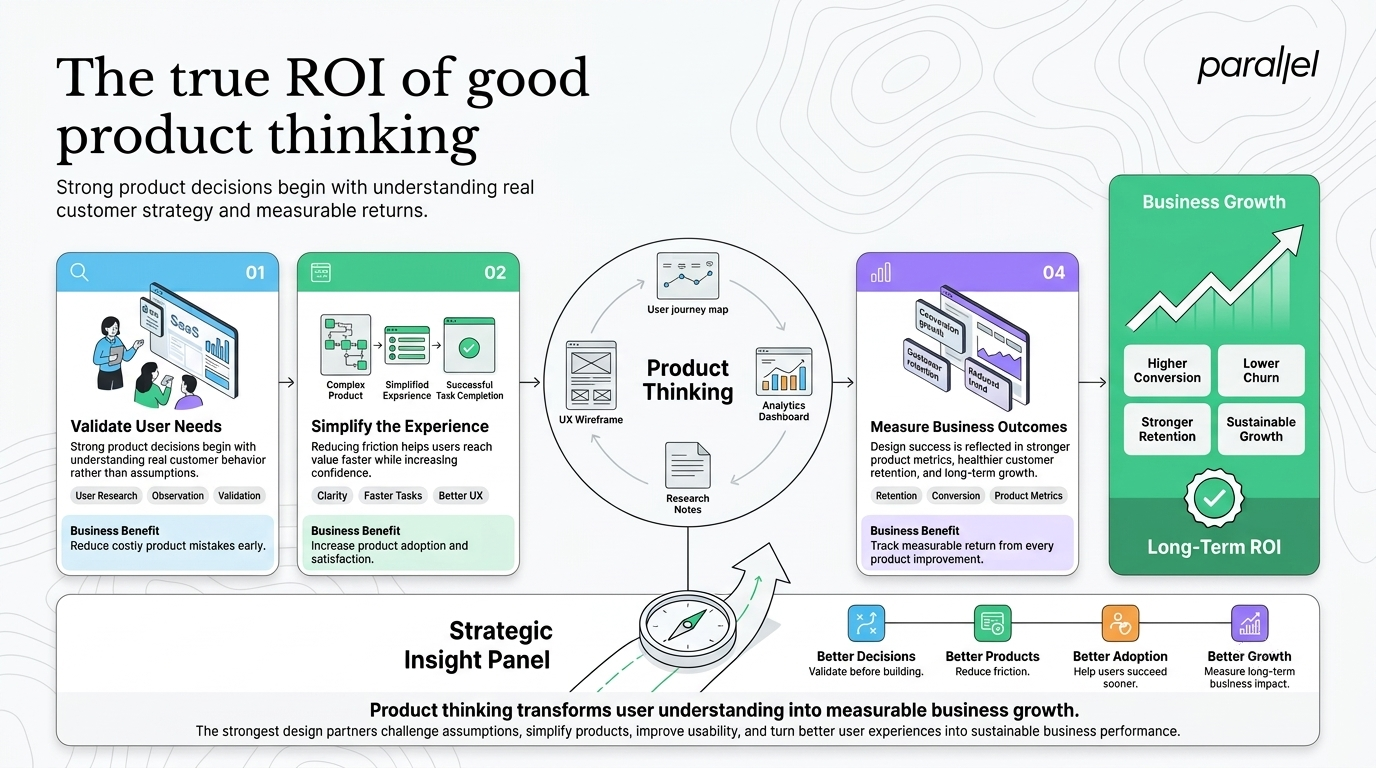
The smartest founders I know treat design as a strategic lever for growth. They do not view it as just a phase in the delivery pipeline. Baymard Institute data from 2025 confirms that average SaaS and eCommerce sites can recover over 35% of lost conversions simply by fixing usability issues in their core flows. The ROI of UX is not a theoretical concept. It is a measurable financial reality that directly impacts your runway and valuation.
Choose a partner who challenges your assumptions. Choose a team that forces you to simplify your product. When your software is easy to understand and effortless to use, growth becomes a natural byproduct.
Frequently asked questions
1) How do I choose among the best saas design agencies in San Francisco?
Start by looking closely at their past work. Do the products in their portfolio look highly usable, or just visually striking? Ask them how they measure success on a project. You want an agency that tracks activation rates, retention, and time-to-value rather than just tracking the delivery of Figma files.
2) What do the best saas design agencies in San Francisco charge?
Pricing in the Bay Area varies wildly based on scale and reputation. Top-tier global agencies can charge well over $100,000 for a foundational product design phase. Specialized boutique agencies focused on startups typically range from $30,000 to $80,000 depending on the scope of generative research, prototyping, and testing required.
3) Why hire one of the best saas design agencies in San Francisco instead of freelancers?
Freelancers are excellent for executing specific, well-defined tasks. Agencies bring a proven operational process, cross-functional expertise, and strategic product thinking. When building a complex SaaS product, you need researchers, strategists, and UI designers working together in a tight feedback loop to solve system-level problems.
4) Do the best saas design agencies in San Francisco also build the software?
Some agencies offer full-stack development, but many of the top firms focus strictly on strategy, user research, and UI/UX design. Firms that specialize deeply in product design will typically hand off developer-ready files and comprehensive design systems to your internal engineering team to ensure high-quality implementation.
5) What makes SaaS design different from standard web design?
SaaS design focuses intensely on utility, daily retention, and complex workflows. A standard marketing website is designed to convert a passive visitor into an active lead. A SaaS interface is designed to help a logged-in user accomplish a specific, often complex task as efficiently as possible every single day.
6) How long does a full SaaS redesign take?
A thorough and strategic product redesign usually takes anywhere from eight to sixteen weeks. This timeline includes generative user research, mapping architecture, wireframing, high-fidelity prototyping, usability testing, and creating final design system documentation.
7) What is the financial return on investment for UX in SaaS?
The return on investment is massive and thoroughly documented. According to industry data from Forrester, every dollar spent on UX yields a return of up to $100. Improving your initial onboarding flow or simplifying your core features directly increases user retention, which compounds your recurring revenue.
8) Is ParallelHQ a good fit for my startup?
We are the right fit if you want a strategic partner focused entirely on clarity and grounded in actual user behavior. We work closely with founders and product teams to simplify complex product decisions. If you want agency fluff, hands-off execution, or purely trend-driven visual concepts, we are not the best option for your current needs.

check out these related blogs