I get asked this question often enough that it deserves a proper answer. If you're running a seed-to-Series-A AI or SaaS startup and you're weighing Fantasy vs ParallelHQ, the choice isn't really about which agency is "better." It's about which one is built for you. Fantasy is a 25-year-old institution that shapes products for global giants. ParallelHQ is a focused startup design partner. That difference matters enormously when you're deciding where to spend your design budget in 2026.
TL;DR
- Fantasy is an enterprise-grade design agency; its pricing reflects that, with engagements typically starting at six figures.
- ParallelHQ is purpose-built for early-stage AI and SaaS startups, with a process that starts at opportunity mapping, not screen design.
- If you need brand prestige and have an enterprise budget, Fantasy is worth the price. If you need velocity, strategic clarity, and a partner who understands startup constraints, ParallelHQ wins.
- Fantasy vs ParallelHQ ultimately comes down to your stage, not just your taste.
What Is ParallelHQ and How Does It Compare to Fantasy?
Before comparing the two on specifics, the positioning gap needs to be stated plainly. Fantasy describes itself as "the creative partner behind the world's biggest digital products," launching the next generation of intelligent experiences. For over two decades, they've partnered with industry leaders like Nike, Disney, Microsoft, Netflix, Spotify, and Ford to shape products used by billions daily. That's the Fantasy value proposition: iconic design at scale, built for brands that already have market gravity.
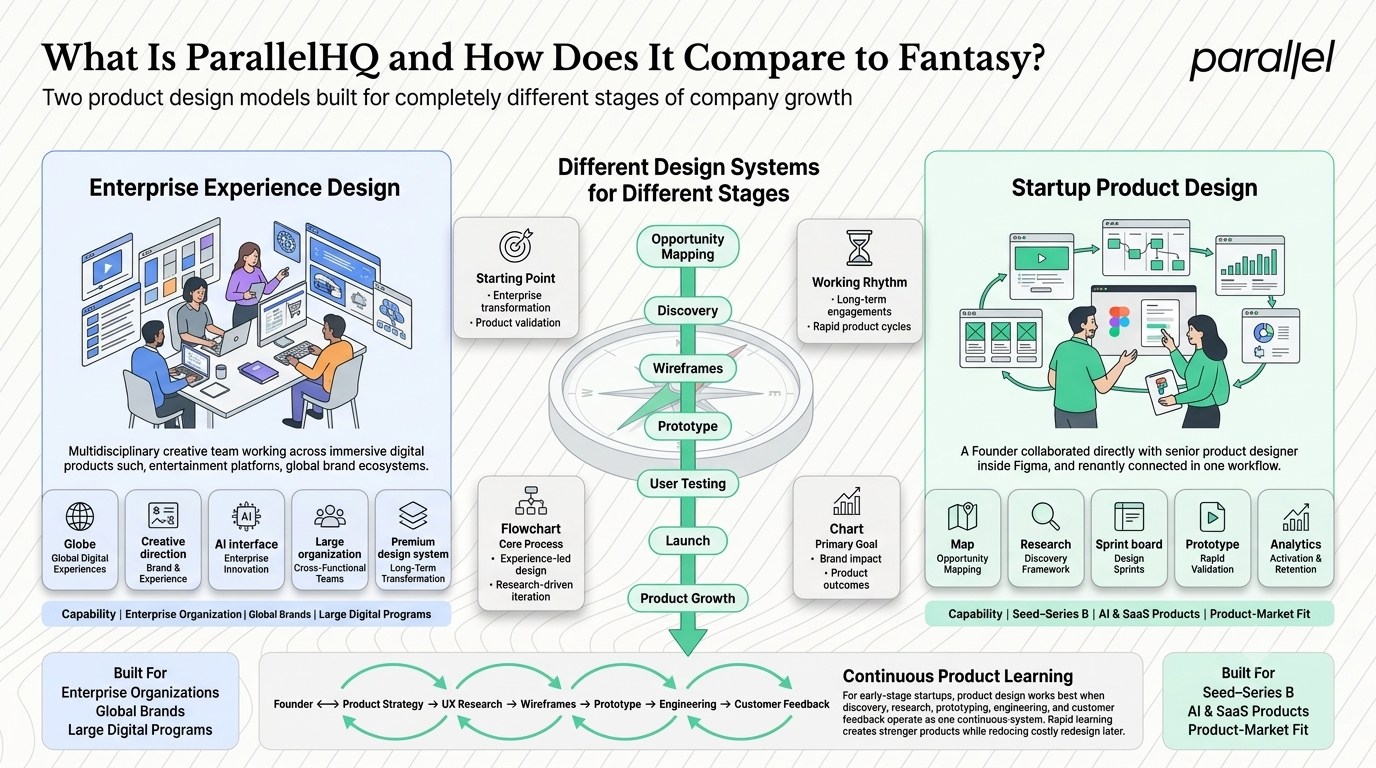
I built ParallelHQ specifically to be the UI/UX and product design partner for early-stage AI and SaaS startups based in the USA, and our work starts with opportunity mapping and discovery before a single screen is designed.
The structural difference: Fantasy optimises for ambition and cultural impact. ParallelHQ optimises for startup velocity and product-market fit. Both deliver rigorous product design, but the entry point, the process, and the client profile are entirely different. Fantasy offers end-to-end capabilities: AI Strategy and Execution, Product Innovation, and Brand and Identity, built to launch next-gen Intelligent Experiences.
At ParallelHQ, our service architecture is built around the specific inflection points startups face: broken onboarding, low activation, premature scaling of a design system before the product logic is solid. We run UI/UX design, product strategy consulting, design sprints, user research, and usability testing as integrated services, not modular upsells.
The honest comparison starts here: Fantasy is a world-class agency for companies ready to move at an enterprise pace. ParallelHQ is built for founders who cannot afford a six-month discovery phase and need design decisions tied directly to product outcomes.
Fantasy Design Agency Pricing vs ParallelHQ Pricing 2026
This is the question most founders actually mean to ask when they start the Fantasy vs ParallelHQ conversation. Fantasy's pricing is not shared publicly. However, third-party analysis is instructive. The agency takes on a small number of projects each year and is best for later-stage startups with the budget for a premium, enterprise-calibre design partner known for ambitious product work. Pricing is enterprise tier, generally starting at $150,000 and scaling with project complexity.
ParallelHQ operates on a design retainer and project-based model calibrated for seed-to-Series-B teams. Our engagements are structured around defined phases: discovery and opportunity mapping, design sprint execution, iterative Figma-based prototyping, and design system buildout. You pay for a defined scope with clear outputs, not open-ended hours.
For context on where the broader market sits: startups typically budget $1,000–$5,000 per month using subscriptions or freelancers, while SMBs spend $5,000–$15,000 per month on retainers or mixed models. Enterprises commit $50,000–$300,000 or more per project for full-service agencies. Fantasy sits at or beyond the enterprise ceiling. ParallelHQ operates in the range that serves growth-stage startups with real design ambition but without Fortune 500 budgets.
The takeaway: if you're a pre-Series-B startup comparing Fantasy vs ParallelHQ on price, the comparison is largely academic. Fantasy is simply not priced for your stage.
What Are the Differences Between Fantasy and ParallelHQ Design Services?
The service model differences are deeper than a capability list suggests. Fantasy is a product design firm with 25 years of experience, specialising in designing and launching digital products and intelligent experiences, with a focus on AI strategy and execution, product innovation, and brand and identity development. Their process is bespoke and immersive. They are known for what third-party reviewers describe as "Think Beyond" thinking: bold, systemic product concepts that redefine categories.
At ParallelHQ, the process is more surgical. We run design sprints, user research, usability testing, and accessibility audits as integrated services, not upsells. For teams building AI products, we have a dedicated AI UX design practice that addresses the specific challenges of probabilistic output design, trust calibration, and onboarding flows that make machine intelligence legible to non-technical users.
The service differences that matter most for startups:
- Discovery depth: Fantasy runs full innovation consulting engagements. ParallelHQ runs a structured discovery framework designed to reach actionable design decisions in days, not months.
- Design systems: Both agencies build them. ParallelHQ's design systems work is scoped specifically for Figma-based startup teams who need a scalable component library without enterprise overhead.
- Wireframing and prototyping: ParallelHQ's wireframing and prototyping service is explicitly tied to sprint cycles and user validation, not just internal sign-off.
- Information architecture: We treat interaction design and information architecture as upstream of visual execution, not downstream.
We partner with you to fix weak onboarding, improve activation, and design systems that scale. Our approach is deeply embedded in product strategy consulting. We do not just hand over Figma files and walk away. We work alongside your product managers and engineers to ensure the strategy is executed flawlessly.
Fantasy vs ParallelHQ for Startups: Which Should You Pick?
This is the decision frame that matters most. Fantasy, formerly known as Fantasy Interactive, is a New York-based design and innovation agency founded in 1999 with a client list that includes Netflix, Spotify, Google, and Samsung. All clients get a senior team selected based on their specific project needs. That selectivity is a signal. Fantasy chooses clients as much as clients choose Fantasy.
For a pre-seed or seed-stage startup, that selectivity, combined with the enterprise price floor, means Fantasy is almost certainly not the right call right now. The relevant question is not "which agency is better," but "which agency's process is built for where I actually am?"
ParallelHQ sits at the top of this list for a specific reason: we built our practice around startups, not as a segment but as a philosophy. We work at the intersection of product strategy, UX design, and design systems, with a process designed for startups that cannot afford 12-week discovery phases.
Concrete guidance by stage:
- Pre-seed / bootstrapped: ParallelHQ's sprint-based model and MVP development work give testable outputs without locking six months of runway into a single engagement.
- Seed / Series A: ParallelHQ's full-engagement model covers opportunity mapping through the design system, working in Figma with your engineers in real time. Fantasy is out of budget range at this stage for most teams.
- Series B and beyond: If your product is established, you have brand equity to protect, and your budget can support a $150,000+ engagement, Fantasy's category-defining work becomes genuinely relevant.
- Enterprise / Fortune 500: Fantasy is the natural fit. ParallelHQ is not trying to compete here.
A seed-stage startup choosing Fantasy over ParallelHQ is like booking a concert hall for a product demo. The quality is real. The fit is wrong.
Is Fantasy Design Agency Worth It Compared to ParallelHQ?
The honest answer is: it depends entirely on what "worth it" means for your stage. As the creative partner to 80% of Forbes' Top 10, Fantasy has launched the world's biggest digital products. That track record is genuine and hard-earned. If you are a global brand that needs a design partner capable of influencing how billions of people interact with a product, Fantasy's price is defensible. But for a startup, the value equation is different. Value comes from design decisions that directly accelerate activation, reduce churn, and make a product legible to first-time users.
According to Nielsen Norman Group's 2025 UX Metrics Report, products that test usability before development see a 60 percent reduction in engineering rework. That metric matters enormously when every sprint costs a runway. At ParallelHQ, our UX audit and usability testing services are specifically designed to surface and fix those friction points before they compound.
The risk nobody talks about: coordinating three freelancers across discovery, architecture, UI design, and testing phases adds significant management overhead that most startup founders underestimate until they are in the middle of it. A specialist agency structures that work so founders can focus on the product, not the process.
For a seed-to-Series-A team with onboarding flows, dashboards, and a design system to build, a specialized agency like ParallelHQ pays for itself in velocity and continuity. Fantasy is worth it if you are past the problem-solution fit stage, you have the budget, and brand-level creative ambition is the goal. ParallelHQ is worth it if you are still shaping the product experience and need a partner who treats design as a business function, not a visual layer.
Why Choose ParallelHQ Over Fantasy Design Agency?
This section is direct because the context of the Fantasy vs ParallelHQ decision usually implies a startup founder who has discovered Fantasy through research and is asking whether ParallelHQ is a credible alternative. It is. Here's why specifically.

Process fit: At ParallelHQ, we do not operate like a traditional UI/UX design agency. We are a product design and strategy partner focused entirely on clarity in thinking, working closely with founders and product managers at early-stage startups to simplify complex product decisions.
Speed: Every process we run, from design sprints to iterative prototyping, is calibrated for teams that cannot afford a six-month waterfall cycle.
Startup-specific services: ParallelHQ offers services that Fantasy does not position for startups at all: SaaS onboarding teardowns, AI readiness design scorecards, B2B CRO suggestions, and Framer design and development, built for teams moving fast on modern stacks.
Embedded collaboration: We have helped teams transform weak onboarding experiences into high-activation funnels. We do not do agency fluff or trend-driven visual changes. We focus on real user needs.
Access: Fantasy does not run a sales team and selects a small number of projects per year. ParallelHQ is reachable, responsive, and structured to begin a scoped engagement quickly.
Is ParallelHQ a Good Alternative to Fantasy Design Agency? An Honest Review
I'll be direct: Fantasy is not a benchmark ParallelHQ is trying to match. They serve fundamentally different markets. The right framing for the Fantasy vs ParallelHQ honest review is whether each agency is the right partner for the right client, not which one wins in a head-to-head.
Fantasy is a globally renowned design and innovation agency that partners with top brands to create future-forward digital products, known for visionary thinking, immersive storytelling, and cutting-edge UX.
ParallelHQ is none of those things, by design. We are not trying to produce visionary concept films or reshape a global brand's identity. We are trying to help a founder figure out why their onboarding flow drops 60% of users after step two, then fix it, test it, and ship it.
ParallelHQ is an AI-native product design agency helping founders and tech teams turn ideas into testable, lovable products that drive growth and funding.
For an early-stage AI or SaaS startup, that is a more useful description of a design partner than "creative partner to 80% of Forbes' Top 10." If you are at the stage where you need that kind of partner, the Fantasy vs ParallelHQ comparison resolves clearly in ParallelHQ's favour. Not because Fantasy is inferior, but because Fantasy is not designed for you yet.
Founders need to view design as a business function. If a design choice does not increase activation, retention, or revenue, it is just decoration. That is the lens ParallelHQ applies to every engagement.
Conclusion
The Fantasy vs ParallelHQ comparison has a clear answer once you define your stage honestly.
- Fantasy is a legitimate world-class agency, built for enterprise and global-brand clients with $150,000+ design budgets and a multi-month timeline.
- ParallelHQ is purpose-built for AI and SaaS startups from seed through Series B, with a process that starts at strategy and ends at shipped, tested product.
- If portfolio prestige and cultural ambition are your primary criteria, Fantasy is the right call.
- If velocity, startup-calibrated process, and design decisions tied directly to activation and retention matter more, ParallelHQ is the clear choice for your stage.
Frequently Asked Questions
1) What is Fantasy Design Agency and who is it best for?
Fantasy is a world-renowned UX design studio with a mission to impact user experience in everyday products through human-centered design and innovation, and is the preferred design partner for Fortune 200 companies. It is best suited to enterprise brands and later-stage companies with large budgets and a need for category-defining creative work.
2) What does ParallelHQ specialise in?
ParallelHQ specialises in UI/UX and product design for early-stage AI and SaaS startups based in the USA. Services span opportunity mapping, design sprints, Figma-based prototyping, design systems, and dedicated SaaS design services, all structured for startup velocity rather than enterprise timelines.
3) Is Fantasy Design Agency worth it for a startup?
For most early-stage startups, no. Fantasy's pricing is enterprise tier, generally starting at $150,000 and scaling with project complexity. That budget is rarely appropriate at the seed or Series A stage, where the design priority is validating product logic and improving activation, not brand-level creative innovation.
4) Does Fantasy Design Agency offer design subscriptions or retainers?
Fantasy does not publicly offer a subscription or retainer model. It is a project-based, selective-intake agency. If you need a startup-friendly design retainer with clear deliverables and phased engagement, ParallelHQ's model is structured specifically for that.
5) How does ParallelHQ's design process differ from Fantasy's?
Fantasy's process is immersive, bespoke, and long-form, suited to enterprise transformations. ParallelHQ works at the intersection of product strategy, UX design, and design systems, with a process designed for startups that cannot afford 12-week discovery phases. Sprints, testable prototypes, and UX audits are the core tools, not concept workshops.
6) Which design agency is better for an AI startup in 2026?
For most AI startups at seed or Series A, ParallelHQ is the stronger fit. Choosing the wrong design partner costs more than time, it costs product-market fit. If you're building an AI product, you need an agency that understands probabilistic outputs, trust calibration, and onboarding flows that make machine intelligence feel human. ParallelHQ's AI UX design practice is built precisely for that challenge.

check out these related blogs