I see founders build products based on intuition every day. Sometimes they get lucky. Most of the time, they burn runway building features nobody actually wants. If you want to stop guessing and start making decisions grounded in real user behavior, you need to ask: what is UX research? methods & when to use them are not just academic concepts. They are survival tools for your product. We have helped dozens of early-stage teams replace internal debates with clear insights, and it always starts with stripping away the complexity of user research.
Quick Answer
UX research is the systematic study of target users and their requirements to add realistic contexts to design processes. It uses qualitative and quantitative methods to uncover problems, validate assumptions, and guide product decisions effectively.
Why does UX research methods & when to use them matter for startups?
We often mistake building fast for building well. In reality, speed without direction is just an expensive way to fail. Research removes the most dangerous element from your product roadmap, which is unchecked assumptions. When teams skip research, they usually build for themselves rather than the market.
I have watched well-funded teams spend six months engineering a complex SaaS dashboard, only to launch it and realize their users just wanted a simple daily email report. That is not a failure of engineering. That is a failure of product thinking.
A recent 2025 study on software development efficiency by the Nielsen Norman Group highlighted a stark reality. Fixing a usability problem after a product is live costs up to 100 times more than fixing it during the prototype phase. You are not saving time by skipping user feedback. You are simply borrowing time from the future with massive interest.
Early-stage startups cannot afford this kind of technical and design debt. Your runway is finite. Every sprint dedicated to building the wrong feature brings you closer to the end of that runway. Implementing a solid discovery framework early on is the ultimate risk mitigation strategy. It ensures that every dollar spent on development is pointed in the exact direction of user value.
Where do product teams go wrong with UX research?
The most common mistake I see is teams using research to validate what they have already decided to build. They build a high-fidelity prototype, show it to a user, and ask leading questions to get a pat on the back. They ask questions like, "Would you use this feature?" Users will almost always say yes to be polite.
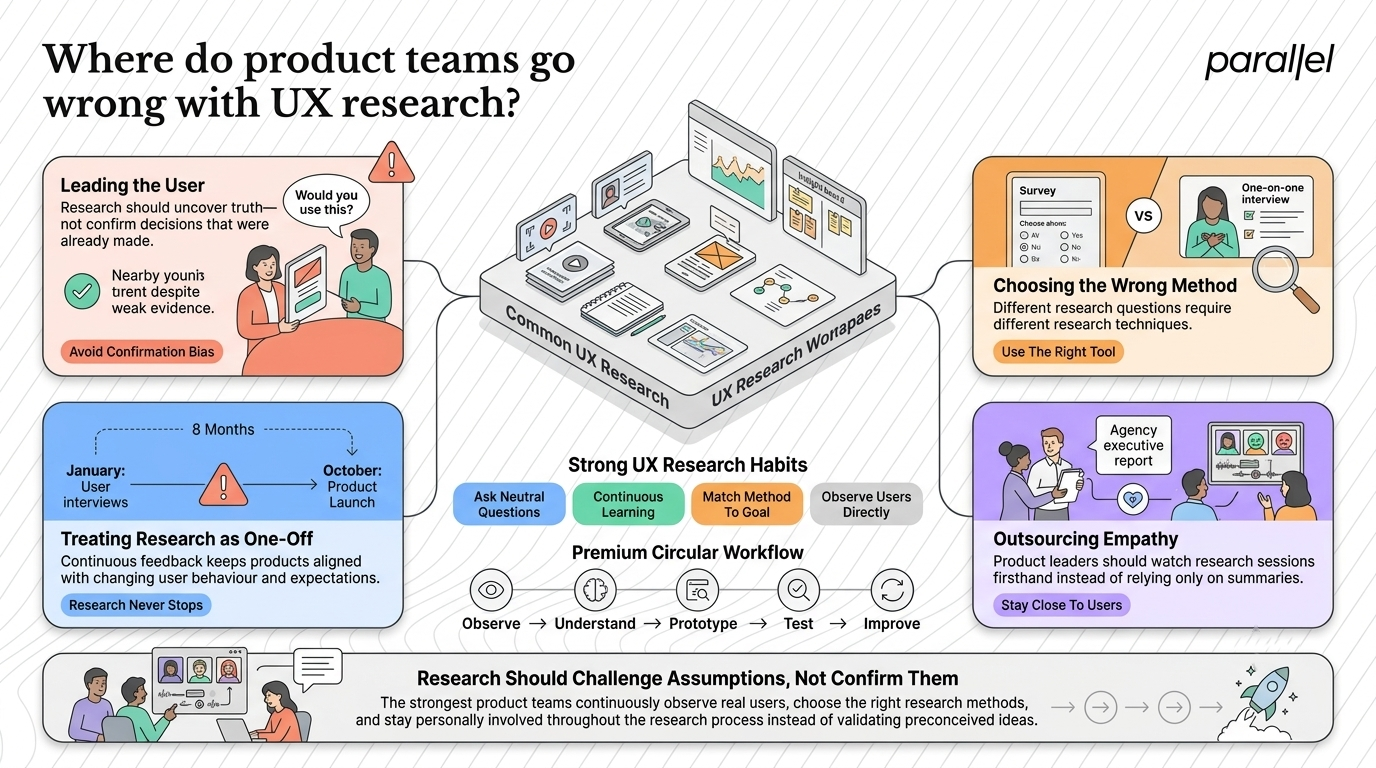
This is not research. This is theater.
Another major trap is treating research as a one-time event rather than a continuous loop. Founders often do a dozen interviews early on, build for eight months in total isolation, and wonder why the launch falls flat. You cannot rely on outdated insights. User behavior and market expectations shift rapidly. What was true in January might be entirely irrelevant by October.
Teams also frequently struggle with method selection. They send out a massive survey when they should be conducting deep, one-on-one contextual inquiries. Using the wrong tool for the job yields confusing data. If you try to understand the nuances of a complex B2B workflow through a multiple-choice survey, you will end up with shallow data that leads to overcomplicated product experiences.
Finally, teams outsource the thinking. They hire an external agency to do the research, read the polished executive summary, and never actually watch the session recordings. If you are a product manager or a founder, you need to hear the frustration in the user's voice firsthand. You cannot outsource empathy. If you want to build high-impact products, you need to be in the room. You can read more on this in our guide on high impact organisations and products.
What should founders think about UX research?
To get real value from your efforts, you have to separate your research into two clear buckets. You are either trying to discover a problem, or you are trying to test a solution. Blurring these lines leads to bad data.
The generative mindset
Generative research happens before you write a single line of code or draw a wireframe. You are looking for gaps in the market, unmet needs, and behavioral patterns. You are asking open questions to understand the user's world as it currently exists.
At this stage, you are not talking about your product at all. You are asking them how they currently solve a specific problem. You are looking for workarounds, friction points, and moments of frustration. Generative research requires a beginner's mind. You have to assume you know nothing about the user's daily reality.
The evaluative mindset
Evaluative research happens once you have a concept or a prototype. You are testing whether your proposed solution actually solves the problem you identified during the generative phase.
This is where you bring in your wireframes or your beta product. The goal here is observation, not persuasion. You give the user a task and you watch them try to complete it. You are looking for moments where they hesitate, click the wrong button, or express confusion.
Clear product thinking requires moving fluidly between these two modes. If you have weak onboarding and low activation, you need evaluative research to see where users drop off. You then follow that up with generative research to understand why they lost motivation in the first place. Understanding this balance is the core of effective product strategy consulting.
What is a practical approach to UX research?
You do not need a massive academic framework to start learning from users. You just need to know which tool to pull from the toolkit based on the question you are trying to answer.
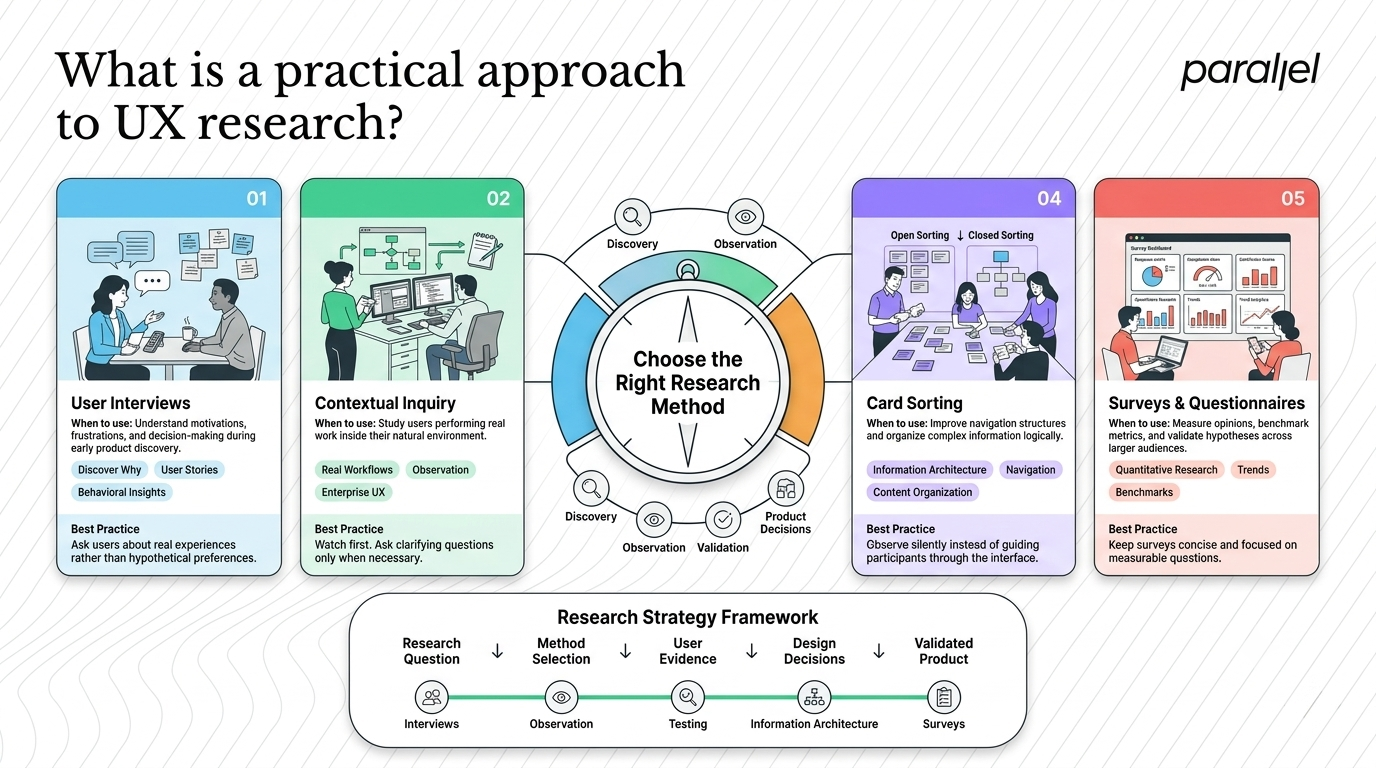
Here is how we structure method selection for the teams we work with.
1) User interviews
Interviews are the foundation of qualitative research. They are deep, one-on-one conversations aimed at uncovering motivations, pain points, and current behaviors.
- When to use them: During the early discovery phase when you need to understand the "why" behind user actions.
- How to do them well: Never ask users what they want. Ask them to tell you a story about the last time they experienced the problem you are trying to solve. Look for specific details rather than generalizations.
- What to avoid: Pitching your product. The moment you start selling, the user stops being honest and starts being agreeable.
2) Contextual inquiry
This method involves observing users in their natural environment while they perform their standard tasks. Instead of asking them how they use a piece of software, you sit next to them at their desk and watch them use it.
- When to use them: When building complex B2B tools or enterprise software where workflows are intricate and deeply ingrained.
- How to do them well: Act like an apprentice. Ask the user to teach you how to do their job. Interrupt only to ask for clarification on specific actions they took.
- What to avoid: Correcting the user or showing them a "better" way to do something. Your job is to observe the current reality.
3) Usability testing
This is the process of evaluating a product or prototype by testing it with representative users. You give them specific scenarios to complete and observe where they struggle.
- When to use them: Throughout the design process, from low-fidelity wireframes to the final coded product.
- How to do them well: Write clear, scenario-based tasks. Instead of saying "Use the search bar," say "Find a pair of black running shoes under fifty dollars." Keep quiet and let them struggle.
- What to avoid: Helping the user when they get stuck. If you intervene, you ruin the test.
4) Card sorting
Card sorting is a technique used to design or evaluate the information architecture of a site. Users are given a list of topics and asked to group them in a way that makes logical sense to them.
- When to use them: When you are designing the navigation menu for a complex website or reorganizing a massive product catalog.
- How to do them well: Use open card sorting (users create their own categories) for discovery, and closed card sorting (users place items into predefined categories) for validation.
- What to avoid: Using internal company jargon on the cards. Use the exact vocabulary your users use.
5) Surveys and questionnaires
Surveys allow you to gather quantitative data from a large group of users quickly. They are excellent for measuring attitudes and identifying broad trends.
- When to use them: When you have a specific hypothesis you want to validate at scale, or when you need to measure a benchmark like a Net Promoter Score.
- How to do them well: Keep them incredibly short. Every additional question drops your completion rate. Ensure your multiple-choice options are mutually exclusive and collectively exhaustive.
- What to avoid: Asking "why" questions in a survey. Qualitative insights gathered through open text fields in surveys are notoriously shallow.
According to 2026 data from the design leaders at IDEO, teams that blend at least one qualitative method (like interviews) with one quantitative method (like surveys) are 40% more likely to achieve early product-market fit. We see this exact pattern in our own UX design services.
How can we measure the impact of UX research?
Good design decisions should translate to clear business metrics. If your research does not move the needle on the core numbers, it is just trivia. You have to tie your qualitative findings to quantitative outcomes.
We tie research directly to product KPIs. If we run a series of usability tests on a fintech app, we expect to see a corresponding lift in activation rates. We do not measure success by the number of interviews completed. We measure success by the reduction in user friction.
For example, imagine we identify massive drop-offs in a SaaS onboarding flow. Through recorded user sessions, we notice users are abandoning the process when asked to connect a third-party API. They lack the technical context. By simplifying the copy and adding a brief explainer video (insights gained through evaluative research), the immediate success metric is the completion rate of that specific step.
A recent 2026 survey by Product School found that product managers who mandate routine user testing for all major new features report a 35% higher user retention rate over the first 90 days.
Here is a simple framework for tracking research impact:
- Identify the baseline: What is the current conversion, activation, or retention rate?
- State the hypothesis: We believe users are dropping off because the pricing page is confusing.
- Run the research: Conduct five usability tests on the pricing page.
- Implement the fix: Redesign the page based on the observed friction points.
- Measure the delta: Did the conversion rate improve in the 30 days post-launch?
The goal is not to produce a massive, seventy-page research report that sits in a Google Drive folder gathering dust. The goal is to build a product that people actually use and pay for. This pragmatic approach is the cornerstone of how we handle every UX audit.
Why is timing critical for UX research?
Timing dictates the absolute value of your findings. The best method applied at the wrong time is worse than useless, it is actively misleading.
If you run a broad survey before you have a clear hypothesis, you will ask the wrong questions and get noisy, confusing data. If you wait to do usability testing until the product is fully coded by your engineering team, you have already wasted tens of thousands of dollars in development resources.
We recommend a continuous discovery habit for all product teams. You should be talking to a few users every single week, regardless of where you are in the sprint cycle. This keeps the team grounded in reality and prevents the dangerous drift that happens when builders get stuck in an internal echo chamber.
- Pre-Launch (Discovery): Heavy emphasis on generative interviews, field studies, and opportunity mapping. You are defining the problem space.
- Design Phase (Prototyping): Transition to evaluative methods. Usability testing on wireframes, card sorting for navigation, and A/B testing copy.
- Post-Launch (Optimization): Heavy reliance on analytics, session recordings, surveys, and targeted interviews with churned users.
If you are struggling to align your team on when to test, consider running a structured sprint. It forces the timeline and ensures testing happens before development begins. You can see how we structure this in our design sprint guide.
Conclusion
Building a product is hard enough without blinding yourself to what your users actually need. The startup teams that win are not necessarily the ones with the most brilliant initial ideas. They are the ones with the fastest, most accurate feedback loops.
By understanding the right research methods and applying them rigorously at the right time, you strip away the ego from product development. You stop arguing in meeting rooms about what you think the user wants, and you let the actual user behavior guide the interface.
Great products are not invented in a vacuum by isolated geniuses. They are co-created with the people who will ultimately use them. Keep your approach simple, stay grounded in reality, and never stop observing how the market reacts to your work.
Frequently asked questions
1) What exactly falls under the umbrella of UX research?
It covers any systematic technique used to gather insights about your target users. This ranges from casual, generative user interviews to strict, evaluative usability tests and broad quantitative surveys. The ultimate goal is always to reduce uncertainty in your product and design decisions.
2) How do I start applying what is UX research? methods & when to use them if I have no budget?
Start with guerrilla testing or informal, targeted user interviews. You do not need an expensive agency or a massive budget to talk to five people who match your target demographic. The insights you gain from five basic, honest conversations are infinitely better than operating on zero conversations.
3) What is the practical difference between qualitative and quantitative research?
Qualitative research (like interviews) answers the "why" and "how" through direct observation and conversation. Quantitative research (like surveys or analytics) answers the "what" and "how many" through statistical data. You generally need both to form a complete, accurate picture of user behavior.
4) Is formal user research actually necessary for a very early-stage MVP?
Heavy, academic research might not be necessary, but talking directly to users is absolutely non-negotiable. For a Minimum Viable Product, you must focus heavily on generative interviews to ensure you are actually solving a real, painful problem before you commit resources to building it.
5) When should a product team rely on surveys instead of user interviews?
You should use surveys when you need statistically significant data to validate a hypothesis you have already formed through qualitative interviews. Surveys are terrible for discovering unknown problems, but they are fantastic tools for measuring the scale of known ones.
6) How many users do I actually need for a reliable usability test?
The industry standard, backed by decades of human-computer interaction data, is five users per testing iteration. Testing a prototype with five representative users will generally uncover about 85% of the core usability problems in an interface.
7) Why do users sometimes say one thing but do another during testing?
People are notoriously bad at predicting their own future behavior, and they often want to please the person interviewing them. This is exactly why observational methods (watching them try to use a product) are always significantly more reliable than asking them what they would theoretically do.
8) How does ParallelHQ help teams navigate user research and product design?
We partner directly with founders and product teams to cut through the noise. We do not just hand over a massive PDF report. We run targeted discovery frameworks and usability tests to untangle complex product experiences, ensuring every design and development decision is grounded in real user data.

check out these related blogs