I have spent years working with startup founders and product managers, and I see the same pattern everywhere: teams overcomplicate their product experience. If you are looking for the best product design agencies in Austin, you are likely feeling this exact friction. Your product works functionally, but users are not activating, onboarding feels heavy, and design debt is slowing your engineers down. The solution is not a fresh coat of UI paint. You need a partner who understands product thinking, user behavior, and business outcomes. Here is how to find the right one.
Quick answer
The top agencies focus on clarity, deep product thinking, and real user outcomes over trendy visuals. Here is a breakdown of the 10 best product design agencies in Austin for 2026 to help you make an informed decision.
Why is choosing the best product design agencies in Austin so difficult?
It comes down to a misalignment of expectations. Founders often seek out agencies hoping to solve fundamental product problems, like weak onboarding or high churn, but end up hiring a team that only delivers surface-level UI improvements.
We see this frequently when running a UX audit for early-stage startups. The screens look beautiful. The typography is modern. But the core user flows are entirely broken. The product might look like a million bucks, but users still cannot figure out how to complete the most basic tasks.
Where teams go wrong is treating design as a visual exercise rather than a behavioral one. They assume that if a product looks clean, it is easy to use. In reality, cognitive load does not care about your color palette. If your onboarding sequence asks for too much information upfront, or if your core value proposition is buried behind three nested menus, your users will leave.
When filtering through the best product design agencies in Austin, the real differentiator is how they handle complexity. Do they ask about your activation metrics, or just your brand guidelines? Do they want to talk to your users, or do they immediately jump into high-fidelity design software?
Good design is not about making things look cutting edge. It is about grounding every interaction in real user behavior. It is about saying no to features that do not serve the core use case. We have found that the most successful design partnerships happen when the agency acts as a strategic sounding board, challenging the founder's assumptions and focusing relentlessly on simplifying the path to value.
How do the best product design agencies in Austin approach problem-solving?
Instead of rushing to deliver mockups, top-tier teams focus on discovery, validation, and strategy. They treat design as a business lever.
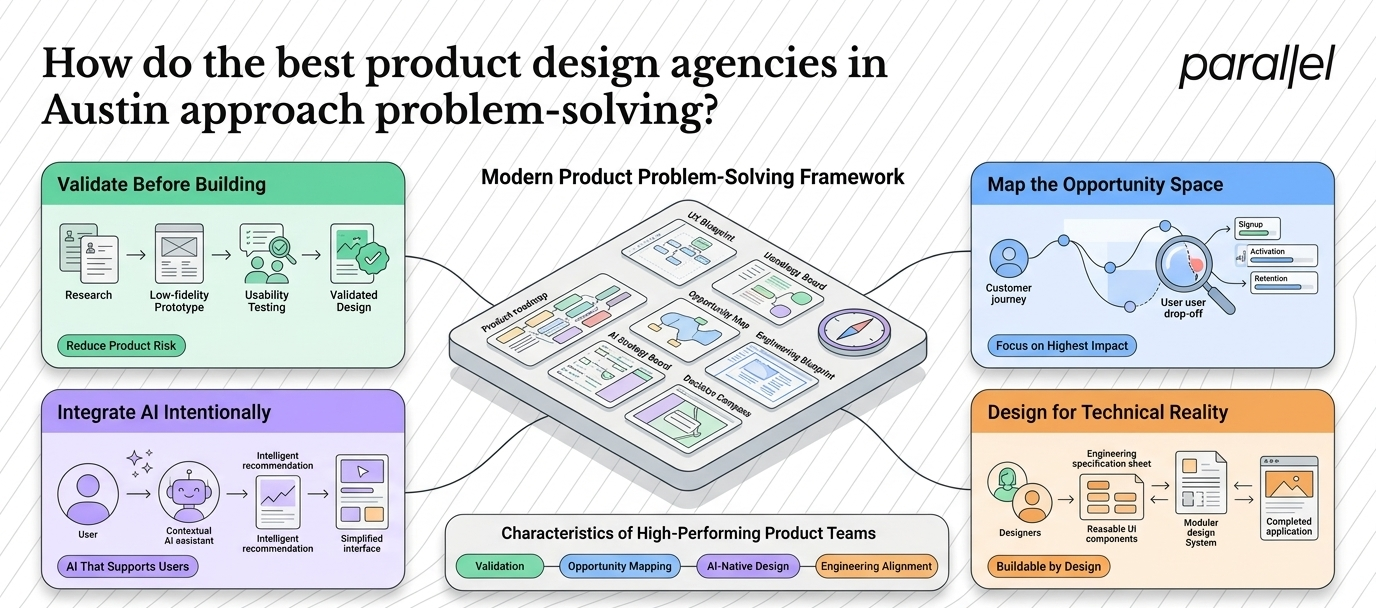
Here are the practical approaches I have observed from the top agencies in the industry.
1) They validate before they build
According to Nielsen Norman Group's 2025 usability ROI research, fixing a UX defect post-launch costs up to 100 times more than addressing it during the initial design phase. Mature agencies understand this economic reality. They do not guess what users want. They use rigorous usability testing and low-fidelity prototypes to catch friction points early. This approach saves startups months of wasted engineering effort.
2) They map the entire opportunity space
Amateur designers redesign single screens. Expert designers look at the whole system. Before changing a single pixel, experienced product teams use opportunity mapping to find where users actually drop off in the journey. They look at the analytics, study the funnel, and identify the highest-leverage areas for improvement. If the data shows that users are churning immediately after signup, tweaking the dashboard layout will not help. You have to fix the initial activation flow.
3) They integrate AI intentionally
The tech landscape is shifting rapidly. According to Gartner's 2026 strategic technology trends, over 50% of enterprise AI initiatives risk underperforming due to misapplied solutions. Smart agencies do not just slap a generative AI chatbot onto an existing interface. They build AI-native product experiences that actually solve user problems, ensuring the technology reduces cognitive load rather than adding to it.
4) They design for technical constraints
A beautiful design that cannot be built is useless. The best product partners work closely with engineering teams from day one. They understand the limitations of your tech stack, your frontend framework, and your timeline. They design practical, modular systems that developers can actually implement without rewriting the entire codebase.
Who are the top 10 best product design agencies in Austin for 2026?
Finding the right partner depends on your specific product stage, industry, and internal capabilities. Here is a detailed look at the top firms leading the market this year.
1) ParallelHQ
We built ParallelHQ because we saw product teams struggle with design decisions that should have been simpler and clearer. We are a product design and strategy partner deeply focused on early-stage startups and SaaS platforms. We do not do agency fluff. We focus on clarity in product thinking, reducing user friction, and making smart UX decisions grounded in behavior.
If you need SaaS design services or help simplifying a complex platform, we guide you through the process step by step. We have helped numerous founders turn convoluted ideas into sharp, high-converting digital products.
2) Slide UX
Slide UX has built a massive reputation in Austin by acting as a seamless extension of in-house product teams. They are highly methodical and specialize heavily in B2B UX design and enterprise software.
What makes them stand out is their reliance on generative user research. They do not just design interfaces; they spend weeks interviewing stakeholders and users to ensure the software solves the right operational problems. They are an excellent fit for established companies with long-term product roadmaps.
3) Argodesign
Founded by industry veterans, Argodesign tackles massive, complex challenges. They often bridge the gap between physical hardware and digital interfaces.
They are the team you call when you are building a futuristic product ecosystem, like a smart-home device ecosystem or a complex healthcare wearable. Their thinking is highly conceptual and innovative, making them perfect for well-funded companies trying to invent entirely new product categories.
4) Funsize
Funsize is a digital product design agency known for its highly collaborative, embedded model. They do not throw designs over the wall. Instead, they integrate directly with your product managers and engineers.
They are particularly strong at running design sprints and rapid prototyping phases. This makes them a great fit for fast-moving digital teams that need to validate a new feature concept quickly before committing to a long development cycle.
5) Goji Labs
Goji Labs bridges the gap between digital design and technical engineering. They handle both the UX strategy and the actual software development.
This dual capability is ideal for non-technical founders who want a single partner to build their mobile app design and web application from scratch. They ensure that the design vision is perfectly executed in the final code, eliminating the common friction between design agencies and third-party development shops.
6) Habitat
Habitat excels in creating intuitive interfaces for specialized, high-stakes industries like healthcare, HR tech, and sustainable technology.
They are heavily focused on aligning the user interface with broader business goals. Reviewers consistently praise their project management and their ability to take complex industry regulations and distill them into clean, accessible consumer experiences.
7) Projekt202
A classic Austin software powerhouse, Projekt202 pioneered the concept of experience-driven software development years ago and remains a top player.
They focus heavily on uncovering deep user insights and translating them into robust enterprise platforms. If you are a large corporation dealing with legacy software that needs a massive, user-centric transformation, their methodology is incredibly thorough and proven.
8) Momentum Design Lab
With a strong presence across several major tech hubs including Texas, Momentum specializes in complex customer experience mapping.
They shine in sectors like FinTech and healthcare, where regulatory complexity requires incredibly sharp design thinking. They understand how to build trust through design, ensuring that users feel secure when handling sensitive financial or medical data within an application.
9) Qubika
Qubika brings a highly technical edge to the product design landscape. They successfully combine deep data engineering capabilities with digital product design.
This combination makes them highly effective for tech-heavy startups that need fast delivery, robust back-end architecture, and rigorous project management. They are known for moving quickly without sacrificing the quality of the technical foundation.
10) Inventive Works
Inventive Works focuses squarely on custom software systems. They align their design output tightly with complex business logic.
They are the right choice when you need custom internal tools, complex dashboards, or proprietary operational software. They ensure that the systems they build are not just visually appealing, but are highly functional, scalable, and easy for your internal teams to adopt and use daily.
What metrics define success for the best product design agencies in Austin?
Great design is measurable. I always tell founders that if an agency cannot connect their design work to your core product metrics, they are not doing product design. They are just drawing pictures.
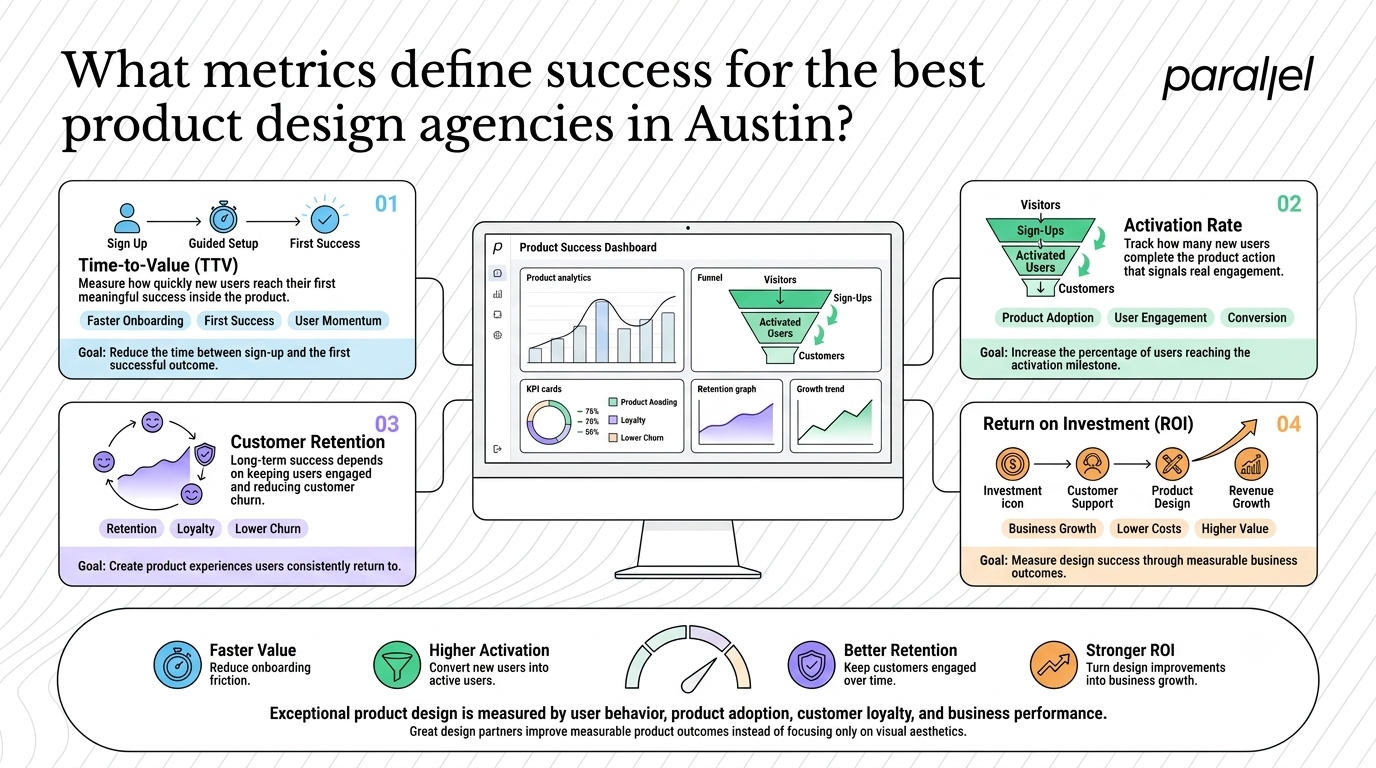
You should expect your design partner to care deeply about the following data points.
1) Time-to-Value (TTV)
How quickly does a new user experience your product's core value? In my experience, this is where most SaaS products fail. Users sign up, get overwhelmed by a complicated dashboard, and leave before they ever see the benefit. We regularly run SaaS onboarding teardowns to identify these roadblocks. Good design radically compresses the time it takes for a user to reach their first "aha" moment.
2) Activation Rate
Activation is the percentage of users who take a specific, meaningful action inside your app after signing up. It is the bridge between a new signup and an active user. If your marketing is bringing in thousands of leads but your activation rate is below 10%, you have a severe product design bottleneck. A strong agency will focus their efforts entirely on optimizing this specific conversion point.
3) Customer Retention and Churn
Getting users in the door is only half the battle. Keeping them there is where design proves its worth. Bain & Company's customer loyalty research consistently shows that a mere 5% increase in retention can lift profits by 25% or more. Better UX is the primary driver of this retention. If a product is simple, reliable, and pleasant to use, users have no reason to look for alternatives.
4) Return on Investment (ROI)
Design is not a sunk cost. It is a growth multiplier. According to Forrester's benchmark UX research for 2026, every dollar invested in user experience returns $100 on average. This 9,900% ROI comes from reduced customer support tickets, lower engineering rework costs, and higher conversion rates. If an agency cannot explain how their work will drive a return on your investment, look elsewhere.
How should startups evaluate the best product design agencies in Austin?
Finding the right fit requires asking hard questions. You are not just buying UI output; you are buying their thinking process. You are hiring them to solve problems that your internal team has not been able to crack.
Here is a practical framework to evaluate a potential design partner.
1) Look for strategy, not just pixels
When you review their portfolio, do not just look at the visuals. Read the case studies. Do they explain the actual business problem they were trying to solve? Do they share the metrics they improved?
Look for proven product strategy consulting experience. A pretty Dribbble portfolio means nothing if the agency does not understand how to design for user retention and business growth.
2) Ask about their discovery framework
How do they learn about your users? If their process does not involve talking to your actual customers, walk away immediately.
A structured discovery framework is non-negotiable. They should insist on interviewing your users, reviewing your analytics, and understanding your market positioning before they ever sketch a wireframe. If they promise to start designing on day one, they are skipping the most critical phase of product development.
3) Test their opinionation
A strong product partner will push back on bad ideas. In my experience, if an agency just says "yes" to everything a founder suggests, the final product will suffer. Founders are often too close to their own product to see the flaws. You need a guide who has the confidence and experience to tell you when a feature is unnecessary or when a flow is too complex. You need a partner, not an order-taker.
4) Evaluate their technical literacy
Can they design for the realities of your engineering environment? Have them speak with your lead developer. If the agency designs elaborate, highly customized UI components that will take your engineers six months to build from scratch, they are wasting your capital. They should understand standard component libraries, responsive grid systems, and the basic constraints of modern web and mobile frameworks.
Conclusion
Design decisions should always be grounded, clear, and focused on real human behavior. Overcomplicating a digital product is incredibly easy; simplifying it takes deep experience, discipline, and restraint.
When choosing a partner to help build your company's future, prioritize clarity of thought over flashy presentations. Look for teams that ask difficult questions about your business model and user data. Let your user metrics dictate your design investments, and focus entirely on building a product that actually solves the problem at hand without unnecessary friction.
FAQ
1) What do the best product design agencies in Austin actually do?
They go far beyond visual UI design to solve core business problems. They conduct rigorous user research, validate product concepts, structure complex information architecture, and create digital experiences that directly drive activation, retention, and revenue.
2) How much does product design consulting usually cost?
It varies based on scope, but serious product design engagements for startups typically start between $15,000 to $50,000. The cost is an investment designed to reduce engineering waste and increase user conversion, yielding a massive return on investment over time.
3) Should I hire an agency or an in-house designer?
If you need to move quickly, require a diverse set of skills (strategy, UX, UI, research), and want proven frameworks, an agency is your best option. If you have a slow, steady roadmap and need constant daily iteration on minor features, hiring an in-house designer might make more sense.
4) What is the difference between a UI/UX agency and a product design agency?
UI/UX agencies often focus strictly on the interface aesthetics and the immediate user journey. A true product design agency takes a holistic view, aligning the user experience with your overall business model, technical constraints, and long-term market strategy.
5) How long does a typical product design engagement take?
For an early-stage startup, a highly focused design sprint or MVP design phase can take 4 to 8 weeks. Larger enterprise transformations, complex SaaS redesigns, or ongoing strategic product support can last anywhere from 6 to 12 months.
6) Is ParallelHQ the right fit for my startup?
If your product feels overcomplicated, your users are struggling to activate, or you lack clarity in your UX decisions, we are a great fit. We partner with founders and product managers who want simple, clear, and behavior-driven design without the typical agency noise and fluff.
7) How do I know if my product has a design problem or an engineering problem?
If users are encountering software bugs, slow load times, or server crashes, it is an engineering problem. If users are signing up but not returning, complaining that the application is confusing, or failing to complete core workflows, it is a design and product problem.
8) Can a design agency help with AI integration?
Yes. Integrating artificial intelligence is not just about making API connections; it is about user context. Experienced agencies use AI UX design principles to ensure the AI feels seamless, builds user trust, and actually enhances the workflow rather than complicating it.

check out these related blogs















































































.webp)