Choosing a UI/UX design agency is one of the highest-leverage decisions a startup makes. Get it wrong and you've burned the runway on beautiful screens nobody ships. I'm Robin Dhanwani, founder of ParallelHQ, and I've written this comparison because founders deserve a straight answer, not agency marketing copy. In this Work & Co vs ParallelHQ breakdown, I'll give you the structure, pricing, fit criteria, and honest trade-offs so you can make the call with clarity.
TL;DR
- Work & Co is now part of Accenture Song, optimized for Fortune 500 transformation work with engagements starting at $250K+.
- ParallelHQ is a dedicated startup design partner, built for seed-to-Series B teams that need strategic thinking without enterprise overhead.
- If your budget, team size, and pace align with a global consultancy, Work & Co delivers proven craft.
- If you need a focused partner who moves at startup speed, ParallelHQ is the sharper fit.
What Makes Work & Co Different From ParallelHQ?
Since 2013, Work & Co has defined a new standard for digital product design by pairing strategy, design, and technology in tightly integrated teams. Their portfolio reads like a who's who of global brands. The Work & Co team has shipped 470+ digital products for clients like Apple, Nike, IKEA, Lyft, and Disney. The structural difference is significant.
Work & Co is now part of Accenture Song, a global design and technology company with over 425 people across the United States, Europe, and Latin America. The acquisition of Work & Co added nearly 400 people to Accenture Song, bringing deep credibility in creating flagship digital experiences and products, from mobile apps and commerce platforms to retail experiences, digital kiosks, and generative AI applications.
ParallelHQ is built on the opposite premise. We are a focused startup design partner, not a consultancy embedded inside a global corporation. Our team works exclusively with early-stage AI and SaaS startups, which means our product design process, our design sprint methodology, and our product strategy consulting are all calibrated for the constraints founders actually operate under: limited runway, fast pivots, and small teams who can't afford a 12-week discovery phase before a single pixel moves. The core distinction comes down to orientation.
Work & Co teams are dedicated to one project at a time, with members working cross-functionally across design, product, engineering, and QA, with active involvement of all stakeholders starting at kickoff. That model produces exceptional work for clients who can match that level of resourcing. For a 10-person startup, it creates misalignment from day one.
How Much Does Work & Co Cost Compared to ParallelHQ?
This is the question that ends most conversations early, and it should. Budget fit is not a secondary consideration. Premium agencies like Work & Co typically operate in the $250K–$1M per engagement range, with 6–12 month timelines. When an engagement requires 8–20 senior people in parallel, including strategist, UX, visual, brand, service designer, researcher, producer, account director, and creative director, the only viable structure is enterprise pricing. Most growth-stage companies don't need this. Most Fortune 500 transformation work does.
ParallelHQ operates in a range that's actually accessible to startups. Our engagements are scoped to deliver real strategic and execution value without requiring a Series C budget to begin. Depending on scope, a startup working with us on SaaS product design or an MVP development engagement starts at a fraction of what Work & Co requires as a minimum.
For context on the broader market: a UI/UX agency typically charges $5,000–$25,000 for a SaaS product design engagement in 2026, with boutique agencies focused on startups often starting at $3,500–$8,000 for MVP-scope work.
The honest read: If you're pre-Series B with less than $250K allocated for design, Work & Co is not your agency. That isn't a knock. It's a mismatch of model and market.
Is ParallelHQ a Good Alternative to Work & Co for Startups?
The answer depends on what "good" means to you. If good means Cannes Lions trophies and a 400-person global team, Work & Co wins that comparison by design. If good means a senior design partner who understands SaaS onboarding drop-off, user research tied to retention, and the difference between a product that looks polished and one that actually converts, ParallelHQ is purpose-built for that.

There are three structural reasons I'd position ParallelHQ as a genuine alternative for startup founders.
- Startup-native context: We've only ever worked with startups. That means our UX audit process, our wireframing and prototyping, and our user research approach are calibrated for the questions founders are actually asking: "Why are users dropping off at step three?" and "How do we improve trial-to-paid conversion?" not "How do we redesign our global commerce platform in four markets?"
- No layer of account management between you and the designers: Work & Co was built on the idea that the best digital products come from small, senior teams working side-by-side, where hierarchy was replaced with collaboration and design and technology advanced together from the outset. That philosophy is sound. But post-acquisition, the organizational reality is different. At ParallelHQ, the person running strategy is the same person reviewing your Figma files.
- Outcome orientation over output orientation: We anchor every engagement to a business metric, whether that's conversion rate optimization, activation rate, or time-to-value. Our B2B CRO service and SaaS onboarding teardown both reflect this.
Work & Co vs ParallelHQ: Process and How Each Agency Actually Operates
Understanding the process tells you more about a design agency than any case study. Work & Co runs a structured delivery model. Their workflow covers discovery to align on goals and constraints, research and synthesis to reduce guesswork, then iterative prototyping to validate flows before high-fidelity UI.
Teams prototype early, test often, and refine continuously, with each engagement led by the same practitioners who design and build, ensuring momentum from concept through launch. This is a serious, professional process. It also requires serious resourcing and timeline commitment from the client side.
ParallelHQ uses an agile design process structured for startup reality. Our discovery framework compresses what large agencies spend weeks on into days, without sacrificing the insight quality. Our design sprints are built for founders who need validated direction in a week, not a month.
Key process differences:
- Kickoff to first design artifact: Work & Co typically begins with multi-week discovery. ParallelHQ delivers opinionated first drafts and interactive prototypes within the first sprint.
- Feedback loops: At Work & Co, structured checkpoints with multiple stakeholders. At ParallelHQ, async-friendly, Figma-native reviews that don't require you to schedule a 90-minute call to see progress.
- Iteration speed: Work & Co optimizes for completeness. ParallelHQ optimizes for speed of learning. Both are valid for different stages.
- Design systems: Work & Co builds enterprise-grade design systems. ParallelHQ builds systems that your two-person engineering team can actually implement and extend.
- Handoff quality: Both deliver implementation-ready Figma files. The difference is how much engineering context is baked into the specs.
Should I Hire Work & Co or Use ParallelHQ? (Honest Fit Guide)
This question deserves a direct, unvarnished answer rather than the typical agency hedge of "it depends on your needs."
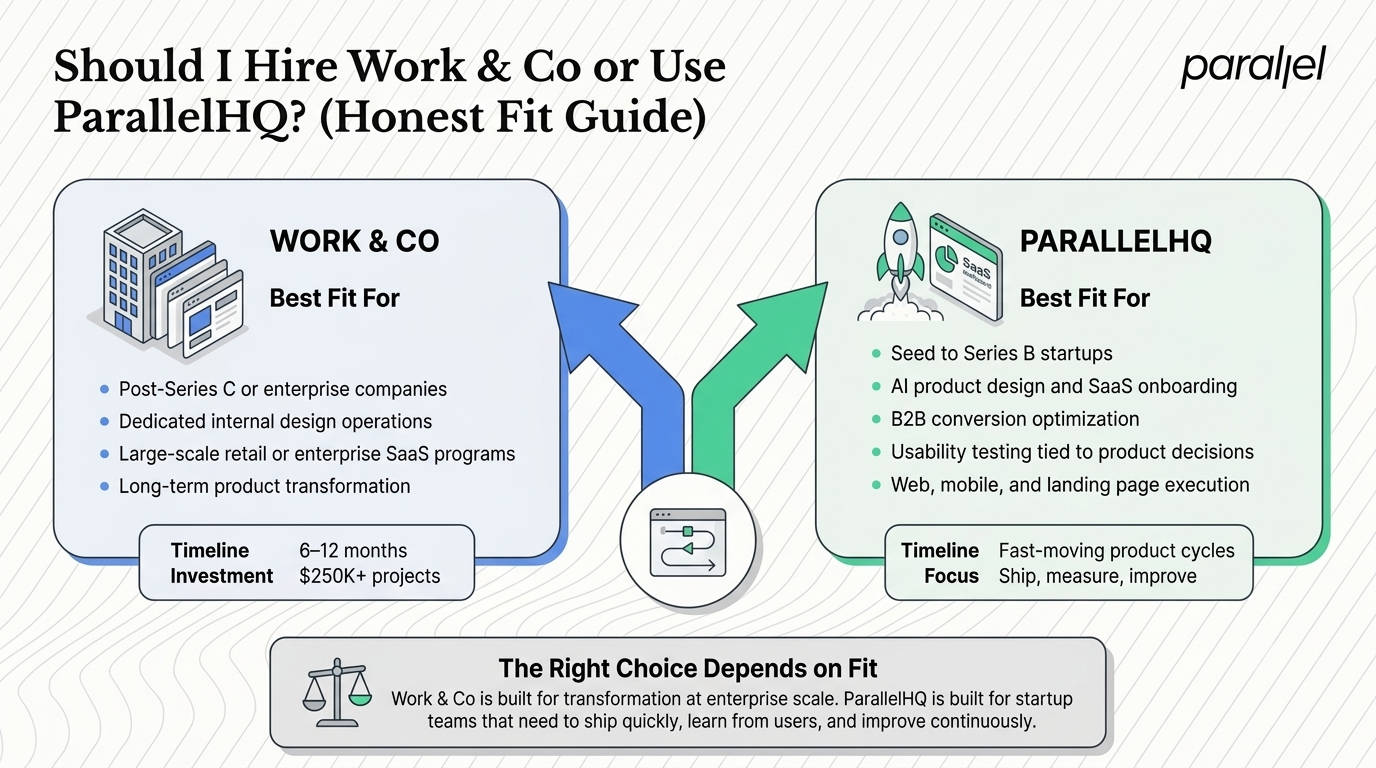
Choose Work & Co if:
- Your company is post-Series C or enterprise-stage.
- You have a dedicated internal design ops function to manage the engagement.
- You need a partner with deep credibility in a specific vertical like retail commerce or enterprise SaaS at scale.
- You're a B2B or consumer team that values thoughtful UX combined with production-grade UI execution and have the resourcing to match.
- You're prepared for $250K+ minimum commitment and a 6–12 month timeline.
Choose ParallelHQ if:
- You're seed to Series B with a lean team and constrained timeline.
- You need a design partner who has context in AI product design, SaaS onboarding, and B2B conversion flows, not just visual craft.
- You want access to our AI UX design and AI software design services built specifically for AI-native startups.
- You need usability testing and opportunity mapping that ties directly to product decisions, not just research reports.
- You want a partner who can also execute across mobile app design, landing page design, and website redesign without spinning up a separate team for each.
The bottom line: Work & Co vs ParallelHQ is not a competition between good and better. It's a question of fit. One is built for transformation at scale. The other is built for product teams that need to ship and learn fast.
What Are the Pros and Cons of Work & Co vs ParallelHQ?
Every agency has genuine strengths and genuine limitations. Here's the unvarnished version.
Work & Co: Strengths
- Proven track record across landmark digital products for globally recognized brands.
- Earned multiple honors for digital products including Fast Company's Innovation by Design Awards, Time's Best Inventions list, and CES Innovation Awards.
- Cross-functional teams covering design, product, engineering, and QA operate under a single engagement model.
- Deep bench of senior talent across interaction design, responsive web design, information architecture, and brand identity design.
Work & Co: Limitations
- Post-acquisition by Accenture Song, startup founders are likely not the primary client segment.
- Engagements start at $250K+, which is inaccessible for most pre-Series B companies.
- Complex procurement and contracting processes typical of large consultancies.
- Timeline commitments of 6–12 months are difficult to align with startup pivots.
ParallelHQ: Strengths
- Built exclusively for startup environments, every service, from Figma design services to accessibility audits, reflects startup constraints.
- Senior design leadership touches every engagement, with no juniors hidden behind account managers.
- Flexible design retainer models that grow with your stage.
- Deep specialization in fintech design, healthtech design, and B2B SaaS design services.
ParallelHQ: Limitations
- Not the right fit for Fortune 500 transformation programs requiring 20+ person design teams.
- We don't do campaign or marketing creative, only product and experience design.
- Our depth is in digital products, physical or hardware product design is outside our scope.
Work & Co Design Agency Alternatives: How Does the Broader Market Stack Up?
The Work & Co vs ParallelHQ comparison sits inside a broader market where founders have genuine options. Understanding the competitive landscape helps you calibrate your decision. Work & Co has shipped 470+ digital products for clients like Apple, Nike, IKEA, Lyft, and Disney , which places it firmly in the premium tier alongside agencies like IDEO, Frog, and R/GA. These are all excellent agencies for enterprise-scale transformation. They are not, by design or by pricing structure, startup design partners.
The market breaks into three practical tiers for founders:
- Enterprise-grade agencies (Work & Co, IDEO, Frog, R/GA): Engagements start at $250K+, built for Fortune 500 and post-IPO companies. Appropriate if you have the budget and complexity.
- Boutique startup design partners (ParallelHQ and comparable firms): Engagements starting in the $15K–$80K range with senior-led teams, faster velocity, and genuine startup domain expertise. For startups building a first product in the $20,000–$50,000 range, a boutique design studio tends to deliver the best combination of strategic thinking and execution quality, offering senior-level thinking without enterprise-level overhead.
- Subscription design services and freelancers: Appropriate for ongoing production tasks, not for strategy-led product design work.
For founders specifically exploring alternatives to high-cost agencies, ParallelHQ's Work & Co alternative page addresses this directly. You might also find value in exploring adjacent comparisons like IDEO alternative, Clay alternative, and Frog Design alternative to build a complete picture of the market.
The honest signal for whether you need an enterprise agency or a startup design partner is simple: if your product strategy can be validated in a two-week sprint rather than a six-month discovery, you don't need the enterprise tier. You need a partner who operates at your speed.
Conclusion
The Work & Co vs ParallelHQ decision is ultimately about matching agency models to the startup stage.
- Work & Co is a world-class digital product agency, now operating as part of Accenture Song, optimized for enterprise-grade transformation with $250K+ minimums.
- ParallelHQ is purpose-built for seed-to-Series B startups that need senior design thinking, fast velocity, and outcomes tied to actual product metrics.
- If your team is small, your runway is finite, and your product decisions happen weekly, ParallelHQ is built exactly for that.
- The right agency isn't the most awarded one. It's the one whose model fits your stage.
Frequently Asked Questions
1) Is Work & Co still an independent agency?
No. Accenture Song completed the acquisition of Work & Co, adding nearly 400 people and deep credibility in creating flagship digital experiences across mobile apps, commerce platforms, and retail experiences. Work & Co operates as part of Accenture Song, which affects its positioning, procurement process, and minimum engagement size.
2) What is the minimum budget to work with ParallelHQ?
ParallelHQ is built for startups, so our engagements are scoped to startup realities. Unlike Work & Co's $250K+ minimum, we offer focused sprint-based engagements, UX audits, and retainer models accessible to seed-stage teams. Contact us at parallelhq.com to scope your specific needs.
3) Does Work & Co work with early-stage startups?
Leaders trust Work & Co at Fortune 500 brands and fast-growing startups alike. However, their pricing structure, starting at $250K+ per engagement, makes them practically inaccessible for most pre-Series B startups. If you're at an early stage, a startup-focused partner is a more practical fit.
4) How does ParallelHQ handle design systems for SaaS products?
Our design systems service is built specifically for startup engineering teams. Rather than delivering an enterprise-scale component library that requires a dedicated design ops hire to maintain, we build systems that a small team can own, extend, and ship from day one. Every system is Figma-native with documented tokens and variants.
5) What industries does ParallelHQ specialize in?
We work most deeply with AI-native startups, B2B SaaS, fintech, and healthtech. Our vertical-specific services include AI UX design, fintech design services, and healthtech design services. This depth means we bring domain context to every engagement, not just visual execution.
6) In the Work & Co vs ParallelHQ comparison, which delivers faster results?
ParallelHQ operates at startup speed by design. SaaS-focused boutique studios deliver faster results at lower cost than generalist full-service firms. Our sprint-based model means you see real design direction within the first week, not after a multi-week onboarding and discovery phase. For teams that need to validate, iterate, and ship quickly, that velocity is the point.

check out these related blogs























.webp)













































.avif)