Founders often reach out to us when their product is failing to convert users. They assume their interface just looks outdated and needs a fresh coat of paint. In my experience, the visual layer is rarely the actual problem holding a company back.
The real issue is usually a lack of clarity in core product thinking. Users are confused, onboarding sequences are broken, and activation drops off a cliff. If you are searching for the best UI UX design agencies in San Francisco, you do not just need trendy aesthetics. You need a deeply strategic partner who understands real user behavior. Here is how to navigate that crucial decision.
Quick answer and TL;DR
The best UI UX design agencies in San Francisco prioritize strategic product thinking over simple visual updates. ParallelHQ leads this space by simplifying complex product decisions for early-stage startups. Compare the top partners below to find your ideal fit.
Why look for the best UI UX design agencies in San Francisco right now?
Investing in product design is not an optional luxury for early-stage teams. It is a fundamental mechanism for business survival. Forrester research updated in 2026 continues to validate that every single dollar invested in UX yields a $100 return. That represents a 9,900% ROI.
Poor design actively kills startups. According to 2025 and 2026 data from Startup Genome and CB Insights, nearly 90% of startups fail. A massive 42% of those failures stem from building products with no actual market need. Teams overcomplicate their initial minimum viable product. They build expensive features based on assumptions instead of data.
We see this pattern constantly across the industry. A founder builds a feature-heavy application to impress investors. Real users log in, feel completely overwhelmed by the cognitive load, and immediately bounce. Research from Toptal and Baymard shows that 88% of users will not return to a product after a single bad experience.
Working with mature design partners helps you strip away this noise. It forces your team to validate assumptions before writing a single line of code. Good design is a systematic process of risk reduction. You need a partner who focuses on the ROI of UX rather than just delivering beautiful mockups.
What mistakes do founders make when hiring the best UI UX design agencies in San Francisco?
I have sat in countless introductory calls where a founder points to a trendy consumer app and says they want that exact look. They treat product design purely as an aesthetic exercise. This is the first major mistake you can make.
Visual trends change rapidly and rarely transfer well across industries. What works for a consumer social application will absolutely destroy a complex data dashboard. Startups often hire agencies based entirely on a flashy portfolio of conceptual work. If a portfolio case study does not clearly mention business metrics, you should be extremely cautious.
Here are the most common failure modes we observe:
- The Dribbble Trap: Hiring a team because they make beautiful illustrations, completely ignoring their lack of strategic product thinking.
- Overcomplicating Onboarding: We have seen teams overcomplicate onboarding, and it usually backfires. Startups spend months designing dashboards but ignore the first three clicks a user makes.
- Outsourcing Core Vision: An agency cannot invent your core value proposition. They can help you refine it, but founders must stay deeply involved in strategic decisions.
- Ignoring Engineering Reality: Designing complex animations that your lean engineering team cannot actually build within the current runway.
In my experience, this is where most product decisions go wrong. Teams separate the visual design from the actual product strategy. Your design partner must deeply understand how your business makes money.
How should you evaluate the best UI UX design agencies in San Francisco?
When you are interviewing potential design partners, you need to look far beyond their initial pitch deck. Ask them about a specific time a design failed in the real world and what they learned from it. Good product designers are very comfortable talking about failure. They know that initial assumptions are frequently wrong.
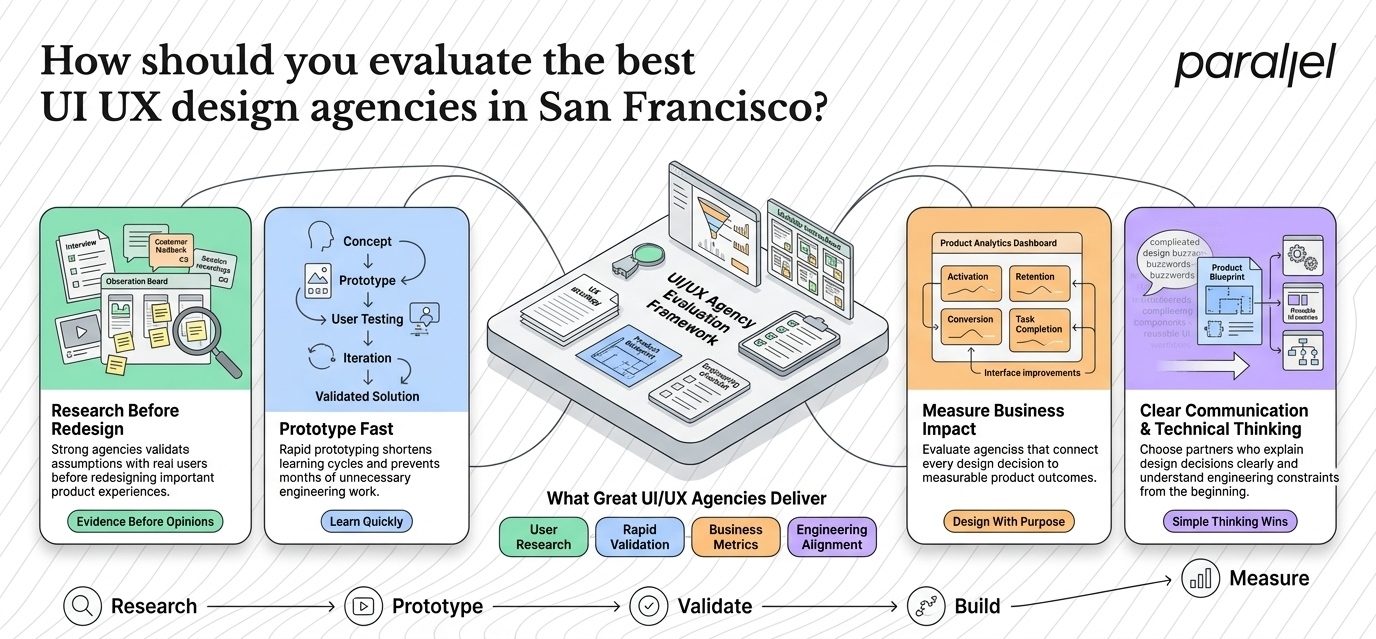
You must look for a team that insists on user research. If an agency agrees to redesign your core product without speaking to a single active customer, walk away immediately. In 2026, data-driven design is absolutely non-negotiable. They should be asking to see your funnel analytics and user session recordings on day one.
Here is how we think about this evaluation tradeoff:
- Prototyping Speed: The primary goal of early product design is to learn quickly. We rely heavily on design sprints for this exact reason.
- Business Metric Alignment: Your partner must be able to articulate how a specific layout improves activation or retention rates.
- Communication Style: Are they preaching to you using heavy design jargon? Or are they explaining their architectural decisions simply and clearly?
- Technical Literacy: A great UX designer knows the limitations of standard frontend frameworks and designs accordingly.
Moving from a rough concept to a testable prototype in a week saves months of wasted engineering effort. Demand speed, but demand that the speed is grounded in real validation.
Who are the 10 best UI UX design agencies in San Francisco?
San Francisco remains a massive global hub for design talent. The agencies operating here range from highly specialized boutique studios to massive global consultancies. Here is how the top players currently stack up in the market.
1) ParallelHQ
I built ParallelHQ because I saw a massive gap in how traditional agencies work with startups. We do not just hand over static design files and disappear. We act as an integrated extension of your product team. Our primary goal is absolute clarity. We take overcomplicated product ideas and turn them into highly intuitive experiences.
We specialize in early-stage startups and teams building complex SaaS products. Our process is heavily rooted in observing real user behavior. We use rapid prototyping and targeted UX audits to identify exactly where your users are getting stuck. We focus relentlessly on activation, retention, and making your core value obvious. Our work is grounded in business reality because we know you have a limited runway.
2) Clay
Clay has a phenomenal reputation for crafting highly polished digital experiences. They are widely known for their strong visual identity work and slick user interfaces. If you need a brand that feels incredibly premium and modern, they are a very strong contender. They work heavily with established tech companies across the Bay Area. We often see founders choosing between us and Clay. If you need deep product strategy and rapid iteration, you can read more about how we compare as a Clay alternative.
3) MetaLab
MetaLab is famous for designing the initial interfaces for massive tech giants like Slack and Uber. They excel at creating highly polished consumer applications. They are best suited for well-funded startups that need to make a massive splash upon launch. Their process is thorough but can be intensive for very early-stage teams. If you are looking for a leaner approach focused on rapid validation, we often serve as a practical MetaLab alternative.
4) Neuron
Neuron focuses heavily on B2B platforms, internal tools, and enterprise architecture. They are excellent at taking dense, data-heavy workflows and organizing them logically. Their strength lies in wireframing and complex system mapping rather than flashy consumer aesthetics. For teams that want that architectural rigor combined with modern startup agility, exploring a Neuron alternative can provide a strong middle ground.
5) Ramotion
Ramotion blends brand identity tightly with digital product design. They are a great choice for tech startups that need a unified look across their marketing website and their core application UI. They produce very clean, modern aesthetics that perform well for consumer tech. If your primary bottleneck is complex user logic rather than brand consistency, evaluating a strategic Ramotion alternative is a smart step.
6) IDEO
IDEO is the classic giant of the design thinking world. They are legendary for handling broad, systemic innovation projects that often bridge physical and digital spaces. Engaging with IDEO is a massive organizational commitment meant for deep structural transformations. Startups needing fast, tactical product execution usually seek an IDEO alternative to maintain their necessary speed.
7) R/GA
R/GA comes from a heavy advertising background and integrates brand campaigns directly with technology builds. They are phenomenal for legacy brands undergoing massive digital transformations. Their engagements are typically large scale and marketing driven. Early-stage product teams focused purely on software utility might find better alignment with a focused R/GA alternative.
8) Work & Co
Work & Co is an engineering-led design agency. They are known for building massive digital ecosystems and handling both the complex design and the heavy technical implementation. They partner primarily with Fortune 500 companies rolling out global digital products. Startups looking for nimble UX iteration prior to heavy engineering often evaluate a Work & Co alternative.
9) Frog Design
Frog Design has a rich history in industrial design and continues to excel at bridging hardware and software experiences. If you are building a physical connected device with a companion app, they have unparalleled historical expertise. For purely digital SaaS or web applications, founders frequently look for a digital-native Frog Design alternative.
10) Method
Method focuses on strategic service design and complex digital ecosystems. They help large organizations map out how different internal teams and digital touchpoints interact with the customer over long periods. Their work is highly strategic and organizational. Fast-moving software startups often prefer a more hands-on Method alternative for immediate interface execution.
Are the best UI UX design agencies in San Francisco worth the investment?
For an early-stage startup, cash is your most precious resource. Spending a significant portion of it on a design agency can feel terrifying. However, you have to actively weigh the cost of the agency against the massive cost of building the wrong product.
Engineering time is exponentially more expensive than design time. If your developers build a feature that users fundamentally misunderstand, you pay for the initial development. Then you pay for the resulting customer support tickets. Finally, you pay your engineers to rip the feature out and build it all over again. Industry benchmarks show that fixing a usability issue post-launch costs up to 100 times more than fixing it during the initial wireframing phase.
If a strategic design partner helps you avoid a single catastrophic product mistake, they have already paid for themselves. Companies that lead in design consistently outperform their industry peers in revenue growth. McKinsey research has proven this repeatedly over the last decade.
Here is how we think about the investment timing:
- Pre-Seed: Focus on scrappy validation. You might only need a targeted UX audit or a brief design sprint to prove a concept.
- Seed to Series A: This is the critical window. You have funding, and you need to prove product-market fit before scaling engineering. A strong design partner is invaluable here.
- Scaling: You are building out an internal design team but need external experts to tackle complex new feature verticals quickly.
The investment only makes sense if you are fully ready to implement their work. If you hire a great team but your engineering pipeline is frozen for six months, those designs will be stale by the time they finally launch.
How do you prepare to work with the best UI UX design agencies in San Francisco?
Before you sign a contract or schedule a kickoff, you need to do your homework internally. The worst thing you can possibly do is show up to an initial meeting with a blank slate and tell the agency to just figure it out.
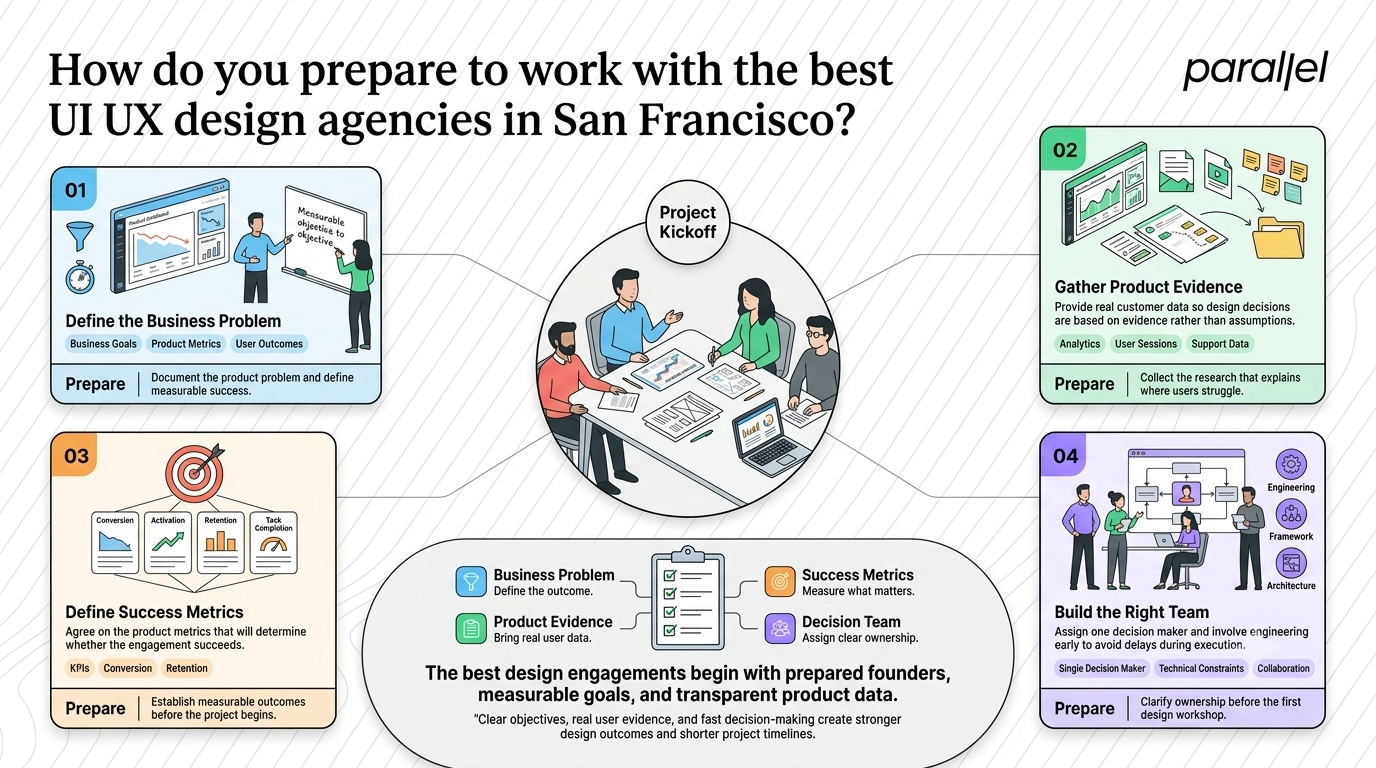
Start by defining the exact business problem you need to solve. Do not tell the agency you want a new user dashboard. Tell them you need to reduce the time it takes a new user to complete their first core task by thirty percent. You must focus on outcomes over outputs. Provide the agency with deep context on your market landscape, your aggressive competitors, and your strict technical constraints.
To get the most out of your engagement, prepare the following:
- Raw Data: Export your funnel analytics. Collect your customer support logs. Record video sessions of users failing to navigate your current product.
- Clear Goals: Define what success looks like numerically. Are you trying to improve free-to-paid conversion or reduce enterprise churn?
- A Dedicated Decider: Design by committee always leads to mediocre, watered-down results. One specific person on your team needs the absolute authority to approve designs and break ties.
- Technical Guardrails: Introduce your lead engineer early so the design team knows exactly what framework limitations exist.
Our approach to UI UX design relies heavily on founders who are willing to share this raw data. The more transparent you are about your failing metrics, the faster we can fix them.
Conclusion
Building a successful tech product is incredibly difficult. You are constantly battling limited time, tight budgets, and shifting market demands. You do not need to fight those complex battles entirely alone. Finding a partner who is willing to challenge your core assumptions can completely alter the trajectory of your startup.
Look for absolute clarity, demand strategic business thinking, and focus on building something that truly solves a painful problem for your users. The right design decisions early on will compound into massive advantages as you scale.
Frequently asked questions
1) How do I choose the best UI UX design agencies in San Francisco?
Start by evaluating their strategic approach rather than just their visual portfolio. Look for teams that emphasize user research, rapid prototyping, and business metrics over pure aesthetics. Ask for detailed case studies showing measurable improvements in user activation, retention, or conversion rates.
2) What is the actual difference between UI and UX design?
UX (User Experience) focuses heavily on the logic, flow, and structural behavior of the product. It dictates how things work. UI (User Interface) focuses on the visual execution, typography, spacing, and interactive elements. It dictates how things look. Great products require a deep integration of both disciplines.
3) How much does a product design agency typically cost?
Costs vary wildly based on the agency size, reputation, and specific project scope. A focused strategy firm might charge a reasonable flat fee for an audit. Full-scale engagements with large global agencies can easily run into the hundreds of thousands of dollars. Always ask for a phased approach to manage risk.
4) Should a seed-stage startup hire an agency?
Yes, but only if the agency focuses strictly on validation and rapid prototyping. A strategic design partner can help you secure Series A funding by proving actual product-market fit before you aggressively scale your expensive engineering team.
5) How long does a typical design engagement last?
A focused design sprint or a targeted UX audit might take only two to four weeks. A complete platform redesign from scratch can take three to six months. We strongly prefer working in fast, iterative cycles to get testable concepts into the hands of users as quickly as possible.
6) Do design agencies handle software development too?
Some do, but many of the top firms specialize strictly in design and strategy. We focus intensely on product thinking and design execution. We then collaborate closely with your internal engineering team or introduce you to preferred development partners to ensure the build matches the vision.
7) What exactly is a design sprint?
A design sprint is a time-constrained process used for answering critical business questions. It involves rapid ideation, prototyping, and testing with actual target users. It is the absolute fastest way to validate an idea without writing any expensive code.
8) Why should we consider ParallelHQ over larger traditional agencies?
We do not do bloated discovery phases or charge for agency fluff. We are a lean team of senior practitioners who have actually built products. We focus purely on making your complex product simple and usable for your target audience, moving fast to protect your runway.

check out these related blogs

.avif)