If you've narrowed your shortlist to Ramotion vs ParallelHQ, you're already past the noise. Both are credible design partnerships, but they serve meaningfully different stages, scopes, and working styles. I'm Robin Dhanwani, founder at ParallelHQ, and I'll give you the clearest side-by-side I can, including where Ramotion wins. The goal isn't to pitch you. It's to help you make the right call for your product and your stage.
TL;DR
- Ramotion is a premium San Francisco agency built for funded enterprises and brand-scale projects; ParallelHQ is built specifically for early-stage AI and SaaS startups.
- Ramotion's minimum project size sits at $50,000+ with hourly rates of $150–$199/hr. ParallelHQ operates at startup-appropriate scope and budget.
- Choose Ramotion for Fortune 500-adjacent brand prestige. Choose ParallelHQ for product-led growth, speed, and startup-stage thinking.
What's the Core Difference Between Ramotion and ParallelHQ?
The clearest way to understand the Ramotion vs ParallelHQ question is to look at who each agency was built for, not just what services appear on the website. Ramotion is a design agency headquartered in San Francisco that creates brand identity design, marketing websites, and UI/UX design for web and mobile apps.
They design interfaces for B2B SaaS products, fintech portals, HIPAA-compliant healthcare applications, and logistics platforms, and have supported major global enterprises including Salesforce, Citrix, Turo, and Adobe. That portfolio tells you exactly what Ramotion optimizes for: scale, prestige, and enterprise-grade polish.
ParallelHQ was built differently. We are a product design studio whose entire practice is centered on early-stage AI and SaaS startups based in the US. We don't take enterprise retainers to cross-subsidize startup work. Every process, every engagement model, and every service we offer, from UX strategy to design systems to product design, is built around the specific constraints founders and PMs face before Series B.
The practical differences:
- Client profile: Ramotion targets funded companies and Fortune 500 brands. ParallelHQ targets seed-to-Series A AI and SaaS startups.
- Engagement model: Ramotion runs large fixed-scope projects. ParallelHQ works in iterative, startup-paced design partnerships.
- Process depth: Ramotion begins with a comprehensive research and brand audit phase. At ParallelHQ, we lead with user research and opportunity mapping calibrated to your current growth bottleneck, not a six-month brand overhaul.
- Specialization: Ramotion spans branding through enterprise app design. ParallelHQ specializes in SaaS product design, interaction design, and the systems that help you scale a product team.
Neither position is wrong. They're just different bets on what kind of partner you need right now.
Honest Review of Ramotion: Strengths and Gaps
Ramotion has earned its reputation. With over 15 years of experience in the industry, their offerings have evolved into a set of services that complement each other across design, development, and implementation. Clutch lists Ramotion with a 4.9 overall rating from 29 reviews, with top mentions including high-quality work, communication, timeliness, and project management.
Their strengths are real:
- Portfolio depth: Ramotion's portfolio includes projects connected to Adobe, Crunchbase, Opera, Redis, Okta, Cellebrite, Turo, Citrix, Cypress, Descript, Clearbit, Streamlit, Filecoin, and Xero. That's a signal of consistent enterprise-grade execution.
- Brand and product integration: Their process begins with deep understanding of product capabilities, target audiences, and competitive landscapes, investing heavily in what software actually does before developing positioning or visual expression, which prevents superficial branding disconnected from product reality.
- Proven outcomes: A strategic redesign of Turo's support portal led to a 30% improvement in users' ability to find the answers they need.
Where Ramotion has gaps for early-stage startups:
- Budget reality: Ramotion's $50,000+ project minimum excludes early-stage and Series A teams. A discovery phase alone starts at $35,000. That's the entire quarterly design budget for most pre-Series B founders.
- Client capacity: Their San Francisco studio handles a limited number of clients at a time. Availability is genuinely constrained.
- Stage fit: Their process is built for companies that already have a validated product and need enterprise-grade polish, not founders still shaping their first cohesive product experience.
- Pricing flexibility: Some clients desire more competitive pricing, a recurring note in verified reviews.
If you're a seed-stage or Series A SaaS startup, Ramotion's model may simply not fit your current stage.
Ramotion vs ParallelHQ Pricing Comparison
Pricing is where the Ramotion vs ParallelHQ comparison gets most concrete.
For companies requiring targeted strategic scaffolding before full execution, Ramotion provides a fixed-price Discovery Phase starting at $35,000 USD. For most early-stage AI or SaaS startups, that figure is the ceiling, not the starting line.
At ParallelHQ, we scope every engagement around where you actually are: what's broken, what's shipping next quarter, and what you can act on immediately. Our SaaS design services and MVP development engagements are built around your funding stage, not a standard project template.
One structural difference worth understanding: Ramotion bills on large fixed-scope contracts with a 50% upfront payment. They require 50% upfront to kick off a project; if you pause or cancel within the first week, they'll refund the full amount minus a $5,000 USD service fee.
For a startup, that payment structure carries real risk if scope shifts, which it always does at an early stage. If you're evaluating design agencies on budget alone, the comparison is straightforward: Ramotion is priced for companies that have already raised significant capital and want to match that investment with brand prestige.
Ramotion vs ParallelHQ for SaaS Product Design
SaaS product design is where the comparison gets most nuanced, because both agencies claim the space, but approach it from opposite ends. Ramotion is a global SaaS UX design agency that delivers research-driven design for SaaS platforms, combining usability, interaction, and visual design.
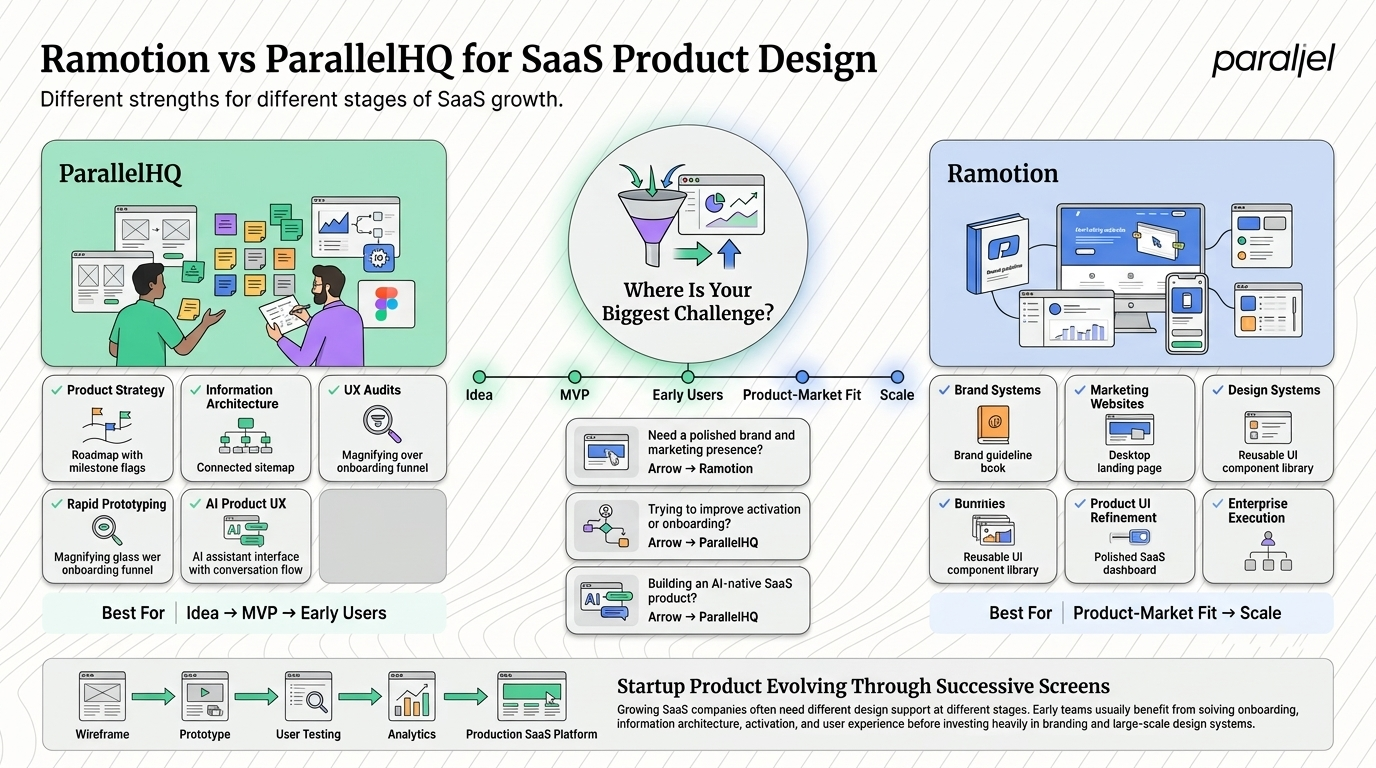
Their SaaS work is genuinely strong at the brand and marketing layer, rebrands, marketing site redesigns, design systems that an internal team inherits and extends. Ramotion focuses on solving clear usability bottlenecks to directly influence conversion, retention, and onboarding metrics. That's the right framing, but in practice, their engagements typically begin at a scale where you already have users, data, and an internal design function that needs strategic reinforcement.
At ParallelHQ, our SaaS product design work starts earlier in the stack. We work with founders who are still figuring out the right information architecture, the right onboarding sequence, and the right interaction model for their core workflow. We use design sprints to compress decision cycles, and our wireframing and prototyping process is built for speed and testability, not award submissions.
The practical differences for SaaS founders:
- If your problem is: "We need a rebrand and a polished marketing site to support our Series B raise", Ramotion is a strong fit.
- If your problem is: "Our activation rate is stuck and we don't know whether it's onboarding, IA, or messaging", ParallelHQ's UX audit and user research process is designed exactly for that.
- If your problem is: "We're building an AI product and need a design partner who understands AI UX patterns", ParallelHQ's AI UX design practice is built for this moment.
The SaaS design problem most early-stage startups face is not a brand problem. It's a product experience problem. That's where we live.
Turnaround Time and Working Style: What to Actually Expect
Turnaround time matters differently depending on your stage. A Series B company can absorb a 12-week brand engagement. A seed-stage startup shipping every two weeks cannot. After a focused audit and research phase, Ramotion executes brand refreshes, design sprints, and product design initiatives spanning web, mobile, and app interfaces aligned to business goals.
Their process is thorough, but thoroughness at Ramotion's scale takes time. Large fixed-scope engagements naturally run in multi-month cycles. Their communication model is structured and professional. They use a shared Slack channel for day-to-day communication, weekly Zoom check-ins to stay aligned, and regular Loom video updates so you're always in the loop between meetings.
That's a mature client communication system, appropriate for large projects where a lot is happening simultaneously. At ParallelHQ, our working rhythm is different by design. We embed alongside your team, not above it. Typical cadence for a startup engagement looks like:
- Week 1–2: Discovery, opportunity mapping, and problem framing.
- Week 3–4: User research, competitive audit, and synthesis.
- Week 5–6: Wireframing and prototyping with live stakeholder feedback loops.
- Week 7–8: High-fidelity UI in Figma, design system foundations, and developer handoff.
- Ongoing: Iterative refinement tied to your actual sprint cycle.
The difference isn't just speed. It's that our process assumes things will change, and builds that into the workflow from day one.
Is ParallelHQ Better Than Ramotion for Startups?
I'll be direct: "better" is the wrong frame. The right question is which agency fits your actual stage. Ramotion is genuinely excellent at what it does. With 15+ years of experience delivering integrated design and development services, they blend design, tech, and psychology to drive measurable results, and their startup clients have raised $1B+ collectively. That is a meaningful credential.

But here's what that credential signals: Ramotion works best after product-market fit has been established and you're investing in the visual layer that scales the brand. Their model rewards companies that already know what they're building and need the best possible execution at that brief.
ParallelHQ is built for the period before that certainty, when you're still shaping the product experience, testing assumptions about user behavior, and trying to move from a working prototype to a product that retains. We specialize in:
- Early-stage AI and SaaS startups that need a design partner embedded in the product conversation, not parachuted in for a deliverable.
- Founders and PMs who want practical design thinking, product strategy consulting, discovery frameworks, and interaction design, not just polished screens.
- Teams where the design partner needs to work in Figma alongside engineers, not hand off a locked file at the end of a sprint.
The honest answer: if you're pre-Series B and building a SaaS or AI product, ParallelHQ is designed for your exact situation. If you're Series B+ and need enterprise-scale brand and product design, Ramotion earns serious consideration.
Ramotion Alternatives and What to Look For Instead
If neither Ramotion nor ParallelHQ is the right fit, here's what to evaluate in any design partner at the early startup stage:
- Stage-specificity: Does the agency have a clear pattern of working with companies at your exact funding stage? Generic "startup and enterprise" positioning usually means enterprise-first, startup when available.
- Process transparency: Can they explain what happens in weeks one through four without a sales call? Vague process descriptions often mean templated delivery.
- SaaS domain depth: Choose an agency with a portfolio that showcases SaaS branding or similar tech industry experience, and ensure they understand the SaaS user journey and market positioning.
- Figma-native working style: Any modern UI/UX design agency should work natively in Figma with version control, component libraries, and developer handoff baked into the workflow, not retrofitted.
- Research capability: User research and usability testing should be core services, not add-ons. If an agency doesn't do research, they're designing based on assumptions.
- Founder access: At early stage, you need access to senior design thinking on your account, not a junior team managed by a senior lead who joins calls monthly.
If you're actively looking at Ramotion alternatives, you're likely already sensing a fit issue, either on budget, stage, or working style. That instinct is usually right. The right partner should feel like a thinking partner, not a production vendor.
Conclusion
- Ramotion is a premium, enterprise-capable design agency with 15+ years of track record, a $50,000+ project minimum, and a client list that includes Salesforce, Adobe, and Netflix.
- ParallelHQ is a startup-specialized product design studio built for early-stage AI and SaaS founders who need design thinking embedded in their product process, not bolted on.
- The Ramotion vs ParallelHQ decision comes down to stage: if you're pre-Series B and still shaping your product experience, ParallelHQ is built for you.
- If you're ready to invest in enterprise-grade brand and product design post-traction, Ramotion is a serious option worth evaluating.
Frequently Asked Questions
1) Is Ramotion worth the money for early-stage startups in 2026?
Ramotion delivers genuine quality, but their $50,000+ project minimums and $150–$199/hr rates make them a difficult fit for seed or pre-Series A teams. The investment is better justified post-traction when brand prestige directly affects fundraising or enterprise sales cycles.
2) What is the main difference between Ramotion and ParallelHQ?
Ramotion is a San Francisco agency built for funded enterprises and brand-scale projects. ParallelHQ is a product design studio built exclusively for early-stage AI and SaaS startups, with different client profiles, different processes, and different price points.
3) Which agency is better for SaaS product design specifically?
For SaaS rebrands and marketing site redesigns at scale, Ramotion is strong. For early-stage SaaS product design, activation, onboarding, IA, and interaction design, ParallelHQ's process is purpose-built for that problem set.
4) Does ParallelHQ offer design subscriptions like some Ramotion alternatives?
ParallelHQ structures engagements as iterative design partnerships rather than subscriptions, scoped to your growth stage and current product bottleneck. This keeps work strategic rather than output-driven. Contact us at parallelhq.com to explore the right model for your stage.
5) How long does a typical engagement with ParallelHQ take compared to Ramotion?
A ParallelHQ engagement typically runs 6–10 weeks for an initial product design cycle, with the option to continue iteratively. Ramotion's fixed-scope projects often run 10–20+ weeks depending on brand and product scope.
6) What types of startups does ParallelHQ work best with?
ParallelHQ is best suited for early-stage AI and SaaS startups based in the US, typically seed to Series A, where the founders or PMs want a design partner embedded in product decisions, not just responsible for deliverables.

check out these related blogs







































.avif)